NASA's MAVEN Spacecraft Went Silent Over Mars. It Left Behind 11 Years of Discoveries.
After more than 11 years studying how Mars lost its atmosphere, NASA's MAVEN fell silent in December 2025. In June 2026, the agency said goodbye. The mission leaves behind over 800 papers, the first measurements of atmospheric sputtering on any planet, and a direct view of what happens when the Sun strips a world bare.
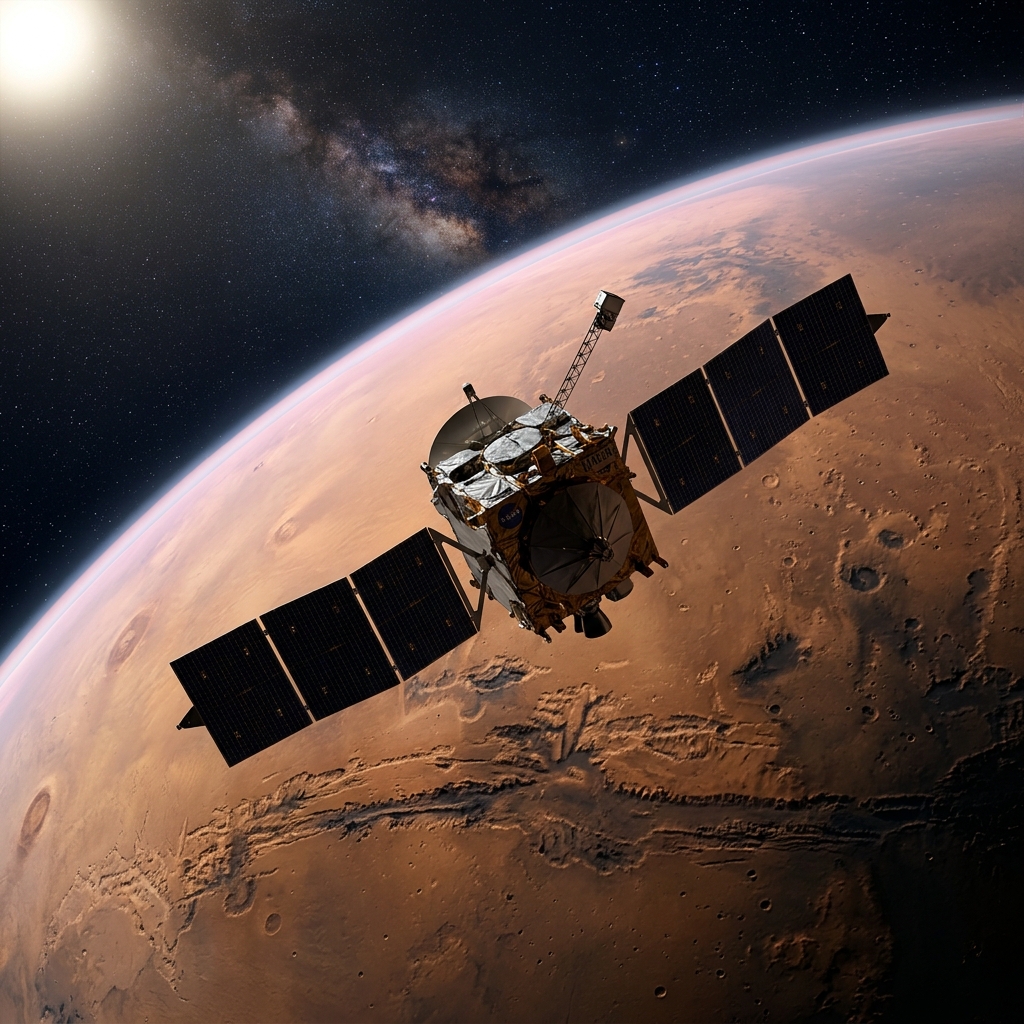
On December 6, 2025, NASA's MAVEN spacecraft passed behind Mars and never called home again.
Telemetry before the maneuver showed everything working normally. The solar panels were charging. The instruments were running. The Deep Space Network was listening. Then the spacecraft emerged from behind the planet and the signal was gone.
A brief fragment of data, recovered later from open-loop radio recordings, told a grim story. The spacecraft was in safe mode and spinning unusually fast. The batteries had drained. The communications system had lost power. MAVEN was in an unrecoverable state.
On June 3, 2026, NASA convened a media teleconference to say goodbye. After reviewing the evidence, an anomaly review board concluded that the spacecraft was lost. The official decommissioning process had begun.
One year, stretched to eleven
MAVEN, short for Mars Atmosphere and Volatile Evolution, launched from Cape Canaveral on November 18, 2013. It arrived at Mars ten months later carrying a suite of instruments designed to answer a single question: what happened to the Martian atmosphere?
Scientists already knew Mars had once been wetter and warmer, with a thicker atmosphere and flowing surface water. They also knew that today it is cold, dry, and surrounded by air less than one percent as dense as Earth's. MAVEN's job was to figure out where all that air went.
Its primary mission was designed to last one Earth year. The spacecraft went on to operate for more than a decade beyond that, producing over 800 scientific publications. Its data archive will keep researchers busy for decades more.
Watching a planet's atmosphere boil into space
One of MAVEN's first major findings was that Mars loses its atmosphere faster when the Sun acts up. During solar storms, the stream of charged particles known as the solar wind intensifies, and the rate of atmospheric erosion spikes dramatically. MAVEN was the only spacecraft at Mars that could measure both the incoming solar energy and the atmospheric response simultaneously.
"The science MAVEN has given us is key to informing what kind of radiation protection and safety measures we must take before sending humans to Mars," said Louise Prockter, director of the Planetary Science Division at NASA Headquarters.
The mission also made the first-ever measurement of atmospheric sputtering at any planet. Sputtering is a process in which energetic particles crash into the upper atmosphere like a cannonball hitting a pool, splashing gas molecules out into space. MAVEN confirmed it was happening by tracking argon, a noble gas that rarely reacts with anything else. The only significant way argon can escape a planet is by getting physically knocked out. For 11 years, MAVEN watched it happen in real time.
Auroras, dust storms, and a visitor from another star
MAVEN discovered that Mars has auroras, and not the kind you see on Earth. On our planet, proton auroras are confined to tiny regions near the poles. On Mars, MAVEN found they can appear anywhere. The spacecraft's instruments captured the glow of energetic particles slamming into the Martian atmosphere, creating light shows invisible to human eyes but clear to MAVEN's ultraviolet sensors.
In 2018, a global dust storm enveloped the entire planet, the same storm that silenced the Opportunity rover. MAVEN kept working through it and revealed something unexpected: the storm was pumping water vapor to much higher altitudes than normal. Once water molecules reached the upper atmosphere, ultraviolet radiation from the Sun broke them apart, and the hydrogen escaped to space. The storm was actively dehydrating Mars.
During its final year, MAVEN took on an unplanned task. When interstellar comet 3I/ATLAS cruised past Mars in 2025, the mission team designed a new observing campaign in ten days. MAVEN snapped images of the comet in multiple wavelengths, then captured high-resolution ultraviolet data to identify hydrogen in the comet's coma. It was one more discovery squeezed into a mission that had been improvising for years.
The relay that connected Mars to Earth
Between the science, MAVEN did something less glamorous but just as important. It served as part of NASA's Mars Relay Network, passing data from rovers on the surface up to orbiters that could beam it home. The spacecraft still holds the solar system record for most data relayed from another planet in a single day.
When Perseverance or Curiosity needed to send images back to Earth, MAVEN was often the bridge. Its loss reduces the relay network's capacity at a time when more surface missions are active than ever before.
What comes next
The anomaly review board is still investigating the root cause of the failure. A final report is expected later this year. In the meantime, NASA is archiving MAVEN's complete dataset for the science community.
Mars science is not slowing down. NASA recently announced Aeolus, a new public-private partnership with Relativity Space that will send a suite of four atmospheric instruments to Mars in 2028. Aeolus builds directly on MAVEN's legacy: it will measure Martian winds, temperatures, dust, and clouds on a daily global scale, providing the environmental data needed to safely land humans on the surface one day.
MAVEN was the first mission devoted to the Martian atmosphere. It will not be the last. But for 11 years, it was the only spacecraft that could watch the Sun strike Mars and measure what flew away in response. That window has now closed.