
How Do You Photograph a Black Hole? The Telescope the Size of Earth Is Still Rewriting the Answer.
On April 10, 2019, the Event Horizon Telescope revealed the first image of a black hole: a lopsided orange ring around a dark shadow in the galaxy M87, 55 million light-years away. The image was not a photograph in any conventional sense. It was assembled from radio signals captured by dishes on four continents, synchronized by atomic clocks, and combined into a virtual telescope with the resolving power of a single dish the diameter of Earth. Here is how the impossible image gets made, why the Milky Way's black hole took three more years to resolve, and what the collaboration is still discovering about magnetic fields, relativistic jets, and the edge of spacetime.
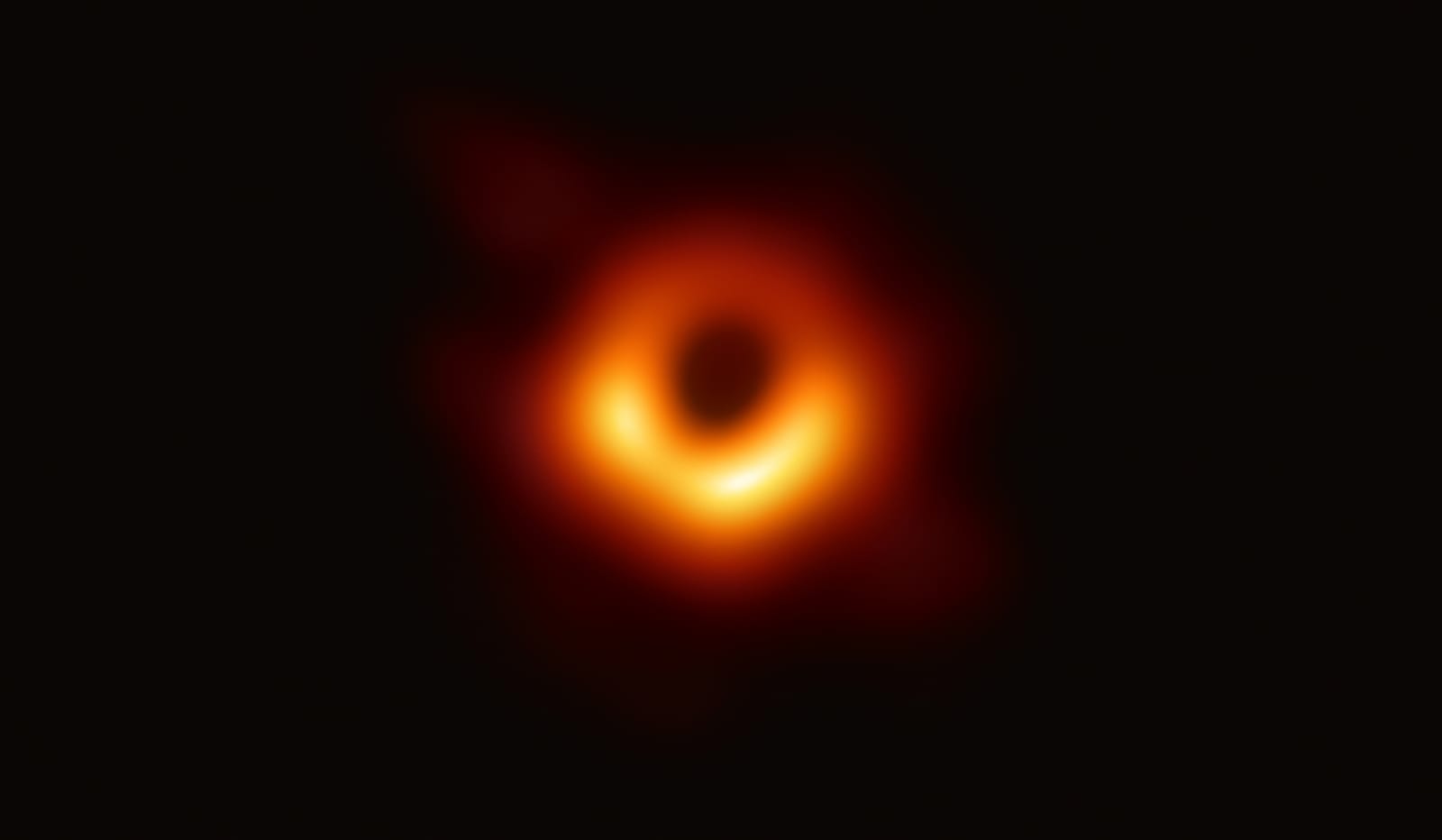
On April 10, 2019, researchers at six simultaneous press conferences on four continents unveiled something no human being had ever seen: the silhouette of a black hole against a ring of hot, glowing gas. The object was the supermassive black hole at the center of the galaxy Messier 87, 55 million light-years from Earth, a gravitational behemoth 6.5 billion times the mass of the Sun. The image was not a photograph in any conventional sense. It was assembled from petabytes of radio signals captured by eight dishes spread across the planet, synchronized by atomic clocks, and combined into a virtual telescope with the resolving power of a single dish the diameter of Earth.
The result was a lopsided orange doughnut that dominated front pages and became one of the most reproduced science images of the 21st century. But the collaboration that produced it did not stop there. Three years later, in May 2022, it released the first image of Sagittarius A*, the black hole at the center of our own galaxy. In March 2021 it mapped the magnetic fields threading the M87* ring. In January 2026 it published images that trace the base of M87's colossal jet for the first time. And the observing campaigns keep running. Here is how the impossible image gets made, and what the telescope the size of Earth is still teaching us.
What you are actually looking at
The EHT images do not show the black hole itself. A black hole, by definition, emits no light. What the images capture is the black hole's shadow: a dark central region surrounded by a bright ring of radio emission from gas heated to billions of degrees as it spirals inward. The dark patch is larger than the event horizon because the black hole's gravity bends light around it. Photons that pass too close get captured and never reach us, creating a shadow roughly 2.5 times wider than the event horizon itself.
The bright ring is not uniform because the glowing gas is orbiting at close to the speed of light. The side of the disk rotating toward us appears brighter due to relativistic beaming, the same effect that makes an ambulance siren sound higher pitched as it approaches. That is why M87* looks lopsided: the brighter crescent tells you which way the accretion disk is spinning.
To resolve something this small, you need extraordinary angular resolution. M87*'s shadow spans about 40 microarcseconds on the sky, roughly the size of an orange on the surface of the Moon as seen from Earth. No single telescope on the planet can come close to seeing it. You need a telescope the size of the planet itself.
How to build a telescope the size of Earth
The technique is called very long baseline interferometry, or VLBI. Eight radio observatories, spread across Hawaii, Arizona, Mexico, Chile, Spain, and the South Pole, all point at the same target at the same time. Each dish records raw radio signal onto hard drives. Those drives are then physically shipped to central processing sites, at the Max Planck Institute for Radio Astronomy in Bonn and the MIT Haystack Observatory in Massachusetts, where a supercomputer called a correlator lines up the signals in time using timestamps from atomic clocks at each site.
The key insight is interference. When you combine the signal from two dishes thousands of kilometers apart, the interference pattern encodes information at a resolution determined by the distance between them, not by the size of either dish. The longest baselines, the separations between the most distant telescopes, set the maximum resolution. For the EHT, that baseline is roughly the diameter of the Earth, giving an angular resolution of about 25 microarcseconds at the observing wavelength of 1.3 millimeters.
That is sharp enough to read the date on a coin in Los Angeles from New York, or to see the gap between the bright ring and the dark shadow around a black hole 55 million light-years away.
The network is not static. Since 2018 the EHT has also been able to observe at 0.87 millimeters, a shorter wavelength that boosts the resolution to about 19 microarcseconds. New telescopes have joined the array over time, including the Greenland Telescope and the Africa Millimetre Telescope project in Namibia. The Large Millimeter Telescope in Mexico is being reintegrated into the array for upcoming campaigns.
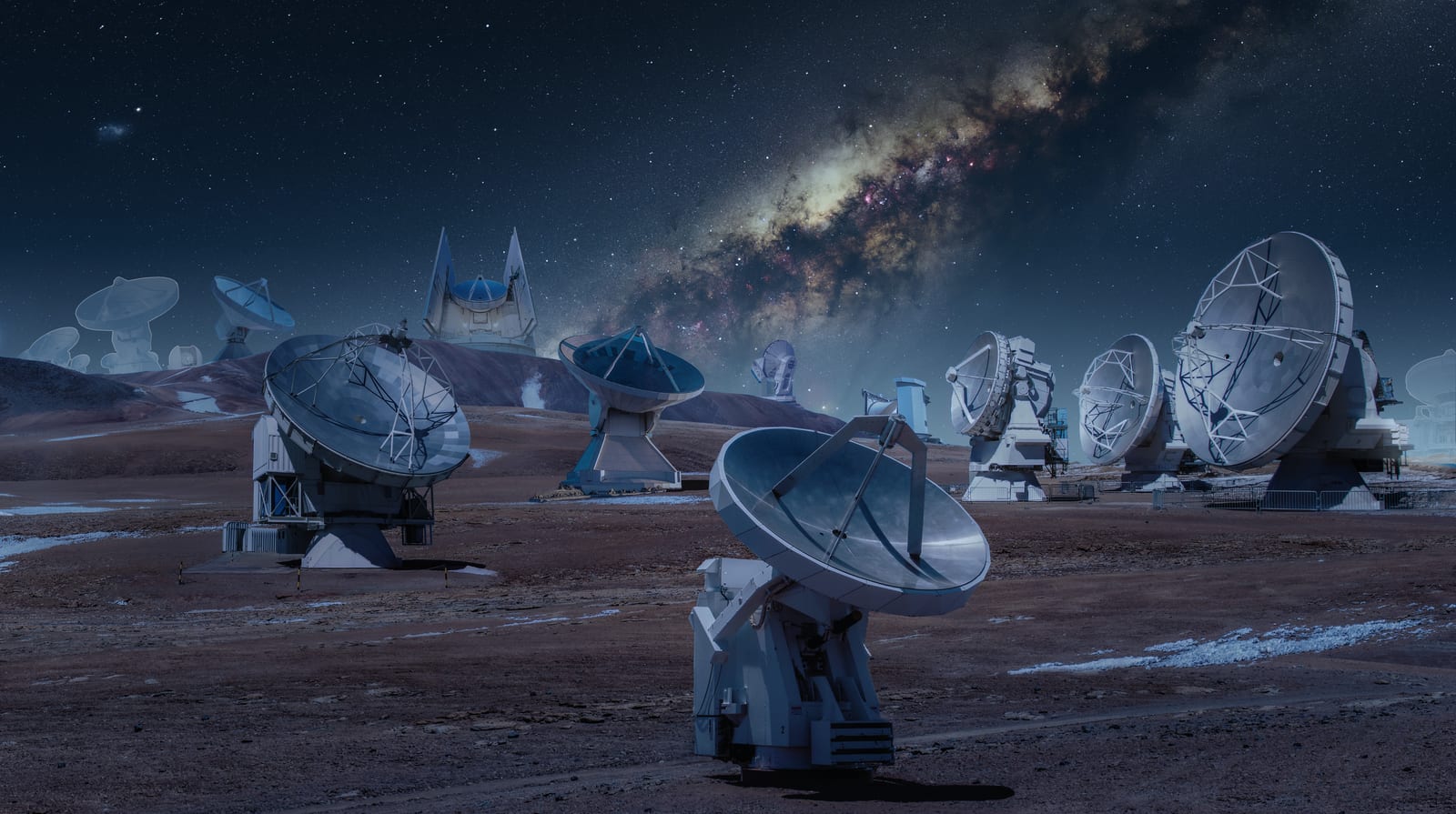
There is a practical obstacle that gives the whole enterprise an almost Victorian feel. The raw data from a single observing run fills so many hard drives, petabytes in total, that it is faster to put them on a plane than to send them over the internet. The South Pole Telescope, in particular, sits through the austral winter with no flights in or out from April to October. Data recorded in April sits on ice for six months before it can be shipped north for correlation. The Sgr A* data from April 2017 did not reach the correlators until December of that year.
Why the Milky Way's black hole took three more years
M87* and Sagittarius A* pose different challenges. M87* is enormous, 6.5 billion solar masses, and its accretion disk is correspondingly vast. Gas takes days to complete an orbit around it, which means the source stays relatively stable during an observing run. You can collect data over several nights and combine it into a single image.
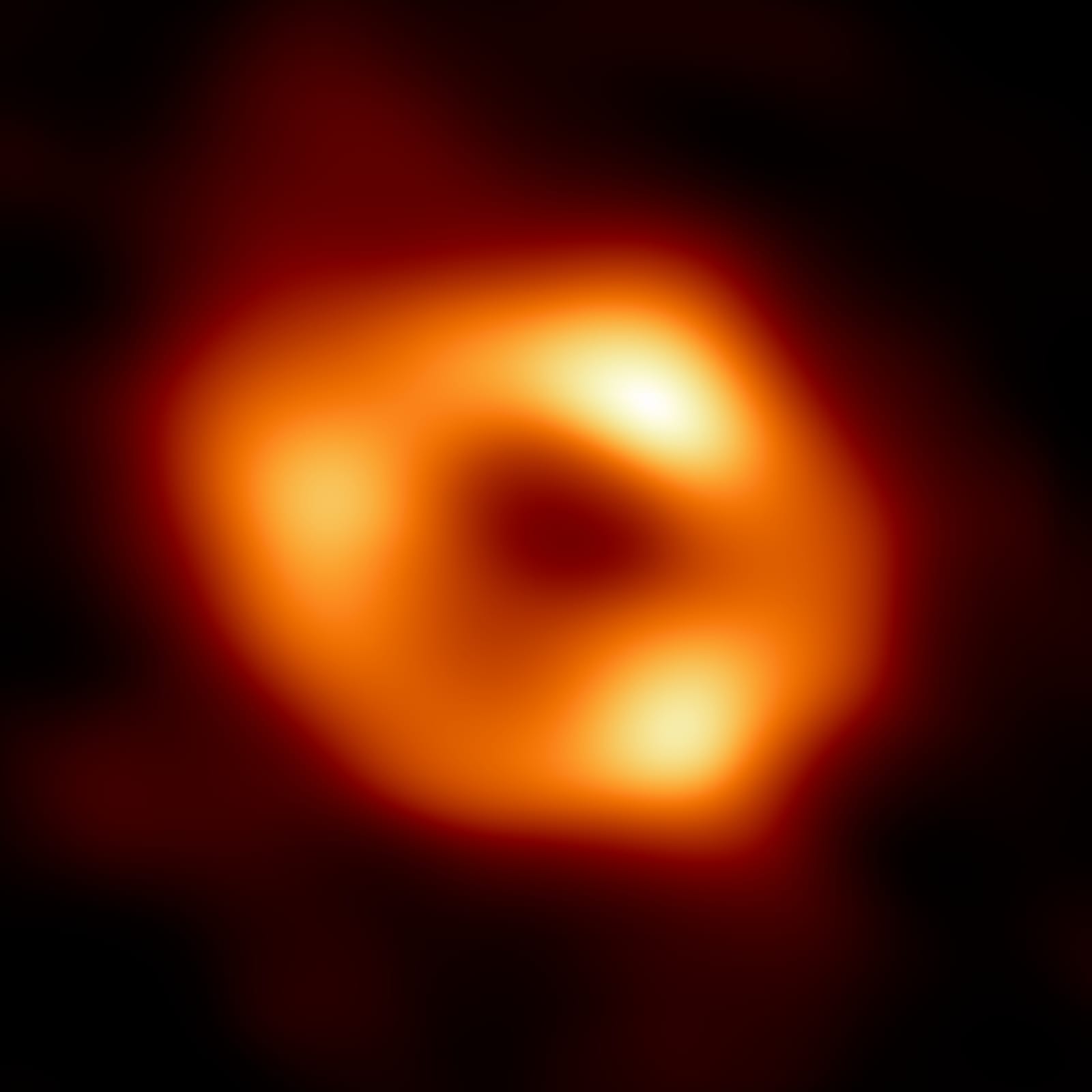
Sagittarius A* is the opposite. It is roughly 1,500 times less massive, at about 4 million solar masses, and material orbiting it whips around in minutes, not days. The source changes while you are looking at it. The image released in 2022 is not a single snapshot but an average of thousands of images extracted from the same dataset, each one representing a different moment in the turbulent flow of gas around the black hole.
The EHT team developed entirely new algorithms to handle this variability. They fed the data into multiple independent imaging pipelines, each using different assumptions about the source structure, and compared the outputs. The fact that all pipelines converged on the same ring shape, with the same diameter and the same central brightness depression, was the validation that the signal was real.
Magnetic fields in the shadow
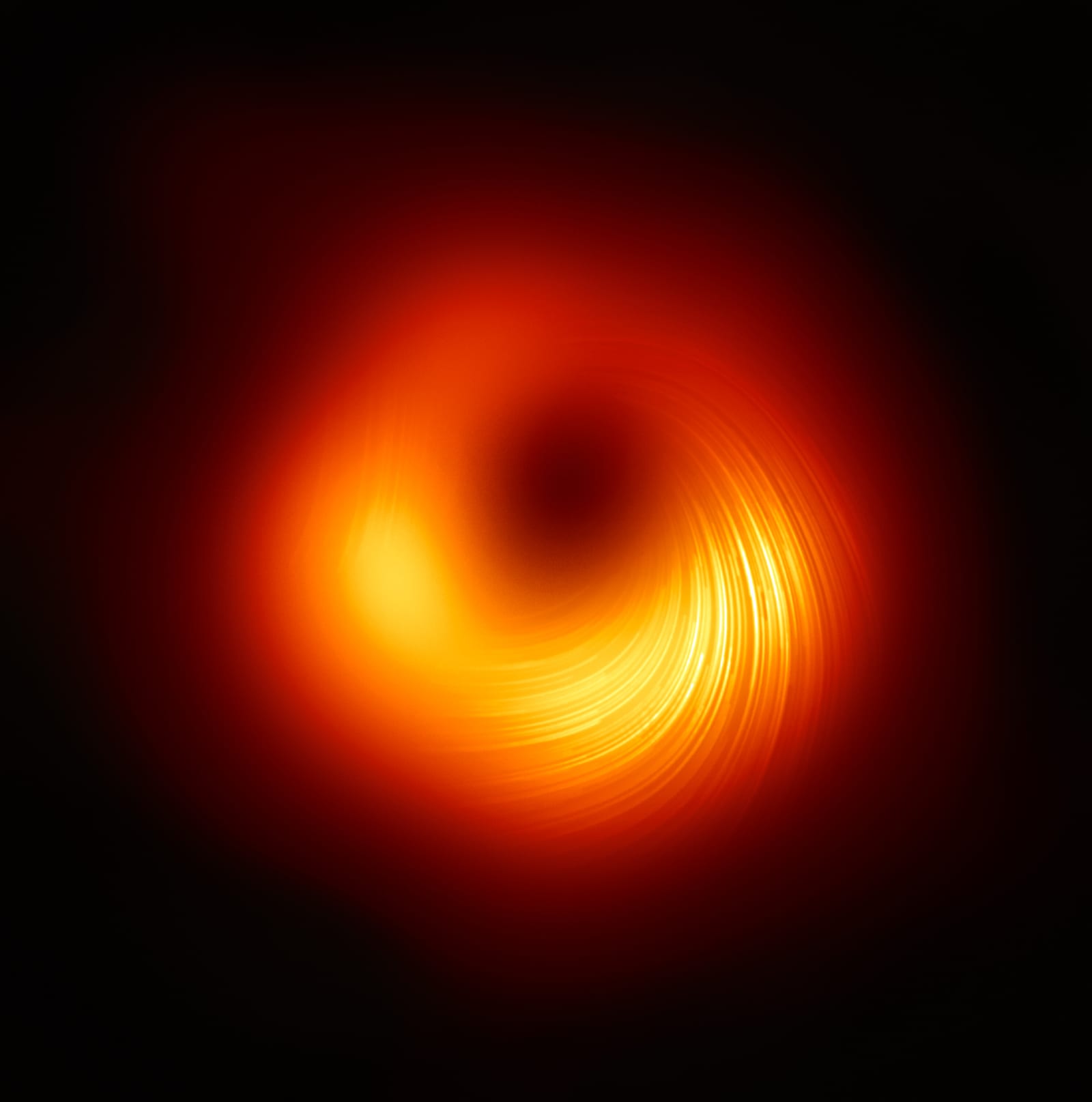
In March 2021 the EHT released a polarized version of the M87* image. Polarization is the orientation of the electric field in a radio wave, and it carries information about magnetic fields in the hot gas around the black hole. The polarized image showed the magnetic field lines wrapping around the ring in a spiral pattern, strong enough to resist the pull of gravity and launch the relativistic jet that extends from M87's core for thousands of light-years.
This was a significant step because the mechanism that launches black hole jets has been debated for decades. Two broad theories compete: the Blandford-Znajek process, in which the jet is powered by the black hole's spin energy extracted through magnetic fields, and the Blandford-Payne mechanism, in which the accretion disk itself accelerates the outflow. The EHT polarization data favors the Blandford-Znajek interpretation for M87*, though the question is not fully settled.
In February 2026 the collaboration released new multi-epoch polarization images showing that the magnetic field structure is not static. It changes from year to year, and comparing images from 2017, 2018, 2021, and 2022 reveals a flickering pattern that may track how the accretion flow reorganizes itself over time.
Finding the jet's starting point
The January 2026 study, led by researchers at the Max Planck Institute for Radio Astronomy and published in Astronomy & Astrophysics, addressed a more specific question: where exactly does M87's famous jet begin?
M87's jet is visible across the electromagnetic spectrum and stretches for at least 3,000 light-years, a blowtorch of charged particles moving at close to the speed of light. The EHT's 2017 and 2018 observations could see the ring around the black hole and, on much larger scales, the extended jet. But there was a gap: the intermediate scales, the few hundred light-years closest to the black hole where the jet must be launched, were missing.
The team went back to data from 2021, which included new intermediate-baseline measurements from telescope pairs a few hundred kilometers apart. By comparing the radio brightness on different spatial scales, they identified an additional compact emission source about 0.09 light-years from the black hole. The location and brightness match models of the jet base, the region where the outflow begins to collimate into the narrow beam visible thousands of light-years downstream.
"This study represents an early step toward connecting theoretical ideas about jet launching with direct observations," said Saurabh, the lead author at MPIfR. "Identifying where the jet may originate and how it connects to the black hole's shadow adds a key piece to the puzzle." The data used in the study was recorded in 2021; the result is not a live view of the jet but a reconstruction at the highest resolution ever achieved at those intermediate scales.
What comes next
The EHT is not a completed instrument. It is an evolving network, and several developments are expanding its capabilities. The next-generation EHT, or ngEHT, proposes adding roughly ten new dishes and upgrading the existing ones to observe at multiple frequencies simultaneously. The goal is to move from a single snapshot of a black hole to time-lapse movies that show how the accretion flow, magnetic fields, and jet launch evolve in real time.
One of the more speculative ideas under discussion is placing a radio dish in space. A space-based baseline would dramatically increase the maximum resolution, potentially sharp enough to see the photon ring, the bright narrow circle predicted by general relativity where light orbits the black hole before escaping. The photon ring encodes the black hole's mass, spin, and a direct test of whether the Kerr metric, Einstein's solution for a rotating black hole, is correct.
The 2026 observing campaign is currently underway, with the recently reintegrated Large Millimeter Telescope in Mexico providing an additional long baseline. The collaboration is also working on imaging M87* at the shorter 0.87-millimeter wavelength, which would sharpen the view by roughly 30 percent and potentially reveal finer structure in the photon ring and jet base.
The images the EHT has produced so far are not the end of the story. They are the first frames of a film that will take decades to complete, a record of what happens at the edge of the visible universe's most extreme objects.
Sources
- ESO: Astronomers Capture First Image of a Black Hole (April 10, 2019) - announcement of the M87* first image; EHT images credit EHT Collaboration, CC BY 4.0
- Event Horizon Telescope - collaboration website with image releases, publications, and array status
- Universe Today: The Collaboration that Brought You the First Image of a Black Hole Just Released Photos of Its Massive Jet (February 2026) - coverage of the M87* jet base study and polarization triptych
- Wikipedia: Event Horizon Telescope - mission history, observatory list, observing campaigns, resolution figures, and Sgr A* announcement details
- ESO: Astronomers Reveal First Image of the Black Hole at the Heart of Our Galaxy (May 12, 2022) - announcement of the Sgr A* first image
- Wikipedia: Sagittarius A* - physical parameters of the Milky Way's central black hole
Related on Impossible Universe
- Black Holes Topic Hub - eight more stories covering missing black holes, dormant black holes, tidal disruption events, Penrose process energy extraction, and more
- The Milky Way's Violent Core Keeps Producing Enormous Bubbles of Plasma. JWST Just Got the Sharpest Look Yet. - what else is happening in the galactic center neighborhood, a few hundred light-years from Sagittarius A*
- LIGO-Virgo-KAGRA Released Its Fifth Gravitational-Wave Catalog. The Count Now Stands at 410 Black Hole Mergers, and Something Changed. - observing black holes by a completely different method: the ripples in spacetime they produce when they collide
- Physicists Recreated Black Hole Energy Extraction in the Lab Using Synthetic Rotation. A 50-Year-Old Theory Finally Works. - a laboratory demonstration of the Penrose process, validating one of the most extreme predictions of general relativity
- Telescopes and Space Missions Topic Hub - the instruments and observatories that make discoveries like this possible