
Physicists Recreated Black Hole Energy Extraction in the Lab Using Synthetic Rotation. A 50-Year-Old Theory Finally Works.
Researchers at CUNY's Advanced Science Research Center demonstrated the Penrose-Zel'dovich process in a laboratory for the first time. Using a ring of electronic resonators that simulate extreme rotation without physically moving, they showed that electromagnetic waves can extract energy from synthetic rotation, confirming a black hole energy theory proposed by Roger Penrose in 1969 and extended by Yakov Zel'dovich in 1971. The findings, published in Nature on July 10, 2026, open new avenues in optics, communications, and quantum science while validating one of the most extreme predictions of general relativity.
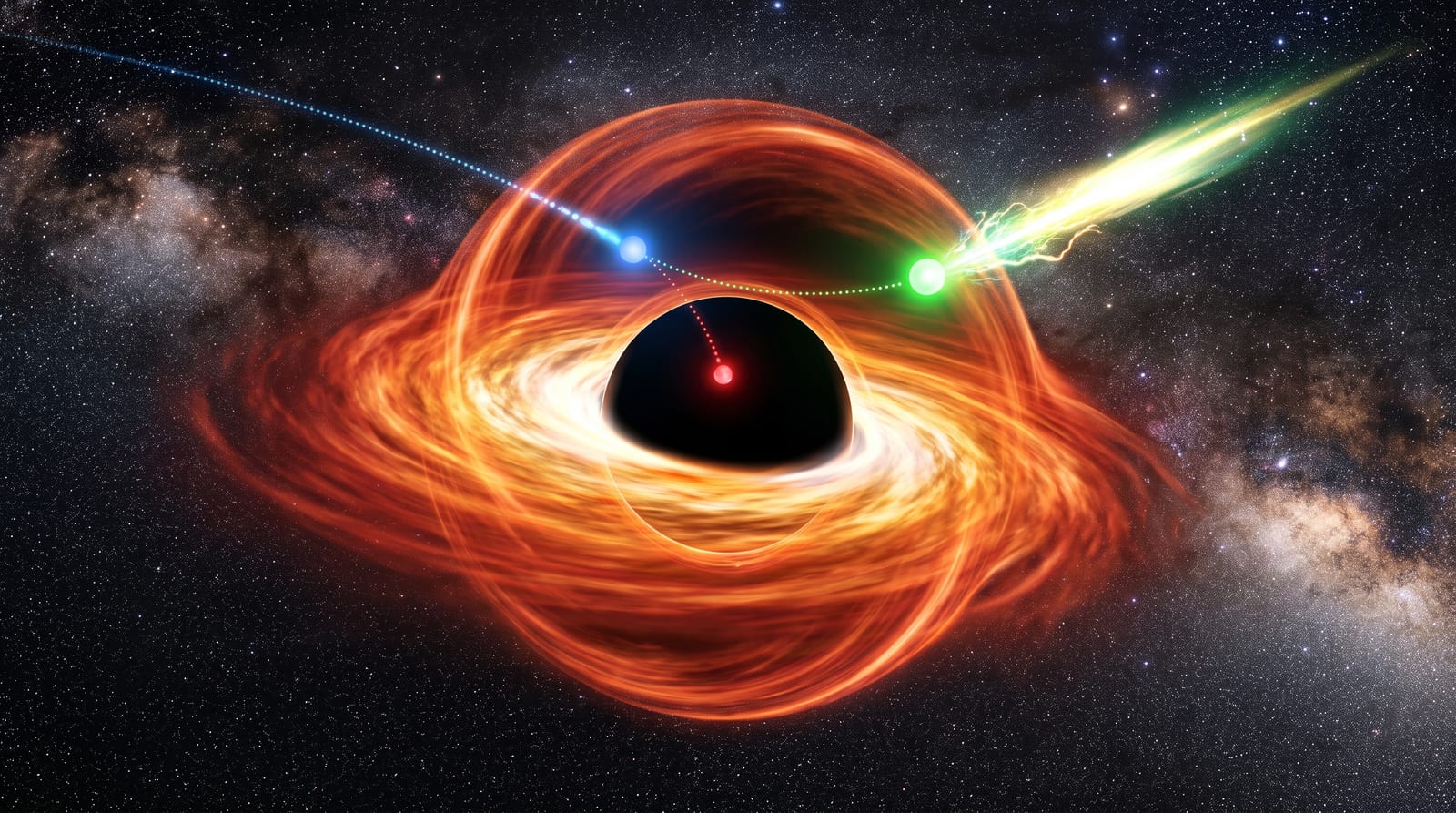
More than 50 years ago, physicist Sir Roger Penrose proposed that energy could be extracted from a spinning black hole. A particle entering the ergosphere, the region just outside the event horizon where spacetime itself is dragged along by rotation, could split in two. One fragment would fall into the black hole. The other would escape carrying more energy than the original particle, effectively stealing rotational energy from the black hole itself.
It was a beautiful idea on paper. No one had ever demonstrated it in a lab. Until now.
Researchers at the Advanced Science Research Center at the City University of New York Graduate Center have built a device that reproduces the essential physics of the Penrose process using synthetic rotation. Their work, published in Nature on July 10, 2026, shows that electromagnetic waves can extract energy from a system that mimics extreme rotation without spinning anything at all.
From a blackboard to a lab bench
Penrose published his energy extraction theorem in 1969, building on the mathematics of rotating black holes first described by Roy Kerr in 1963. Unlike non-spinning (Schwarzschild) black holes, which are defined solely by their mass, a Kerr black hole carries angular momentum, a property that warps the surrounding spacetime into a region called the ergosphere.
Inside the ergosphere, nothing can remain stationary. The rotation of the black hole drags spacetime around with it so forcefully that any object or particle in this region must co-rotate with the black hole. This frame-dragging effect, predicted by Einstein's general theory of relativity, is the engine behind the Penrose process.
In 1971, Soviet physicist Yakov Zel'dovich extended the idea. He predicted that waves, not just particles, could extract energy from a rapidly spinning object. A wave with the right rotational characteristics striking a rotating absorber would come back amplified, carrying away some of the absorber's rotational energy. The effect, now called the Penrose-Zel'dovich process, remained theoretical for more than half a century.
The challenge was practical. To test the effect, you would need an object spinning at extraordinary speeds: hundreds of millions of rotations per second, far beyond what any physical material could survive. No one could build a spinning absorber fast enough to test the prediction.
Synthetic rotation: spinning without moving
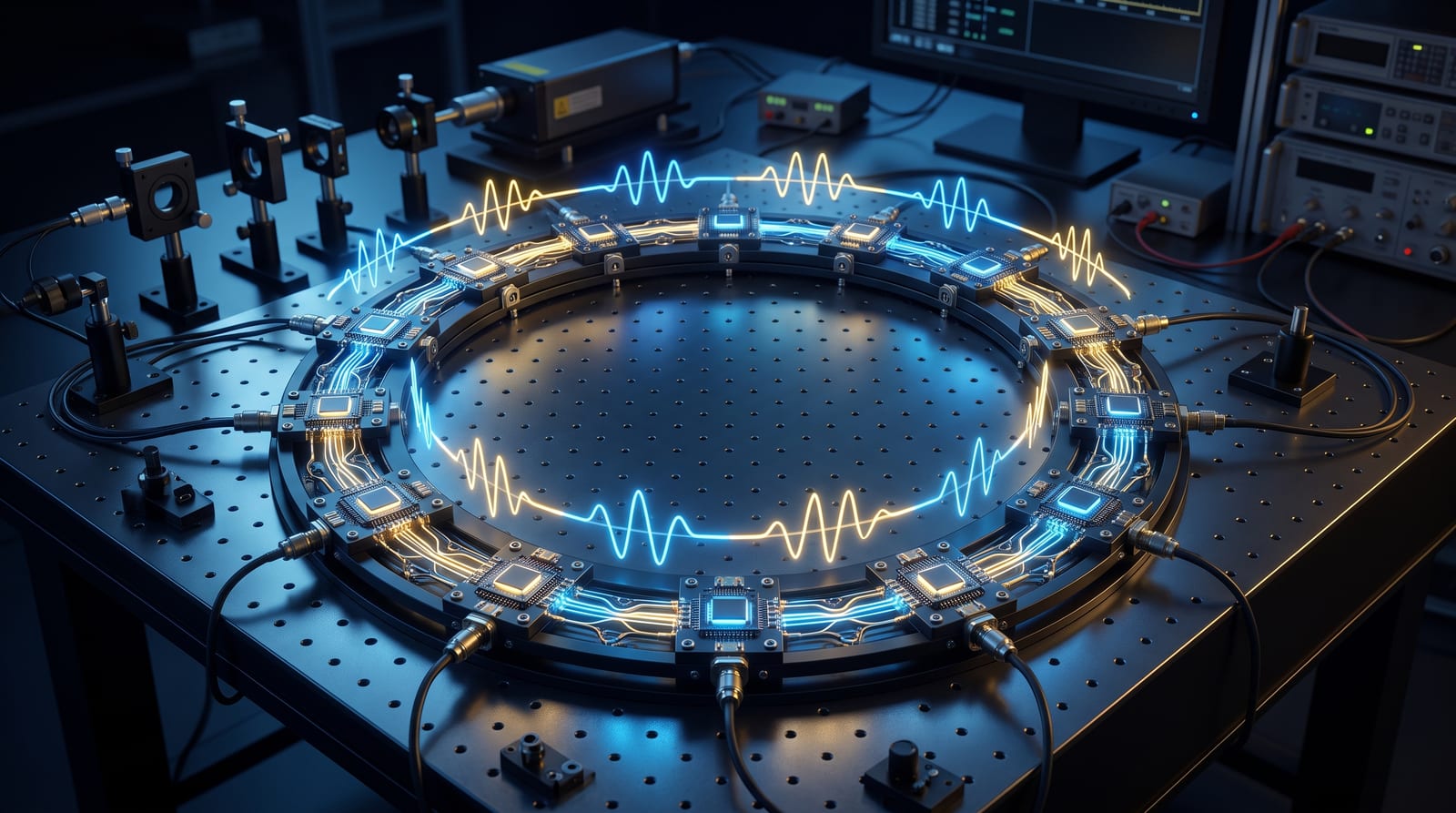
The CUNY team, led by Professor Andrea Alu and co-led by Hadiseh Nasari and Hady Moussa, bypassed the speed limit of physical rotation using a trick from the world of metamaterials. They built a ring of electronic resonators, each capable of having its electromagnetic properties changed rapidly. By modulating the properties of each resonator in a carefully timed sequence around the ring, they created a traveling wave pattern that simulates the effect of ultrafast rotation.
The hardware never moves. But for an electromagnetic wave traveling through the ring, the experience is identical to encountering a physical object spinning at a speed that would tear any real material apart.
"Our approach relies on engineered metamaterials that are designed to control how waves propagate," said Moussa, a former PhD student at the CUNY ASRC Photonics Initiative. Waves with the right rotational characteristics entering this synthetic rotation device gained energy and were amplified, reproducing the essential physics of the Penrose-Zel'dovich process.
The result is the first laboratory confirmation that energy can be extracted through this mechanism, something theorists have predicted for decades but could never test directly.
What the discovery means
The significance of the experiment extends beyond validating a half-century-old theory. By demonstrating that synthetic rotation can reproduce extreme relativistic physics in a controlled laboratory setting, the work opens a new approach to studying phenomena that were previously accessible only through mathematical theory or astronomical observation.
The implications include potential advances in optics, wireless communications, and quantum science. The same principles that allowed the team to amplify waves using synthetic rotation could be adapted for practical devices: amplifiers, directional antennas, and components that manipulate electromagnetic waves in ways not possible with conventional materials.
There is also a deeper scientific payoff. The Penrose process is one of the most energy-dense theoretical mechanisms in physics. A maximally spinning black hole could, in principle, release up to 29 percent of its mass as usable energy. For comparison, nuclear fission releases about 0.1 percent of mass as energy. That does not mean black hole power plants are around the corner, and the experiment is not a prototype for energy generation. But demonstrating that the physics works in a controlled environment confirms that one of the most extreme predictions of general relativity is experimentally sound.
What it does not mean
It is important to be clear about what the experiment did and did not do. The device amplified electromagnetic waves using energy from synthetic rotation. It does not generate usable power from nothing, and the energy extracted comes from the input driving the synthetic rotation, not from a spontaneous source. The Penrose process for real black holes remains theoretically sound but astronomically unobserved; the energy extraction is too small and the ergosphere too far from any telescope to detect directly.
The experiment also works at radio frequencies, not in the optical regime relevant to astrophysical observations. Scaling the effect to higher frequencies remains an open engineering challenge.
What the experiment does is confirm that the physical principle is real. The mathematics predicted it. The lab validated it. The next question is where the idea can go from here.
A bridge between theory and application
The CUNY team plans to extend their approach to photonic and quantum systems. Because synthetic rotation does not require physical motion, it can be scaled, tuned, and reconfigured in ways that mechanical rotation cannot. The same ring of resonators can simulate different rotation speeds, different geometries, and different wave regimes, simply by changing the modulation pattern.
This flexibility makes the platform useful for investigating other relativistic phenomena that depend on rotation, including the rotational superradiance predicted for astrophysical black holes and neutron stars. The team's work, supported by the Department of Defense, the National Science Foundation, and the Simons Foundation, establishes a new tool for laboratory astrophysics: the ability to study extreme relativistic effects without leaving Earth.
Sources
- Nasari, Moussa, Alu et al., "Synthetic rotation wave amplification and the Penrose-Zel'dovich process," Nature (2026) - primary peer-reviewed paper
- ScienceDaily: Physicists Recreate Black Hole Energy Extraction in the Lab (July 12, 2026) - coverage of the Nature publication
- Universe Today: Researchers Prove Black Hole Theory in a Laboratory Setting - detailed coverage with team interviews
- Phys.org: Synthetic Rotation Unlocks Black Hole Energy Extraction (July 2026) - coverage of the experiment and methodology
- DongA Science: CUNY ASRC Recreates Extreme Black Hole Physics in the Lab - international science coverage with conceptual art from Nature's press package
Related on Impossible Universe
- 390 Black Hole Mergers and Counting: The Gravitational Wave Catalog Just Got 161 New Entries - black hole physics from the observational side, with LIGO-Virgo-KAGRA detecting 390 merger events
- An Astronomer Spent 20 Years Looking for a Black Hole in Omega Centauri. It Was There the Whole Time. - how astronomers find black holes through stellar motion, complementing the lab-based approach with real astrophysical detection
- A Dormant Black Hole Outside the Milky Way Just Revealed Itself. It Was Hiding in Plain Sight for Years. - another black hole discovery, this time using stellar wobbles in the Large Magellanic Cloud
- Black Holes Topic Hub - explore the complete collection of black hole stories on Impossible Universe
Correction and clarification
This article was updated to clarify that the experiment demonstrates wave amplification through synthetic rotation, not energy generation. The amplified waves draw energy from the synthetic rotation input, not from a spontaneous source. The Penrose process for astrophysical black holes remains theoretically sound but has not been directly observed. The experiment operates at radio frequencies, not optical wavelengths. Published July 28, 2026.