
A Chinese Spacecraft Just Arrived at Earth's Tiny Quasi-Moon. The First Close-Up Images Reveal an Asteroid Much Smaller Than Expected.
China's Tianwen-2 spacecraft arrived at the near-Earth asteroid Kamo'oalewa on July 2, 2026, after a 400-day, 1-billion-kilometer journey. The first close-up images from 20 kilometers away reveal an elongated rocky body roughly 20 meters across, far smaller than ground telescopes suggested. New JWST observations challenge the idea that it is a fragment of the Moon.
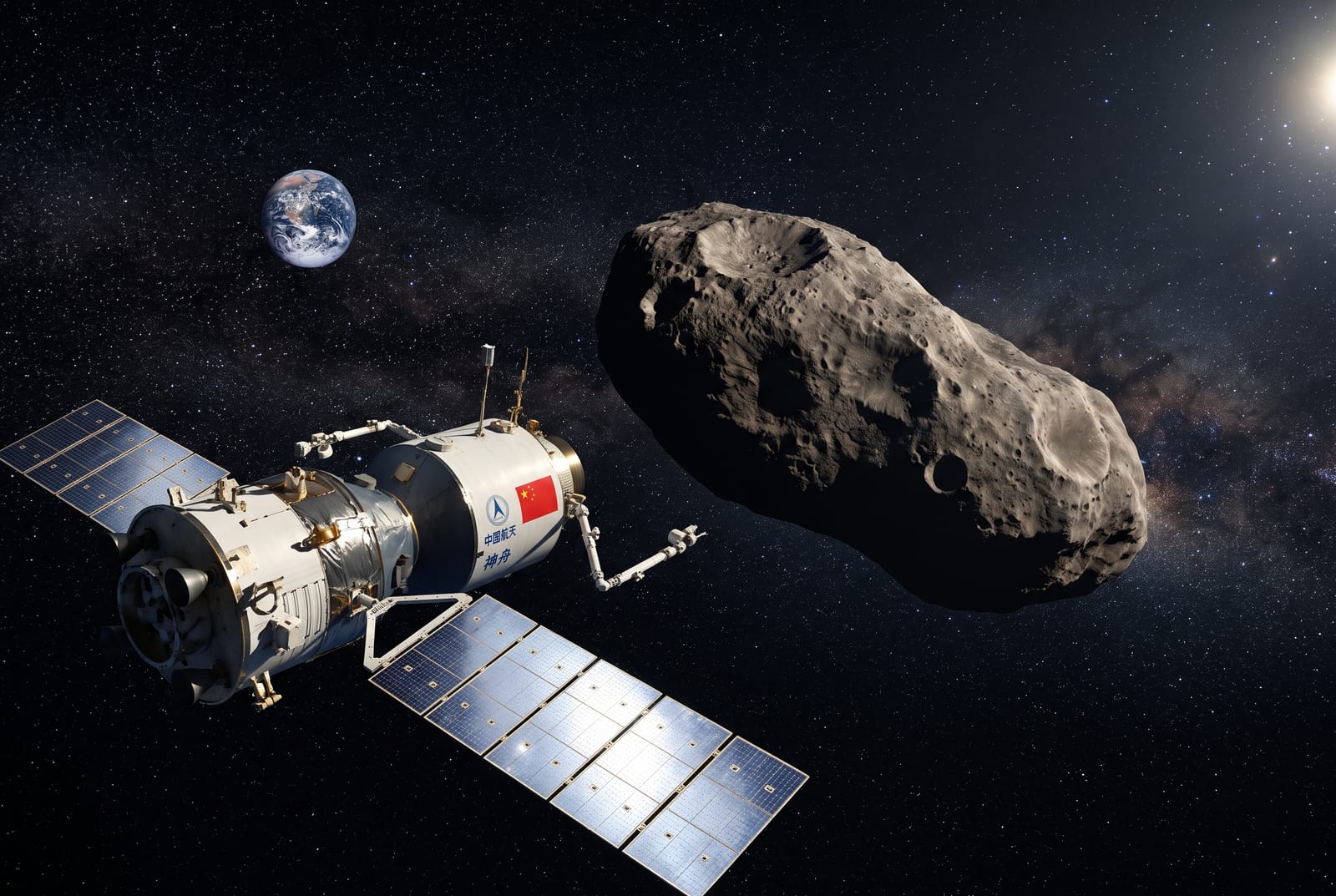
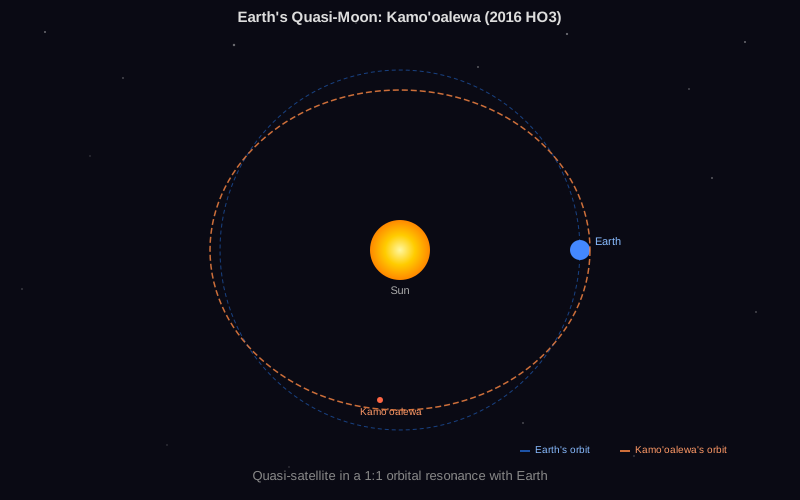
On July 2, 2026, a Chinese spacecraft called Tianwen-2 pulled up next to one of the strangest objects in the solar system. The asteroid Kamo'oalewa (2016 HO3) is not your typical space rock. It shadows Earth in a stable 1:1 orbital resonance, making it a quasi-satellite -- a kind of temporary second moon that loops around the Sun while appearing to orbit our planet. For four days, almost nobody knew what the spacecraft had found. Then, on July 6, the China National Space Administration (CNSA) published the first close-up image. The asteroid was roughly 20 meters across, an elongated gray rock against black space. It was far smaller than anyone expected.
Ground-based telescopes had estimated Kamo'oalewa to be somewhere between 40 and 100 meters in diameter. The actual size, confirmed independently by the James Webb Space Telescope in a paper posted to arXiv on July 1, is closer to 18 meters. That makes it roughly the length of two school buses parked end to end. The arrival marks the beginning of a months-long survey campaign that will culminate in an asteroid sample grab, one of the most technically ambitious space missions China has ever attempted.
A billion kilometers in 400 days
Tianwen-2 launched on May 29, 2025, from the Xichang Satellite Launch Center. Over the following 400 days, it covered roughly a billion kilometers of deep space, crossing Earth's orbit to catch up with an object that is almost invisible from the ground. By June 7, the spacecraft had closed to within 30,000 kilometers of the asteroid. On June 19, the distance was down to 2,000 kilometers. By the end of the month, Tianwen-2 had settled into a station point at 20 kilometers, the closest a spacecraft has ever been to a quasi-satellite of Earth.
The mission carries 11 science instruments, including cameras, laser ranging, spectrometers, sounding radar, and particle analyzers. It also carries DIANA, a dust analyzer contributed by Italy. Over the next several months, Tianwen-2 will map Kamo'oalewa's surface at centimeter-level resolution from an altitude of about eight kilometers, looking for suitable sampling sites and understanding the asteroid's shape, composition, and internal structure.
Is it a piece of the Moon?
The most intriguing question about Kamo'oalewa is where it came from. In 2024, a study published in Nature Astronomy proposed that the asteroid might be a chunk of the lunar far side, blasted into space by the impact that formed the Giordano Bruno crater. The evidence came from ground-based spectroscopy: Kamo'oalewa's reflected light looked more like lunar material than like a typical asteroid.
But the newer data tells a different story. The JWST observations published online July 1, together with the colors visible in the CNSA close-up image, point toward Kamo'oalewa being an E-type silicate asteroid, a rare class of space rock with a high surface reflectivity. "The first image basically confirms the high geometric albedo suggested by the JWST paper, which is not compatible with the low-to-moderate albedo of the moon," Mikael Granvik, an astronomer at the University of Helsinki, told SpaceNews. "So it seems that Kamo'oalewa is of asteroidal origin."
The debate is not fully settled. Tianwen-2's spectrometer readings and the eventual sample return will provide a definitive answer. Either way, the object is scientifically valuable. If it did come from the Moon, the samples would be a free lunar sample-return mission. If it is an E-type asteroid, it is one of the closest examples of a rare class of primitive solar system material.
Three ways to grab a rock
Asteroid sampling is hard. The surface of a small asteroid is not like a planet's -- it can be loose rubble, solid rock, or something in between. The spacecraft has to approach slowly, make contact, and collect material without bouncing off or getting stuck. Partly because almost nothing was known about Kamo'oalewa's surface before arrival, Tianwen-2 carries three redundant sampling techniques.
The first is a hovering approach, where the spacecraft descends close to the surface and collects particles without touching down. The second is a touch-and-go maneuver, similar to what NASA's OSIRIS-REx used at asteroid Bennu and JAXA's Hayabusa2 used at Ryugu. The third and most ambitious is an anchor-and-attach system, where the spacecraft would physically secure itself to the asteroid's surface before sampling. This gives the mission engineers a backup plan for every probable surface condition.
The target is between 200 and 1,000 grams of material. If all goes well, the sample collection will happen by April 2027 at the latest. The return capsule is expected to separate from Tianwen-2 and land near the Jiuquan Satellite Launch Center in late November 2027. The main spacecraft will then fly past Earth -- using the gravity assist to sling itself toward the main asteroid belt for an extended mission studying comet 311P/PANSTARRS.
One week, two asteroid encounters
Tianwen-2's arrival at Kamo'oalewa was not the only asteroid flyby that week. On July 5, three days after the Chinese arrival, Japan's Hayabusa2 spacecraft flew within 10 kilometers of asteroid Torifune and returned images showing the object to be a contact binary: two rubble piles stuck together. The coincidence of two asteroid encounters in the same week from two different space agencies is a reminder of how quickly small-body exploration is accelerating. In a few years, scientists will have returned samples from Ryugu (JAXA, already on Earth), Bennu (NASA, arriving 2027), Kamo'oalewa (CNSA, returning 2027), and potentially Phobos (JAXA's MMX mission, planned for later this decade).
Kamo'oalewa is part of a broader international effort to understand the building blocks of the solar system. The samples from these missions will be compared with each other, revealing whether different types of asteroids represent different stages of planetary formation, different regions of the early solar system, or both. Tianwen-2 is China's contribution to that global sample library.
Sources
- SpaceNews: Tianwen-2 arrives at asteroid Kamo'oalewa, first image revealed (July 6, 2026)
- China in Space: Tianwen-2 Arrives at Kamo'oalewa, Starts Surveying Ahead of Sample Grabs
- Sharkey et al., JWST Near-Infrared Observations of 469219 Kamo'oalewa (arXiv, July 1, 2026)
- Castro-Cisneros et al., Lunar ejecta origin of near-Earth asteroid Kamo'oalewa (Nature Astronomy, 2024)
- EarthSky: 2 asteroid flybys yield new closeup images (July 2026)
- Wikipedia: 469219 Kamo'oalewa
Related on Impossible Universe
- NASA's Lucy Probe Just Found a Tiny Moon Orbiting Asteroid Donaldjohanson -- another asteroid exploration milestone
- New Horizons Heads for the Solar System's Edge -- pushing the boundaries of what we know about the solar system
- The Greatest Cosmic Movie Ever Made: Rubin Observatory Started Its 10-Year Survey -- the survey that will find thousands more near-Earth objects
- Nancy Grace Roman Space Telescope Arrives at Kennedy Space Center -- another major space mission taking shape