JWST Found a Third Planet Hiding in the Beta Pictoris System. What Made It Visible Was Not a Picture, but a Chemical Bar Code.
The Beta Pictoris system, one of the most studied young star systems in the galaxy, has been hiding a third giant planet for more than a decade. JWST discovered Beta Pictoris d not by imaging it directly, but by detecting the chemical fingerprint of its atmosphere in spectroscopic data. At 2.4 times the mass of Jupiter, it is the faintest exoplanet ever imaged from Earth.
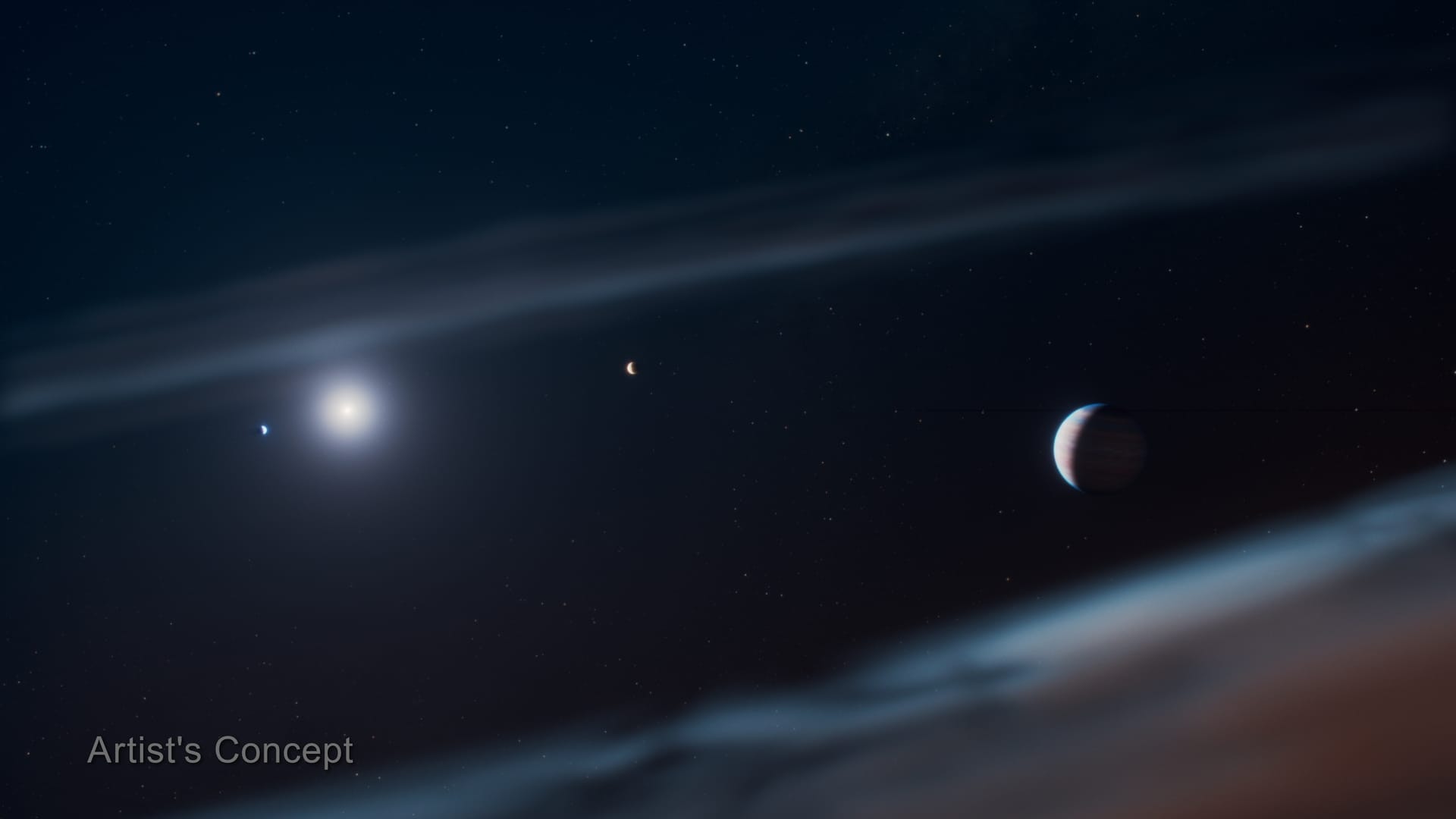
The Beta Pictoris system, 63 light-years away in the constellation Pictor, has been one of the most intensely studied young planetary systems in astronomy for more than four decades. Since the discovery of its spectacular edge-on debris disk in 1983, astronomers have found exocomets, intricate dust structures, and two known giant planets orbiting the 23-million-year-old star. Now, the James Webb Space Telescope has uncovered a third planet hiding in the system, and it found it using a method that has never been done before.
Beta Pictoris d, a gas giant at least 2.4 times the mass of Jupiter, was discovered not by seeing it as a bright point of light, but by detecting the unique chemical fingerprint of its atmosphere in Webb's spectroscopic data. The discovery, published July 15 in the Astrophysical Journal Letters by two independent teams, makes Beta Pictoris only the second planetary system after HR 8799 known to contain at least three directly imaged planets.
"We weren't looking for a new planet," said Aidan Gibbs, lead author of one of the studies and a postdoctoral researcher at the University of California, San Diego. "We were trying to understand one we already knew existed. Then, this telltale signal appeared in the data where we didn't expect it."
A chemical bar code in the data
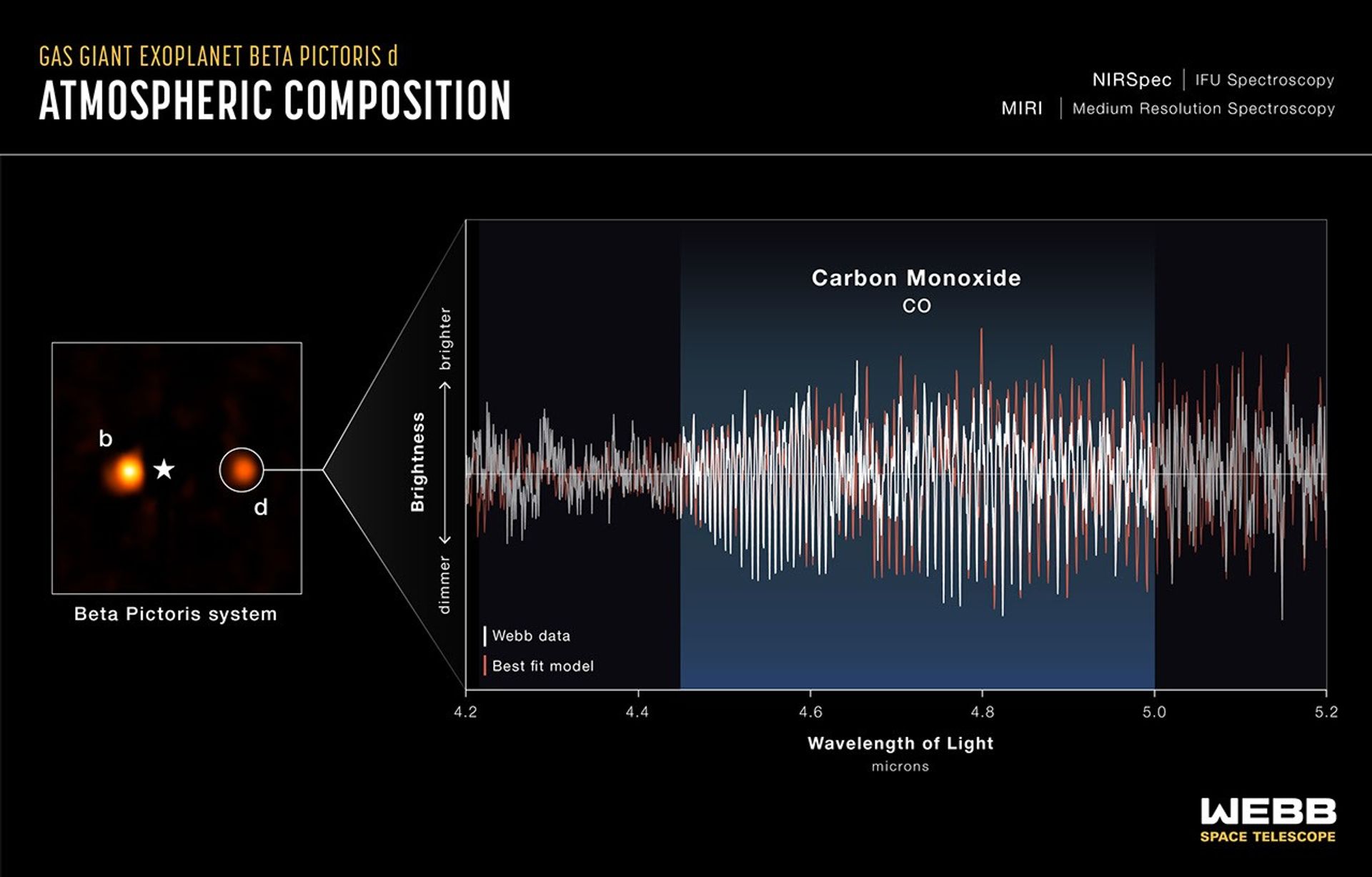
The team was using Webb's NIRSpec (Near-Infrared Spectrograph) Integral Field Unit to study the atmosphere of Beta Pictoris b, one of the system's two previously known planets. NIRSpec's IFU is a powerful tool: it captures an image and a spectrum from every single pixel in the field of view, creating a data cube where each layer corresponds to a different wavelength of light.
When the team looked at the spectroscopic data, they found something unusual. Instead of a smooth spectrum from light scattering off dust, they saw a distinctive pattern of peaks and troughs: the absorption lines of carbon monoxide, spread out like a bar code. That pattern, expected in giant planet atmospheres, was coming from a location in the system where no known planet sat.
"There was an unexpected bright source of light within the Integral Field Unit imaging, but we've learned not to trust bright blobs in images," said Jean-Baptiste Ruffio, a research scientist at UC San Diego and principal investigator of the Webb observations. "They can be instrumental artifacts or other structures in the debris disk. By obtaining a spectrum at the same time as the image, we were able to quickly confirm our suspicions."
Spectroscopy can also reveal motion. By measuring the Doppler shift of the carbon monoxide lines, the team determined the object's radial velocity, its position, and its alignment with the debris disk. All the data pointed to one conclusion: a giant planet orbiting Beta Pictoris.
A planet that was hiding for a decade
Beta Pictoris d remained hidden for years for a simple reason: the disk of dust and gas surrounding the star acts like fog. It scatters starlight, making it difficult for conventional imaging techniques to distinguish faint planets from the surrounding debris. The JWST spectroscopic method effectively ignored that fog, isolating only the narrow molecular signatures unique to a planetary atmosphere.
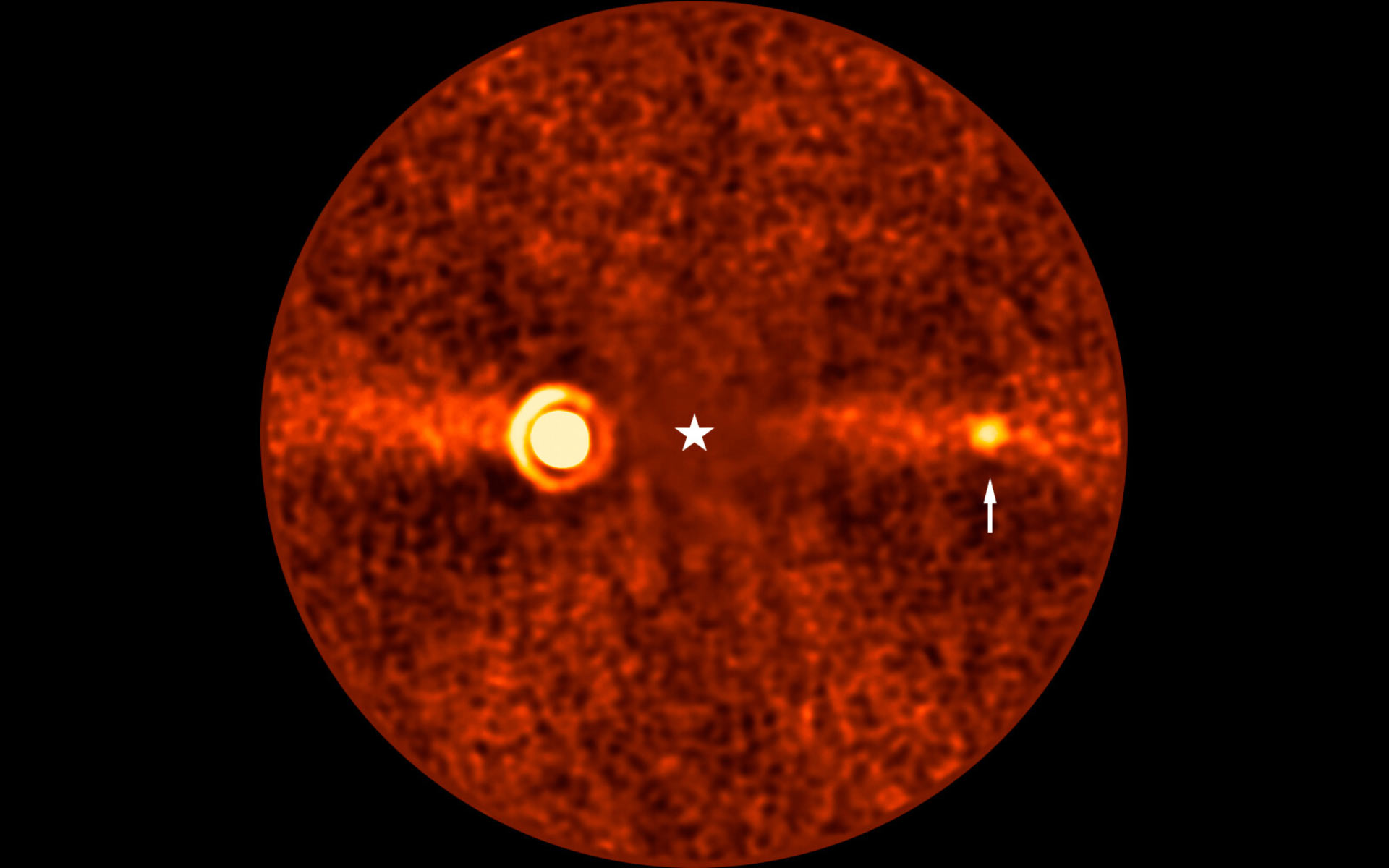
Follow-up observations with Webb's MIRI (Mid-Infrared Instrument) detected water vapor and methane, further confirming the planet's identity. But the discovery did not stop with Webb. A separate team led by Ben Sutlieff at the University of Edinburgh and Markus Bonse at the European Southern Observatory independently confirmed the existence of Beta Pictoris d using the VLT's ERIS instrument in Chile and Webb's NIRCam.
The ESO team went further: they looked through the ESO archive and found the new planet in images dating back 11 years, including one where it was barely visible against the glare of its larger neighbor, Beta Pictoris b. The planet had been sitting in archived data all along, waiting for someone to see it.
The faintest planet ever imaged from Earth
Beta Pictoris d is extraordinary not just because of how it was found, but because of what it is. At roughly 2.4 Jupiter masses, it is the smallest of the three known planets in the system and 100 times fainter than Beta Pictoris b. That makes it the faintest exoplanet ever imaged directly from the ground.
The planet orbits at roughly 30 astronomical units from its star, comparable to Neptune's distance in our own solar system, and has the widest orbit of the three known planets. Beta Pictoris b orbits at 9.8 AU (between Saturn and Uranus), while Beta Pictoris c is at just 2.7 AU.
Scientists say the planet's presence may help explain one of the Beta Pictoris system's long-standing puzzles: why the debris disk has such a sharply defined inner edge. Astronomers had predicted the existence of a planet like Beta Pictoris d to account for the disk's unusual structure. Now they have one.
A new way to find planets
The most important aspect of this discovery may be the method. This is the first time a directly imaged planet has been discovered primarily through moderate-resolution spectroscopy rather than coronagraphic imaging. The approach opens the door to finding planets in complex environments where dust and debris would otherwise hide them.
"A spectrum contains an incredible amount of information," Ruffio said. "You don't just learn that something is a planet; you immediately begin learning about its temperature, chemistry, and motion."
For the Beta Pictoris system itself, the work is not finished. The planet's temperature, chemical composition, and orbit still need to be pinned down more precisely. But the discovery has already changed the landscape. A system that astronomers thought they understood for 40 years turns out to have been hiding one of its planets in plain sight, in data that existed all along, visible to anyone who knew how to read the chemistry instead of just the image.
Sources
- NASA's Webb Discovers Hidden Planet in Famous Star System (NASA Science, July 15, 2026) - NASA press release with quotes from Aidan Gibbs (UC San Diego), Jean-Baptiste Ruffio (UC San Diego)
- NASA's Webb Discovers Hidden Planet in Famous Star System (STScI News Release 2026-126, July 15, 2026) - STScI press release with technical details and image credits
- Gibbs et al., ApJL (July 15, 2026) - primary paper: JWST NIRSpec IFU discovery of Beta Pictoris d through moderate-resolution spectroscopy
- Sutlieff et al., ApJL (July 15, 2026) - independent confirmation via VLT/ERIS imaging and archival data
- Astronomers Discover and Directly Image Third Planet in Beta Pictoris System (Sci.News, July 15, 2026) - coverage with additional details from both teams
- Beta Pictoris System (NIRSpec IFU Image and Spectrum) (ESA/Webb) - ESA Webb image archive with spectrum and description
Related on Impossible Universe
- AI Found 118 Hidden Planets in NASA TESS Data. The Neptunian Desert Just Got Its First Head Count. - Another example of how new techniques are finding planets that traditional methods missed
- TESS Found Its First Planet by Watching It Warp Spacetime: Gaia23bra b Microlensing Discovery - A different serendipitous planet discovery using gravitational microlensing
- JWST Caught an Ultra-Hot Jupiter Getting Roasted. The Temperature Spike Was Worse Than Expected. - JWST exoplanet atmosphere study revealing extreme heating on another unusual world
- JWST Saw Dawn and Dusk on a Hellish Exoplanet. The Two Faces Could Not Be More Different. - Temperature and chemistry differences across an ultra-hot Jupiter
- JWST Found Salt Clouds on the Pink Planet. After a Decade, We Finally Know What's in Its Sky. - JWST atmospheric detection on a planet that resisted study from the ground for years
Hero image: Artist concept of the Beta Pictoris system by Ralf Crawford (STScI). Credit: NASA, ESA, CSA, STScI. Inline NIRSpec IFU image: NASA, ESA, CSA, STScI, L. Hustak (STScI); Science: A. Gibbs (UC San Diego), J.B. Ruffio (UC San Diego), A. Bidot (STScI); Image Processing: A. Pagan (STScI). Inline VLT/ERIS image: ESO/Sutlieff et al. (CC BY 4.0). Research published in The Astrophysical Journal Letters (Gibbs et al. and Sutlieff et al., July 15, 2026).