For a Decade, Astronomers Could Not Figure Out the Pink Planet. JWST Just Found Salt Clouds in Its Sky.
An exoplanet 57 light-years away has been too faint for ground-based telescopes to study since its discovery in 2013. The James Webb Space Telescope finally got a clean look and found something theorists predicted but had never confirmed: salt clouds.
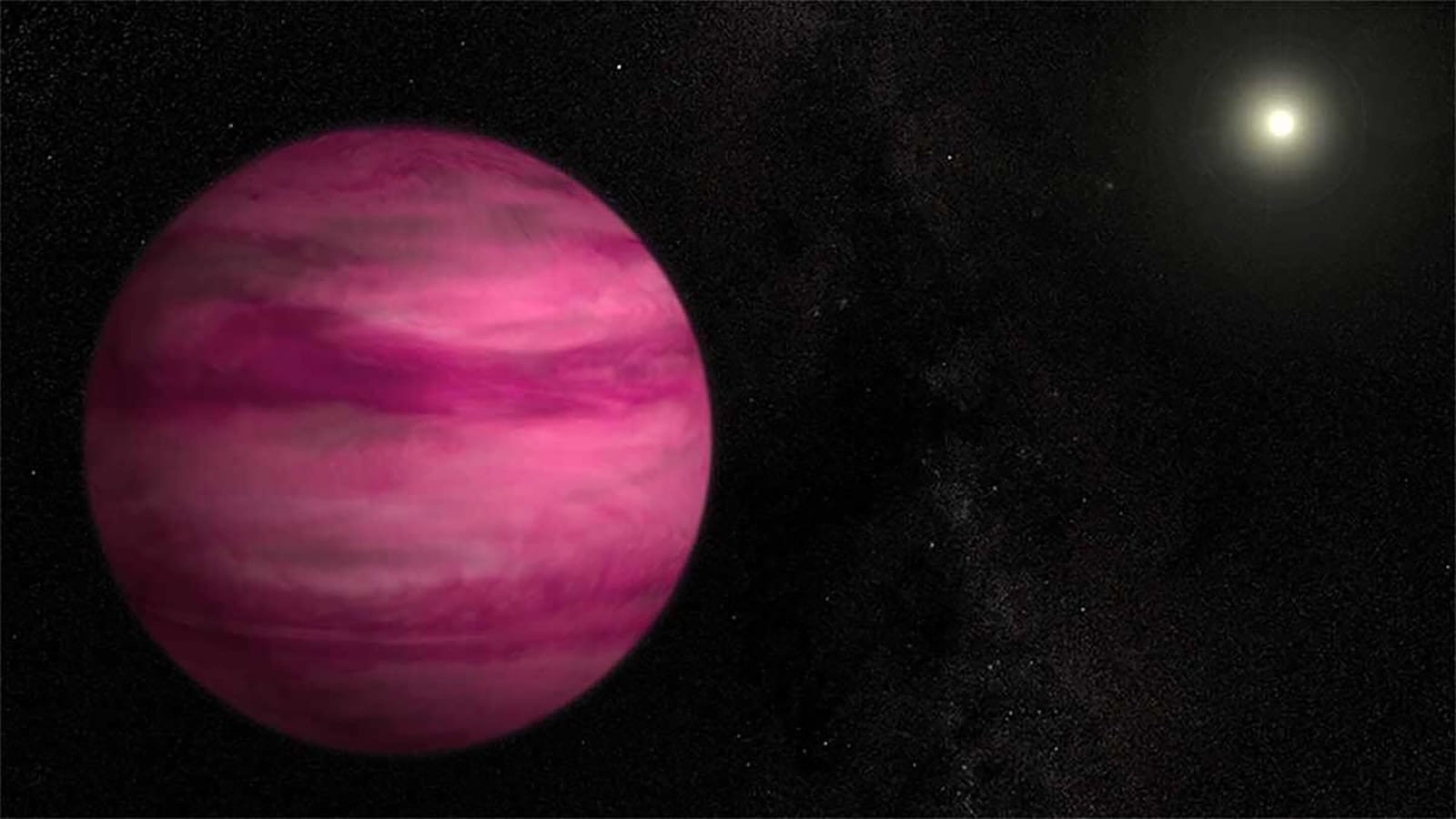
In 2013, astronomers using the Subaru Telescope on Mauna Kea pointed the world's most advanced adaptive optics system at a sun-like star 57 light-years away. When they subtracted the star's glare from the image, a faint pink dot appeared in the residual light. It was big, roughly 25 times the mass of Jupiter. It was cold, just 550 degrees Fahrenheit, the temperature of a bread-baking oven. And it was too dim for any ground-based telescope to study in detail.
For more than a decade, the Pink Planet, officially called GJ 504b, remained a beautiful question mark. Was it a giant planet or a brown dwarf? What was its atmosphere made of? Was it actually pink, and if so, why?
In June 2026, the James Webb Space Telescope finally got a clean look. The answer, published in The Astronomical Journal, was salt.
A team led by Aneesh Baburaj, a postdoctoral researcher at Northwestern University's Center for Interdisciplinary Exploration and Research in Astrophysics (CIERA), used JWST's NIRSpec instrument to capture the first-ever spectrum of GJ 504b. The observation took roughly two hours. For context, earlier attempts using the largest telescopes on Earth had failed to detect the object even over a full night of observing time.
The spectrum showed a rich chemical inventory: water vapor, methane, carbon dioxide, ammonia, and other molecules. But when Baburaj fed the data into an atmospheric model, something was off. The model kept demanding physically impossible features to match the observations.
Salt clouds, not water vapor
The problem vanished when the team added clouds. Specifically, salt clouds.
"We ran simulations with clouds, and the results aligned with what we know about cold planets," Baburaj said. "We tried three different types of clouds, and salt clouds fit best. When we accounted for salt clouds, it subdued the signature of molecules hidden deeper in the companion's atmosphere. Then the results became physically possible."
At 550 degrees Fahrenheit, sodium chloride and potassium chloride can exist as suspended crystals in a mostly hydrogen atmosphere. These crystals form a haze that absorbs light coming from deeper layers, shaping what JWST can detect. The phenomenon, theorists predicted more than 15 years ago, is the same basic physics that produces salt flats on Earth, but operating in an alien sky 57 light-years away.
The spectrum also revealed that GJ 504b is unusually rich in heavy elements, what astronomers call metals. That enrichment hints that the object might have formed inside a planet-forming disk, where heavier elements condense into solid grains and get swept into a growing planet. But the evidence is not yet conclusive. GJ 504b sits on the fuzzy boundary between giant planets and brown dwarfs, and the new data does not settle the question of which category it belongs to.
The problem with cold objects
GJ 504b was discovered as part of the SEEDS survey, a Japanese-led effort to directly image exoplanets using the Subaru Telescope's extreme adaptive optics system. At the time, it was the coldest and least massive exoplanet ever directly imaged. But that coldness also made it nearly invisible. Directly imaged exoplanets and brown dwarfs are typically studied at temperatures above 1,000 degrees Fahrenheit, where they glow brightly in near-infrared light. At 550 degrees Fahrenheit, GJ 504b is simply too faint.
"The Pink Planet is the coldest companion ever discovered using ground-based instruments," Baburaj said. "Many teams all around the world performed follow-up observations to study its light, but it was too faint for ground-based instruments. That made it a perfect target for JWST."
The companion's age is responsible for its low temperature. Giant planets and brown dwarfs are born blistering hot from the gravitational energy of their formation, then cool over time. The new study estimates GJ 504b is between 2.5 billion and 4 billion years old, old enough to have radiated away most of its formation heat.
Marshall Perrin, a member of the JWST Telescope Scientist Team at the Space Telescope Science Institute who devised the observing program, said the result demonstrates a capability that goes beyond this one object. If JWST can get a clean spectrum of something as cold as a bread oven in two hours, it can do the same for objects even fainter and colder, worlds whose light has been entirely out of reach.
What the salt tells us
The detection of salt clouds on GJ 504b is a first, but it is also a warning. Atmospheric models of exoplanets and brown dwarfs often simplify or ignore clouds, assuming they are thin or absent. The new results suggest that assumption can lead researchers astray.
"This is the first time we've found that salt clouds are critical to explaining the spectrum of an object," Baburaj said. "It's a good reminder to account for clouds in our models."
The finding also connects to the gas giants in our own solar system. Jupiter hosts clouds made of ammonia ice, not salt. But the modelling techniques developed for GJ 504b, and the broader lesson about how clouds can mask deeper atmospheric layers, could sharpen how astronomers interpret observations of planets much closer to home.
The study was conducted in collaboration with scientists at the Space Telescope Science Institute and is part of the JWST Telescope Scientist Team's observing program, which contributed to the telescope's design and is responsible for its day-to-day operations.
The Pink Planet spent a decade as a beautiful enigma, a pink smudge in Subaru images that nobody could decode. Now it has a chemical fingerprint, a cloud deck, and a place in the growing catalogue of strange worlds that JWST is bringing into focus. There are colder objects still waiting.
Sources
- Phys.org: Famous 'Pink Planet' harbors a salty surprise - detailed news coverage with researcher quotes from Aneesh Baburaj and team
- Baburaj et al., The Astronomical Journal (2026) - peer-reviewed paper: "JWST-TST High Contrast: First Direct Spectroscopy of GJ 504 b Reveals Clouds and Possible Metal Enrichment"
- Wikipedia: Gliese 504 b - background on the object's discovery, physical characteristics, and observation history
Related on Impossible Universe
- JWST Saw Dawn and Dusk on a Hellish Exoplanet. The Two Faces Could Not Be More Different. - JWST mapping morning and evening on a world where iron clouds form on one side and rain metal on the other
The hero image is an artistic illustration of GJ 504b credited to NASA/Goddard Space Flight Center. NASA images are public domain. The research described in this article is peer-reviewed and published in The Astronomical Journal (DOI: 10.3847/1538-3881/ae6919).