
Physicists Created a Tiny Universe From 24,000 Atoms and Watched Time Emerge All by Itself
A physicist at the University of Birmingham sealed 24,000 ultracold atoms inside an isolated chamber and watched as time emerged naturally from the system, without any external clock. When the distribution of atoms stopped changing, time effectively stopped. The experiment tests whether time is fundamental or emerges from change.
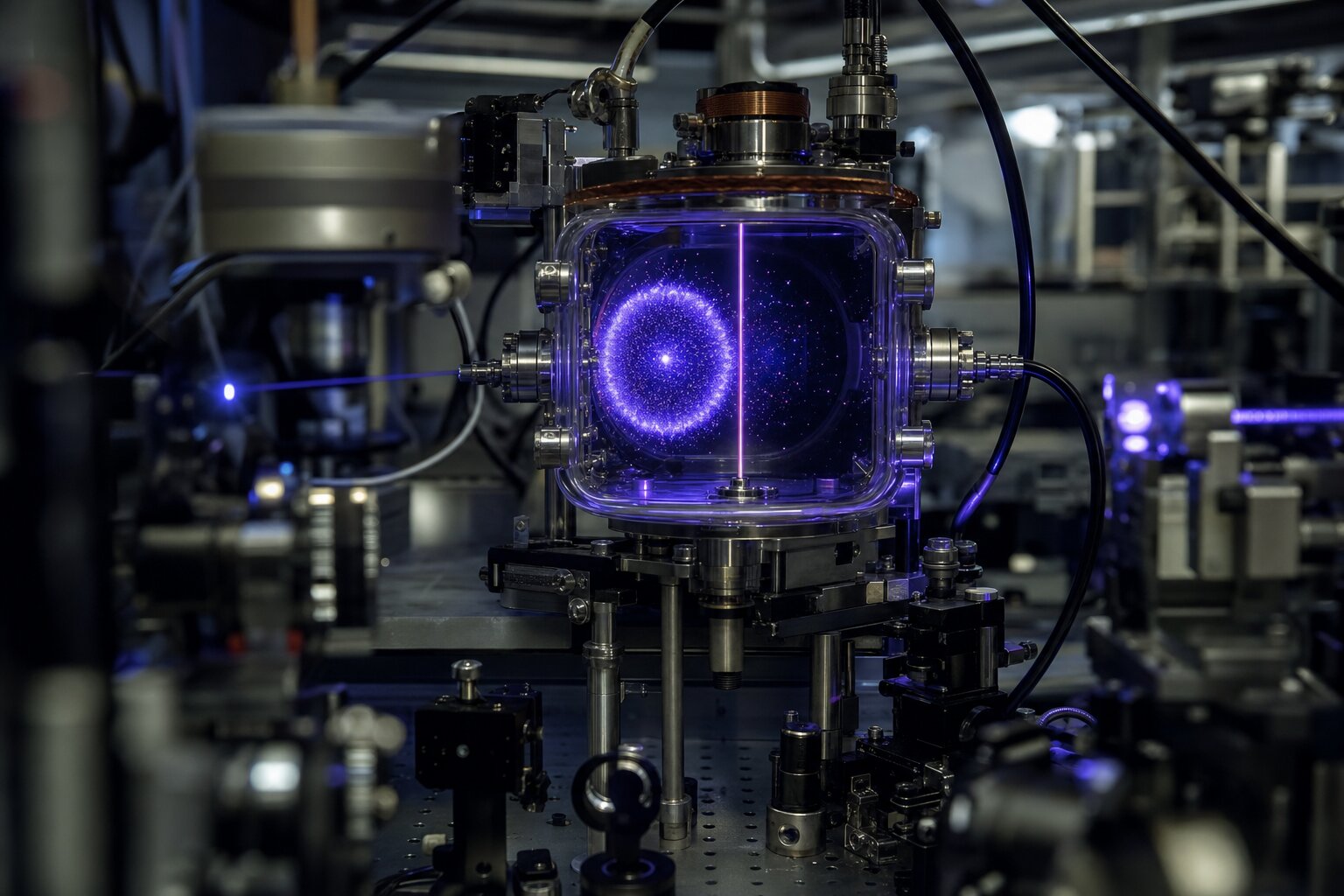
Inside a physics lab at the University of Birmingham, a sealed glass chamber holds 24,000 rubidium atoms cooled to a few billionths of a degree above absolute zero. Two laser beams create a thin barrier that splits the cloud into two regions. One side is bright, watched by instruments. The other is dark, unobserved. The bright side expands and contracts like a miniature cosmos going through its own Big Bang and Big Crunch.
There is no clock anywhere in the system. No external timekeeper. And yet time emerges on its own.
Professor Giovanni Barontini published the experiment in Physical Review Research on June 12, 2026. It is the first controlled laboratory demonstration that time can arise from inside a quantum system without any reference to an outside clock. The concept is called entropic time, and it addresses a question that has bothered physicists for nearly a century: Is time a fundamental property of the universe, or does it emerge from something deeper?
The universe without a clock
In everyday life, time feels like a stage. Events happen on it. It ticks forward whether anything changes or not. But some of the most powerful theories in physics suggest this may be wrong.
The Wheeler-DeWitt equation, developed in the 1960s, describes the entire universe as a single quantum state. There is no external clock in the equation. No ticking mechanism that tracks how fast things evolve. The equation simply exists. It suggests that, at the deepest level, the universe might be timeless, and what we experience as time may be an emergent property of relationships between parts of the system.
"Several theories of modern physics suggest that time may not exist as a built-in feature of the universe," Barontini said in a university press release. The idea has been debated in theoretical physics for decades, but testing it experimentally has always been the hard part.
That is what Barontini set out to do.
How to make time from scratch
Barontini built what he calls a "mini universe": a sealed quantum system of 24,000 ultracold rubidium atoms. Two laser beams of different frequencies create a thin barrier inside the chamber, dividing the atoms into two zones. The atoms can move between zones, but nothing else enters or leaves the system.
The bright zone, where atoms are illuminated and observed, repeatedly expands and contracts. Each expansion is like a tiny Big Bang. Each contraction is a Big Crunch. The cycle repeats inside the glass chamber, over and over, in a self-contained rhythm.
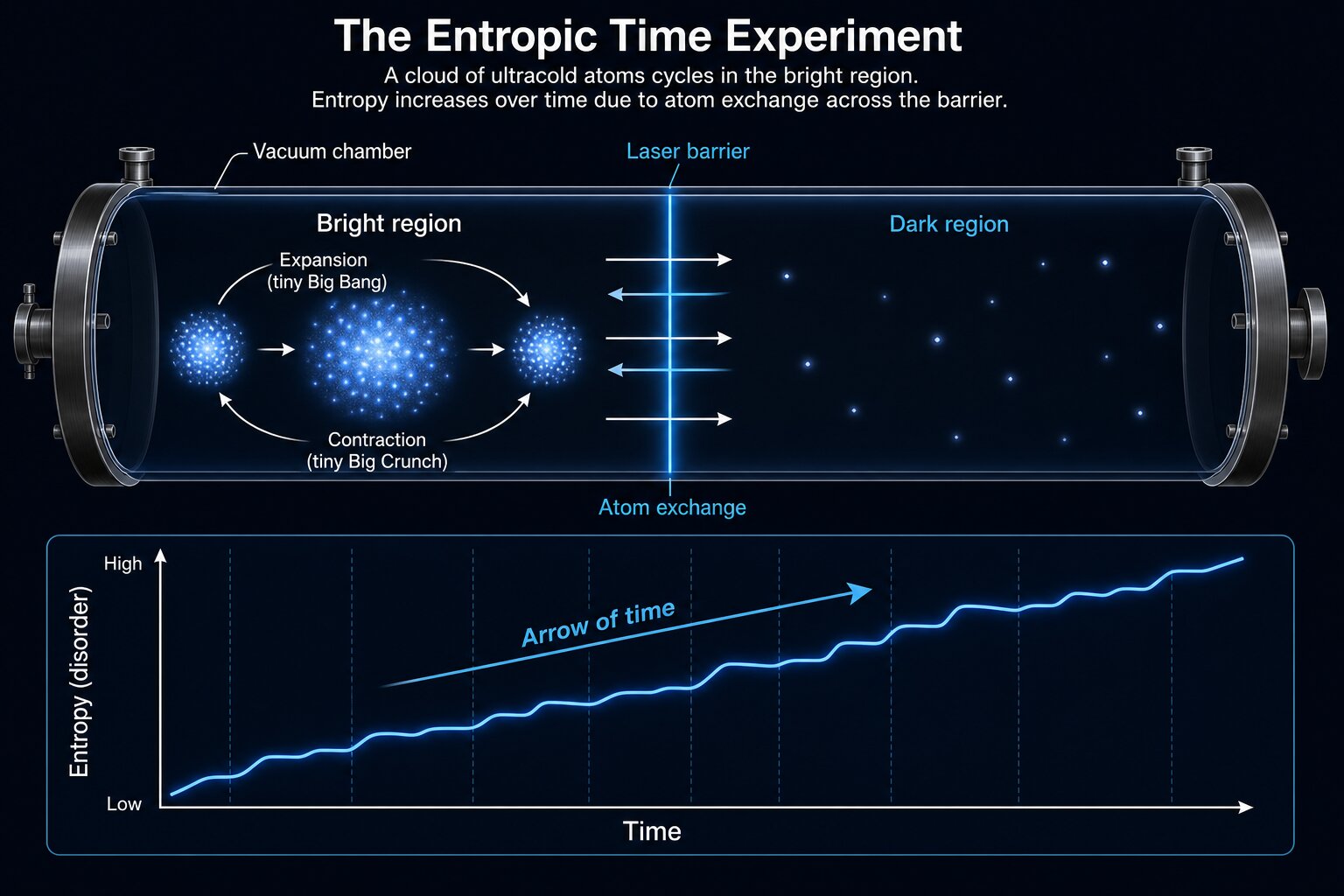
The key was to measure time without ever looking at an external clock. Barontini tracked how atoms moved between the two regions. When atoms spread out and the distribution changed, the system was moving forward. When the distribution stopped changing, time effectively stopped. The arrow of time came from entropy: the natural tendency of particles to become more disorderly over time.
This is entropic time in action. The concept was first proposed in the 19th century when Ludwig Boltzmann connected the arrow of time to the second law of thermodynamics. Entropy tends to increase. The universe becomes more disordered. That statistical bias gives time a direction. But until Barontini's experiment, nobody had shown that a closed quantum system could define its own time from entropy alone, without any external reference.
The three behaviors of entropic time
Barontini found that entropic time inside the mini universe has three specific properties.
It flows in one direction. The spread of atoms between the bright and dark zones increases on average, giving a consistent arrow of time even though random fluctuations sometimes briefly decrease entropy.
It correctly orders events. The system can tell cause from effect. Even as the bright zone expands and contracts like a cosmic cycle, the entropy clock keeps events in the right sequence.
It speeds up and slows down. The rate of time depends on how fast entropy changes. When atoms move rapidly between zones, time moves faster. When the system reaches equilibrium and nothing changes, time slows to a stop.
The third point is the most striking. In the experiment, when the distribution of atoms stopped changing, time effectively stopped. Not because a clock broke, but because nothing in the system was changing anymore. Without change, there was no way to define forward from backward.
What this means for the nature of time
The experiment does not settle the debate about whether time is fundamental or emergent. That is a question for philosophers of physics as much as experimentalists. But it does something important: it provides a working laboratory model where time emerges from within a system, meeting all the criteria for a clock without actually being one.
"This study provides the first controlled experimental evidence that time can be defined by changes within a system rather than as the external ticking clock we think of as time," Barontini said.
This matters because the problem of time in quantum gravity has been one of the biggest obstacles to unifying quantum mechanics with general relativity. If time is not a fundamental ingredient of the universe but something that emerges from quantum systems, the equations of quantum gravity may not need a time variable at all. The Wheeler-DeWitt equation may be incomplete, but it might also be pointing in the right direction.
The experimental platform also opens the door to testing other cosmic phenomena in the lab. Barontini's mini universe can simulate Big Bang and Big Crunch analogs. Similar setups could be used to study black hole horizons, vacuum decay, and other scenarios that are impossible to observe directly in the real cosmos.
Sources
- Barontini, Physical Review Research (2026): Entropic time in a closed quantum system - primary peer-reviewed study
- University of Birmingham: Scientist Creates Mini-Universe to Measure Time Without a Clock - primary press release with researcher quotes and experimental details
- ScienceDaily: Physicists Created a Tiny Universe Where Time Emerged Without a Clock - accessible summary and context
- Phys.org: Scientist Creates Mini-Universe to Measure Time Without a Clock - additional reporting and photograph of the experimental apparatus
- Wikipedia: Wheeler-DeWitt Equation - background on the timeless universe formulation in quantum gravity
Hero image and experimental setup diagram generated for Impossible Universe. Professor Barontini photograph available from University of Birmingham press office.
Related on Impossible Universe
- Scientists Created the First Time Crystal You Can Actually See With Your Own Eyes - another experiment where time behaves unusually in a quantum system, this one visible under a microscope
- A Dying Star Could Create a Tiny New Universe Instead of a Black Hole - theoretical physicists explore what happens when a massive star collapses and creates a small expanding universe inside
- Scientists Built LEGO-Like Nanoparticles Into a Material That Shows Quantum Behavior at Room Temperature - another room-temperature quantum phenomenon that challenges assumptions about where quantum effects can exist
- Euclid Found 31 Ancient Quasars From the Universe's Infancy - how astronomers observe cosmic time across billions of years