
Scientists Built LEGO-Like Nanoparticles Into a Material That Shows Quantum Behavior at Room Temperature
Researchers at Brown University and the University of Michigan used custom-shaped silver nanoparticles to freeze a fleeting structural phase of matter that had been predicted by theory but never captured in a physical material. Under light, the superlattice exhibits deep-strong light-matter coupling at room temperature, a quantum behavior normally seen only near absolute zero.
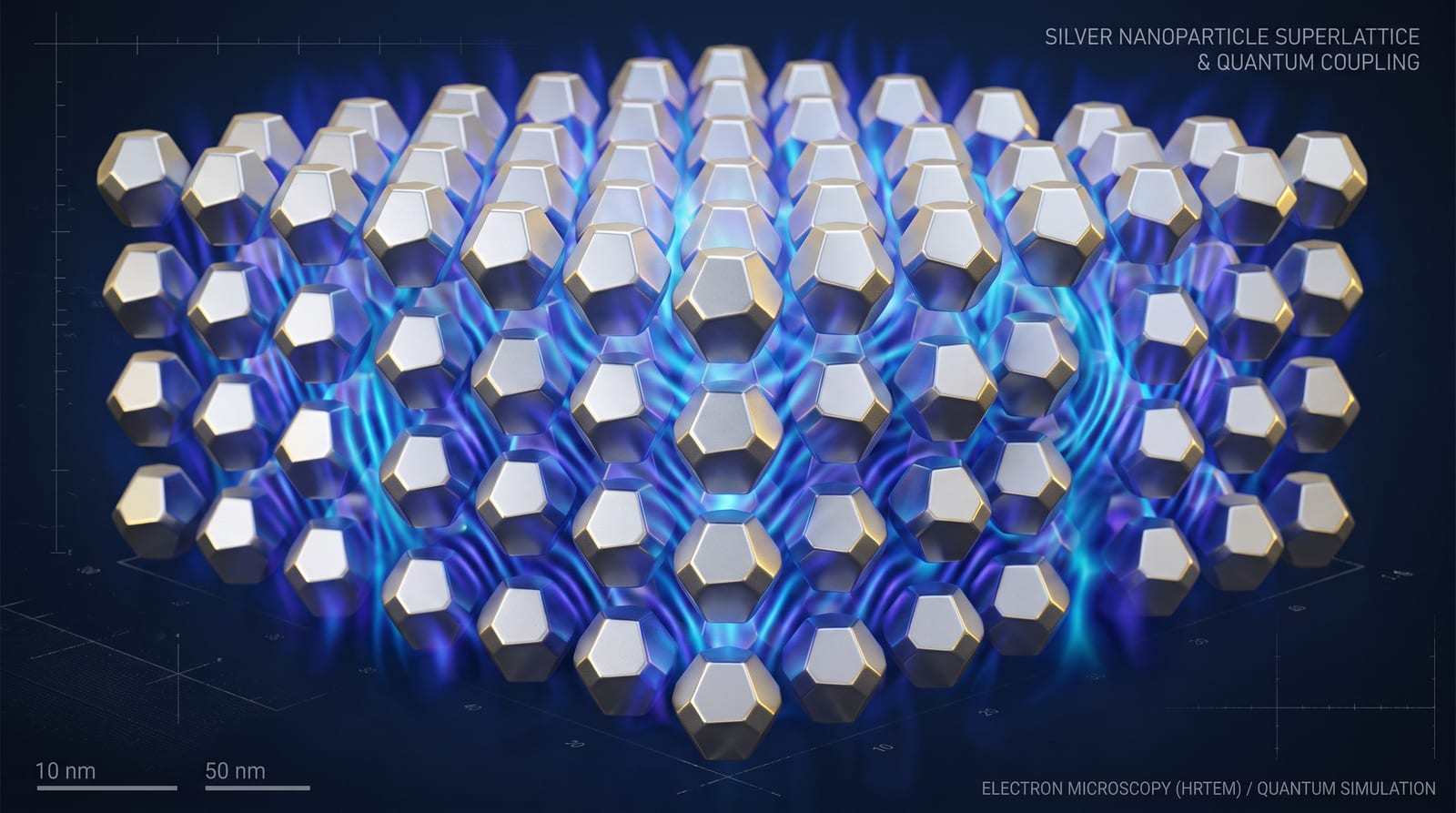
Ou Chen describes the work in terms of children's toys. "Our work is a little bit like kids playing with LEGO blocks," said Chen, an associate professor of chemistry at Brown University and a corresponding author of the new research. "We synthesize unique nanoscale building blocks and stack them into interesting structures."
The blocks in question are silver nanoparticles, each one roughly 14-sided and a fraction of a hair's width. When Chen and his collaborators at the University of Michigan assembled them into a lattice, the particles did something no one had managed before. They froze a fleeting structural phase of matter that had been predicted on paper for decades but had never been captured in a physical material. The result, described May 28 in the journal Science, behaves like a room-temperature quantum material, a category of matter that normally needs extreme cold to function.
The two ways atoms like to stack
Metals tend to arrange their atoms in one of two patterns. The first, face-centered cubic or FCC, is the tightest possible packing of spheres. Picture a cube with an atom at every corner and one in the center of every face. Most familiar metals, including aluminum, copper, gold, and silver, crystallize this way in their standard form.
The second, body-centered cubic or BCC, is slightly less dense. Atoms occupy every corner of a cube plus one at the dead center of the cube's interior, no atoms on the faces. Iron crystallizes as BCC at room temperature, then switches to FCC when heated past 912 degrees Celsius. That switch is why blacksmiths can shape hot iron differently from cold iron. The atomic arrangement itself changes.
What happens between those two arrangements has been harder to pin down. Theorists proposed several pathways for the FCC-to-BCC transition, and one of the most studied goes by the name Nishiyama-Wassermann. The pathway predicts a set of intermediate structures that exist only fleetingly, with lower symmetry than either FCC or BCC. Because those intermediates are unstable, they vanish almost as soon as they form. Nobody had managed to isolate one.
Nanoparticles shaped like tiny diamonds
The key insight was shape. Spherical particles pack into FCC naturally. Cubes can pack into either FCC or BCC depending on conditions. But what about something in between? Chen's team, led by senior research scientist Yasutaka Nagaoka, synthesized silver nanoparticles shaped as truncated octahedra, essentially diamonds with every corner snipped off to produce a solid with 14 flat faces. The team calls them "mecons." The shape sits on a continuum between a sphere and a cube, and by tweaking the synthesis temperature, the researchers could produce particles with a controlled balance of rounded and flat features.
Shape alone was not enough. The particles also needed the right kind of coating. The team attached long, sticky polymer molecules to the surface of each nanoparticle. Tim Moore, an assistant research scientist at the University of Michigan and study co-author, described them as "hairy particles." The hairs gave each particle flexibility, enough freedom to shift position slightly while still locking together with its neighbors.
"You can kind of picture them like hairy particles," Moore said. "The hairs are flexible enough that the particles have more freedom to shift, but they also fit together nicely, which allows the particles to mesh together."
When the team let these coated mecons self-assemble into larger superlattices, the structures that formed matched the transient intermediate phases predicted by the Nishiyama-Wassermann pathway. The particles had frozen the in-between state. Combined with computer simulations run by Sharon Glotzer's group at the University of Michigan, the results confirmed that the sticky coating was essential for giving the particles just enough room to settle into arrangements that would otherwise be unstable.
"Materials scientists have cared about how to control the amount of FCC and BCC in their metals for a long time, but the transitions between these phases have been hard to study because they are so unstable," Moore said. "Being able to observe these structures is a fundamental breakthrough in materials science, and it gives us greater control over nanomaterial engineering."
The quantum behavior that should not happen at room temperature
Then came the surprise. When the researchers shined light on the silver nanoparticle superlattice, the electrons in the silver particles began oscillating in unison with the light waves. The electrons and photons became quantum mechanically entangled in a phenomenon called deep-strong light-matter coupling.
This is not supposed to happen at room temperature. Quantum optical interactions like these are typically observed only in cryogenic conditions, at temperatures within a few degrees of absolute zero, where thermal noise is low enough that fragile quantum states can survive. Thermal vibrations at room temperature normally destroy quantum coherence before it can do anything useful.
The superlattice appears to sidestep that limitation. The silver nanoparticles collectively couple to light so strongly that the quantum behavior persists even as atoms jostle at 300 Kelvin. The mechanism is not yet fully understood, but the researchers suspect the ordered nanoparticle arrangement creates a kind of protected collective state that resists thermal disruption.
"Anytime you're able to identify a new phase of matter, new applications are going to emerge," Chen said.
Why room temperature matters for quantum computing
Quantum computers today are housed inside dilution refrigerators that cool their processors to millikelvin temperatures. The cooling infrastructure is expensive, power-hungry, and physically large. A material that exhibits quantum behavior at ambient temperature would not replace those systems overnight, but it could simplify certain components, such as quantum sensors, modulators, or interfaces between classical electronics and quantum processors.
The superlattice is not a quantum processor in itself. The light-matter coupling it demonstrates is a building block. If researchers can control it precisely enough, the same approach could produce materials that convert single photons into quantum information states without the need for a cryostat. That would bring quantum technologies closer to practical use outside specialized laboratories.
The broader promise of the work goes beyond quantum computing. The team has demonstrated a general method: start with custom-shaped nanoparticles, coat them with flexible molecular tethers, and let them find their own structural arrangement. If the same approach can stabilize other predicted but elusive phases of matter, the design space for new materials expands dramatically. Chen's team has already begun exploring other nanoparticle shapes and compositions.
The research was supported by the National Science Foundation and the Department of Energy. The fabrication and characterization were performed at Brown University. Computer simulations and structural modeling were led by the Glotzer group at the University of Michigan.
Sources
- Nagaoka et al., "Nanoparticle Superlattices with Tunable Structural Transitions," Science (May 28, 2026) - primary research article describing the synthesis, structural characterization, and optical measurements of the silver nanoparticle superlattice
- Researchers Create Novel Structural State of Matter with Exotic Properties (Brown University, May 28, 2026) - press release with direct quotes from Ou Chen and Tim Moore, plus background on the Nishiyama-Wassermann pathway and nanoparticle synthesis method
- Room-Temperature Quantum Computing: A Superlattice Breakthrough That Could Supercharge Information Science (The Debrief) - coverage of the research with additional context on quantum computing implications and room-temperature quantum materials
- New Material Could Lead to Room-Temperature Quantum Technologies (The Quantum Insider, June 1, 2026) - quantum industry trade coverage with analysis of potential applications in quantum sensing and information processing
Related on Impossible Universe
- Scientists Made a Time Crystal You Can See With the Naked Eye. It Changes What We Thought Possible. - a team at Aalto University created a macroscopic time crystal that couples to visible light, another novel phase of matter that breaks textbook symmetry rules
- This Light-Powered Chip Could Let a Phone Do the Work of a Server Farm. It Just Got Phase Two. - room-temperature nanoscale light processing on a silicon chip, part of the same push toward ambient-condition quantum and exotic-matter technologies
- A Dying Star Could Create a Tiny New Universe Instead of a Black Hole - another example of predicted but unobserved states of matter on cosmic scales, from gravastars to quantum materials
Hero image: Generated illustration for Impossible Universe. The research was published in Science on May 28, 2026, and supported by the National Science Foundation (DMR-1943930, CHE-2203700, EAR-2223273, CBET-2230729, CBET-2230891, 2243104, DMR 140129, 2138259, 2138286, 2138307, 2137603, 2138296) and the Department of Energy (DE-SC0012704, DOE-NNSA, DE-NA-0003975).