
The Ballista Spider Catapults Ants Into Its Web Using a Spring-Loaded Silk Trap
In the rainforests of Queensland, a spider builds a cone-shaped silk trap that launches green tree ants into its web with accelerations of 1,300 m/s2, more than 15 times the G-force of a jet pilot. The ballista spider only hunts one species of ant, making it one of the most specialized predators ever discovered.
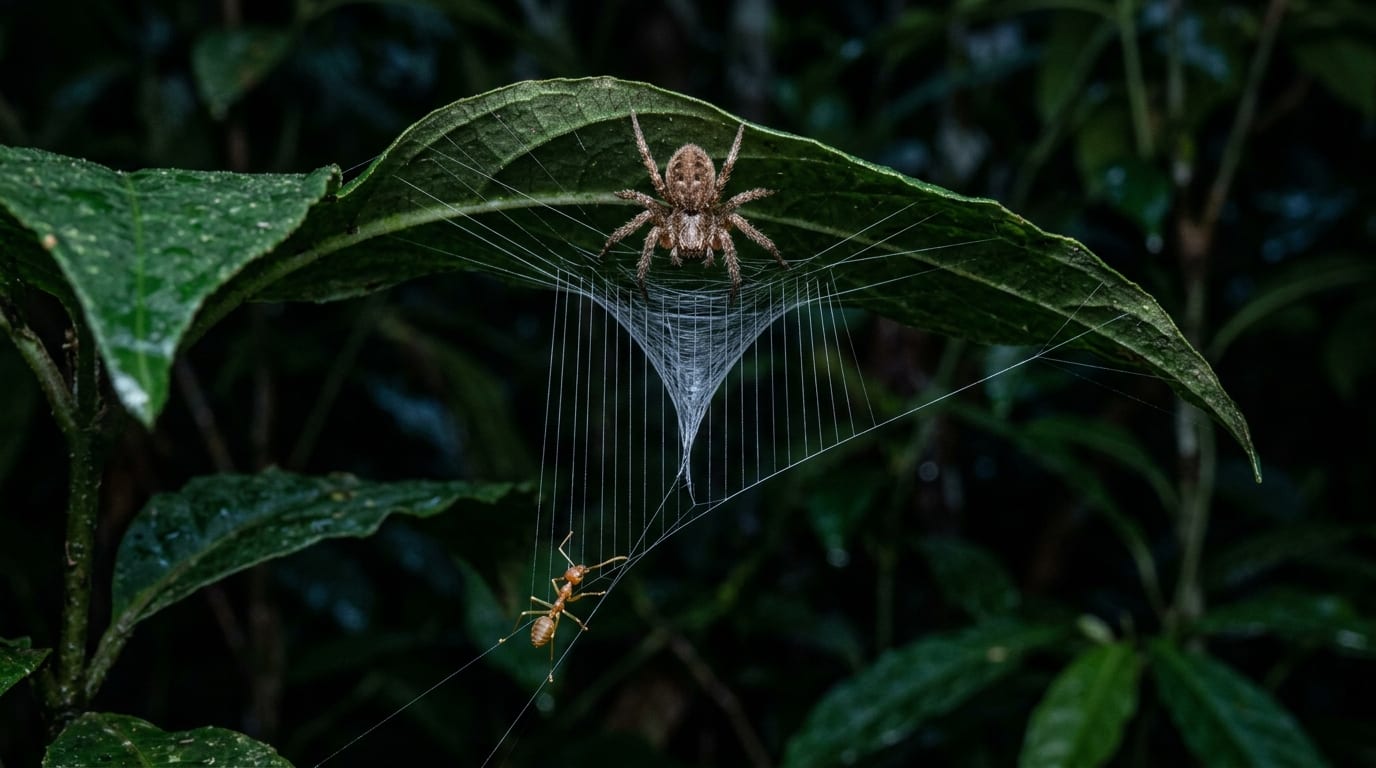
In the tropical rainforests of northern Queensland, a spider has evolved a hunting strategy that sits at the intersection of biomechanics, chemistry, and extreme specialization. Nicknamed the ballista spider after the ancient Roman torsion weapon, it builds a spring-loaded silk trap that catapults its prey upward with accelerations exceeding 1,300 meters per second squared. That is more than 15 times the peak G-force experienced by an F-16 pilot pulling a hard turn.
The target of this explosive mechanism is a single species: the green tree ant Oecophylla smaragdina, an aggressive, territorial insect that nests in the same trees the spider occupies. The spider, which belongs to the genus Propostira, has not yet been formally named. But the researchers who described it, led by Professor Ajay Narendra of Macquarie University, spent ten nights in the rainforest near Cooktown capturing its behavior with high-speed and infrared cameras. Their findings were published June 23 in Current Biology.
"It's very unusual for a spider to feed on ants because they're notoriously dangerous, and even more bizarre to find a spider that eats only one particular ant species," Narendra said in a university statement. "Ants have a range of chemical defenses, including the ability to sting in some species, and they use alarm signals to rapidly recruit hundreds and even thousands of other ants as backup to overcome potential predators."
A four-hour construction project
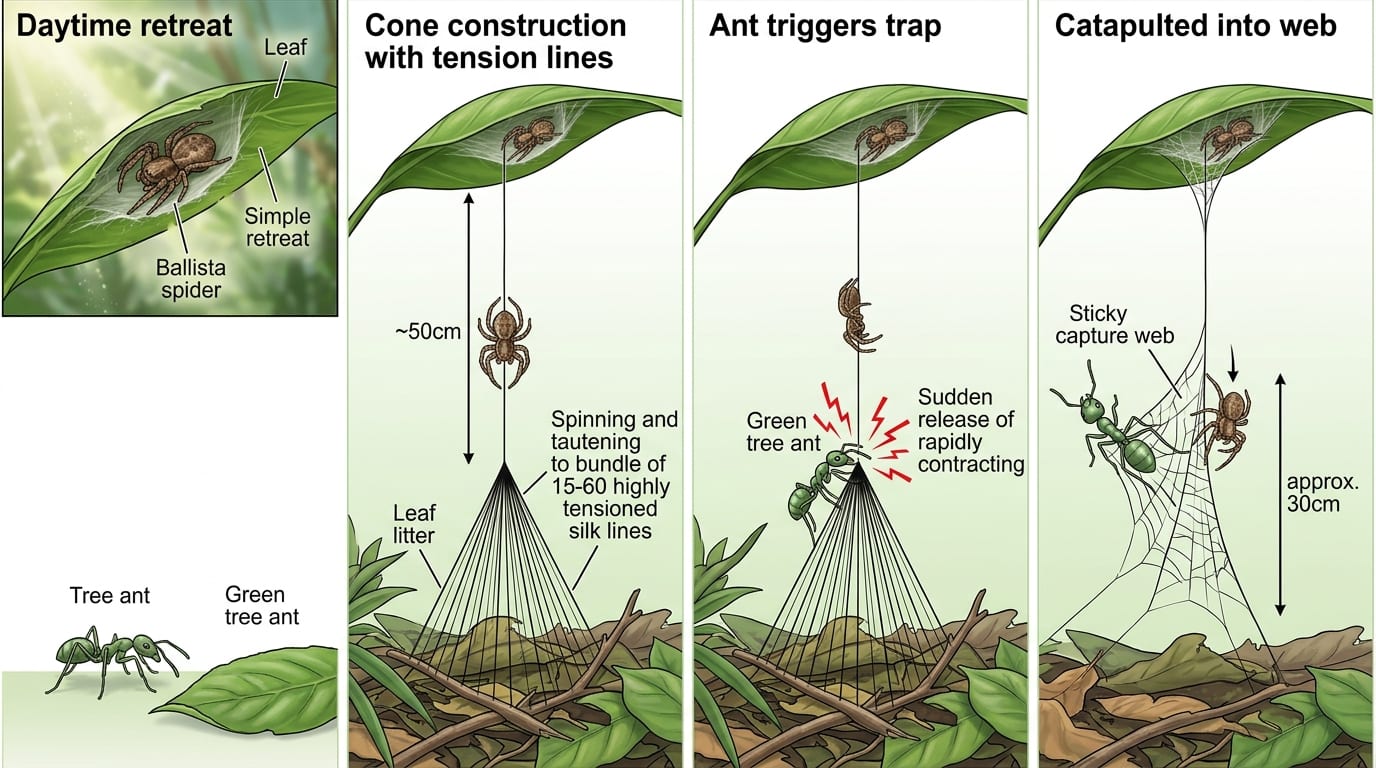
The ballista spider spends its days hidden in a retreat web on the underside of a leaf, above a zone where green tree ants forage. When darkness falls, it descends roughly 50 centimeters to a leaf, branch, or the forest floor and creates an anchor point using a single silk line. Then it begins the construction of its trap.
Over the next four hours, the spider spins a vertical arrangement of 15 to 60 tension lines bundled together into a cone near the ground. The cone is the mechanical heart of the trap. Each tension line is a strand of silk stretched taut between the anchor point and the spider's upper web. As the spider wraps additional layers of thinner silk around the bundle, the entire structure becomes a spring under tension, storing elastic energy like a drawn bow.
Once the cone is complete, the spider rapidly retreats upward to its web and waits.
Within seconds, a green tree ant approaches the cone. It reacts aggressively, biting the silk structure. The bite causes the cone to detach from its anchor point. In an instant, the tension lines contract, converting stored elastic energy into kinetic energy. The ant is launched more than 30 centimeters upward, directly into the spider's waiting web.
Higher power density than any other silk catapult
Co-senior author Dr. Jonas Wolff, who studies the biomechanical properties of spider silk at the University of Greifswald in Germany, traveled to Australia to observe the spider in the wild and took samples of its silk back to his lab for physical analysis, including scanning electron microscopy.
The numbers are striking. The acceleration of 1,300 m/s2 is roughly equivalent to 133 times the force of gravity. To put that in context, a jet pilot experiencing 9 Gs will black out without a G-suit. The green tree ant endures a force equal to its own weight times 133, all delivered by a few dozen strands of spider silk.
The trap also has an additional challenge to overcome: green tree ants have adhesive pads on their feet that allow them to cling to smooth surfaces. The snap release of the tension lines has to generate enough force to overcome that adhesion. The cone's contraction has to lift the ant with a force many times its body weight just to peel it off the surface before launching it upward.
Narendra described the trap as "bioengineered to store elastic energy in the silk and rapidly release it, giving it incredible instantaneous power density greater than any other specialized silk-based biological catapults."
A trap that hunts one prey and one prey only
What makes the ballista spider's strategy particularly unusual is not just the mechanics, but the selectivity. When the research team released other nocturnal ant species near the trap, the spider did not catch them. Only the green tree ant triggered the mechanism, and only the green tree ant was consumed.
The researchers suspect the spider adds a chemical lure to its trap. "We suspect during the final construction stage the spider adds a pheromone that specifically lures worker ants and induces an aggressive attack, triggering the snare," Narendra said. If confirmed, this would make the ballista spider one of the only predators known to chemically bait its own trap, targeting a single species with a combination of mechanical engineering and chemical mimicry.
This extreme specialization, known as monophagy, is rare among spiders. Most spiders are generalists: they eat whatever they can catch. A spider that invests four hours building a spring-loaded trap for one species of ant is an evolutionary bet that green tree ants are worth the effort and that no other prey is worth adapting for.
"This seems to be the only case where a spider's web is designed to catch a single prey species, and where the mechanism is triggered by the prey rather than by the predator," Narendra said.
Why ants are hard prey
Ants are not typical spider prey for good reason. Many species can sting, and nearly all can release alarm pheromones that summon hundreds of reinforcements within minutes. For a spider that cannot flee easily, an ant that calls for backup is a lethal threat. Most spiders avoid ants entirely.
The ballista spider solved this problem by eliminating contact. It does not approach the ant on the ground. It does not grapple with it. Instead, the ant triggers its own demise by biting the silk cone, and by the time it arrives in the spider's web, it is already disoriented from the acceleration, high above the ground, separated from its colony. The spider waits for the ant to become fully entangled in the web before approaching and wrapping it with silk.
"The snare mechanism seems to have evolved as a highly specialized way of allowing the spider to 'pick off' potentially hazardous prey one at a time and transport them a safe distance away from ant trails and nests," Wolff said.
Discovered by a biomedical researcher
The spider was first observed by Professor Greg Anderson, a biomedical research scientist who is also a spider taxonomist and photographer. Anderson noticed the unusual trap structure during fieldwork and recognized it as something new. His observation led to the collaboration between Macquarie University and the University of Greifswald that produced the current study.
The spider has not yet been formally described as a new species, but its behavior establishes it as a significant addition to the known repertoire of spider predation strategies. The genus Propostira itself is small, and this is the first member observed using a mechanical spring-trap approach to hunting.
Sources
- Spider Which Uses Spring Trap to Capture Prey Discovered in Australia (BBC News, June 23, 2026) - Coverage with quotes from Professor Ajay Narendra and Dr. Jonas Wolff
- Spider's Spring-Loaded Trap Launches Prey Into Its Web (CNN, June 23, 2026) - Description of the trap mechanism and acceleration measurements
- Newly Described Australian Ballista Spider Builds a Spring-Loaded Snare (Phys.org, June 2026) - Technical breakdown of silk biomechanics and power density comparisons
- This Newly Discovered Ballista Spider Catapults Ants Into a Deadly Trap (ScienceDaily, June 23, 2026) - Summary with acceleration measurements and pheromone hypothesis
- Ballistic High-Powered Spider Webs Overcome Dangerous Prey Defenses (Current Biology, 2026) - DOI 10.1016/j.cub.2026.04.066 - Primary research paper (Narendra et al.)
Related on Impossible Universe
- 31 New Species Discovered in Two Weeks. The Ocean's Largest Habitat Is Even Stranger Than We Thought. - Another story of extreme specialization in nature, this time in the deep ocean
- Goblin Shark Filmed Alive in the Deep Ocean for the First Time. It Cracked a 125-Million-Year-Old Mystery. - A rare predator with a unique hunting mechanism, discovered in its natural habitat
- Physicists Created a Visible Time Crystal at Room Temperature. Atoms Flipped in a Pattern That Should Not Exist. - Extreme physics meets living systems, through the lens of crystal structures
- The First Global Map of Underground Fungal Networks Reveals a Vast Hidden Ecosystem. - Nature's hidden engineering at planetary scale
- Scientists Found a Golden Orb in the Deep Ocean. They Had No Idea What It Was. - A mystery from the deep that reveals how little we know about life on Earth
Hero image: Generated illustration of the ballista spider (Propostira sp.) and its cone-shaped silk trap in a Queensland rainforest setting. Inline diagram: Cross-section of the spring-loaded trap mechanism showing the four-stage hunting sequence. Generated for Impossible Universe. Research published in Current Biology (Narendra et al., June 23, 2026). DOI: 10.1016/j.cub.2026.04.066.