The Golden Orb That Wasn't an Alien Egg
A shiny object found more than 3,000 meters deep near Alaska looked like a deep-sea mystery. NOAA and Smithsonian scientists traced it to a rare anemone.
A bright thing in the dark
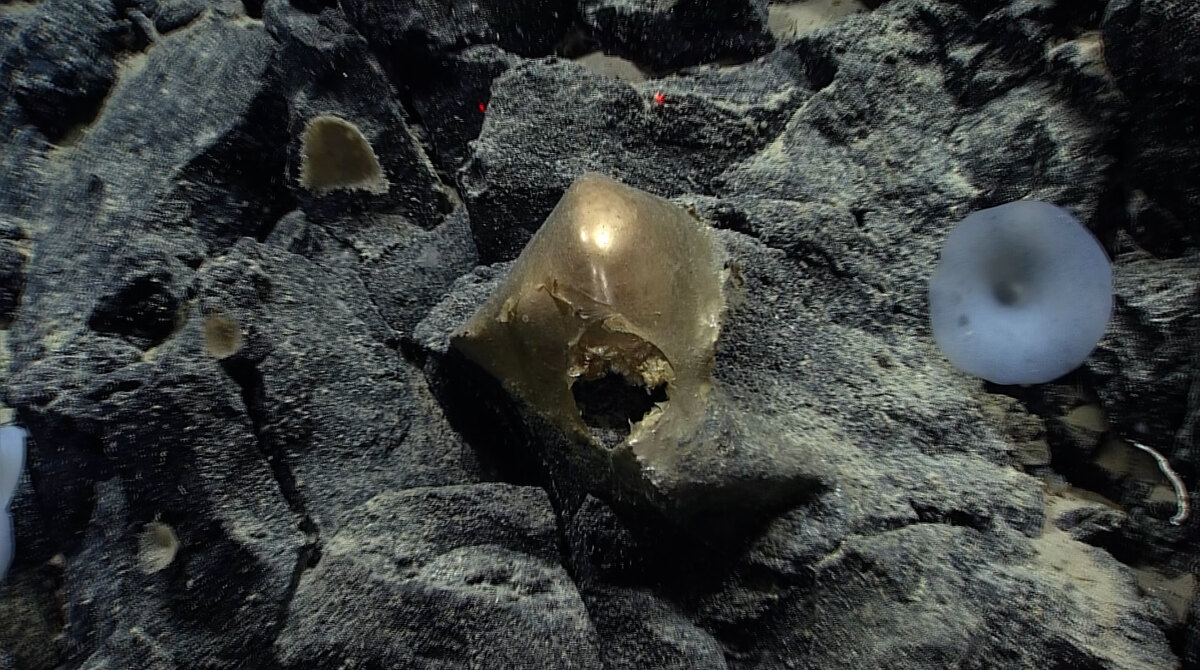
The object was small, round, golden, and sitting on the seafloor more than 3,000 meters below the surface near Alaska. In the video from NOAA Ocean Exploration, it looked almost too clean for the mud around it: a smooth, shiny lump with a small opening in the side.
That was enough to send the internet into guessing mode. Egg casing. Sponge. Coral. Something unknown. The more careful answer was less dramatic and more useful: nobody could say for certain until scientists brought back a sample and studied it in a lab.
The answer was an animal, but not the animal itself
NOAA later reported that the sample was connected to Relicanthus daphneae, a rare giant deep-sea anemone-like animal. The golden orb was not an alien egg and not a new creature curled into a ball. It appears to have been part of the animal's base, a structure that helped it attach to the seafloor.
That answer is better than the wild guesses because it turns the mystery into a clue. If these golden remains can be recognized on future dives, scientists may be able to spot traces of an animal that is rarely seen directly.
Why the weird guesses mattered
The public speculation was not science, but the confusion was honest. Deep-sea biology often does not look like the land-based categories people carry around in their heads. A tissue sample, microscopy, and DNA work can change a thing from unidentified object to part of a known but mysterious species.
That is the quiet lesson of the golden orb: the deep ocean is strange enough without exaggeration. The real answer still involves a rare animal, a hidden landscape, and the fact that humans had to send a robot miles down just to ask a simple question: what is that?
Sources
- NOAA Ocean Exploration: Mysterious Golden Orb Identified
- NOAA: Scientists Reveal Identity of Mysterious Golden Orb
- Smithsonian Ocean: Identity of Mysterious Golden Orb Revealed
Related on Impossible Universe
- A Golf-Ball-Sized Blue Octopus From 6,000 Feet Deep - another deep-sea discovery that took more than a decade to fully identify
- 31 New Deep-Sea Species Found in Two Weeks Off Brazil - glowing jellyfish, gossamer worms, and a glass squid filmed by ROV SuBastian
- A Shark That Walks: New Species Discovered Off Papua New Guinea - a tenth species of walking shark found in shallow coastal waters