
This Shark Walks on Four Fins. Scientists Just Found a New One.
Marine biologists surveying the waters of eastern Papua New Guinea have identified a tenth species of walking shark. Hemiscyllium dudgeonae uses its fins to crawl across the seafloor, and like its cousins, its tiny home range makes it vulnerable to extinction before most people even learn its name.
Christine Dudgeon has spent years studying sharks, and not just the big ones. She works on carpet sharks, a group that includes the epaulette sharks of northern Australia and New Guinea. These are small, reef-dwelling animals that rarely grow longer than a meter. They are nocturnal. They are cryptic. And they walk.
In June 2026, a species in that group was named after her.
Dudgeon's epaulette shark, Hemiscyllium dudgeonae, is the tenth walking shark found in the waters of Papua New Guinea. It was discovered during surveys conducted between 2023 and 2025 in Milne Bay province, on the eastern tip of the island, and formally described in a paper published June 15 in the Journal of the Ocean Science Foundation.
"New shark species don't come along that often, and it's most definitely the first one named after me," Dudgeon said.
What makes a walking shark walk
Walking sharks belong to the genus Hemiscyllium, a group of longtailed carpet sharks that live exclusively in the shallow coastal waters around Australia and New Guinea. They use their four pectoral and pelvic fins to push and wriggle across the seafloor rather than swim, a behavior that lets them navigate tight spaces in coral reefs, seagrass beds, and tidal pools.
They are built for a small world. Most walking sharks have a home range of only a few hundred square meters. They are oviparous: females deposit small oval egg cases directly onto the seafloor, which means the next generation starts life exactly where the last one did. Between their limited mobility and their benthic lifestyle, walking sharks tend to stay put. Over time, this has produced a genus of species that are genetically distinct but geographically close.
The new species is a good example. Genetic analysis showed that H. dudgeonae is most closely related to H. michaeli, a species named in 2010. But the two do not co-occur. The surveys found that distributions in eastern Papua New Guinea overlap, but individual species stay separate.
Freckles, spots, and a telltale mark
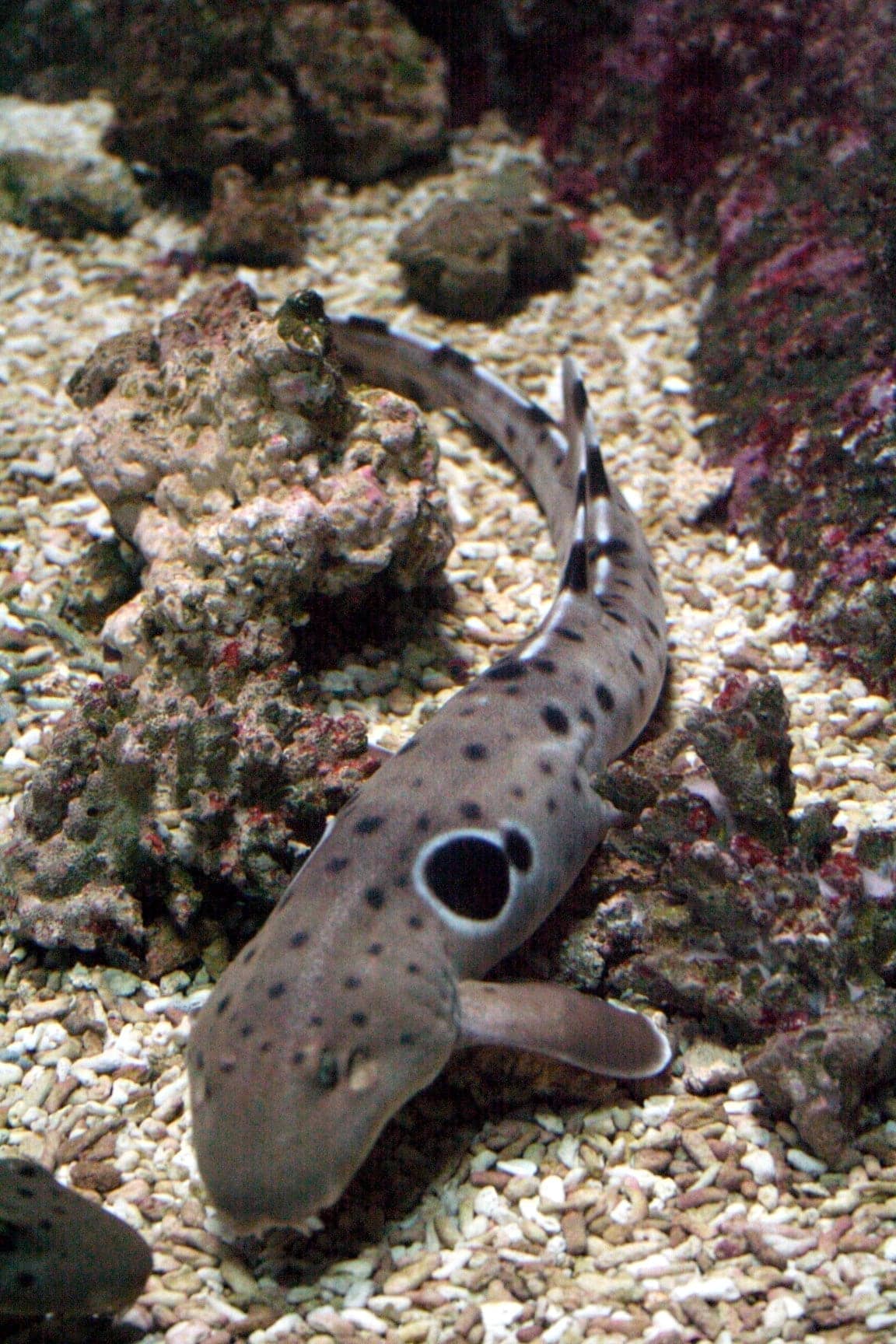
The visual differences between walking shark species are subtle but consistent. H. dudgeonae is distinguished by brown freckles interspersed with white spots and short dashes across its body. Behind its head is a prominent eye-like marking, or ocellus, which is characteristic of the group. The common name "epaulette shark" comes from this marking: it looks like a military epaulette on the shoulder.
The research team, led by University of the Sunshine Coast PhD student Jess Blakeway, also revised the known ranges of two other Papua New Guinean walking sharks during the study: H. michaeli and H. hallstromi. Their surveys upended an earlier assumption that each species was separated by natural barriers like rivers or deep water. Instead, they found that the ranges overlap, though the sharks themselves stay segregated by habitat within those shared zones.
"Previously, it was thought that each species had distinct habitat barriers such as rivers or deep water," Blakeway said. "Now we know that distributions in eastern Papua New Guinea overlap, though species do not co-occur."
A vulnerable new arrival
The discovery carries weight beyond taxonomy. Five of the ten walking shark species in Papua New Guinea are already listed as Threatened with Extinction on the IUCN Red List under criterion B, which applies to species with restricted geographic ranges. That criterion covers only about three percent of all shark species worldwide. Walking sharks are disproportionately at risk because their tiny home ranges make them exceptionally sensitive to local habitat loss.
The researchers are concerned about H. dudgeonae in particular. Its known distribution appears limited, and the team plans to collect more data on an expedition in October 2026 to assess whether it qualifies as Vulnerable or Endangered.
"We hope to collect more data on our next research trip in October to help the IUCN Red List assess the species," Blakeway said.
Walking sharks face threats from coastal development, destructive fishing practices, and the aquarium trade. Their shallow-water habitat puts them in direct contact with human activity. And because individual populations are so isolated, once a local group is gone, there is no source population to recolonize from.
Dudgeon, who has worked on walking shark conservation genetics for years, noted that the naming is a reminder of how much is still unknown. "The species endemic to eastern Papua New Guinea remain poorly known," the paper states. If a new shark species can still turn up in surveys in 2025, the full picture of coral reef biodiversity in the region is far from complete.
A family tree with room to grow
The walking shark genus Hemiscyllium is a peculiar branch of the shark family tree. It sits within the carpet sharks (Orectolobiformes), an order that includes whale sharks and wobbegongs. But unlike their enormous filter-feeding relatives, walking sharks are small, bottom-dwelling animals that have traded speed for maneuverability.
Their distribution is shaped by the geological history of the Australia-New Guinea region, a global hotspot for carpet shark diversity. Rising and falling sea levels during the Pleistocene repeatedly connected and separated the landmasses, fragmenting populations and driving speciation. The result is a cluster of closely related species, each adapted to a narrow slice of coastline.
With the addition of H. dudgeonae, the total number of walking shark species in the genus sits at ten. But the researchers make clear that the count is not final. The waters around Papua New Guinea are still under-surveyed, and the team's paper revises the understanding of where even the known species live. More surveys are planned. More species may be waiting.
Dudgeon's epaulette shark is a quiet kind of discovery. No deep-sea submersible. No multi-institution press conference. Just a team of biologists in small boats, counting spots on sharks in the shallows, finding something nobody had named before.
Sources
- Sci.News: New Species of Walking Shark Discovered off Papua New Guinea (Natali Anderson, June 16, 2026) - primary reporting with researcher quotes
- Blakeway, J.-A. et al. (2026). A review of walking shark (Hemiscylliidae: Hemiscyllium) distributions in Papua New Guinea and description of a new species. Journal of the Ocean Science Foundation 46: 71-110. DOI: 10.5281/zenodo.20575429
- Wikipedia: Epaulette shark (Hemiscyllium ocellatum) - background on walking behavior, hypoxia tolerance, and genus taxonomy
- FishBase: Hemiscyllium genus - species list and distribution data for walking sharks
Related on Impossible Universe
- 31 New Deep-Sea Species Found in Two Weeks Off Brazil - a two-week expedition that turned up glowing jellyfish, gossamer worms, and dozens of species new to science
- The Golden Orb That Wasn't an Alien Egg - a mystery object on the seafloor near Alaska, identified as part of a rare deep-sea anemone
- A Golf-Ball-Sized Blue Octopus From 6,000 Feet Deep - a tiny octopus discovered 6,000 feet down in the Galapagos
The hero image shows Hemiscyllium ocellatum, a closely related species in the same genus as the newly discovered Dudgeon's walking shark (H. dudgeonae). Photo by Strobilomyces, licensed under CC BY-SA 3.0, via Wikimedia Commons. Attribution and license terms have been followed. The research was published in the peer-reviewed Journal of the Ocean Science Foundation.