
Goblin Shark Filmed Alive in the Deep Ocean for the First Time. A 125-Million-Year-Old Mystery Just Got Answers.
For more than a century, every confirmed sighting of a live goblin shark came only after the animal was caught on a fishing line and hauled to the surface, where it soon died. Now scientists have filmed two healthy goblin sharks swimming in their natural deep-ocean habitat, dramatically expanding the known range of a 125-million-year-old species and setting a depth record for the entire mackerel shark group.
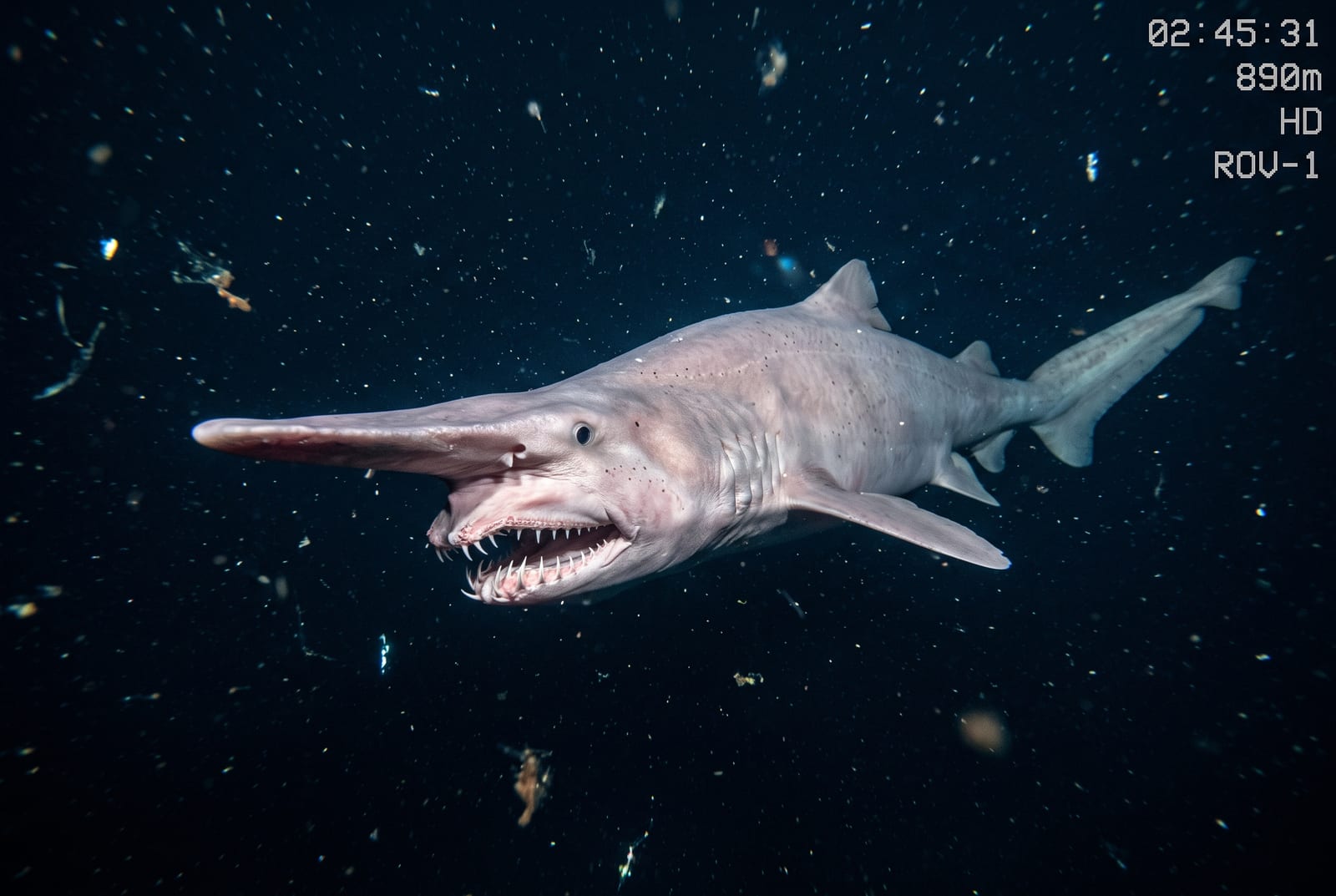
For more than a century, the goblin shark existed mostly as a rumor told through dead specimens. Every confirmed video of a living one came only after the shark had been accidentally hooked on a fishing line and hauled to the surface, where it usually died within hours. Scientists knew the species as a preserved body in a museum jar. They had never seen it alive in its own world.
That changed when a team led by Aaron Judah, a doctoral candidate at the University of Hawai'i at Manoa, published the first confirmed in-situ observations of live goblin sharks (Mitsukurina owstoni) in the Journal of Fish Biology. The study documents two separate sightings: one from a 2019 expedition near Jarvis Island in the Central Pacific, and another from a 2024 expedition in the Tonga Trench. Both show healthy sharks swimming freely in the deep ocean, hundreds of kilometers outside their previously known range.
Two sightings, one mystery resolved
The first observation dates to July 4, 2019. During an Ocean Exploration Trust expedition aboard the E/V Nautilus, the remotely operated vehicle Hercules descended on an unnamed seamount northwest of Jarvis Island. At 1,237 meters depth, the ROV camera captured a large male goblin shark swimming in water measuring 3.9 degrees Celsius. The footage was archived for public access and sat unremarked in the library for years.
In 2025, Judah heard from colleagues at the Deep-Sea Animal Research Center (DARC) at UH Manoa that a potential goblin shark had been recorded during that 2019 expedition. He was skeptical. The species was not known to inhabit the Central Pacific.
"I was shocked to hear this because this species was not known to be in the Central Pacific," Judah said.
He combed through the archived video and confirmed it: a goblin shark, alive, in its natural habitat, more than 4,000 kilometers from its nearest documented location.
The second encounter came during a 2024 expedition to the Tonga Trench aboard the R/V Dagon as part of the Inkfish Open Ocean Expedition, led by scientists from the Minderoo-UWA Deep-Sea Research Center in Australia. A baited camera mounted on a bottom lander captured a goblin shark at 1,997 meters depth. That observation set a depth record for the entire order of Lamniformes, the mackerel sharks, which includes great whites, makos, and basking sharks.
"Seeing the most iconic of all the deep-sea sharks alive and looking healthy in its natural habitat is a unique honor," Judah said. "I was also very surprised about how deep this species was found. The observation from the slope of the Tonga Trench is nearly 700 meters deeper than this species was known to live."
The living fossil's strange anatomy
The goblin shark is sometimes called a living fossil, and the label fits. It is the sole surviving member of the family Mitsukurinidae, a lineage that stretches back nearly 125 million years to the early Cretaceous period. The group survived the asteroid impact that ended the dinosaurs and carried on largely unchanged into the modern deep ocean.
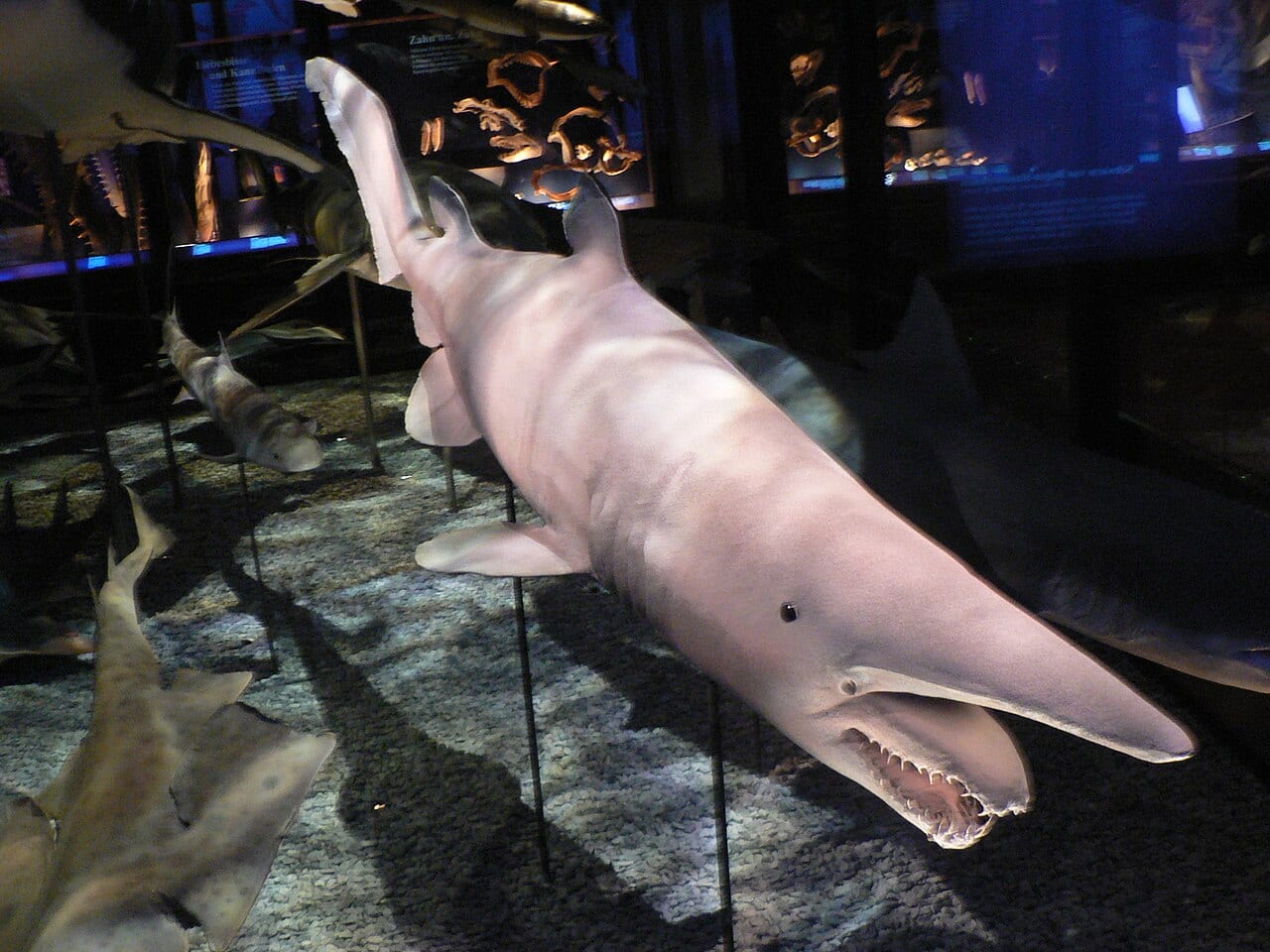
Its most striking feature is its jaw. The goblin shark does not bite like most fish. Instead, it launches its entire mouth forward from the skull on specialized cartilage stalks, creating a sudden suction that pulls prey into its needle-lined mouth. The mechanism is among the fastest jaw protrusions in any fish, and it has earned the species comparisons to a horror movie creature, even though the shark is slow-moving and poses no threat to humans.
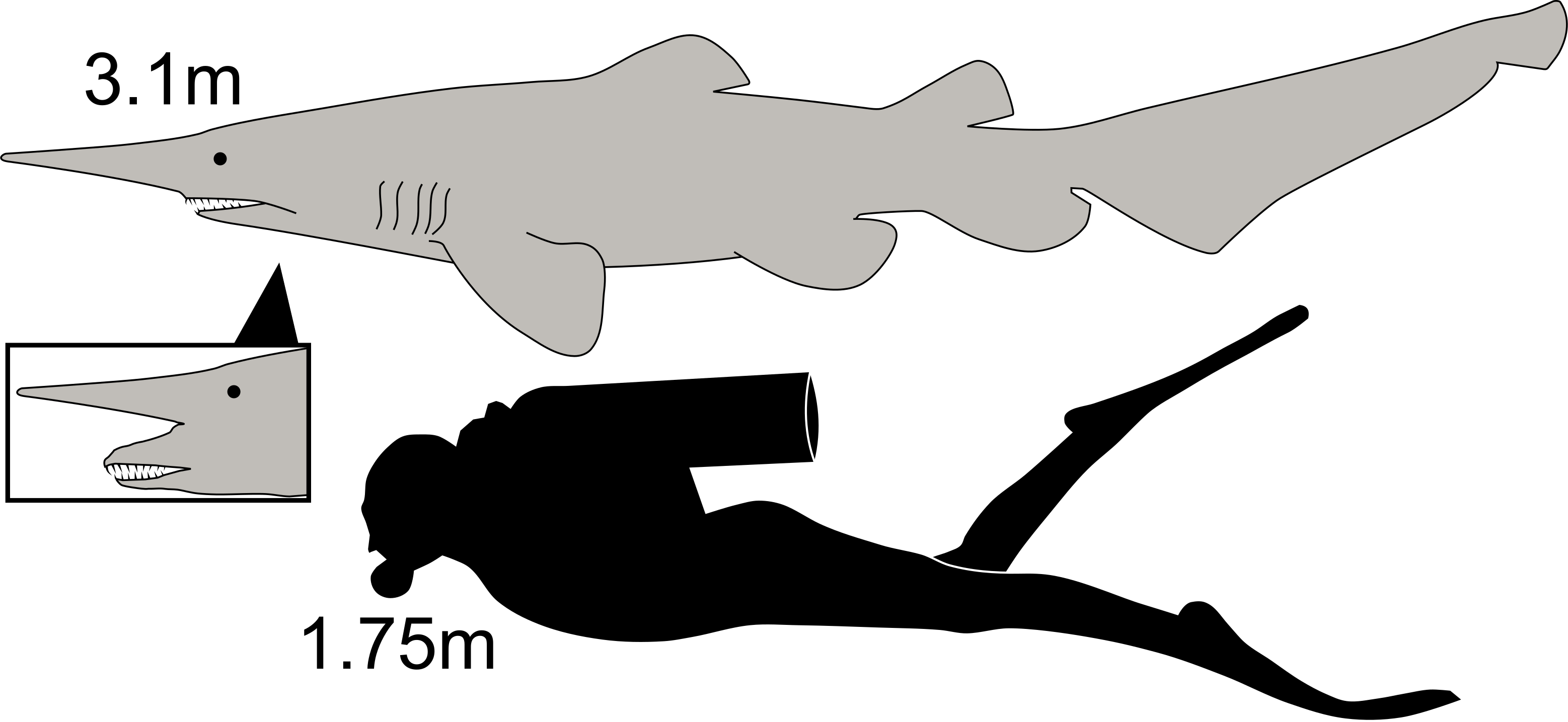
The species grows to roughly 3 to 4 meters in length, with pale pinkish-white skin that gets its color from blood vessels visible through translucent tissue. The long, flattened snout is covered in electroreceptors called ampullae of Lorenzini, which help the shark detect the faint electrical fields of prey in the darkness of the deep ocean.
Why archive footage matters
The Jarvis Island discovery was possible only because the Ocean Exploration Trust archives its ROV video footage as a public resource. Judah's team at DARC had been annotating this archive for other deep-sea species when the goblin shark image surfaced. Without the archived footage, the 2019 sighting would have remained unknown.
"It is really important that we still perform natural history work," Judah emphasized. "New discoveries like this demonstrate that there is still so much to explore in our deep ocean home. Given the newly expanded geographic range of the goblin shark, this species can be included in regional management and a nation's biodiversity list, whereas beforehand we didn't know it was even there."
Professor Alan Jamieson of the Minderoo-UWA Deep-Sea Research Center, who documented the 2024 Tonga Trench sighting, echoed the sentiment. "The Goblin Shark is one of these deep-sea charismatic animals that I never thought we'd see alive," he said. "And then to do so was amazing, but to then learn that colleagues in Hawaii also saw one was just incredible."
What this changes
Before these observations, the goblin shark was known only from narrow bands off the western United States, Australia, and Japan in the Pacific, with scattered records in the Atlantic and Indian Oceans. The Central Pacific is a vast region, and the new sightings suggest the species may be more widespread than previously assumed.
The depth record matters too. The Tonga Trench observation at nearly 2,000 meters confirms that goblin sharks inhabit the lower bathyal zone, a depth range where pressure reaches 200 atmospheres and sunlight never penetrates. Finding a mackerel shark there pushes the known ecological limits of the entire group.
The study also demonstrates that ROV technology and baited camera systems are changing deep-sea biology faster than anyone expected. Species that were previously known only from trawl catches or accidental fishing bycatch are now being observed alive, in place, behaving naturally. For the goblin shark, a species that spent 125 million years mostly invisible to science, the footage is the first chapter of a much longer story.
Sources
- Judah et al., First in situ observations of the goblin shark Mitsukurina owstoni, Journal of Fish Biology (2026) - primary source
- University of Hawai'i at Manoa: Rare, deep-sea goblin shark observed in natural habitat
- Ocean Exploration Trust / Nautilus Live: Goblin Shark Spotted in Surprising Habitat
- ScienceDaily: Rare goblin shark filmed alive for the first time in the deep sea
- phys.org: Rare deep-sea goblin sharks filmed in natural habitat for first time
Related on Impossible Universe
- 31 New Species Discovered in Two Weeks: The Ocean's Largest Habitat Is Even Stranger Than We Thought - a deep-sea expedition off Brazil found 31 new marine species in the midwater zone
- The Golden Orb That Wasn't an Alien Egg - a mystery object on the seafloor near Alaska, identified as part of a rare deep-sea anemone
- A Golf-Ball-Sized Blue Octopus From 6,000 Feet Deep - a tiny new octopus species discovered in the Galapagos
- A Shark That Walks: New Species Discovered Off Papua New Guinea - a tenth species of walking shark found in shallow coastal waters