In Two Weeks Off Brazil, Scientists Identified 31 New Deep-Sea Species
An international team aboard Schmidt Ocean Institute research vessel Falkor (too) spent 14 days exploring the midwater off Brazil and identified 31 previously unknown species, from glowing jellyfish to gossamer worms, using laser imaging and onboard genetic sequencing.
In the spring of 2026, an international team of scientists boarded a research vessel off the coast of Brazil and did something that normally takes decades: they found 31 new marine species in two weeks.
The expedition, led by Dr. Karen Osborn of the Smithsonian National Museum of Natural History and supported by the Schmidt Ocean Institute, targeted the ocean's midwater, the vast layer between the sunlit surface and the seafloor. It is Earth's largest habitable ecosystem, and it may also be the least explored.
"The largest habitat on Earth, the midwater, is filled with incredible animals we are only just starting to understand," Osborn said. "I continue to be fascinated by the fantastic variety of solutions they have evolved to survive in this formidable environment."
Thirty-one species, two weeks, one ship
Working from the research vessel Falkor (too), the team used a combination of advanced imaging systems and onboard genetic sequencing to identify new species in days instead of the usual years-long process. The list reads like a roll call of deep-sea oddities:
- Nine new jellyfish, including species from the genus Solmissus, known as dinner plate jellyfish, which hunt by swimming with their tentacles extended forward.
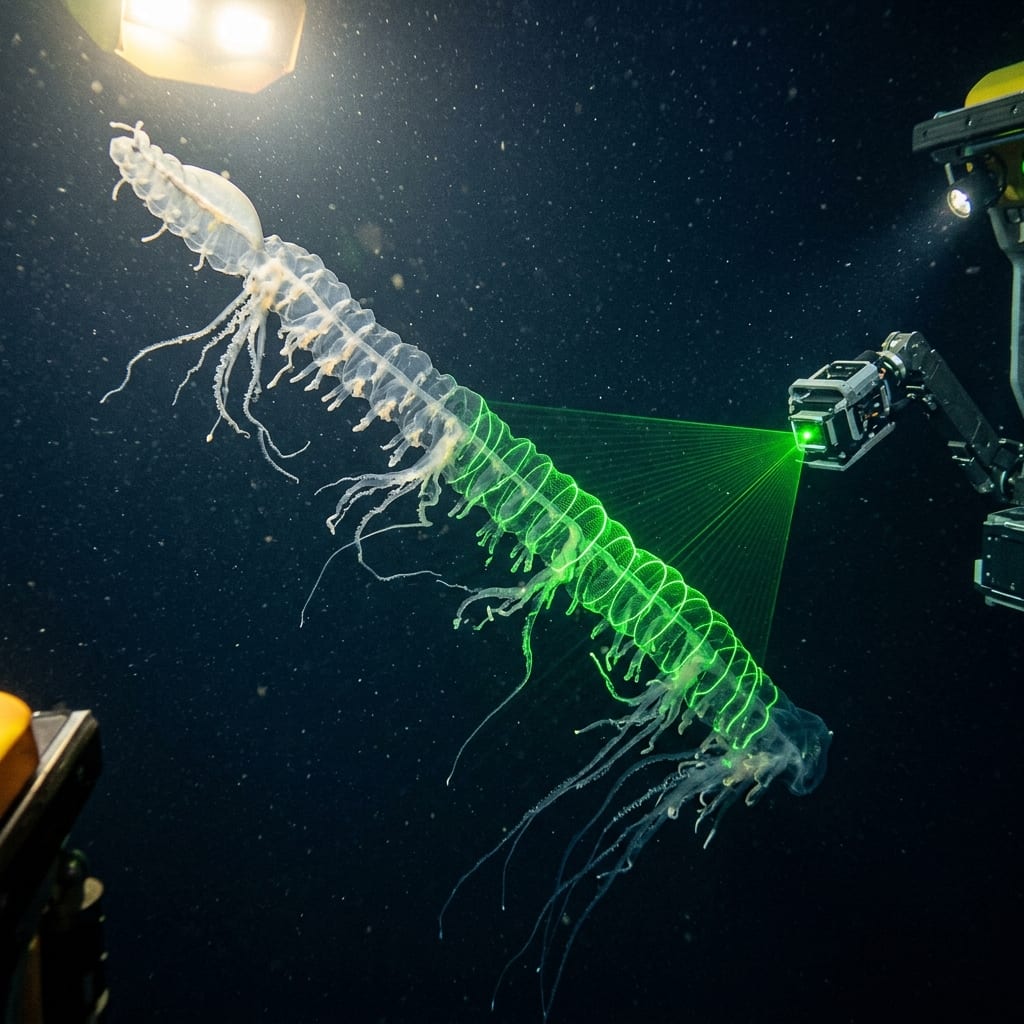
- Seven siphonophores, colonial organisms related to jellyfish and corals that can stretch dozens of meters through the water column.
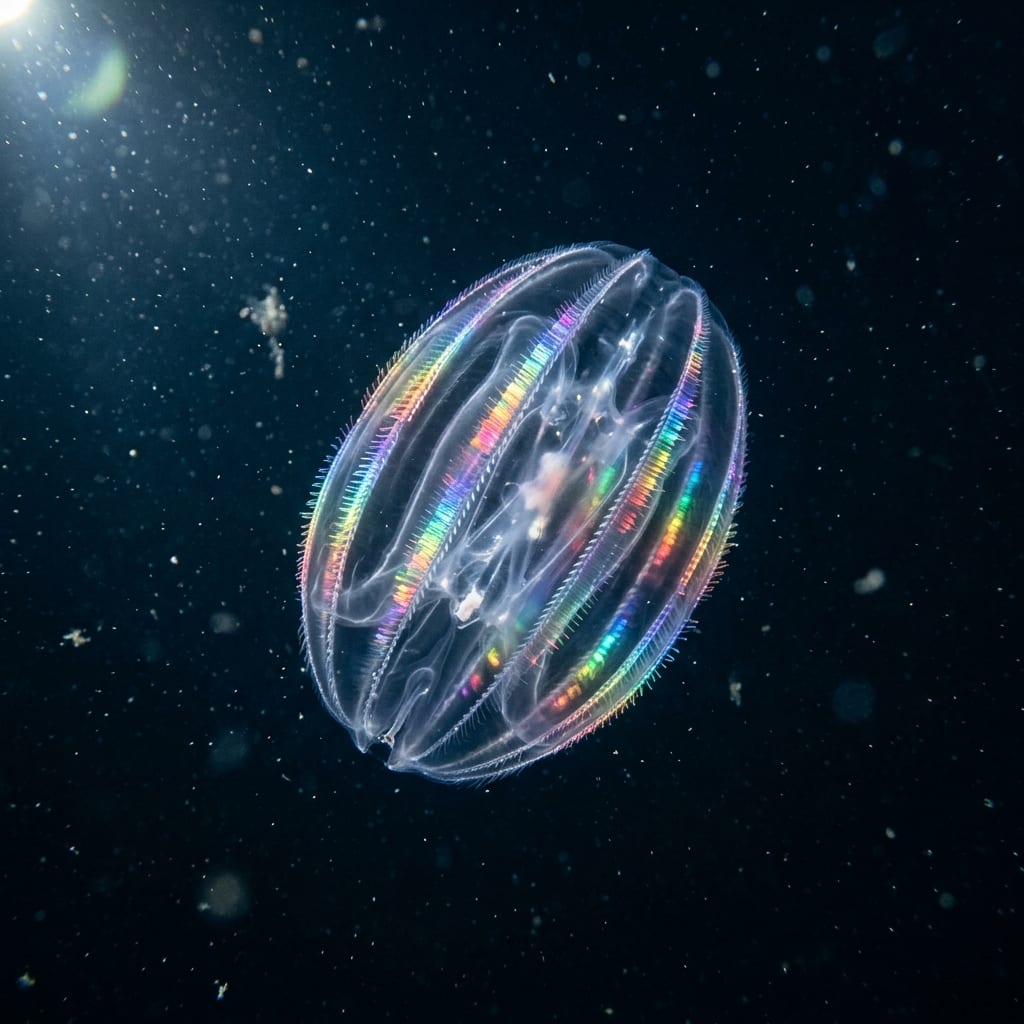
- Seven comb jellies (ctenophores), whose glittering cilia create the most beautiful light shows in the deep ocean.
- Four larvaceans, tadpole-like creatures that build intricate mucus houses around themselves and are more closely related to humans than to most invertebrates.
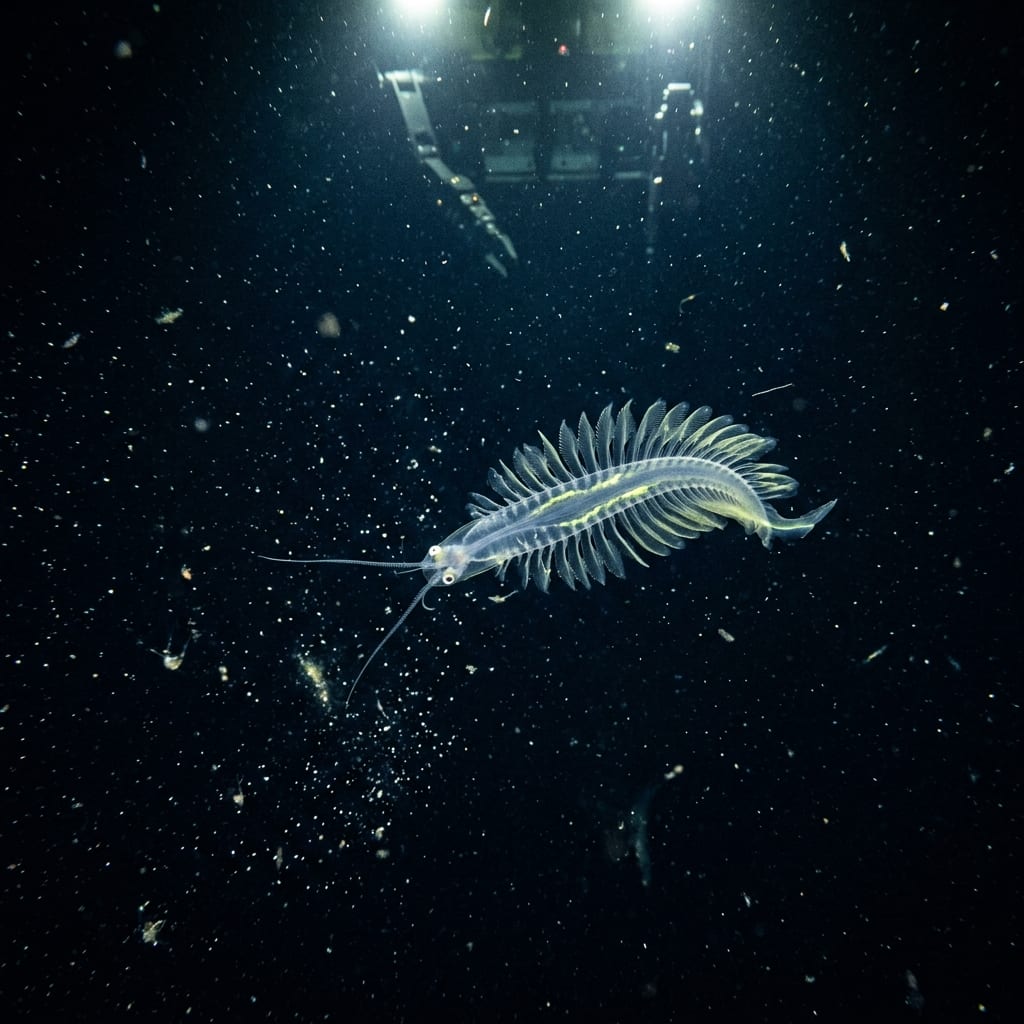
- A gossamer worm from the genus Tomopteris, which moves faster than scientists can explain based on its delicate body shape.
- An amphipod, a crustacean relative of crabs and lobsters that has adapted to a life spent drifting in open water.
- Two giant rhizarians, single-celled organisms large enough to be visible without a microscope.
The team witnessed far more diversity than they expected, including a glass squid at 779 meters depth and a large female octopus (Haliphron atlanticus) consuming a bright red jellyfish at 800 meters. These feeding interactions help scientists understand how midwater communities function and how carbon cycles through the largest habitat on Earth.
Lasers, shadowgraphs, and genomes at sea
The species identification relied on technology that did not exist a decade ago. Instruments developed by the Bioinspiration Lab at MBARI, including DeepPIV (particle image velocimetry) and EyeRIS (a remote imaging system), were attached to Schmidt Ocean Institute's remotely operated vehicle SuBastian. These systems use lasers to scan gelatinous animals and build 3D models of their shapes and internal structures without ever touching them.
A shadowgraph camera from the Japan Agency for Marine-Earth Science and Technology (JAMSTEC) captured finer details invisible in the 3D scans. A team from Stanford University brought an open-source confocal microscope called Squid, which for the first time at sea imaged the living 3D cellular structures of a midwater protist, revealing how its glass skeleton interacted with its internal architecture.
"This opens a new door for researching deep-sea physiology, linking cellular architectures to organism function," said Dr. Manu Prakash of Stanford University. "We can now witness live internal processes within these extreme organisms adapted to withstand immense pressure and darkness."
In tandem with the imagery, Dr. Cheryl Ames of Tohoku University and Dr. John Burns of Bigelow Laboratory sequenced genomes from collected specimens onboard the vessel, providing the genetic evidence needed to confirm each new species.
The midwater: Earth's last frontier
The midwater is Earth's largest habitable environment by volume, yet more people have visited the Moon than the deep ocean. Because of its inaccessibility, it remains the least studied ecosystem on the planet.
"The ocean never let up with surprises in every pocket of water that we explored," said Dr. John Burns of Bigelow Laboratory. "This expedition and the project supporting it is helping us pair expert taxonomists with innovative engineers to forge and implement a new paradigm for the future of ocean exploration."
The expedition was funded by the Sasakawa Peace Foundation's Ocean Shot Research Grant Program, supporting two midwater programs at Bigelow Laboratory and the University of Western Australia. It was the third cruise in a series testing innovative midwater equipment for Schmidt Ocean Institute.
"The novel suite of technologies on this cruise is a glimpse into the future of marine biological science," said Dr. Jyotika Virmani, Schmidt Ocean Institute's Executive Director. "We look forward to a future in which scientists study marine life as elegantly as this team did, and in virtual reality."
Sources
- Schmidt Ocean Institute: 31 New Species Discovered in Two Weeks of Deep Sea Exploration
- Bigelow Laboratory for Ocean Sciences: 31 New Species Discovered in Two Weeks
- Marine Technology News: Schmidt Ocean Institute Research Team Discovers 31 New Species
- Discover Wildlife: Deep-sea expedition finds mysterious creatures in the darkness
Related on Impossible Universe
- A Golf-Ball-Sized Blue Octopus From 6,000 Feet Deep - a tiny new octopus species discovered in the Galapagos
- A Shark That Walks: New Species Discovered Off Papua New Guinea - a tenth species of walking shark found in shallow coastal waters
- The Golden Orb That Wasn't an Alien Egg - a mystery object on the seafloor near Alaska, identified as part of a rare deep-sea anemone