A Golf-Ball-Sized Blue Octopus From 6,000 Feet Down Is New to Science
In 2015, researchers aboard the E/V Nautilus spotted a tiny blue octopus near Darwin Island. Eleven years later, it has a name: Microeledone galapagensis.
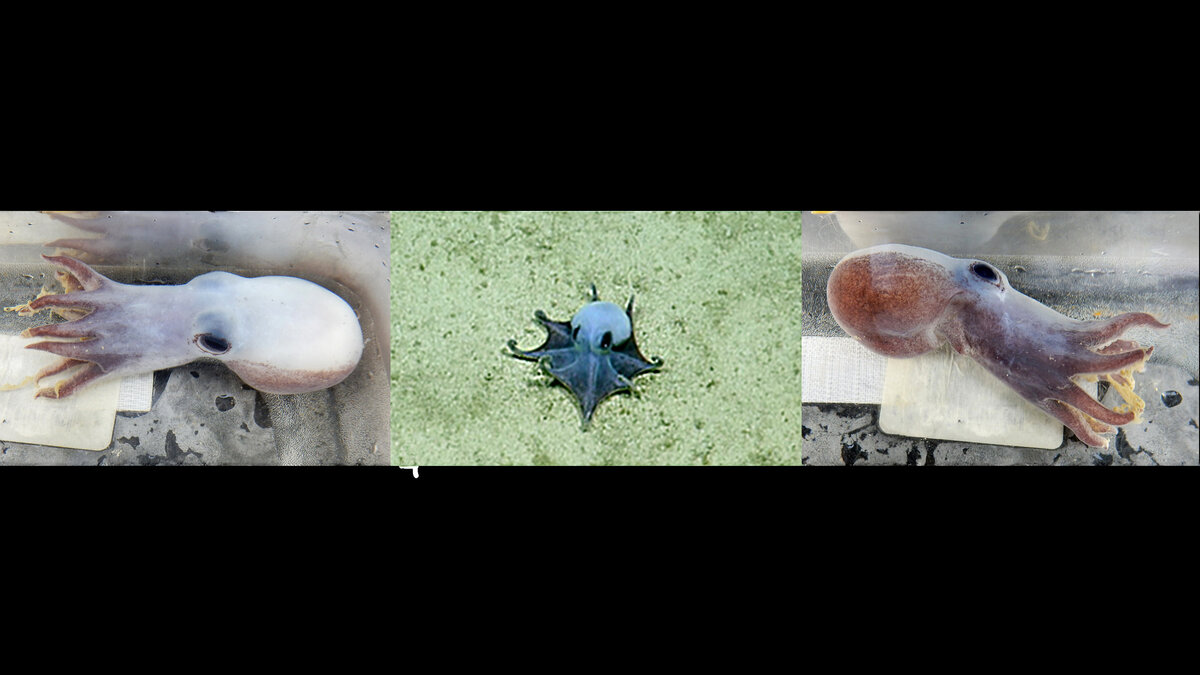
In July 2015, a remotely operated vehicle named Hercules was crawling across the seafloor near Darwin Island, at the northern edge of the Galapagos archipelago. The water was cold, dark, and nearly 1,800 meters deep. As the ROV's camera panned across the sediment, a voice came through the research vessel E/V Nautilus above: "He's tiny!" Then: "It's blue!"
The researchers had just spotted an octopus roughly the size of a golf ball. They collected the specimen, along with dozens of other deep-sea animals from the expedition. Video footage captured two more octopuses that looked like it. Then they waited more than ten years to find out what it was.
From the seafloor to a CT scanner
When the research team brought their specimens back to the Charles Darwin Research Station in the Galapagos, the little blue octopus stood out immediately. Nobody could identify it. The researchers sent a photo to Janet Voight, curator emerita of invertebrates at the Field Museum in Chicago and one of the world's leading octopus taxonomists.
"Right away, I knew it was something really special," Voight said. "I'd never seen anything like it."
The specimen was preserved in alcohol and formalin and shipped from the Galapagos to Chicago. But Voight faced a problem that comes with studying a one-of-a-kind animal: normally, describing a new octopus species requires dissection. You need to examine the mouth, the beak, the teeth, the internal organs. You have to cut the specimen open.
"We only had the one specimen, so I didn't want to take it apart," Voight said.
Instead, she turned to Stephanie Smith, manager of the Field Museum's X-ray computed tomography laboratory. Using micro-CT scanning, the team created a three-dimensional model of the octopus, inside and out, without making a single cut. The scans revealed fine details of internal organs, including the mouth and beak, that provided the anatomical data needed to declare it a new species.
Even without contrast agents normally needed for soft-tissue imaging, the scans were remarkably clear. "There's nothing like spending the day looking at something no other human has ever seen," Smith said.
What makes it different
The formal description, published in May 2026 in the journal Zootaxa, named the species Microeledone galapagensis. It belongs to the family Megaleledonidae, a group of deep-sea octopuses that includes only one other species in its genus, Microeledone mangoldi, which was found thousands of kilometers away in the south Atlantic.
The new species is unusual in several ways. Its mantle measured just 31.5 millimeters across, roughly the diameter of a golf ball. Its arms are short and stubby, averaging 38.5 millimeters long, each carrying about 31 tiny suckers. That is remarkably few arm suckers for an octopus. The specimen carried 13 eggs in its ovaries, suggesting it was a mature female.
It lacks an ink sac, which makes sense for an animal that lives in permanent darkness. It also has no anal flaps, no crop diverticulum, and smooth skin without the raised bumps common in many other octopus species. Its central tooth is unusually large for its size.
The most immediately striking feature, though, is its color. The octopus has a light blue, nearly colorless back and a dark purple inner mantle. This reverse pattern, technically called reverse countershading, serves as camouflage. From below, against the faint glow of surface light, the dark underside blends with the water above. From above, against the dark seafloor, the pale back helps it disappear.
A career first and a deep-sea puzzle
For Voight, who has studied octopus evolution for four decades, M. galapagensis marks a personal milestone. It is the first new octopus species she has officially led a team of scientists in describing.
"These are little octopuses that live in the deep sea, and hardly anybody on Earth has ever gotten to see them," Voight said. "If you took all the land on Earth and pieced it together, you would not cover the Pacific Ocean. The oceans are so big, and there's so much left to explore."
The discovery raises an evolutionary question that the researchers are still working on. Deep-sea octopuses in this group have unusually short arms with few suckers, yet they are thought to hunt by probing sediment with their arms to find prey. Longer arms with more suckers would seem to be an advantage. Why these octopuses have evolved the opposite strategy is not yet understood.
"One of the interesting questions about this and related octopus species is how they survive in the deep sea, which we consider to be resource limited, with such short arms," Voight told Mongabay. "If you gather prey by moving your arms through the sediment, wouldn't it be better to have longer arms with more suckers than short little arms?"
Why the deep sea keeps producing new species
The pace of deep-sea discovery is not slowing down. Jim Barry, a senior scientist at the Monterey Bay Aquarium Research Institute who was not involved in the study, put it plainly: "We just don't know enough about the biodiversity of the deep sea in general, so as discoveries like this keep coming up every dive, you may see something new that's never been seen before."
The 2015 expedition that collected the blue octopus was conducted in collaboration between the Charles Darwin Foundation, the Galapagos National Park Directorate, and the Ocean Exploration Trust, which operates the E/V Nautilus. The Galapagos Marine Reserve covers roughly 133,000 square kilometers. Most of its deep-water ecosystems remain unsurveyed.
"Galapagos Marine Reserve still harbors ecosystems and species that remain unknown to us," said Lorena Sanchez, Director of the Galapagos National Park. "Discoveries like this demonstrate the importance of coordinated efforts between science and conservation to expand our understanding of our oceans."
Salome Buglass, a marine scientist at UCLA and former researcher at the Charles Darwin Foundation who co-authored the paper, described the long path from specimen collection to species description. "There was something unusual about it, so we went out of our way to find the right person to help us identify what it was. Getting the specimen to Janet was a long process, but one I would gladly repeat if it means getting to know the most precious parts of our ocean just a little bit better."
A decade-long paper trail
Eleven years passed between the moment the ROV pilot collected the little blue octopus and the moment its scientific description appeared in print. That timeline is not unusual for deep-sea taxonomy. Specimens must be preserved, transported, studied, compared against museum collections, scanned, analyzed, written up, peer-reviewed, and published. The single-specimen constraint made every step more careful.
The published description, authored by Voight, Smith, Ziegler, Buglass, and colleagues, places M. galapagensis within an amended diagnosis of the Megaleledonidae. The paper also notes that three additional individuals were observed on video during the same expedition, all resting on sandy substrate between 1,770 and 2,006 meters depth. None were collected, so the only physical specimen in any museum collection anywhere on Earth is the one sitting in a jar at the Field Museum.
Given how little of the deep Pacific has been explored and how few people study these animals, Voight expects more discoveries. "We definitely will be discovering new deep-sea octopuses for a long time to come," she said.
Sources
- Field Museum Press Release: This newly-discovered blue octopus from the Galapagos Islands could curl up in the palm of your hand - primary source with quotes from Voight, Smith, Ziegler, Buglass, and Sanchez
- Charles Darwin Foundation: A newly-discovered blue octopus from Galapagos - expedition and collaboration details
- Voight et al., Zootaxa (2026): A new species of Microeledone from Galapagos Islands and an amended diagnosis of the Megaleledonidae - peer-reviewed species description and taxonomy
- National Geographic: The color of this new and unusual blue octopus is what helps it survive - reverse countershading explanation and species context
- Mongabay: New golf-ball sized blue octopus species now identified in the Galapagos - additional quotes from Voight and Jim Barry (MBARI)
Related on Impossible Universe
- 31 New Deep-Sea Species Found in Two Weeks Off Brazil - glowing jellyfish, gossamer worms, and a rare squid filmed by ROV SuBastian
- The Golden Orb That Wasn't an Alien Egg - a shiny object on the seafloor near Alaska that took DNA analysis to identify
The hero image is courtesy of the Charles Darwin Foundation and shows Microeledone galapagensis on the seafloor near Darwin Island, Galapagos, at approximately 1,773 meters depth. The research was published in the peer-reviewed journal Zootaxa. Specimen collected during the 2015 E/V Nautilus expedition in collaboration with the Galapagos National Park Directorate.