
The Underground Fungal Superhighway: Mapped for the First Time
Beneath every ecosystem on Earth is a hidden circulatory system: complex networks of underground fungi that move carbon, nutrients, and water across the planet. Scientists just produced the first global map of this vast living infrastructure, and the numbers are staggering.
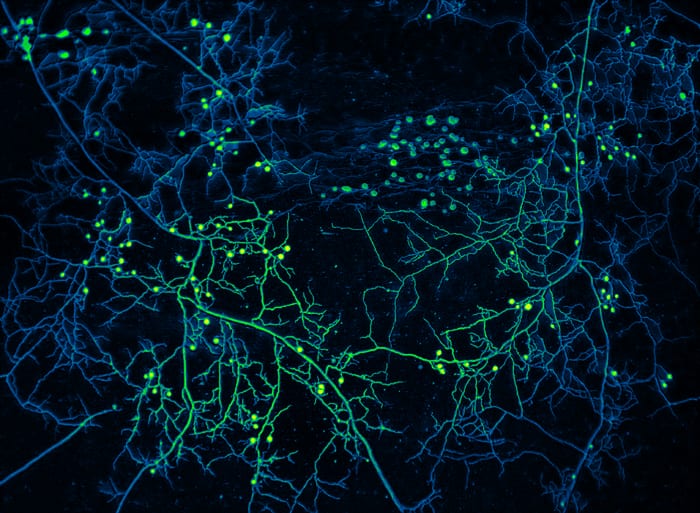
Beneath every patch of soil on Earth, something is moving. Not worms or water, though those are there too. A network of thread-like fungal cells, thinner than a human hair and so dense that a single teaspoon of healthy soil can hold up to 10 meters of them, stretches across every continent. Scientists just mapped it for the first time.
The study, published June 12, 2026 in Science, estimates that the global network of arbuscular mycorrhizal (AM) fungi in the top 15 centimeters of soil reaches roughly 110 quadrillion kilometers in total length. That is nearly a billion times the distance from Earth to the Sun. The total mass of these fungi is around 300 megatons of carbon, equivalent to four to six times the weight of every living human.
"It is hard to overstate the importance and enormity of these fungi," said lead author Dr. Justin Stewart, a mycologist with the Society for the Protection of Underground Networks (SPUN).
The research was conducted by an international team including scientists at SPUN, the University of Sheffield, Vrije Universiteit Amsterdam, and the AMOLF research institute in the Netherlands.
A living circulatory system
AM fungi form symbiotic relationships with roughly 70 percent of all plant species on Earth. The fungi thread their hyphae into plant roots, where they exchange nutrients and water for carbon produced through photosynthesis. In healthy soils, the fungal network can expand the effective foraging area of a plant's roots by up to 100 times and provide more than 80 percent of the plant's phosphorus needs.
Scientists often describe mycorrhizal networks as one of Earth's circulatory systems. They move carbon, nutrients, and water across underground ecosystems on a planetary scale. The new study found that AM fungal networks transport an estimated 4 billion tons of carbon dioxide equivalent into soils every year, roughly 11 percent of all human-related carbon dioxide emissions.
To build the global map, researchers compiled data from more than 16,000 soil cores collected at over 4,000 locations worldwide, spanning deserts, tundra, forests, and grasslands. They then used machine learning models, incorporating climate data, soil chemistry, and vegetation types, to predict fungal network density in regions where direct measurements were not available.
At the AMOLF institute, the team used robotic imaging to analyze more than 300,000 living AM fungal hyphae grown under laboratory conditions. That calibration data helped convert field measurements of hyphal length and thickness into reliable estimates of total biomass across different soil types.
Where the fungi are thickest
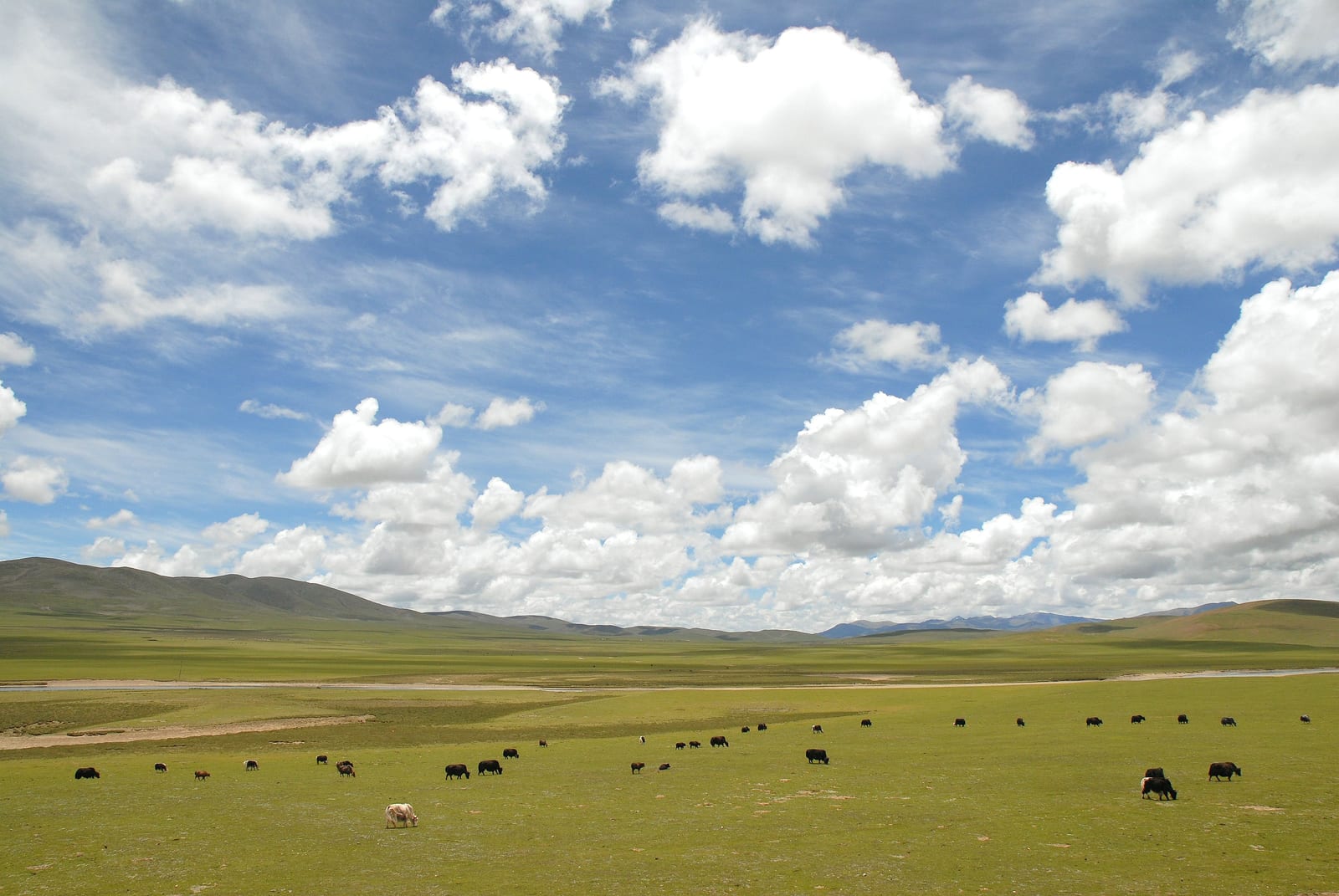
The highest densities of AM fungi are not where most people would guess. Tropical rainforests, the most productive ecosystems above ground, are not the leaders below it. The densest networks are in grasslands.
Grasslands contain roughly 40 percent of the world's AM fungal infrastructure. Regions with exceptionally high predicted densities include the flooded grasslands of South Sudan's Sudd Wetlands, Florida's Everglades, the Tibetan Plateau, and the Flint Hills Prairie of Kansas.
The finding matters because grasslands are among the least protected ecosystems on Earth. They are being converted to agricultural land at roughly four times the rate of forests. And when land shifts from wild grassland to cropland, something changes underground.
The cost of farming
The study's models predict that large-scale agricultural croplands have roughly 50 percent lower AM fungal network densities than wild ecosystems. Practices like tilling physically tear apart the hyphal networks. Fertilizers and fungicides can disrupt the symbiosis between plants and fungi.
These lower densities have consequences. Fungal networks help store carbon in soil, cycle nutrients, and filter chemicals from waterways. When they are damaged, the soil loses resilience. "If they disappear, there is going to be a lot more chemicals going into waterways," said Dr. Toby Kiers, an evolutionary biologist at SPUN and an author of the study. Kiers was recently named a MacArthur Fellow and received the Tyler Prize for her work on plant-fungal relationships.
The data behind the maps are publicly available, giving governments and conservation agencies new tools for monitoring the health of underground fungal communities. The research will be presented at the upcoming UNCCD COP17 on desertification in Mongolia in August 2026.
A 475-million-year partnership
AM fungi are not a recent innovation. They have been forming partnerships with plants for roughly 475 million years, since the first plants colonized land. Their evolution is intertwined with the evolution of terrestrial ecosystems themselves.
"Mycorrhizal fungi have shaped life on earth for hundreds of millions of years, but we still understand too little about how the infrastructure of these living transport systems is distributed across the planet," said co-author Dr. Merlin Sheldrake, a biologist and author. "This study is an exciting step towards understanding how this planetary circulatory system operates."
A separate team of researchers, including several of the same authors, published a cover story in Nature in 2025 describing how mycorrhizal fungal networks and their plant partners build hyper-efficient supply chains for exchanging carbon and nutrients. Carbon flows inside these living transport systems can reach speeds of 120 micrometers per second. Scaled to human proportions, that would feel like traveling at roughly 400 kilometers per hour.
The invisible infrastructure
The study was accompanied by an interactive visualization called the Mycorrhizal Infrastructure Map, created by award-winning data visualization designer Moritz Stefaner. It is the first time Earth's fungal infrastructure has been seen at this scale and resolution. The visualization, published by SPUN, allows users to explore the predicted density of fungal networks across every square kilometer of vegetated land.
The work also builds on previous SPUN research showing that 95 percent of biodiversity hotspots for arbuscular mycorrhizal fungi lie outside protected areas. The new mapping gives researchers a baseline for what a healthy underground fungal community should look like, and where those communities are most at risk.
"There is a big movement now to not only restore communities above ground, the things that you can see, the plants and animals, but also to restore underground fungal communities," Kiers said. "And this dataset allows us to have benchmarks for what a healthy microbial community can look like."
Sources
- Stewart, J. et al. "Global mapping of arbuscular mycorrhizal fungal network density." Science, June 12, 2026. DOI: 10.1126/science.adu4373
- SPUN. "A Hidden Infrastructure: Mycorrhizal Infrastructure Map." Interactive visualization.
- The Guardian. "Subterranean fungi networks more than 100 quadrillion km in length, study finds." June 11, 2026.
- ScienceDaily. "Fungal superhighway stretching 68 quadrillion miles." June 14, 2026.
- University of Sheffield. "First global map reveals underground fungi networks." June 12, 2026.
- Popular Science. "621 trillion miles of fungi networks crisscross the planet." June 12, 2026.
- Steidinger, B.S. et al. "Global mycorrhizal fungal diversity." Nature, 2025.
- Kokkoris, V. et al. "Carbon flow dynamics in mycorrhizal networks." Nature, 2025.
Related on Impossible Universe
- Why Some Tree Frogs Near Chornobyl Turned Black - how a nuclear disaster created an unexpected evolutionary experiment in pigmentation, linked through underground fungal networks
- Pando, the Trembling Giant Aspen Clone, Is Falling Apart. Scientists Are Trying to Save It. - a 47,000-stem aspen clone connected by a single root system, a different kind of underground network