A Dying Star Could Create a Tiny New Universe Instead of a Black Hole
Theoretical physicists solved Einstein's equations and found that when a massive star collapses, the result may not be a black hole. Instead, a tiny expanding universe could be born inside, powered by dark energy.
Every star in the universe lives by a single bargain. Gravity pulls inward. The energy released by nuclear fusion pushes outward. When a massive star runs out of fuel, that bargain collapses. Gravity wins, and the star caves in on itself.
Standard theory says this collapse ends in a black hole: all that mass crushed into an infinitely small point called a singularity, wrapped in an event horizon where even light cannot escape. But singularities bother physicists. They are places where the known laws of physics break down, where mathematics produces infinities instead of answers.
Now two theoretical physicists at Goethe University Frankfurt have published a solution to Einstein's equations that describes a radically different outcome. When a massive star collapses, they propose, a tiny new universe could be born inside it, expanding outward and pushing back against gravity just as dark energy pushes our own universe apart. Instead of a black hole, the star becomes a gravastar, an ultra-compact object that looks like a black hole from the outside but contains no singularity and no event horizon.
The 25-year question
The gravastar idea is not new. Theorists have speculated about such objects for about 25 years as a way around the uncomfortable mathematics of singularities. The name is short for gravitational vacuum star. In place of a singularity, a gravastar would be filled with dark energy, the mysterious force that is accelerating the expansion of our own universe. That dark energy would exert outward pressure, stabilizing the star's mass against further collapse.
The problem was that nobody could explain how a gravastar would actually form. You could describe one, but you could not show how a star got there.
Daniel Jampolski, then a master's student working under Professor Luciano Rezzolla, set out to solve that problem. He wanted to find a dynamic solution to the field equations of Einstein's General Relativity, one that described the full collapse process rather than just the finished object. When he found it, the solution described something unexpected: the collapse triggers a Big Bang inside the star.
"The Big Bang of the emerging universe can unfold once the star has already collapsed almost to the point of becoming a black hole," Jampolski said. "It is easier to imagine that the Big Bang occurs only at a very late stage, when matter has already been compressed to an extreme degree, thereby giving rise to new effects."
A mini universe inside a dying star
The mathematics works like this. As the star's core collapses under its own weight, matter becomes compressed far beyond anything that exists in normal stars. At these extreme densities, the equations allow a new solution: a patch of spacetime that begins expanding from within, driven by dark energy in the same way the Big Bang drove the expansion of our own universe.
This expanding mini universe pushes outward against the collapsing stellar matter. The two forces, inward gravity and outward dark energy, eventually balance each other. The result is a stable gravastar: an object roughly as massive and compact as a black hole, but with ordinary matter in its outer layers and a dark energy core where the singularity would have been.
Unlike a black hole, a gravastar has no event horizon. Matter and energy that fall toward it can, in principle, reach its surface. But the extreme gravity would still make direct observation nearly impossible from Earth, which is why gravastars could have been mistaken for black holes in every observation so far.
Rezzolla, a professor of theoretical astrophysics at Goethe University, emphasized that the work is not a rejection of black holes. "Looking for alternatives to black holes should not suggest a skepticism towards black holes, which still represent the most natural and simplest solution to the fate of gravitational collapse," he said. "However, as scientists in general, and as theoretical physicists in particular, it is essential to maintain an unbiased approach towards what we do not know and hence explore both the accepted wisdom and the more exotic interpretations. History teaches us that it is not unusual for the latter to become the former."
What a gravastar would look like
From the outside, a gravastar and a black hole would be nearly impossible to tell apart. Both bend spacetime so severely that light follows curved paths around them. Both can have the same mass, spin, and gravitational pull. The difference is entirely internal: one has a singularity sealed behind an event horizon, the other has a dark energy core that prevents the singularity from forming in the first place.
But there may be subtle clues. Gravastars could produce slightly different gravitational wave signatures when they merge. Their surfaces, if they exist, might emit faint radiation that a sensitive enough telescope could detect. And the dark energy inside a gravastar would be the same force driving the accelerated expansion of the universe at large, making each gravastar a tiny laboratory for studying one of cosmology's biggest mysteries.
The paper, published in Physical Review D on June 11, 2026, presents the first dynamic solution showing how gravastars can form from ordinary matter. Jampolski discovered the solution during his master's thesis work, which means the next generation of physicists is already pushing into territory where the old certainties dissolve.
Whether any real star has ever become a gravastar is a question that cannot be answered yet. There is no way to look inside a black hole candidate and check. But the mathematics now allows it, which is more than physics had a month ago. When a star dies, it may not end in a point of infinite density. It may give birth to a universe.
Sources
- Jampolski & Rezzolla, "Formation of gravastars," Physical Review D 113, L121502 (June 11, 2026) - peer-reviewed paper presenting the first dynamic solution to Einstein's equations describing gravastar formation
- Goethe University Frankfurt Press Release: "Big Bang inside a Star: How a Gravastar Forms" - primary institutional press release with researcher quotes
- SciTechDaily: "Scientists Say a New Universe Could Form Inside a Dying Star" - science journalism coverage
- ScienceDaily: "A dying star could create a new universe instead of a black hole"
- Innovation News Network: "Gravastar theory offers alternative to black holes"
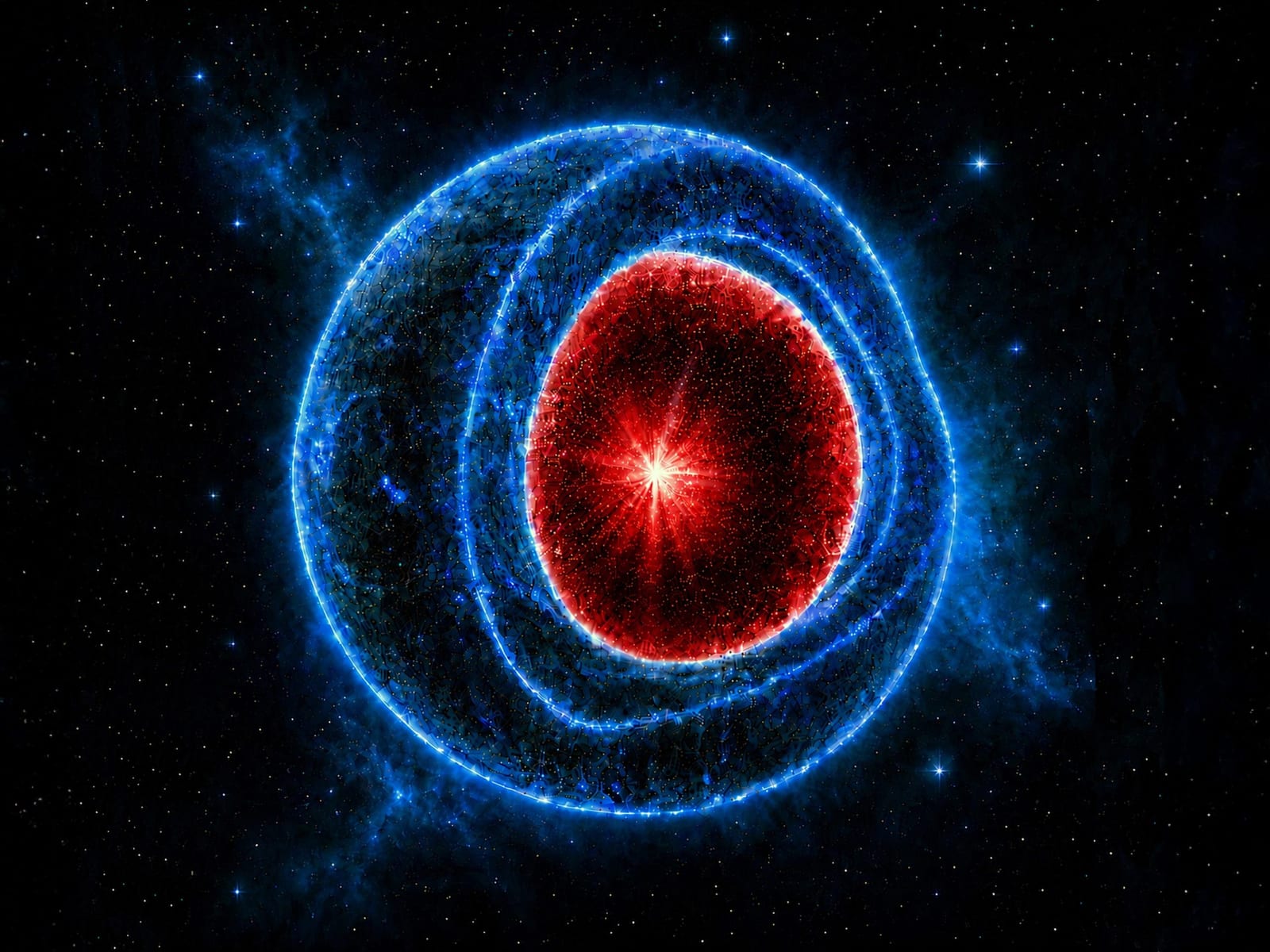
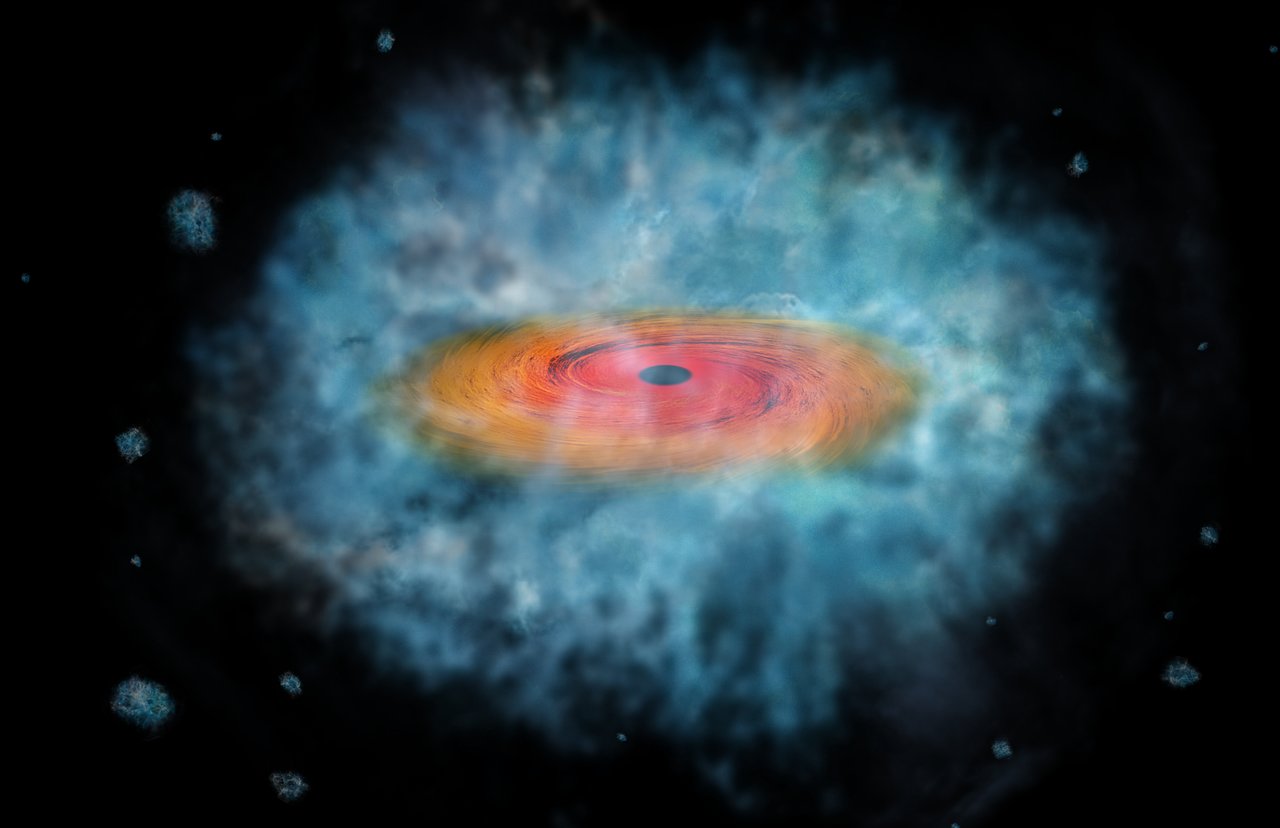
Hero image is an artist concept by Daniel Jampolski and Luciano Rezzolla, Goethe University Frankfurt, released with the press release. Black hole artist concept is credited to NASA/CXC/M. Weiss. The paper was published in the peer-reviewed journal Physical Review D.
Related on Impossible Universe
- The First Time Crystal You Can See With Your Own Eyes - physicists made a new phase of matter using liquid crystals and light, visible under a microscope and even to the naked eye
- This Tiny Chip Processes Information With Light Instead of Electricity - a nanoscale circuit built at Monash University uses light instead of electrons to process data at room temperature
- The Sun Might Not Swallow Earth After All - another story about what happens when stars reach the end, from the opposite direction