Euclid Found 31 Ancient Quasars From the Universe’s Infancy. Two Are the Most Distant Ever Seen.
The European Space Agency’s Euclid space telescope discovered 31 quasars from the universe’s first 800 million years, more than doubling the known population at those distances. Two of them are the most distant quasars ever observed, existing when the cosmos was just 670 million years old, barely 5 percent of its current age.
In July 2023, the European Space Agency launched Euclid, a 1 billion euro space telescope with one main job: map the dark universe. It was built to survey billions of galaxies, measure the shapes of their distortions, and tease apart the effects of dark matter and dark energy on the largest scales of the cosmos.
Quasar hunting was never part of the mission plan.
But Euclid's ability to scan huge areas of sky in both visible and near-infrared light, with sharp enough resolution to pick out faint objects, turned out to be exactly what astronomers needed. The result, published in Astronomy & Astrophysics on July 6, 2026, is the largest haul of ancient quasars ever found in a single survey: 31 new quasars from the universe's first 800 million years. Two of them are the most distant quasars ever observed.
What a quasar actually is
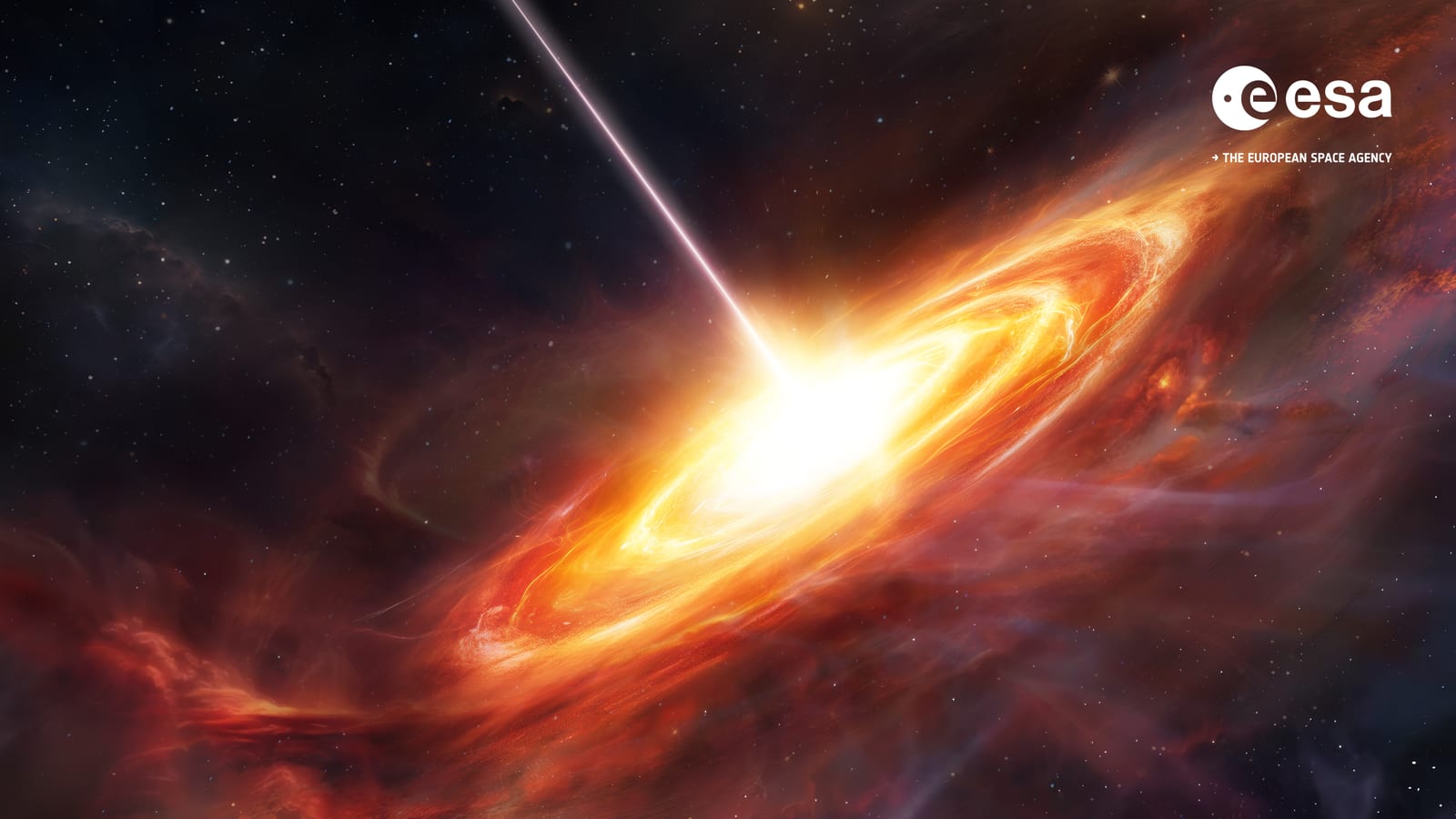
A quasar is not a kind of object. It is a brief phase in a galaxy's life. During this phase, enormous amounts of gas and dust spiral into the supermassive black hole at the galaxy's center, heating up to extreme temperatures and releasing more energy than all the stars in the galaxy combined. The result is a galactic nucleus so bright that it can be seen across the entire observable universe.
The brightest quasars outshine their host galaxies by a factor of hundreds or thousands. They are the most luminous persistent objects in the cosmos.
For astronomers, quasars are useful for two very different reasons. First, they act as backlights: their light travels through intervening gas clouds, and the absorption patterns in their spectra reveal what the intergalactic medium was made of at different points in cosmic history. Second, they mark the locations of supermassive black holes in the early universe, objects that theory has a hard time explaining. How did black holes containing the mass of billions of Suns form in only a few hundred million years after the Big Bang?
Finding needles in a cosmic haystack
Before Euclid, astronomers knew of exactly nine quasars at a redshift above 7, meaning their light had been traveling for more than 12.9 billion years. Each was discovered individually, often requiring years of searching.
The difficulty is twofold. Quasars from this era are rare: only a tiny fraction of galaxies had grown big enough to host a supermassive black hole in the first few hundred million years after the Big Bang. And their light, stretched by cosmic expansion into the near-infrared, falls into a wavelength range where Earth's atmosphere glows brightly, drowning out faint signals from the ground.
Euclid solves both problems. From space, it avoids the atmospheric glow entirely. Its near-infrared instrument reaches magnitudes as faint as 24.5, deep enough to detect quasars 10 to 100 times fainter than what previous wide-field surveys could see. And Euclid's field of view is enormous for a space telescope: it can cover more than 100 times the area of a typical Hubble or JWST image in a single pointing.
The Euclid Consortium team used machine learning to scan Euclid's optical and near-infrared images for the telltale dropout signature of high-redshift quasars: objects that appear bright in the infrared but invisible in the optical bands, because the light at those shorter wavelengths has been stretched beyond the visible range by cosmic expansion. Candidate objects were then confirmed with ground-based spectroscopy from the Keck Observatory in Hawaii, the Magellan Telescopes in Chile, and the Large Binocular Telescope in Arizona.
The two that broke the record
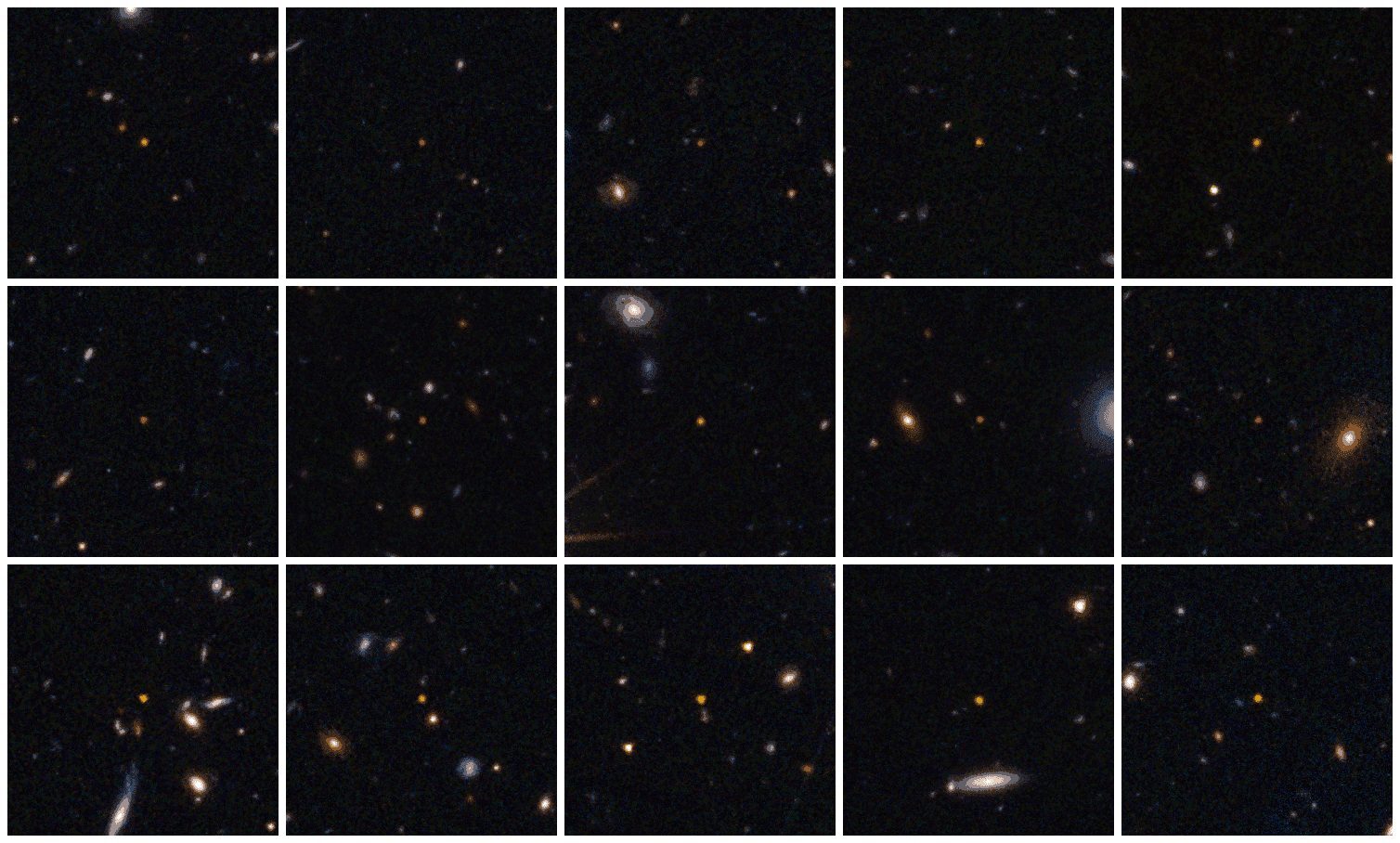
The new haul includes every quasar from this epoch that Euclid could detect across its survey area, not just the brightest ones. Until now, the known ancient quasars were the rare and luminous outliers, the ones easiest to spot. Euclid's census captures fainter, more typical examples, giving astronomers a representative sample for the first time.
The two standouts are designated EUCL J172902.75+641018.1 at redshift 7.77 and EUCL J125308.55+705432.3 at redshift 7.69. Both existed when the universe was roughly 670 million years old, just 5 percent of its current age. The previous record-holder, discovered in 2021, sits at redshift 7.64, making the new objects about 15 million years older.
"These early quasars date back to the universe's infancy," said Daming Yang of Leiden University, lead author of the discovery paper. "By finding and studying them, we can better understand how these enormous systems formed and grew so quickly, one of the greatest mysteries in astrophysics."
Follow-up observations of the second-most-distant quasar, led by Silvia Belladitta of the Max Planck Institute for Astronomy, showed something striking: the quasar is embedded in a dusty, gas-rich galaxy that is forming new stars at a furious rate. The finding offers a rare direct look at what the host galaxy of an early supermassive black hole looks like.
"With only a few quasars known beyond redshift 7, we simply cannot answer these questions," Yang said. "Finding more of them at such distances, and pushing to even greater distances, is the only way forward."
Why this matters for the early universe
These quasars shine from deep inside a pivotal period known as the epoch of reionization. When the universe emerged from the Big Bang, it was filled with neutral hydrogen gas. Over time, the first stars and galaxies emitted enough ultraviolet light to strip electrons from this gas, turning it from neutral to ionized. It was the last major transition in the universe's history, and quasars are some of the few objects bright enough to serve as beacons back into that era.
"These luminous quasars, shining from deep within the reionization era, offer invaluable insights into how the cosmos emerged from darkness and how the earliest supermassive black holes formed," said Jinyi Yang of the University of Michigan, a co-author of the study.
The discovery also sharpens an open question in astrophysics: how did supermassive black holes grow so large so fast? The existence of a black hole billions of times the mass of the Sun when the universe was only 670 million years old pushes the limits of formation models. Some theories invoke direct collapse of massive gas clouds, others propose very efficient accretion, but none fully explains the full range of quasars now seen at these distances.
What comes next
The 31 quasars reported in this paper were found in the first year and a half of Euclid's survey data. The full six-year survey will cover more than one third of the entire sky and is expected to uncover hundreds more high-redshift quasars, including the first ones at a redshift above 8, pushing even closer to the Big Bang.
"Euclid is a true game-changer," Daming Yang said. "Before, we could only find a handful of the very brightest ancient quasars, but Euclid lets us search far more efficiently across huge areas of sky to capture much fainter light. It's a unique tool for quasar hunting."
The next Euclid data release, scheduled for late 2026, will be the largest map of the universe ever produced from space in both infrared and visible light. Along with the expected haul of new quasars, it will also drive breakthroughs in the understanding of dark matter and dark energy, the mission's original purpose.
Xiaohui Fan, Regents Professor of Astronomy at the University of Arizona and a co-author of the study, put it simply: "We are reaching the limit of what ground-based observations can give us. We have to go really deep and cover a lot of sky, because these things are rare. Euclid allows us to find them."
Sources:
Yang et al., Astronomy & Astrophysics, July 6, 2026: "Euclid: Discovery of 31 new quasars at 6.6 < z < 7.8" (DOI: 10.1051/0004-6361/202658883)
ESA: Euclid discovers the most ancient quasar in the Universe (July 6, 2026)
University of Arizona: Two most distant quasars ever observed (July 6, 2026)
NASA Science: Euclid finds universe's most ancient quasars (July 6, 2026)
Phys.org coverage (July 2026)
Image credits: Hero: ESA artist concept, CC BY-SA 3.0 IGO. Inline: ESA/Euclid Consortium/NASA, CC BY-SA 3.0 IGO.