A Near-Invisible Black Hole 6 Billion Times the Sun Mass Was Hiding 10 Billion Light-Years Away. JWST Found It by Watching Stars Orbit Nothing.
Using the James Webb Space Telescope and a natural gravitational lens that magnified the view 30 times, astronomers measured the mass of a dormant supermassive black hole in galaxy MRG-M0138 for the first time at cosmological distances. The black hole clocks in at roughly 6 billion solar masses and is observed as it was when the universe was only 3 billion years old. The previous distance record for this technique was 700 million light-years. This one is 10 billion.
There is a black hole 6 billion times the mass of the Sun sitting in the heart of a galaxy 10 billion light-years away. It is not eating anything. It is not glowing in any wavelength of light. And it is the most distant object of its kind ever measured.
The black hole lives in MRG-M0138, a massive galaxy seen as it was when the universe was roughly 3 billion years old, about a quarter of its current age. Astronomers using the James Webb Space Telescope and a natural gravitational lens that magnified the view 30 times tracked the motion of stars racing around an invisible center. The result, published June 4 in the journal Science, is the first stellar-dynamical mass measurement of a dormant supermassive black hole at cosmological distance. The previous record for this technique was 700 million light-years. This one is 10 billion.
The problem with quiet black holes
Supermassive black holes are easiest to find when they are active. When gas falls toward them, it heats up to millions of degrees and outshines entire galaxies. These are the quasars and active galactic nuclei that populate surveys across the universe. But a quasar is a temporary phase. Eventually the black hole runs out of nearby material. The gas stops falling. The light goes out.
A dormant black hole is invisible across the entire electromagnetic spectrum. It emits no X-rays, no radio, no infrared, no visible light. The only way to detect it is through its gravity: stars orbiting the galactic center move faster when a compact mass is pulling on them. The technique is called stellar dynamics, and it is how astronomers confirmed the black hole at the center of the Milky Way, work that won Reinhard Genzel and Andrea Ghez the 2020 Nobel Prize in Physics.
But that method requires resolving individual stars within the black hole's "sphere of influence," the region where the black hole's gravity dominates over the galaxy's overall gravitational field. At distances of billions of light-years, that sphere is far too small to see with ordinary telescopes.
A 30-times magnifier
The team led by Andrew Newman of Carnegie Science overcame the distance problem with two tools working together: JWST and gravitational lensing. A massive foreground galaxy cluster sits directly between Earth and MRG-M0138. The cluster's gravity bends and refocuses the light from the distant galaxy behind it, stretching the image of MRG-M0138 into four separate arcs and enlarging it roughly 30 times.
"By combining JWST data with gravitational lensing, we could peer inside the black hole's sphere of influence, where its gravity boosts the speeds of stars," Newman said in a statement. "This is one of the best techniques we have to weigh a black hole, so we were excited to extend it to a much earlier period in cosmic history."
Using JWST's NIRSpec Integral Field Spectrograph, the team measured the velocities of stars across the magnified region. Stars closer to the galactic center moved faster than those farther out, a telltale sign of a compact, massive object at the core. By modeling the velocity differences, the researchers calculated the black hole's mass: roughly 6 billion solar masses.
Only a handful of dormant black holes of this size have been found before, all in galaxies much closer to Earth.
The fully grown engine in an unfinished galaxy
The timing of the measurement matters. MRG-M0138 is observed at a stage when the universe was still assembling its largest structures. The galaxy itself is no longer forming stars, a rare state so early in cosmic history. The black hole at its center has stopped growing as well, at least for now.
The study found something unexpected about the relative sizes: compared with the galaxy's bulge mass, the black hole is about 12 times more massive than the local relationship would predict. MRG-M0138 had not yet built up enough stars to match a black hole of this size by today's standards. But compared with the galaxy's stellar velocity dispersion, a measure of how strongly gravity holds the stars, the black hole looks normal.
The tension tells a story. The black hole and the galaxy's central gravitational potential were already in place while the galaxy's stellar population was still catching up. "In other words, the central engine was already fully grown, but the galaxy around it was still catching up," the Hong Kong University team member Meng Gu explained.
Senior author Richard Ellis of University College London put the broader significance this way: "Determining how stars collectively move within the core of this distant galaxy has allowed us to measure the mass of its otherwise undetectable supermassive black hole. By demonstrating the feasibility of such a technique for galaxies in the early universe, we can now undertake a more complete census of how black holes develop over time and infer their role in shaping galaxy evolution."
What killed the galaxy
MRG-M0138 is not just black hole-dormant. It is galaxy-dormant too. The research team found evidence that the galaxy shut down star formation long ago, likely because of the black hole itself. When MRG-M0138's central black hole was actively growing in the past, the energy it released during its quasar phase would have heated or ejected the free-floating gas throughout the galaxy, cutting off the raw material needed to form new stars.
This kind of feedback, where a supermassive black hole effectively strangles its host galaxy's star formation, is a major mechanism in theories of galaxy evolution. But direct observational evidence for it in the early universe has been scarce. MRG-M0138 provides a case study: a black hole that grew fast, shut down its galaxy, and then went quiet, leaving behind a fossil of the process.
Dormant black holes can reactivate if fresh gas finds its way back to the center. Future observations will test whether MRG-M0138's black hole remains asleep forever or whether it has another active phase ahead of it.
Opening a new window
The most important result of the study may be the method itself. By combining JWST's sharp infrared vision with gravitational lensing, astronomers have shown that stellar-dynamical mass measurements of dormant black holes are possible at distances previously thought unreachable. The technique opens the door to a census of dormant black holes across cosmic time, something that has been largely impossible until now.
Nearby galaxies reveal a close relationship between the mass of a central black hole and the properties of its host galaxy. But that relationship was established mostly from active black holes and nearby dormant ones. Whether the same scaling laws held when the universe was young is one of the open questions in astrophysics. A census of distant dormant black holes, measured through stellar dynamics, would provide the data needed to answer it.
"The team expects that additional observations from JWST and other space telescopes will reveal many more dormant black holes from the early universe," the researchers noted in their study, published in Science. The early results are promising: if MRG-M0138 is representative, then the densest early galaxies were sites of rapid black hole growth, and the black holes got there first.
Newman and colleagues are already planning follow-up observations of other gravitationally lensed galaxies in the early universe. Each one offers a chance to weigh an invisible black hole that has been sitting there, silent and hidden, for 10 billion years.
Sources
- Newman et al., "A stellar dynamical mass measurement of an inactive black hole at redshift 2," Science 392 (6802): 1065-1068 (June 4, 2026) - primary research article describing the JWST NIRSpec observations, gravitational lensing analysis, and stellar-dynamical mass measurement of the dormant black hole in MRG-M0138
- Carnegie Science News: JWST Measures Mass of Dormant Black Hole in Early Universe for the First Time (June 2026) - press release with direct quotes from Andrew Newman and study context
- JWST 'weighs' dormant black hole 10 billion light-years away (phys.org, June 4, 2026) - coverage with additional context from UCL and study co-authors
- Astronomers Discover a Sleeping Giant: Ancient Black Hole 6 Billion Times the Sun's Mass (SciTechDaily) - coverage with analysis of the galaxy evolution implications
- James Webb Telescope Detects Most Distant Dormant Black Hole, Invisible in All Wavelengths (Live Science, June 2026) - coverage explaining the gravitational lensing and stellar dynamics method
Related on Impossible Universe
- A Dying Star Could Create a Tiny New Universe Instead of a Black Hole - theoretical alternatives to black holes and the physics of extreme gravitational collapse
- A Star Vanished in Andromeda. Astronomers Think a Black Hole Swallowed It Without a Trace. - what happens when a black hole is anything but dormant, consuming a star in another galaxy
- Scientists Expected a Black Hole. They Found a Neutrino Factory Powered by Stars. - a galaxy 11 billion light-years away that masqueraded as a black hole but turned out to be something else entirely
- Astronomers Just Found a Fragment of the Galaxy Birth Hiding in Plain Sight - a stellar system that preserves 10 billion years of galactic evolution
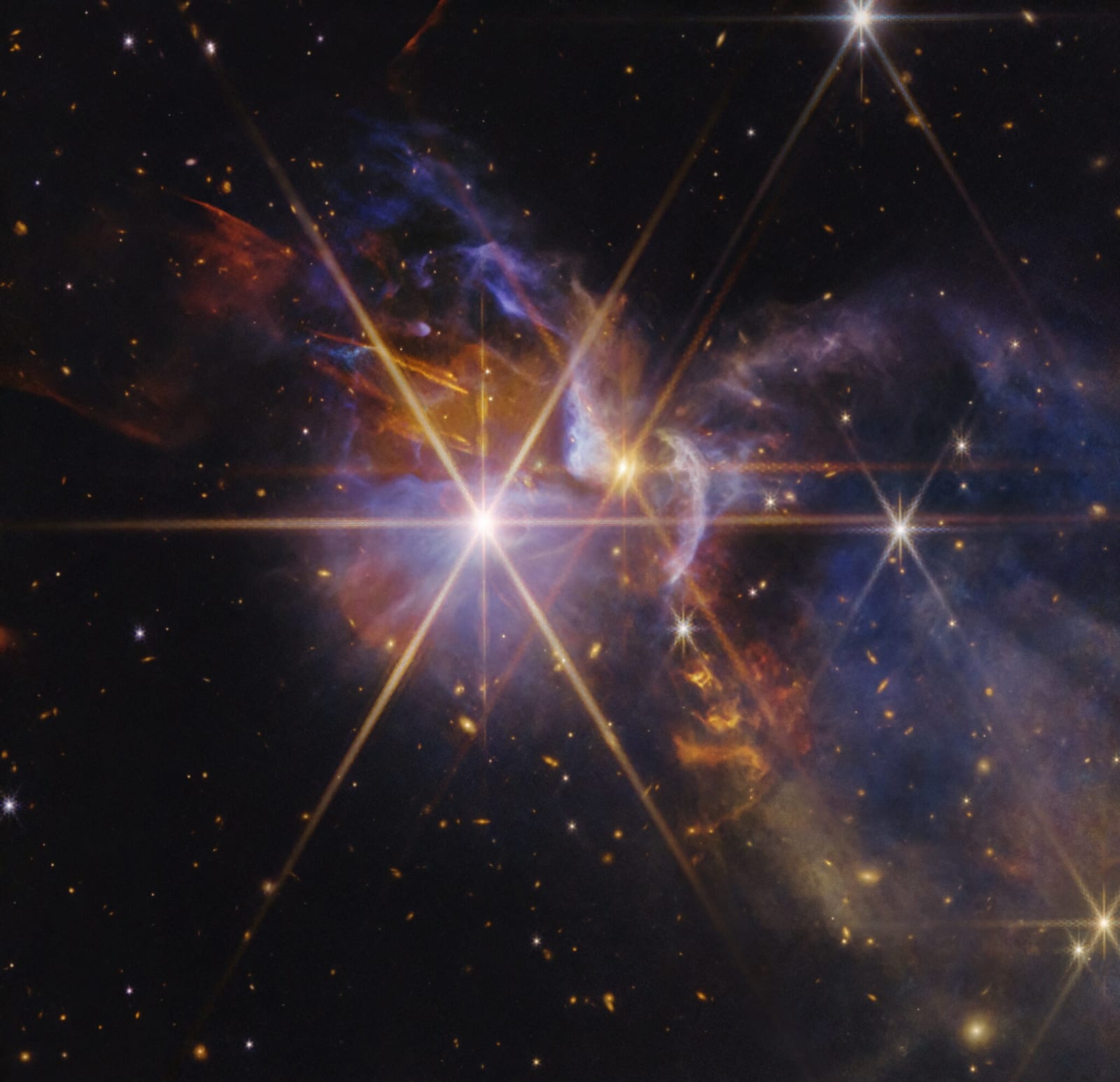
Hero image: JWST NIRCam image of the gravitationally lensed galaxy MRG-M0138, which appears as four distorted images around the foreground galaxy cluster MACS J0138.0-2155. Credit: NASA / ESA / CSA / Webb. This image is in the public domain as a work of the U.S. federal government and ESA.