Physicists Recreated Black Hole Energy Extraction in the Lab Using Synthetic Rotation. A 50-Year-Old Theory Finally Works.
Researchers at CUNY's Advanced Science Research Center demonstrated the Penrose-Zel'dovich process in a laboratory for the first time. Using a ring of electronic resonators that simulate extreme rotation without physically moving, they showed that electromagnetic waves can extract energy from synthetic rotation, confirming a black hole energy theory proposed by Roger Penrose in 1969 and extended by Yakov Zel'dovich in 1971. The findings, published in Nature on July 10, 2026, open new avenues in optics, communications, and quantum science while validating one of the most extreme predictions of general relativity.
One of the brightest stars in the Andromeda Galaxy, visible for decades across 2.5 million light-years of space, simply stopped being visible. It did not explode. It did not flare and fade. It just went dark.
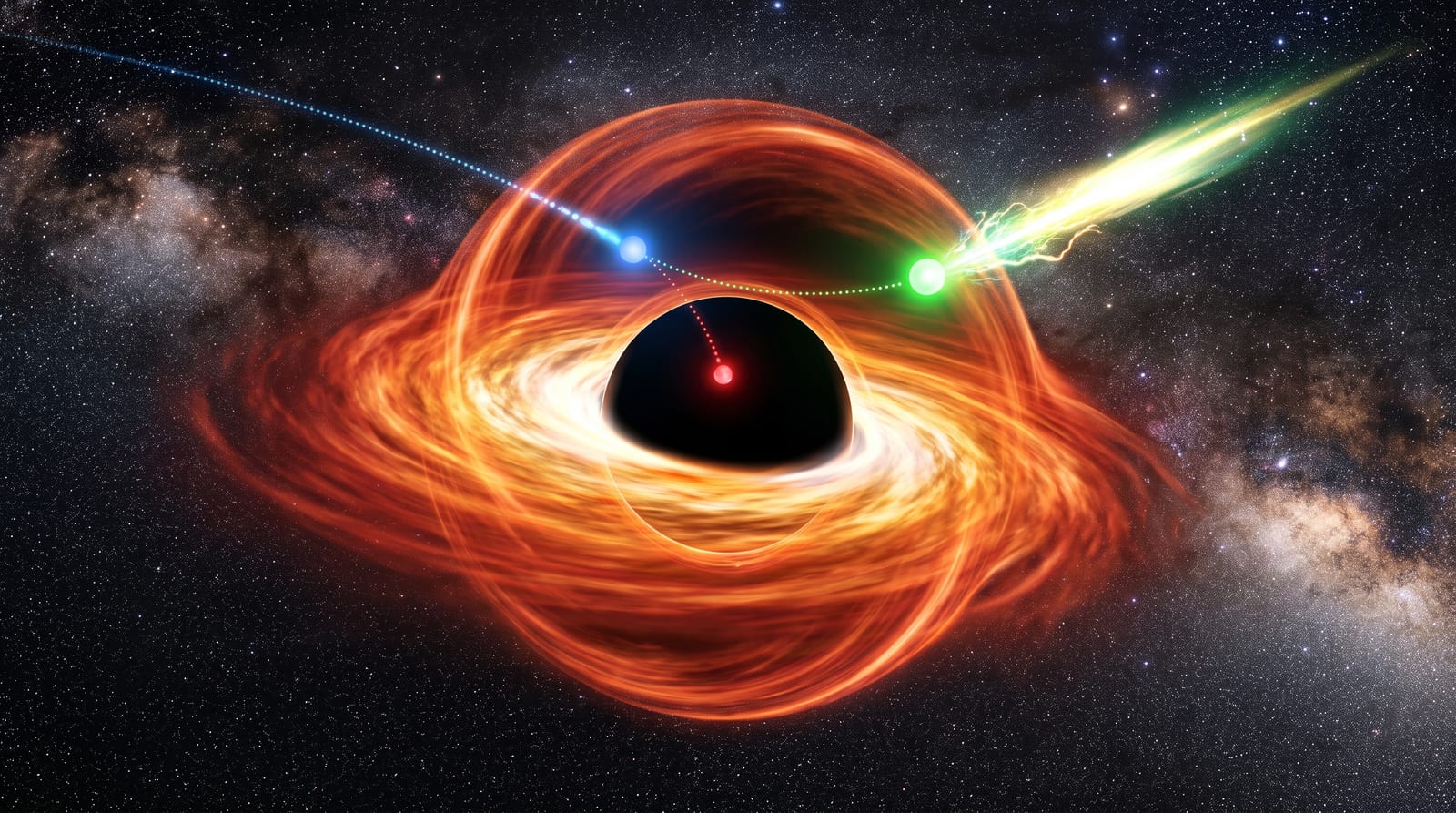
Astronomers now have the best look yet at what happened. The star, catalogued as M31-2014-DS1, collapsed directly into a black hole without detonating as a supernova. A team led by Kishalay De, now at Columbia University and the Flatiron Institute, tracked the star's disappearance across nearly two decades of data from NASA's NEOWISE mission and other observatories. The results were published February 12 in the journal Science.
The star started out with about 13 times the mass of the Sun. By the time it died, it had shed most of that mass through powerful stellar winds, dropping to about 5 solar masses. Stars in this mass range have long been expected to end their lives in supernovae. This one did not. Its core collapsed, the shock wave needed to blast the outer layers into space failed, and gravity won.
A star that brightened, then blinked out
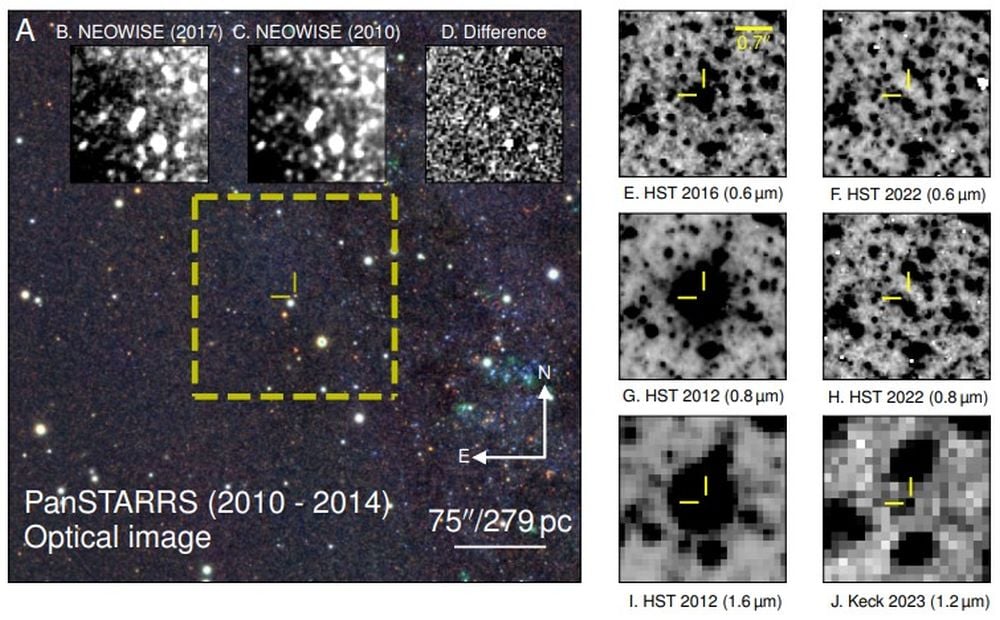
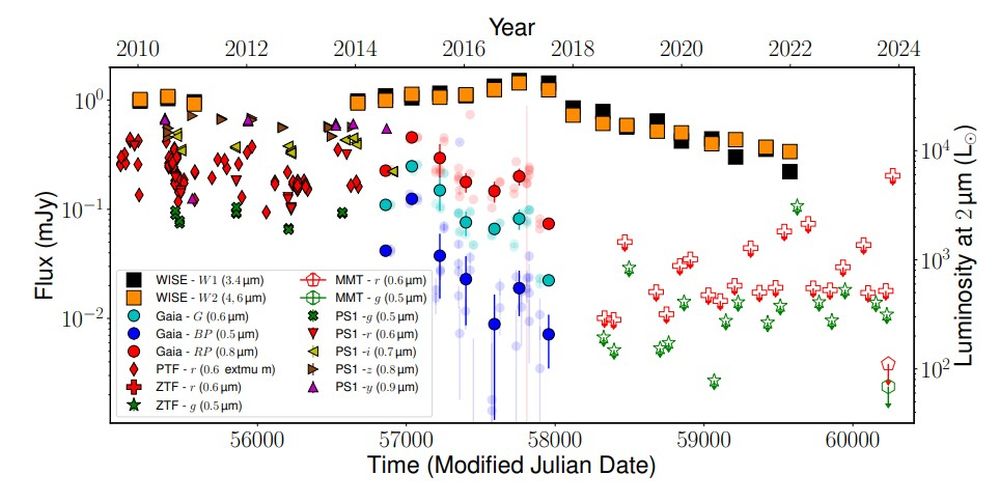
The story begins in 2014, when NEOWISE, a NASA space telescope originally built to hunt asteroids, detected something strange in Andromeda. A star that had been steadily shining began to brighten in infrared light. Over two years, its mid-infrared flux increased by about 50 percent. NEOWISE, which scans the entire sky every six months, captured the change as part of its routine survey.
Then the star dimmed. Between 2016 and 2019, its optical light faded by a factor of roughly 100. By 2023, the star that had once been one of the most luminous in the entire Andromeda Galaxy had dimmed by a factor of more than 10,000 in visible and near-infrared wavelengths. Hubble imaged the same spot in 2022 and found nothing in the optical, only a faint source in the near infrared. Follow-up observations with the Keck Observatory in 2023 confirmed a faint near-infrared glow, the dying ember of what used to be a massive star.
"This has probably been the most surprising discovery of my life," De said in a press release from Columbia University. "The evidence of the disappearance of the star was lying in public archival data and nobody noticed for years until we picked it out."
Today M31-2014-DS1 is only detectable in mid-infrared light, where it glows at a mere one-tenth its original brightness. The visible star is gone.
Why some stars fail to explode
Massive stars stay alive by fusing hydrogen into helium in their cores. The outward pressure from this fusion balances the inward pull of gravity. When the fuel runs out, the balance breaks. The core collapses, and a flood of subatomic particles called neutrinos is released. In a successful supernova, those neutrinos drive a shock wave outward that tears the star apart and blasts material across space.
But if the neutrino-powered shock is too weak to push the stellar envelope outward, the outer layers fall back onto the collapsing core. The result is not a supernova. It is a black hole, formed in silence.
The team found that M31-2014-DS1 fits this failed supernova model precisely. The infrared brightening in 2014 matched the predicted signal of a star shedding its outer layers before core collapse. The rapid dimming after 2016 matched the absence of a supernova explosion. The lingering mid-infrared glow matched hot dust surrounding a newborn black hole, heated by the slow infall of the remaining envelope.
Only about one percent of the original stellar envelope actually falls into the black hole, the researchers estimate. The rest orbits the black hole in a chaotic disk, slowly feeding energy into the surrounding dust. That glow, De says, will be visible for decades at the sensitivity of telescopes like the James Webb Space Telescope.
Convection, not direct collapse
The researchers initially expected the star to have imploded directly. The data told a different story. Material near the center of a dying star is extremely hot, while the outer layers are much cooler. This temperature difference drives convection, the same process that moves heat in a pot of boiling water. When the core collapsed, the gas in the outer layers was still moving rapidly due to convection. That momentum prevented most of the envelope from falling straight in.
Andrea Antoni, a research fellow at the Flatiron Institute and co-author of the study, had previously developed theoretical predictions for these convection models. The observations from M31-2014-DS1 confirmed them.
"The accretion rate is much slower than if the star imploded directly," Antoni said. "This convective material has angular momentum, so it circularizes around the black hole. Instead of taking months or a year to fall in, it is taking decades. And because of all this, it becomes a brighter source than it would be otherwise."
The team also reinterpreted a similar object, NGC 6946-BH1, a star in a galaxy 25 million light-years away that had been catalogued as a possible failed supernova roughly 10 years ago. The same convection-driven model explained its behavior, suggesting that M31-2014-DS1 is not an oddball but one example of a class of objects that had been overlooked.
What the vanishing star means
The discovery of M31-2014-DS1 is the most complete observational record ever made of a star transforming into a black hole. For decades, the theoretical framework for failed supernovae existed on paper. Astronomers knew the physics should allow stars to collapse directly into black holes. They could point to NGC 6946-BH1 as one possible example. But the Andromeda event, at just 2.5 million light-years away, gave researchers details they had never had before: a decade of pre-collapse observations, a clear before-and-after record across multiple wavelengths, and a close enough distance for Hubble and Keck to track the fading.
It also raises a deeper question. If a star of roughly 13 solar masses can fail to explode, how many other stars have done the same thing? Standard stellar evolution models assumed that stars above a certain mass threshold always produce supernovae. M31-2014-DS1 breaks that assumption. The team suggests that small variations in how gravity, gas pressure, and shock waves interact inside a dying star may determine whether it explodes or collapses, meaning stellar mass alone is not enough to predict the outcome.
Stars with this mass range are common in the universe. If even a fraction of them end their lives through failed supernovae, the population of stellar-mass black holes could be significantly larger than current estimates suggest.
Light from the dusty debris around the newborn black hole will remain visible for decades. JWST can monitor its slow fading, track the evolution of the surrounding dust shell, and test the convection model further. What was once a bright star in a neighbouring galaxy is now a quiet source of infrared heat, and a benchmark for understanding how stars turn into black holes.
Sources
- De et al., Science (2026): "Disappearance of a massive star in the Andromeda Galaxy due to formation of a black hole" - peer-reviewed paper presenting the discovery (DOI: 10.1126/science.adt4853)
- NASA JPL: Archival Data From NEOWISE Tracks Star Turning Into Black Hole - primary NASA coverage with mission context
- Simons Foundation: Caught in the Act: Astronomers Watch a Vanishing Star Turn Into a Black Hole - detailed story with researcher interviews and context on convection models
- NASA Science: Archival Data From NASA's NEOWISE Tracks Star Turning Into Black Hole - NASA Science blog coverage of the discovery
Hero image: Artist concept of the direct-collapse black hole by Keith Miller, Caltech/IPAC - SELab (NASA/JPL-Caltech). Figure images from De et al. 2026, Science (reproduced with credit). The Caltech/IPAC image was produced with NASA support and is public domain. This article describes peer-reviewed research published in Science on February 12, 2026 (DOI: 10.1126/science.adt4853).
Related on Impossible Universe
- A Dying Star Could Create a Tiny New Universe Instead of a Black Hole - a theoretical alternative to the standard black hole formation model
- JWST Found These Little Red Dots in the Early Universe. They Were Black Hole Stars. - how supermassive black holes form in the early universe, revealed by JWST
- Chandra Finds Unexpected Fireworks in a Galaxy's Dead Stars - what happens after stars die, seen through X-ray eyes