A Galaxy 15 Million Light-Years Away Is Putting On a Fireworks Show Nobody Expected
Supernova remnants are supposed to fade slowly after the explosion. But when astronomers watched the galaxy M83 for 14 years with NASA's Chandra X-ray Observatory, half of them started flickering instead.
When a massive star explodes, the cloud of debris it leaves behind is supposed to do one thing: fade. Slowly, quietly, over centuries. That was the working assumption when astronomers pointed NASA's Chandra X-ray Observatory at the spiral galaxy Messier 83 and settled in for routine monitoring.
What they got instead was a fireworks show nobody ordered.
Presented June 15 at the American Astronomical Society meeting in Pasadena and published in the Astrophysical Journal, the results from 14 years of Chandra data on M83 revealed that roughly half of the galaxy's supernova remnants, the debris clouds from exploded stars, were changing brightness dramatically. Some flared up. Some dimmed. A few flickered in patterns that kept repeating. None of them were supposed to be doing any of this.
A galaxy that would not sit still
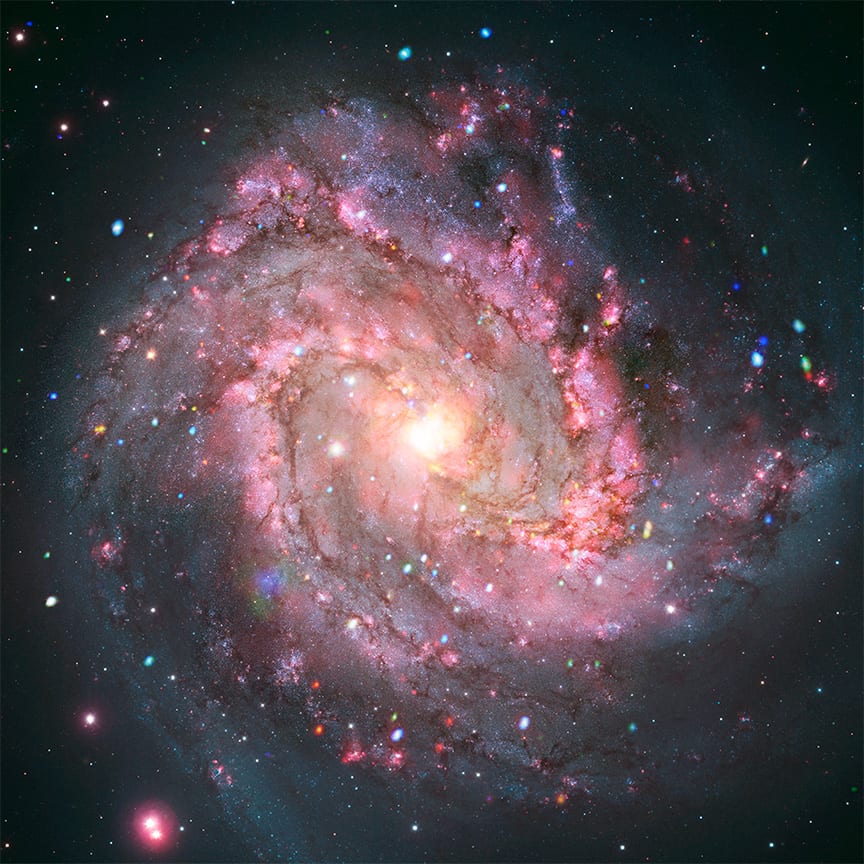
M83 is a face-on spiral galaxy in the constellation Hydra, about 15 million light-years away. It is one of the closest and most actively star-forming galaxies visible from Earth, which made it an ideal target for Chandra. The observatory took single images in 2000 and 2001, followed by 10 more observations from 2010 to 2011 and one final look in 2014.
The team, led by Andrea Prestwich of the Catholic University of America, identified 22 X-ray sources that had previously been classified as supernova remnants. Then they checked how those 22 sources changed across the 14-year window.
"We knew that individual X-ray sources could vary dramatically," Prestwich said. "But finding that so many supernova remnants were behaving this way was a real surprise. Something unusual is going on in these objects."
The expectation was straightforward. After a supernova's initial blast fades, the expanding shell of hot gas should cool and dim on a timescale of roughly a hundred years. After that first century or so, the X-ray glow should remain steady, declining only very gradually. Sudden changes should not happen. Yet half the sample was doing exactly that.
A family of stellar survivors
One of the 22 variable remnants has a clean explanation. SN 1957D, the debris from a supernova first spotted from Earth nearly 70 years ago, appears to be ramming into material around the explosion site, creating X-ray flares. But the other roughly 20 sources cannot be explained by fresh collision debris alone. There is no evidence they all exploded recently enough for that.
The team's preferred explanation is more interesting. They think they have uncovered a population of stellar survivors: stars that lived through their partner's destruction in a supernova.
In this scenario, each variable X-ray source started as a pair of massive stars orbiting each other. The heavier one exhausted its fuel, collapsed, and exploded as a supernova, leaving behind either a black hole or an ultra-dense neutron star. Its companion star survived the blast and remained in orbit.
"It may be that this galaxy contains a collection of supernova remnants where one massive star survives the supernova and becomes locked into an orbit with a black hole or neutron star," said co-author Michael McCollough of the Center for Astrophysics | Harvard & Smithsonian. "The neutron star or black hole can then start pulling material from the massive star's surface."
That infalling material gets superheated by the compact object's gravitational pull, blasting out the X-rays Chandra detects. Astronomers call these systems high-mass X-ray binaries, or HMXBs, and they are among the most variable X-ray sources in the universe. The twist in M83 is not the existence of HMXBs. It is their connection to supernova remnants.
Before this study, only a handful of supernova remnants associated with HMXBs had been identified across all known galaxies combined. Finding more than 20 strong candidates in a single galaxy is unprecedented.
Cosmic recycling
There is a second possibility. Rather than feeding off a surviving companion, the black hole or neutron star may be pulling back material from its own explosion.
"This could be an example of cosmic recycling, where debris from the explosion falls back onto the very object the supernova created," said co-author Roy Kilgard of Wesleyan University. "And it's quite possible that both explanations are at play. Different sources in our sample may have different origins."
The two mechanisms are not mutually exclusive. Some systems may involve a surviving companion. Others may be feeding on their own debris. Figuring out which is which will need deeper observations, and M83's distance of 15 million light-years makes resolving those details difficult with current instruments.
It was not just M83
The finding prompted a quick follow-up. A separate study led by Zoe Hoiland of Vassar College, working with Kilgard, pointed Chandra at another nearby galaxy, M51, and found the same thing: a surprisingly large population of variable X-ray sources associated with supernova remnants. M51 is also a vigorously star-forming galaxy.
This suggests the phenomenon may be a common feature of galaxies undergoing active star formation, not some quirk unique to M83. The flickering is probably happening in similar galaxies all over the universe. We just had not looked long enough to notice.
The Chandra data for M83 stretched from 2000 to 2014, and the long time baseline turned out to be essential. A single snapshot would have caught each source at one random point in its brightness cycle and labeled it unremarkable. Only by stacking more than a decade of observations did the pattern emerge.
Why it matters
Supernova remnants are the primary way that heavy elements like oxygen, silicon, and iron get distributed through galaxies. Every atom of calcium in your bones was forged inside a star and blasted across space by an explosion like the ones Chandra watched in M83.
Understanding what happens after a supernova matters for understanding how galaxies evolve chemically and how the raw materials for planets and life get around. The Chandra results add a new chapter to that story: the aftermath of a stellar explosion is not a quiet fade. It can remain dynamic, even violent, for far longer than anyone expected.
The work also demonstrates how much science is hidden in archival data. Chandra observed M83 multiple times for unrelated projects. It took a team willing to chip away at 14 years of old observations to find something nobody was looking for.
Sources
- NASA Science: Chandra Finds Unexpected Fireworks in Aftermath of Stellar Explosions - primary NASA coverage of the AAS presentation and research findings
- Chandra X-ray Observatory Press Release (June 15, 2026) - official release with researcher quotes, methodology, and M51 follow-up details
- Chandra Photo Album: M83 - composite imagery, timelapse animations, and visual descriptions of the varying X-ray sources
- Prestwich et al., The Astrophysical Journal (2026) - peer-reviewed paper presenting the discovery of variable supernova remnants in M83
Related on Impossible Universe
- Juno Caught Particles Moving Near Light Speed at Jupiter. It Solved a 100-Year-Old Mystery. - another mission that found particles behaving more violently than anyone expected
The hero image is a composite of X-ray data from NASA's Chandra X-ray Observatory and optical light data from the Hubble Space Telescope. NASA images are generally in the public domain. The composite image credit: X-ray: NASA/CXC/SAO; Optical: NASA/ESA/AURA/STScI, Hubble Heritage Team, W. Blair (STScI/Johns Hopkins University) and R. O'Connell (University of Virginia); Image Processing: NASA/CXC/SAO/A. Jubett, L. Frattare and P. Edmonds. This article describes peer-reviewed research presented at the 248th AAS meeting and published in The Astrophysical Journal.