NASA's Roman Space Telescope Launches in 36 Days. It Will Map a Billion Galaxies and Find Thousands of New Worlds.
The Nancy Grace Roman Space Telescope, NASA's next flagship astrophysics observatory, launches August 30 aboard a SpaceX Falcon Heavy. With a field of view 100 times larger than Hubble, a billion-galaxy dark energy survey, and a coronagraph that could pave the way to imaging Earth-like planets, Roman is built to answer questions no existing telescope can touch.
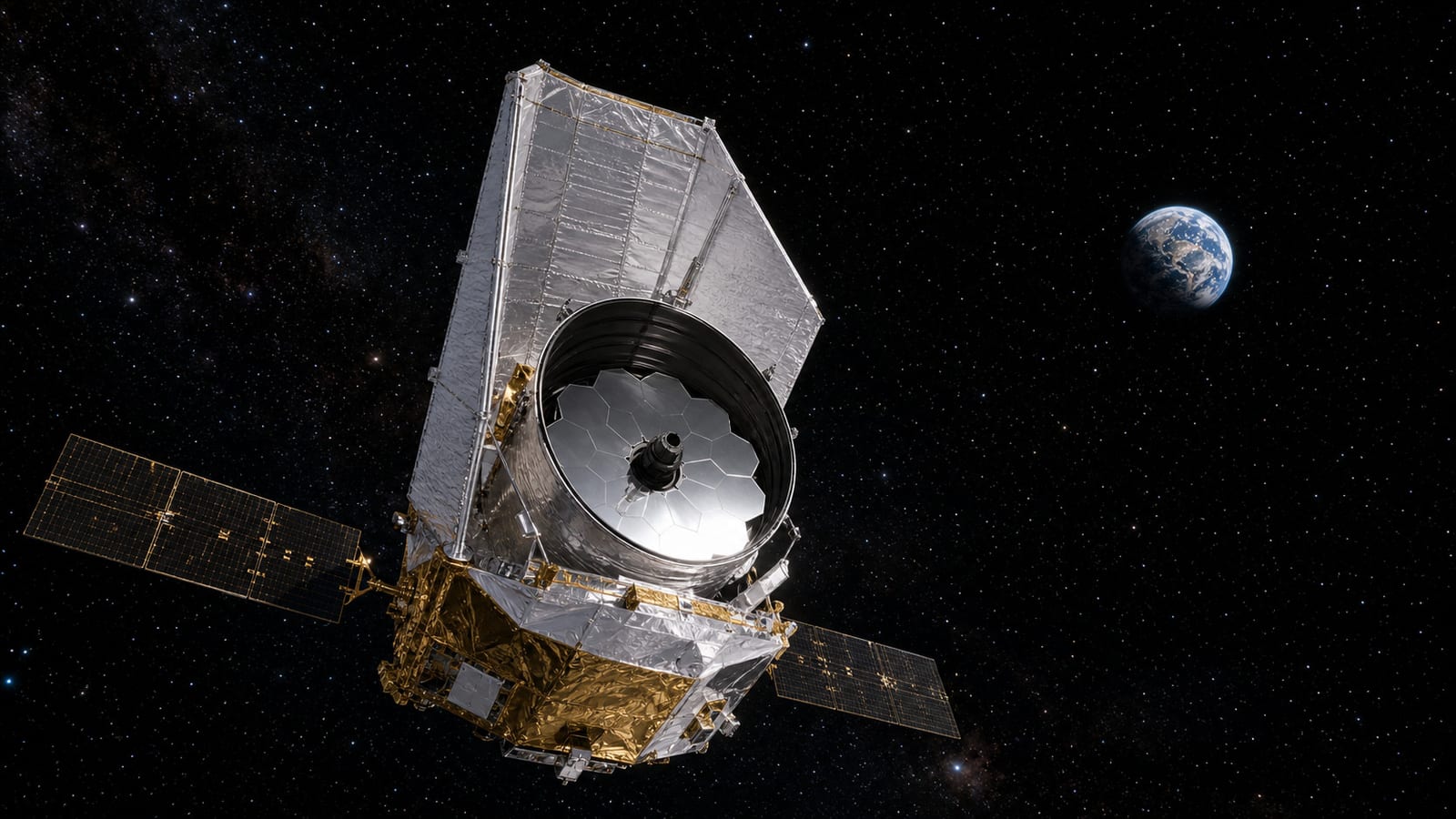
On August 30, a SpaceX Falcon Heavy rocket will lift off from Launch Complex 39A at Kennedy Space Center carrying NASA's most ambitious survey telescope ever built. The Nancy Grace Roman Space Telescope, named after the woman known as the mother of Hubble, is designed to do something no space telescope has done before: conduct a wide-field infrared survey of the entire universe at a resolution comparable to Hubble but across an area 100 times larger.
Where the James Webb Space Telescope peers deep into the infrared to study individual galaxies, stars, and exoplanets in exquisite detail, Roman will take the big-picture approach. In its five-year primary mission, it will measure light from a billion galaxies, discover thousands of new exoplanets, and probe the nature of dark energy, the mysterious force driving the universe's accelerating expansion. The telescope was completed on November 25, 2025, at NASA's Goddard Space Flight Center in Maryland, and arrived at Kennedy Space Center on June 21, 2026, after an eight-day barge journey.
Its launch date, coming eight months ahead of the original schedule, marks the culmination of a project first recommended by the National Research Council's 2010 Decadal Survey as the top priority for the next decade of astronomy.
Built for speed, not just depth
The key difference between Roman and its predecessors comes down to a single number: field of view. Roman's Wide-Field Instrument (WFI) is a 300.8-megapixel visible and near-infrared camera that covers 0.28 square degrees of sky in a single exposure. That is 100 times the area captured by Hubble's infrared camera and more than 200 times the area of its visible-light camera.
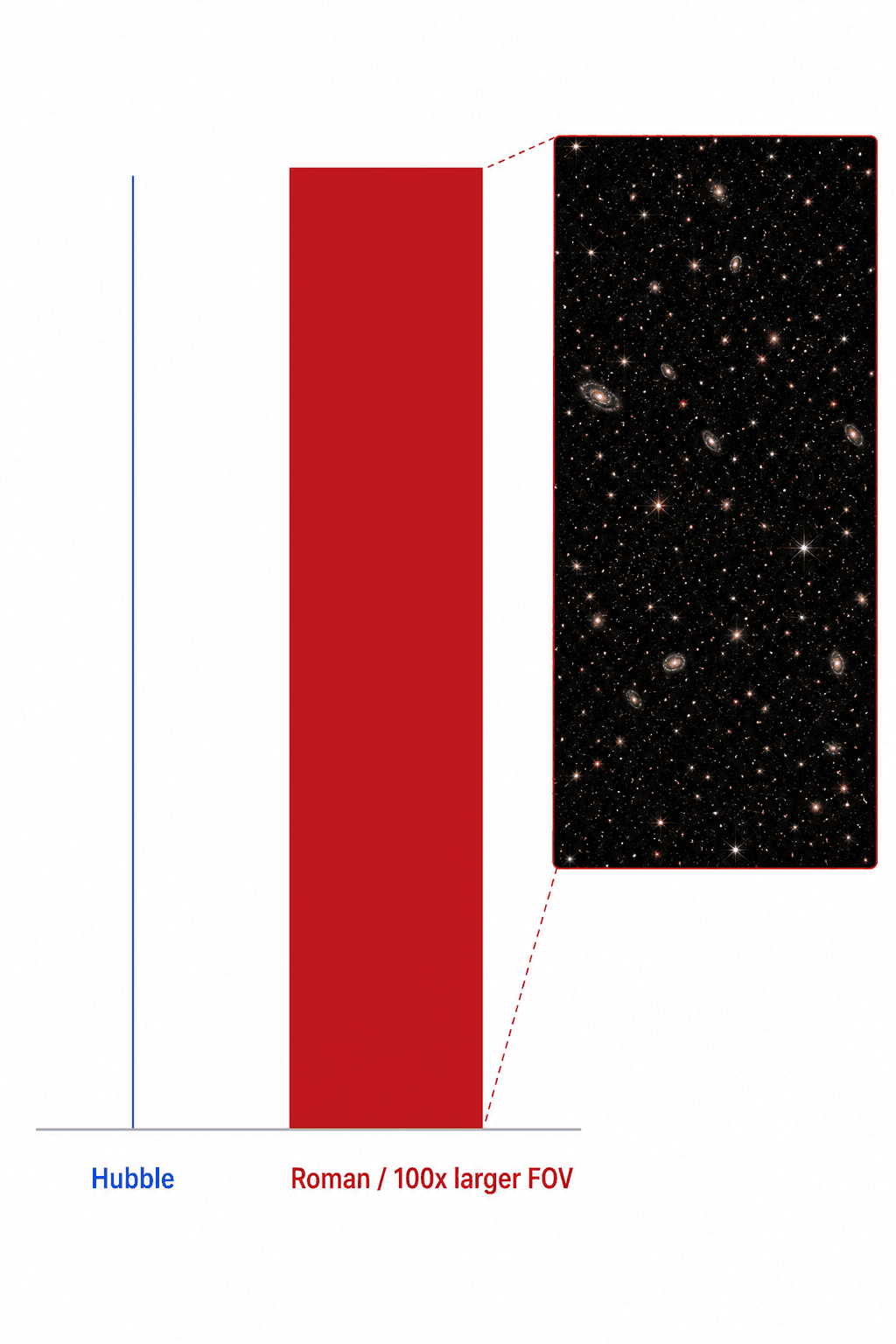
This wide field, combined with a 2.4-meter mirror donated by the National Reconnaissance Office (the same size as Hubble's), lets Roman map the sky at an extraordinary rate. It would take Hubble 85 years to observe the same area Roman can cover in its first year. The telescope orbits the Sun-Earth L2 Lagrange point, the same gravitational balance point 1.5 million kilometers from Earth that Webb uses, but Roman's halo orbit keeps it thermally stable and allows continuous survey operations without the Earth or Moon blocking its view.
Roman's survey speed is not just a convenience. It is essential to answering the questions the telescope was built to address. Some of those questions, like the nature of dark energy, require measuring the properties of a billion galaxies too many for any narrow-field telescope to tackle efficiently. Others, like finding the population of rogue planets roaming the galaxy unbound to any star, require monitoring hundreds of millions of stars for years, a task only a wide-field survey can accomplish.
Dark energy: the billion-galaxy question
Dark energy makes up roughly 70 percent of the energy content of the universe, yet no one knows what it is. It was discovered in 1998 when two independent teams found that distant supernovae were dimmer than expected, meaning the expansion of the universe is accelerating rather than slowing down under gravity. The discovery won the Nobel Prize, but the underlying physics remains one of the deepest unsolved problems in all of science.
Roman will attack the dark energy problem using three independent methods on the same dataset. First, it will map the large-scale structure of the universe by measuring the positions and shapes of a billion galaxies, tracing how matter has clustered over cosmic time. Second, it will measure weak gravitational lensing, the subtle distortion of galaxy shapes by the gravity of intervening matter, to construct a three-dimensional map of dark matter distribution. Third, it will observe thousands of Type Ia supernovae across a wide range of distances to measure the expansion history of the universe with unprecedented precision.
Each method has different systematic errors. By combining all three from the same instrument, astronomers hope to distinguish between competing explanations for dark energy: whether it is a cosmological constant (Einstein's original idea), a dynamic energy field (quintessence), or a sign that general relativity breaks down on cosmic scales.
Roman's High Latitude Imaging Survey and High Latitude Spectroscopy Survey, the two core cosmology programs, together will cover roughly 2,000 square degrees of sky, about 5 percent of the entire celestial sphere. The surveys will produce the largest and most precise three-dimensional map of the universe ever created.
Thousands of new worlds by watching gravity bend light
Roman's second major science goal is a statistical census of planetary systems across the galaxy. To do this, it will use a technique called gravitational microlensing, which does not detect planets by their own light or by the dimming they cause when crossing their star. Instead, it watches how a planet's gravity bends and magnifies the light of a background star as the planet drifts across the line of sight.
Microlensing is uniquely sensitive to planets that other methods miss. It can detect worlds as small as Mars, at orbital distances from their star where neither transit surveys like TESS nor radial velocity surveys are effective. It is the only technique that can measure the complete demographics of exoplanets across all orbital separations, from close-in rocky worlds to distant ice giants in the outer reaches of their systems.
Roman's Galactic Bulge Time Domain Survey will monitor hundreds of millions of stars in the crowded center of the Milky Way, scanning every 15 minutes for six years. The expected yield is roughly 1,000 microlensing planets, including dozens of Earth-mass worlds and potentially the first statistically meaningful sample of free-floating rogue planets, worlds ejected from their home systems that drift through the galaxy untethered to any star.
If the yield reaches expectations, Roman will more than double the number of known exoplanets and, more importantly, fill the vast gap in our knowledge of what kinds of planets exist at what distances from their stars. It will answer a question that no current survey can: how typical is the architecture of our own solar system?
Blocking starlight to see planets directly
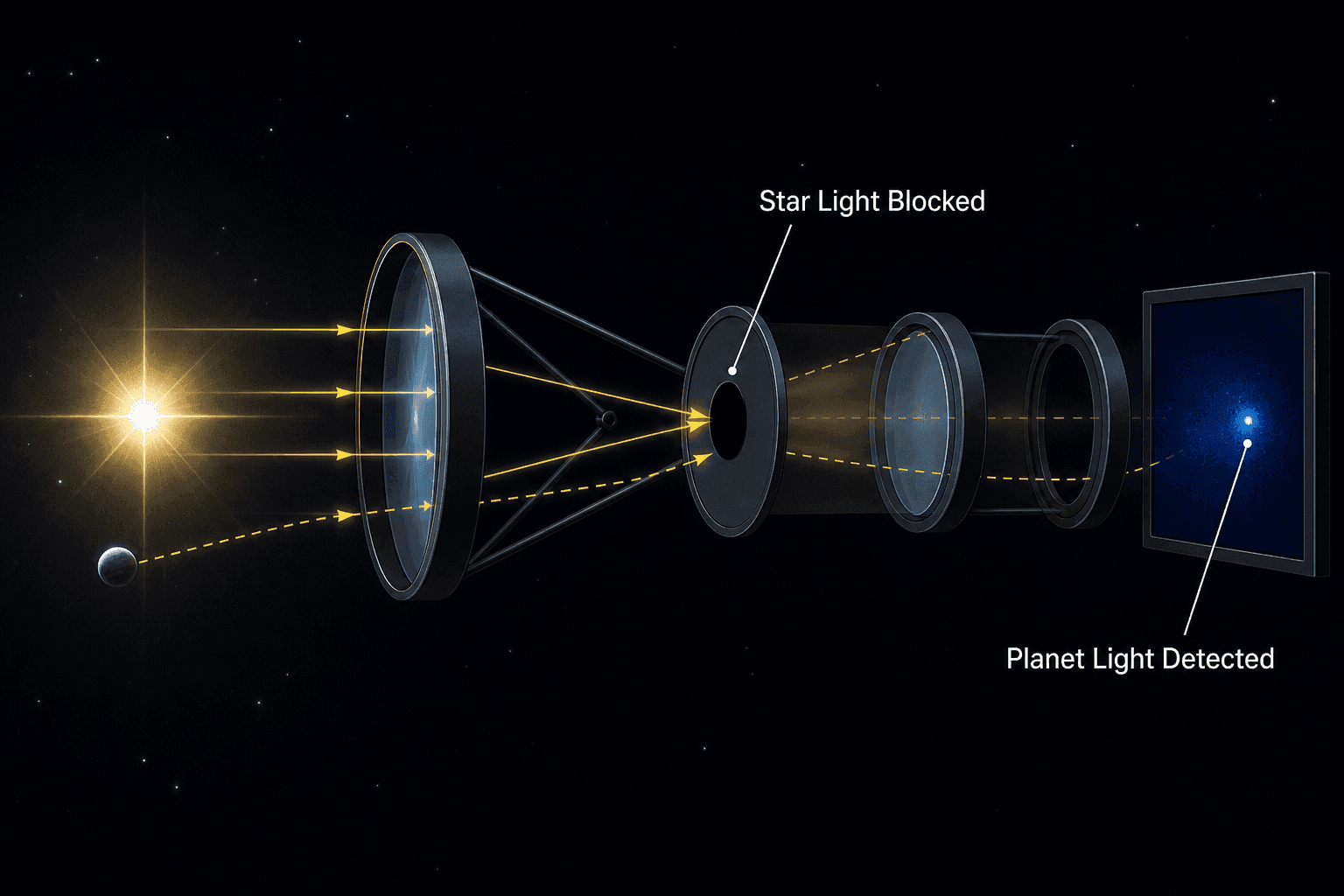
In addition to its wide-field camera, Roman carries a technology demonstration that could reshape the future of exoplanet science: the Roman Coronagraph Instrument. Built at NASA's Jet Propulsion Laboratory, the coronagraph is a system of masks, prisms, detectors, and deformable mirrors designed to block the light of a star by a factor of a billion or more, revealing the faint planets orbiting around it.
From the ground, even the best coronagraphs struggle to see planets that are more than about a million times fainter than their star. Roman's coronagraph aims to push that contrast ratio to 10 billion to one or better, a leap of three to four orders of magnitude over any currently operating system. At that performance, it could directly image Jupiter-like planets at Sun-like distances around nearby stars, and possibly even photograph the disks of dust and gas from which planets form.
The coronagraph will operate for at least the first 18 months of the mission as a technology demonstration. If it performs as designed, the same technologies could be used on NASA's proposed Habitable Worlds Observatory, a future flagship telescope specifically designed to image Earth-like planets and search their atmospheres for signs of life.
The woman behind the telescope
Nancy Grace Roman was NASA's first chief of astronomy and the first woman to hold an executive position at the agency. In the 1960s and 1970s, she built NASA's space astronomy program from scratch, championing the concept of a large space-based optical telescope at a time when the idea seemed like science fiction. Her advocacy and organizational work led directly to the Hubble Space Telescope, earning her the nickname mother of Hubble.
Roman was born in 1925 in Nashville, Tennessee. As a child, she found astronomy by accident while waiting for a parade and saw a comet instead, an experience that set the course of her life. She earned her Ph.D. in astronomy from the University of Chicago in 1949, one of only a handful of women in the field at the time. After working at the Naval Research Laboratory, she joined NASA in 1959, just a year after the agency was founded.
During her 21-year career at NASA, Roman oversaw the development of the Orbiting Astronomical Observatory program, the International Ultraviolet Explorer, and the early planning for what would become the Hubble Space Telescope. She died in 2018 at the age of 93, having lived long enough to see Hubble transformed from a troubled project to one of the most productive scientific instruments in history.
In 2020, NASA renamed WFIRST, the Wide-Field Infrared Survey Telescope, after Roman, making her the first woman to have a NASA space telescope named in her honor. "I don't know how many grandmothers it took to raise this telescope, but I'm glad they chose her to be the one remembered," her former colleagues said at the renaming ceremony.
36 days to launch
As of July 25, 2026, the Roman Space Telescope is at Kennedy Space Center undergoing final pre-launch preparations. Engineers have completed the primary mirror inspection, the shake test, and the thermal vacuum testing. The telescope will be loaded with fuel, encapsulated in the Falcon Heavy fairing, and mounted on the rocket in the weeks before launch.
Launch is scheduled for 7:20 AM Eastern Daylight Time (11:20 UTC) on August 30, 2026. The Falcon Heavy will lift Roman from Kennedy Space Center Launch Complex 39A, the same pad that launched Apollo 11 to the Moon and countless Space Shuttle missions. After a 30-minute ascent, the telescope will separate from the upper stage and begin its month-long journey to Sun-Earth L2. The first science observations are expected roughly six months after launch, following commissioning and calibration of both instruments.
Roman joins Webb and Hubble in a triumvirate of NASA great observatories that together cover the full spectrum of modern astrophysics. Hubble sees the universe in visible and ultraviolet light with exquisite resolution across a narrow field. Webb sees deeper into the infrared with even sharper resolution across a modest field. Roman covers the near-infrared at the same resolution as Hubble but across an enormous field, bridging the gap between pointed observations of individual targets and panoramic surveys of the sky.
All three observatories are complementary rather than competitors. Webb finds the most distant galaxies and studies the atmospheres of exoplanets. Roman maps the large-scale structure that connects those galaxies and counts the exoplanet population across the galaxy. Hubble continues to provide the high-resolution visible-light context that neither infrared-optimized telescope can match.
Roman's data will be non-proprietary, meaning every image and catalog it produces will be publicly available immediately. The science community is already preparing for a data deluge: 11 petabytes of data over the mission lifetime, equivalent to roughly 3,000 years of continuous HD video. For the generation of astronomers who will grow up with Roman's sky maps as their baseline reference, the telescope named after the mother of Hubble will have become the standard view of the cosmos.
Sources
- NASA Science: Nancy Grace Roman Space Telescope mission page
- Wikipedia: Nancy Grace Roman Space Telescope
- Engadget: NASA's Nancy Grace Roman Space Telescope is set to launch on August 30
- TechTimes: NASA Moves Roman Space Telescope Launch Up to August 30
- NASA: Experience the Launch of Roman Space Telescope (NASA Social)
- NASA Science: Roman Coronagraph Instrument
- STScI: Roman Science Themes