
JWST Caught a Hot Jupiter Getting Flash-Heated. The Temperature Spike Was Worse Than Expected.
HD 80606b has one of the most extreme orbits of any known exoplanet, a 111-day elliptical loop that swings from 0.88 AU to 0.03 AU from its star. JWST's MIRI instrument watched the planet whip past its star and measured a temperature spike of 1,100 degrees Fahrenheit, more extreme than Spitzer had predicted.
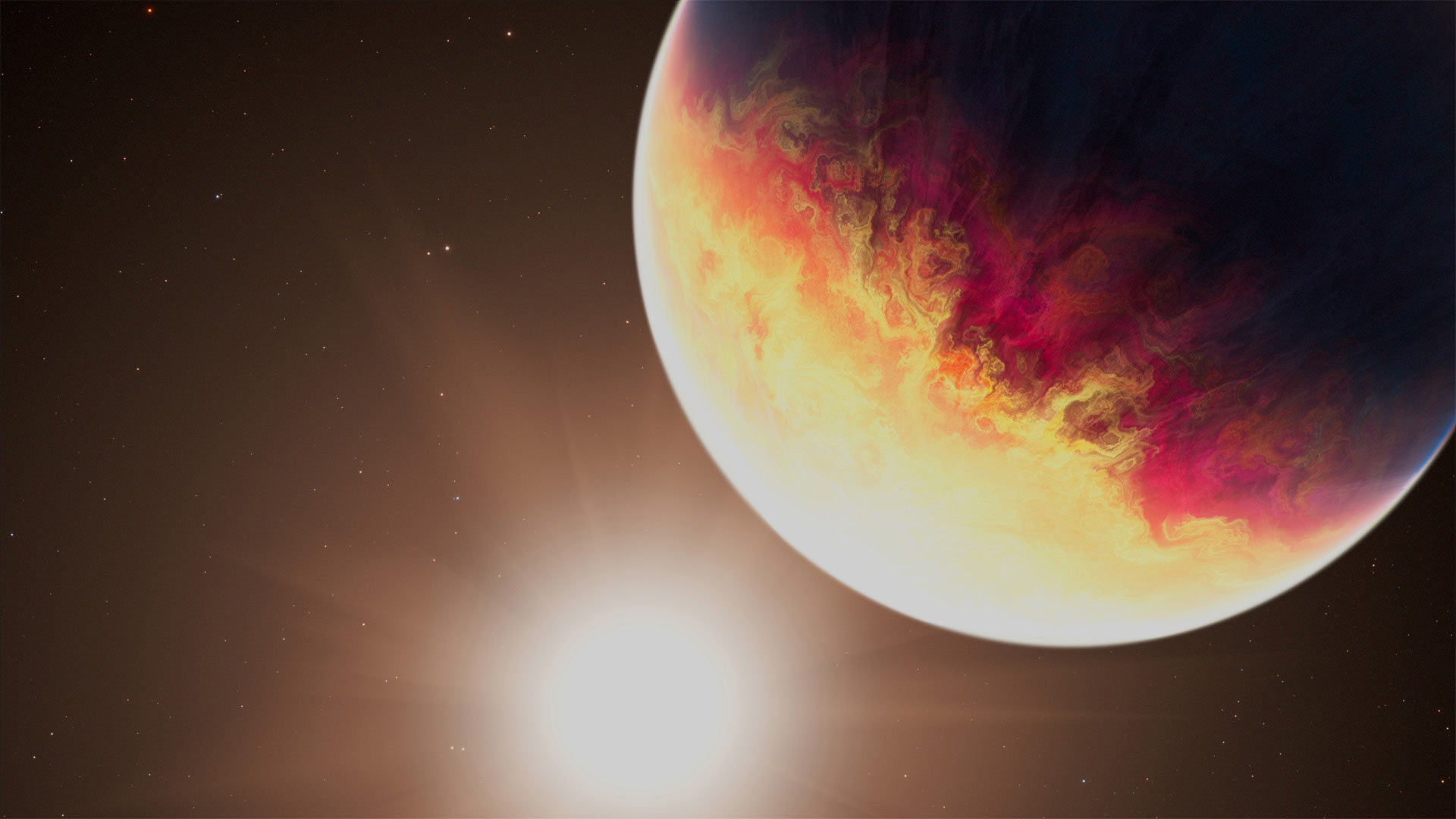
HD 80606b is a hot Jupiter about 217 light-years away in the constellation Ursa Major. It orbits a Sun-like star once every 111 days. That is already unusual. Most hot Jupiters orbit their stars in days, not months. But the truly strange thing about HD 80606b is not how long the orbit takes. It is the shape.
The planet's orbital eccentricity is 0.93, one of the highest ever measured for any exoplanet. At its farthest point from the star, apastron, HD 80606b sits roughly 0.88 AU away, a bit closer to its star than Earth is to the Sun. At its closest point, periastron, it plunges to 0.03 AU. That is ten times closer than Mercury gets to the Sun. Over a single 111-day orbit, the planet experiences a thousand-fold swing in the amount of stellar radiation it receives.
Researchers led by Tiffany Kataria at NASA's Jet Propulsion Laboratory used the James Webb Space Telescope to watch what happens when a planet goes through an atmospheric trauma like that. The results, presented June 16 at the 248th meeting of the American Astronomical Society in Pasadena, show a temperature spike more extreme than anything the team expected.
How to catch a planet in the act
The team used Webb's MIRI (Mid-Infrared Instrument) to observe HD 80606b before, during, and after its periastron passage. The timing was critical. A planet with an eccentricity of 0.93 spends most of its 111-day orbit far from the star, coasting in relative quiet. The action happens in a narrow window, hours to days, as it whips around the star at closest approach.
During periastron, the planet also passed behind the star from Webb's perspective, an event known as a secondary eclipse. By measuring the system's brightness before, during, and after the eclipse, the team could isolate the planet's own infrared glow from the star's light. The observation took years to plan. Webb's field of regard depends on Earth's position in orbit, and the timing of HD 80606b's periastron had to align with Webb's available pointing windows.
"Hot Jupiters are already considered some of the most extreme exoplanets we know of, but even among that population, HD 80606b is one of the most extreme," Kataria said. "We typically think of hot Jupiters as hot gas giants sitting right next to their stars, but this planet's highly eccentric orbit creates a completely different beast."
A temperature spike that broke expectations
The team measured a temperature jump of roughly 1,100 degrees Fahrenheit (about 610 degrees Celsius) as the planet swept past its star. NASA's Spitzer Space Telescope had previously observed HD 80606b and seen similar temperature swings. But Webb's infrared sensitivity revealed a spike even larger than the Spitzer data had predicted.
"Webb has shown that the planet's increase in temperature was even more extreme than we anticipated based on Spitzer data," Kataria said.
The difference matters because it points to atmospheric processes that Spitzer could not resolve. Spitzer measured total infrared brightness. Webb's MIRI instrument can split that infrared light into a spectrum, revealing specific molecules in the planet's atmosphere.

From total brightness to individual molecules
Spectroscopy breaks light into its component colors, and each molecule has a characteristic pattern of absorption in the infrared. By reading these patterns, astronomers can identify which gases are present and how they change with temperature and pressure.
"Spitzer did amazing work on this exoplanet, and now Webb is building on that legacy by enabling us to drill down to distinguish specific chemical signatures like methane and carbon dioxide, which is just amazing progress," said Ryan Challener, co-author and research associate at the Cornell Center for Astrophysics and Planetary Science. "There's so much to learn from this one dataset here. We really are just getting started deciphering what Webb has to tell us."
The ability to trace individual molecules through a rapid heating event is rare. Most exoplanets change slowly, if at all, on human timescales. HD 80606b compresses what would be a gradual seasonal shift on another world into a few hours of extreme atmospheric upheaval.
"Observing a planet like HD 80606b is actually very efficient because its unusual orbit, with the corresponding swings in temperature and chemical composition, allow us to gather data under varying conditions in just hours and apply those findings to other hot Jupiters or more conventional exoplanets," said Laura C. Mayorga, co-investigator on the study and an exoplanet astronomer at the Johns Hopkins Applied Physics Laboratory.
What the Roasted Planet tells us about others
Hot Jupiters are the easiest exoplanets for telescopes like Webb to study because they are large, bright in infrared, and orbit close to their stars. But most hot Jupiters are static. They sit in circular orbits, locked in constant proximity to their star, their atmospheres in steady state. Observations of HD 80606b give astronomers a controlled experiment: start with a cold, quiescent atmosphere, hit it with a thousand-fold increase in radiation, and watch how the chemistry responds.
The results will apply to more than just eccentric worlds. They inform models of how planetary atmospheres respond to rapid changes in stellar heating, which has implications for understanding weather patterns, cloud formation, and atmospheric escape across a range of exoplanet types.
The team stresses that they have only begun analyzing the data. Webb's MIRI observation produced a rich dataset, and the full analysis, including the final chemical inventory of the planet's atmosphere during the flash-heating event, is in progress.
HD 80606b has held the nickname "the roasted exoplanet" since Spitzer first observed it, a name that earned it its own poster in NASA's Galaxy of Horrors series. Webb has now confirmed that the roasting is worse than anyone expected. The question is what else the extreme heat is doing to the planet's chemistry, and what that chemistry can teach us about how atmospheres behave in the most extreme conditions the galaxy has to offer.
Sources
- NASA's Webb Catches Exoplanet Getting Roasted (NASA Science, June 2026) - NASA press release with quotes from Tiffany Kataria (NASA JPL), Laura Mayorga (JHU APL), and Ryan Challener (Cornell)
- Flash-Heating a Roasted Planet: Time-Resolved Characterization of HD 80606b with JWST/MIRI (AAS 248, June 2026) - Kataria et al., presentation at the 248th American Astronomical Society meeting in Pasadena
- NASA Exoplanet Catalog: HD 80606 b - orbital parameters including mass, eccentricity, and discovery history
- The Roasted Planet Poster (NASA/JPL-Caltech Galaxy of Horrors series) - public domain poster artwork and earlier Spitzer-based characterization
- Webb Sees Jupiter-Size Exoplanet Being Roasted by Its Star (Sci.News, June 2026) - coverage of the AAS presentation with additional mission context
Related on Impossible Universe
- JWST Saw Dawn and Dusk on a Hellish Exoplanet. The Two Faces Could Not Be More Different. - another JWST exoplanet atmosphere study revealing dramatic temperature and chemical differences on WASP-121b
- JWST Found Salt Clouds on the Pink Planet. After a Decade, We Finally Know What's in Its Sky. - JWST atmospheric detection on a world that had resisted ground-based study for a decade
- Jupiter-Sized Planets Lighter Than Cotton Candy: The Puffiest Worlds Ever Found - two gas giants with densities lower than cotton candy found by a global telescope network
Hero image: NASA/ESA/CSA/STScI artist concept by Joseph Olmsted. The Roasted Planet poster: NASA/JPL-Caltech Galaxy of Horrors series (public domain). This article describes research presented at the 248th meeting of the American Astronomical Society on June 16, 2026. Full analysis of the JWST dataset is ongoing.