JWST Saw Dawn and Dusk on a Hellish Exoplanet. The Two Faces Could Not Be More Different.
JWST revealed dramatic differences between the permanent dawn and dusk regions of ultra-hot Jupiter WASP-121 b. Fierce winds make evening hundreds of degrees hotter than morning, water molecules are torn apart by the heat, and mineral clouds may shroud the cooler side.
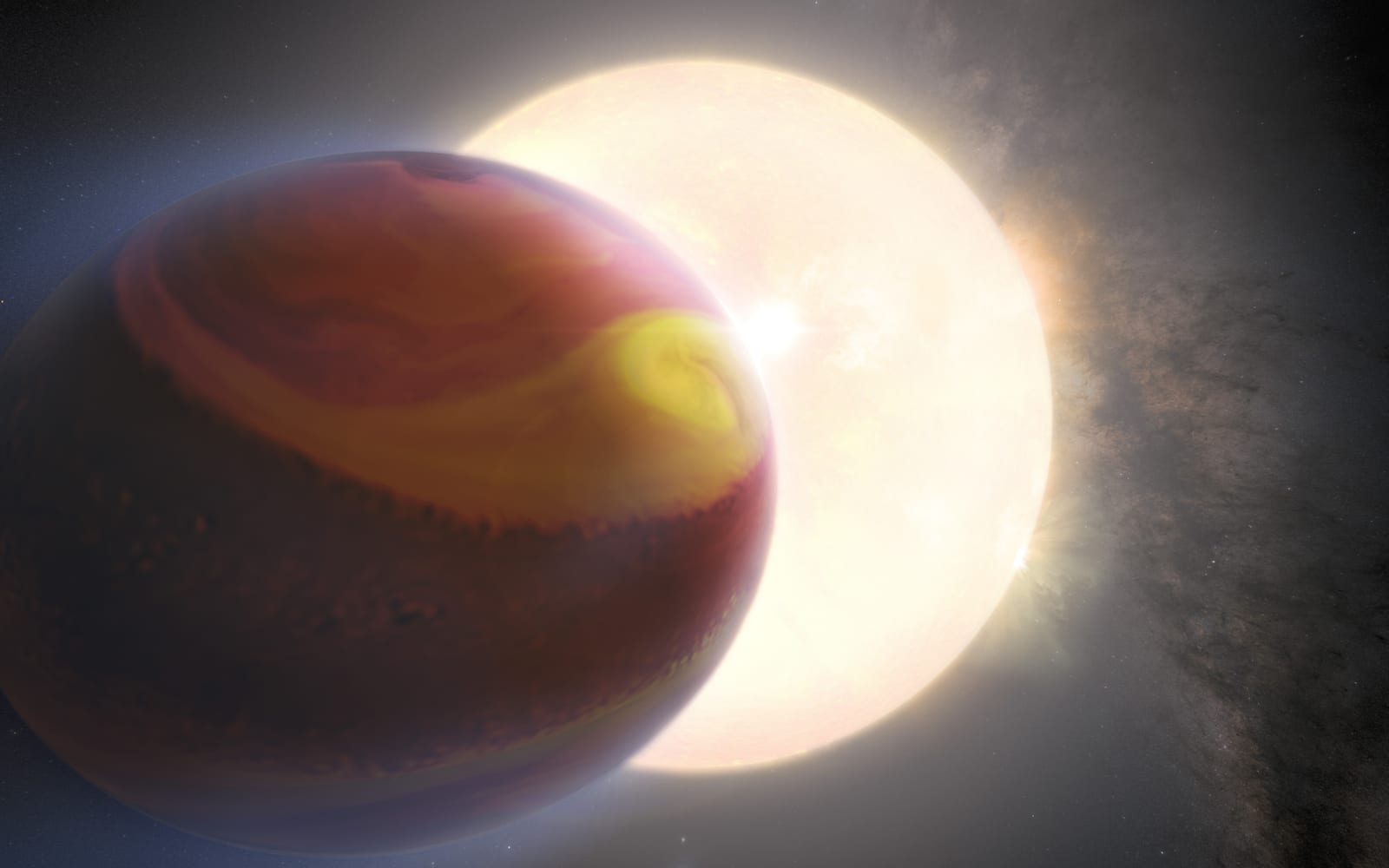
WASP-121 b is an ultra-hot Jupiter about 880 light-years away in the constellation Puppis. It orbits its star at just 2.6% of the distance between Earth and the Sun, completing one lap every 30 hours. The proximity has tidally locked the planet, meaning the same hemisphere always faces the star.
The permanent dayside reaches roughly 2,770 Kelvin (about 2,500 degrees Celsius). The permanent nightside hovers around 1,000 Kelvin (about 725 degrees Celsius). In between, where the planet rotates into and out of the star's glare, lie two narrow transition zones called terminators: the dawn side, where the planet rotates toward the star, and the dusk side, where it rotates away. Astronomers call them the morning and evening terminators.
Until now, no one had directly measured whether both sides of the terminator were the same. Theoretical models predicted they would not be. But nobody had the instrument to test it.
JWST's NIRSpec and NIRISS instruments gave a research team led by Cyril Gapp, a PhD student at the Max Planck Institute for Astronomy in Heidelberg, the precision they needed. The results, published June 11, 2026 in Nature Astronomy, show that the evening terminator absorbs significantly more infrared light than the morning terminator. The two faces of this planet could not be more different.
How to measure a terminator
The trick was timing. When WASP-121 b transits its host star, it takes about 2.5 hours to cross the star's face. During that transit, the planet rotates by roughly 30 degrees relative to the observer. Early in the transit, we see more of the morning terminator. Late in the transit, the evening terminator comes into view.
Astronomers usually average a planet's entire transit signal to get a clean spectrum. Gapp and his colleagues did something different: they let the data vary over time, treating each phase of the transit separately. Statistical tests confirmed that the time-varying model fit the data significantly better than a flat average.
"With its unprecedented observational quality, JWST gives us the most detailed glimpses into distant planets to date," Gapp said. "By measuring how starlight absorption changes as WASP-121 b rotates, we probe its atmosphere longitude by longitude."
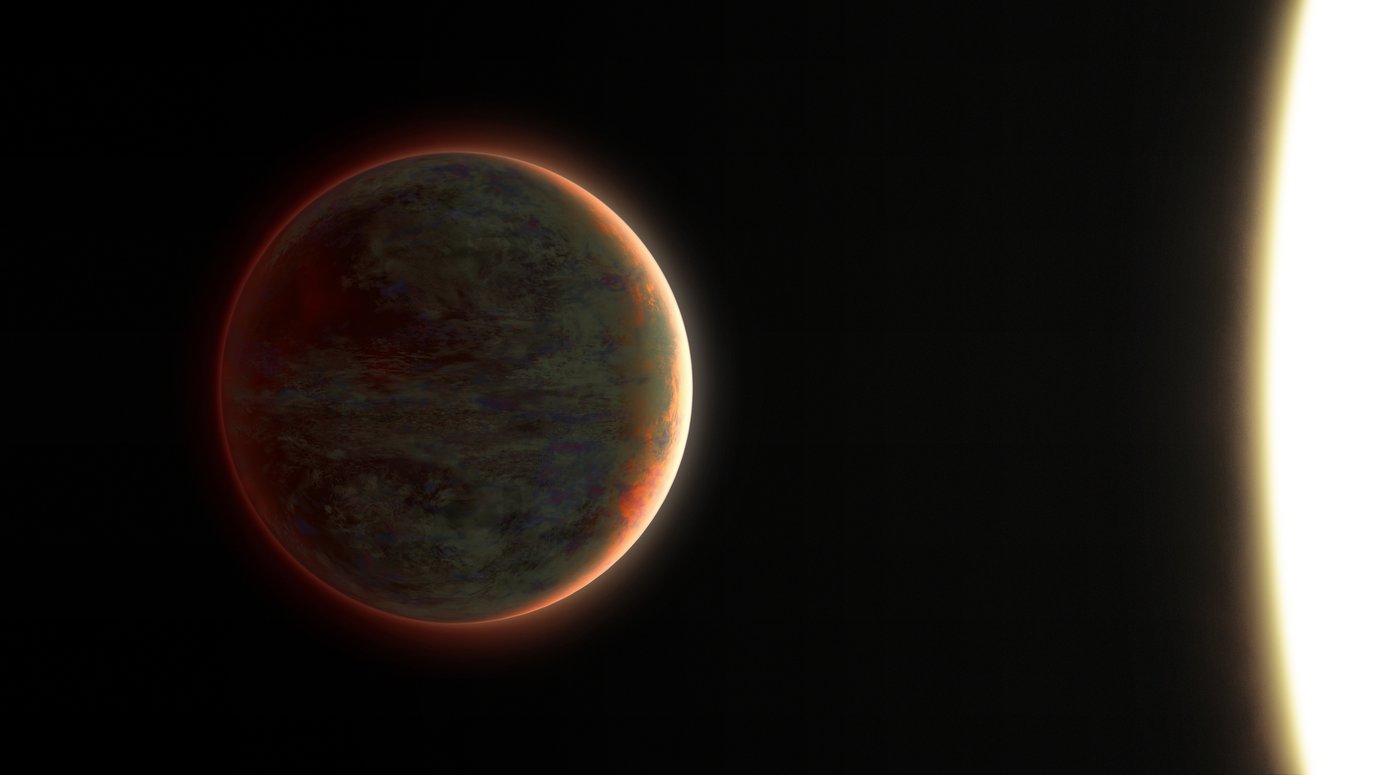
What they found was a clear asymmetry. The evening side absorbs more starlight, consistent with a hotter, more expanded atmosphere. The morning side absorbs less, suggesting it is cooler and more compressed. The difference is driven by fierce winds: superheated gas flows eastward from the dayside, following the planet's rotation, and piles up on the evening side.
Water torn apart, CO as a thermometer
The spectroscopy revealed two specific chemical signals that reinforce the picture.
Carbon monoxide (CO) appeared stronger on the evening side. But the increase is not about chemistry. It is about temperature. Carbon monoxide absorbs at specific infrared wavelengths, and when the gas is hotter, the absorption lines get stronger. The higher temperature on the evening side makes the CO signal look larger even though the actual abundance of CO molecules has not changed.
The water signal told a different story. Water (H2O) absorption actually drops on the evening side. The researchers interpret this as a real decrease in water molecules, not a temperature effect. The upper atmosphere is hot enough to break water apart into its constituent hydrogen and oxygen atoms, a process called thermal dissociation. On the morning side, where temperatures are lower, more water survives intact.
Both signals point in the same direction: the evening terminator is significantly hotter than the morning terminator, and the heat is strong enough to alter the planet's chemistry.
The cloud problem
When the team ran atmospheric circulation models to simulate the expected asymmetry, the models confirmed the general pattern: the evening side should be hotter and more expanded. But the observed signal was larger than the models predicted. Something was amplifying the difference.
The likely answer is clouds, but not the kind that form on Earth. Previous studies of WASP-121 b have found evidence for mineral clouds made of silicates, the same material that makes up sand and glass. These clouds would form on the cooler morning terminator, where temperatures drop enough for minerals to condense out of the gas phase. Once formed, they would act as a shield, blocking infrared radiation from the hotter layers below and making the morning side appear even cooler than the temperature alone would explain.
Most exoplanet atmosphere models do not include clouds, because simulating the physics of condensation and cloud formation in a dynamic environment is extremely difficult. The team adjusted their model to approximate the effect of mineral clouds on infrared radiation, and the results aligned more closely with observations. But confirming the presence of clouds will require more sophisticated models.
A blueprint for future studies
The method Gapp and his colleagues developed, called rotational transit spectroscopy, opens a new way to study exoplanet atmospheres. Instead of averaging across an entire transit and losing spatial information, astronomers can now map atmospheric properties longitude by longitude, reading a planet's weather patterns the same way you might read a clock by watching how the light changes as it rotates.
The team has already identified additional ultra-hot Jupiter candidates where the method should work. These planets share the same essential geometry: a short orbital period, tidal locking, and a temperature range that produces detectable atmospheric asymmetries. By building a sample, researchers can look for patterns across multiple planets and learn what controls terminator asymmetry in different environments.
For WASP-121 b itself, the discovery adds to a growing catalog of extreme planetary physics. Previous studies of the same planet have mapped its 3D atmospheric structure using ESO's Very Large Telescope, detected heavy metals escaping from its upper atmosphere with Hubble, and found evidence for exotic weather patterns. The new JWST data adds the dawn-dusk asymmetry to the list.
The finding also highlights the value of treating each transit as a continuous event rather than a single data point. As JWST continues to observe exoplanet atmospheres, the rotational transit technique could become a standard tool, turning the rotation of distant worlds into a natural spectrometer scanning their skies.
Sources
- Atmospheric asymmetries in WASP-121 b revealed by rotational transits detected with JWST (Nature Astronomy, 2026) - Gapp et al., peer-reviewed paper presenting the rotational transit spectroscopy discovery using JWST NIRSpec and NIRISS observations
- Max Planck Institute for Astronomy: From Dusk Till Dawn - MPIA press release with lead author quotes and technical background
- Phys.org: JWST reveals dawn-dusk atmosphere split on ultra-hot exoplanet WASP-121 b - detailed coverage with co-author quotes and temperature data from Tom Evans-Soma
- ScienceDaily: James Webb reveals two completely different twilights on an alien world - summary of the Nature Astronomy findings with mineral cloud discussion
- MPIA Science News: WASP-121 b terminator differences - direct MPIA science release with full author list and observing program details
Related on Impossible Universe
- JWST Found Salt Clouds on the Pink Planet. After a Decade, We Finally Know What's in Its Sky. - another JWST atmospheric detection on a world that spent 10 years as an enigma
- Jupiter-Sized Planets Lighter Than Cotton Candy: The Puffiest Worlds Ever Found - two planets with density lower than candy floss, found in a rare orbital resonance
- JWST Caught a Hot Jupiter Getting Flash-Heated. The Temperature Spike Was Worse Than Expected. - another JWST atmospheric time-resolved observation, watching an eccentric exoplanet get flash-fried at periastron
Hero image: NASA/ESA Hubble artist concept of WASP-121 b by Q. Changeat et al. and M. Zamani (ESA/Hubble). Inline artist impression by Patricia Klein and MPIA. Orbit diagram by MPIA (CC BY 4.0). This article describes peer-reviewed research published in Nature Astronomy on June 11, 2026 (DOI: 10.1038/s41550-026-02887-6).