A Supernova Exploded Near the Milky Way Central Black Hole. Astronomers Just Found Its Remains.
A team using NASA Chandra X-ray Observatory and ESA XMM-Newton data has found a possible supernova remnant in Sagittarius C, a star-forming region just a few dozen light-years from the supermassive black hole at the center of the Milky Way. The blast wave is racing through dense molecular clouds at two million miles per hour.
The center of the Milky Way is the most extreme neighborhood in our galaxy. A supermassive black hole, Sagittarius A*, sits at its heart, surrounded by dense molecular gas, long threads of magnetic field, and some of the most massive stars in existence. It is not a place where things stay quiet for long.
A team of astronomers led by Zhenlin Zhu at UCLA has found what appears to be a supernova remnant in Sagittarius C, a star-forming region just a few dozen light-years from the galactic center. If confirmed, it would be one of the closest supernova remnants ever discovered to the supermassive black hole at the center of the Milky Way.
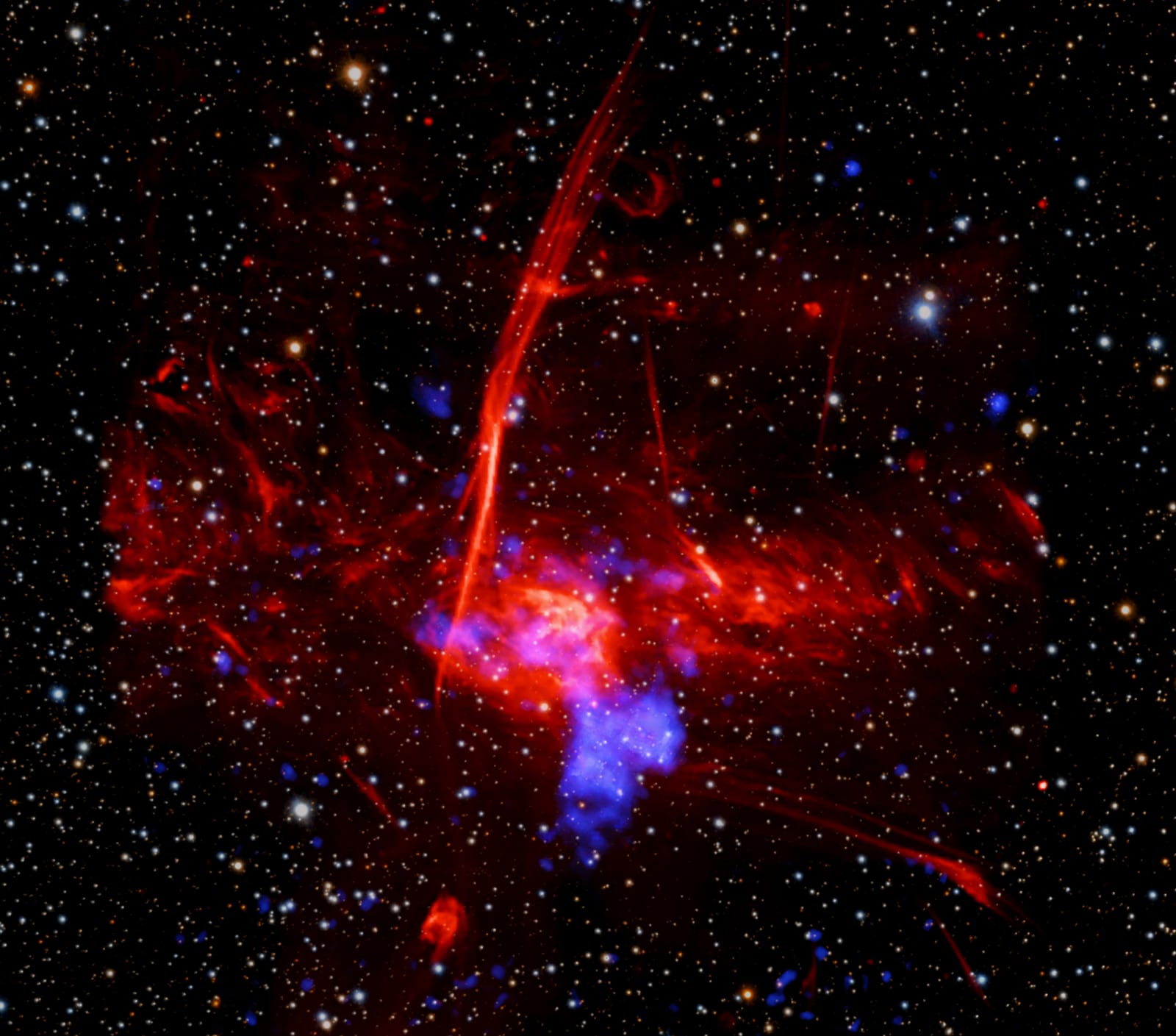
The evidence, published in The Astrophysical Journal and announced June 11 by NASA's Chandra X-ray Observatory, comes down to a blue blob of X-rays buried inside a much larger red cloud of radio emission. The blob is expanding at roughly two million miles per hour into the surrounding gas, and it has been doing so for at least 1,700 years.
How to spot a dead star's debris
The team used 20 years of data from NASA's Chandra X-ray Observatory and ESA's XMM-Newton mission to peer into Sagittarius C, a bright source of radio emission that marks a bubble of ionized hydrogen, called an H II region, surrounding a massive young star. The H II bubble sits inside a much larger cloud of molecular gas, and the whole complex lies within a few dozen light-years of Sagittarius A*.
Within that hot, chaotic environment, the X-ray data revealed something unexpected: a discrete blob of X-ray emission roughly ten times brighter than would be expected from a cluster of massive stars alone. The blob's position coincides with an expanding shell of gas that NASA's SOFIA mission, now retired, had previously detected in far-infrared observations. SOFIA had found evidence for a shock wave pushing through the molecular gas, a hint that a stellar explosion had occurred in this spot. The new X-ray data provides the strongest follow-up yet.
The researchers measured the X-ray spectrum of the blob and compared its brightness, temperature, and size against models of supernova remnants at various stages of evolution. The physical parameters matched a remnant expanding into a dense, clumpy molecular environment. The blast wave is plowing through gas that is thousands of times denser than the average interstellar medium, which slows the expansion but also makes the remnant brighter in X-rays.
The missing elements problem
Supernova remnants are not just expanding debris clouds. They are the delivery mechanism for heavy elements forged inside stars during their lifetimes. When a massive star explodes as a supernova, it scatters iron, oxygen, silicon, and other elements into interstellar space, where they eventually become part of new stars, planets, and, under the right circumstances, life.
The team searched the X-ray data for signs of elevated levels of these key elements, which would have been a clean signature of a supernova and would have confirmed the remnant. They did not find them. The X-ray spectrum showed no clear elemental enhancement above the surrounding environment.
That does not rule out the supernova interpretation. It may simply mean that the stellar debris, the material actually produced inside the exploded star, has already mixed completely with the surrounding dense gas. In a region as crowded and dynamic as the galactic center, mixing happens fast. The explosion could have happened long enough ago that the remnant's original chemical fingerprint has been diluted beyond recognition.
Without elemental enhancement, the case for a supernova remnant rests on the X-ray blob's brightness, its location inside a known expanding shell, and the fact that it is more than ten times brighter than any known collection of massive stars could produce. The alternative explanation, that the hot gas comes from stellar winds blowing off a cluster of young stars, does not fit the brightness data.
The paper describes the object as a "supernova remnant candidate." Confirmation will need deeper X-ray observations with higher spectral resolution, the kind that future missions like the proposed AXIS (Advanced X-ray Imaging Satellite) or the Chinese-led Einstein Probe follow-up might provide.
Why a supernova near the black hole matters
The galactic center is the nearest laboratory for studying how stars live and die in one of the most extreme gravitational and radiative environments in the modern universe. It is also notoriously difficult to observe. Thick clouds of molecular gas block visible light, which is why astronomers rely on X-rays, radio, and infrared to study the region.
Finding a supernova remnant so close to Sagittarius A* tells astronomers that massive stars are forming and exploding right next to the black hole, a region that was once thought to be too hostile for star formation. The dense molecular clouds that feed the black hole also feed the stars, and when those stars die, their debris enriches the very gas that may eventually fall into the black hole.
The multi-wavelength approach that made this discovery possible is also worth noting. The X-ray detection came from Chandra and XMM-Newton. The radio context came from MeerKAT, a radio telescope array in South Africa that has revolutionized galactic center imaging. The optical background came from Pan-STARRS in Hawaii, and follow-up infrared data came from the James Webb Space Telescope. Each wavelength sees something different, and together they produce a complete picture that no single telescope could capture.
Sagittarius C is one of several massive star-forming complexes near the galactic center. If this candidate is confirmed, it opens the door to finding more supernova remnants in similar environments, remnants that have been hidden for decades behind gas, dust, and sheer observational difficulty.
Sources
- Zhu et al., The Astrophysical Journal (2026) - peer-reviewed paper presenting the discovery of the supernova remnant candidate in Sagittarius C
- NASA Science: NASA's Chandra Discovers Possible Supernova Remnant in Galactic Center - NASA press release with mission context and researcher quotes
- NASA Image Article: Chandra Finds Possible Supernova Remnant (June 11, 2026) - composite image release with credit details and visual description
- Chandra Photo Album: Sagittarius C - additional imagery including JWST close-up view and 3D printable files
- Sci.News: Possible Supernova Remnant Found in Sagittarius C (June 2026) - independent coverage with additional scientific context
- Scientific American: NASA's Chandra Observatory Spots Possible Supernova Remnant in the Middle of Our Galaxy (June 2026) - broader coverage of the discovery and its implications
Related on Impossible Universe
- Chandra Found Something Unexpected in a Galaxy 15 Million Light-Years Away: Not a Single Supernova Aftermath Was Sitting Still - another Chandra discovery that upended assumptions about what supernova remnants do after the explosion
- A Star Vanished From Andromeda. Astronomers Think It Fell Into a Black Hole. - a different type of extreme stellar event in the heart of a galaxy
- If Black Holes Are Not What We Think, the Universe Could Be Filled With Things That Look Like Them but Are Not - the strange physics of compact objects, from the very center of galaxies to the theoretical edge of physics
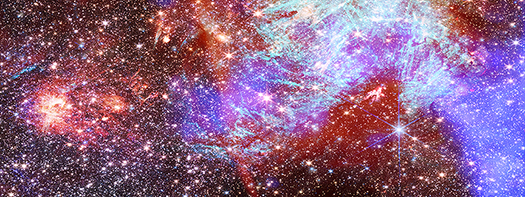
Hero image is a composite of X-ray data from NASA's Chandra X-ray Observatory and ESA's XMM-Newton (blue), radio data from the MeerKAT telescope (red), and optical from Pan-STARRS. Close-up image adds JWST infrared data. All NASA/ESA images are public domain. See individual image credits for full attribution. This article describes peer-reviewed research published in The Astrophysical Journal (Zhu et al. 2026). The supernova remnant candidate has not been definitively confirmed.