Astronomers Found the First of 10,000 Missing Black Holes in Omega Centauri. It Took Hubble 20 Years to Spot It.
The globular cluster Omega Centauri, a dense ball of 10 million stars 17,000 light-years away, should contain about 10,000 stellar-mass black holes. For decades none were found. Now, using 20 years of Hubble archival data and new JWST observations, astronomers have finally detected the first one: a 4.46-solar-mass black hole tracked by the motion of a visible star in a 94-year orbit.
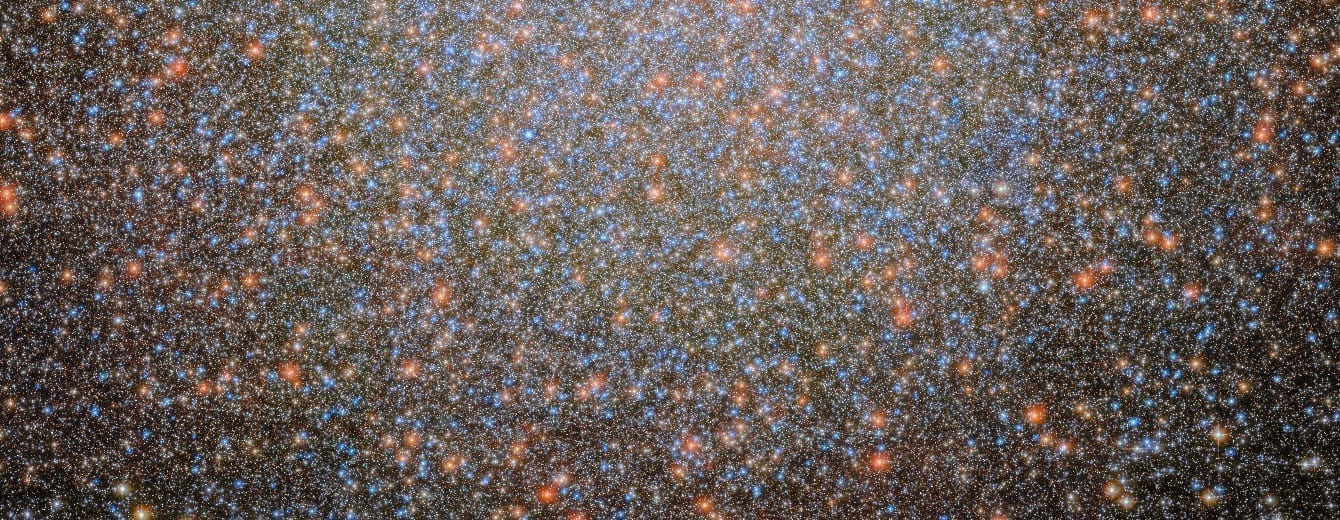
Omega Centauri, the largest globular cluster in the Milky Way, is a dense ball of roughly 10 million stars about 17,000 light-years from Earth. For decades, astronomers have believed it should contain about 10,000 stellar-mass black holes, the collapsed remnants of massive stars that long ago exploded as supernovae and sank toward the cluster's center. Yet no one had ever found a single one. They were, as NASA put it, the cluster's missing black holes.
Now, a team of astronomers has finally found the first. Using over 20 years of archival images from the Hubble Space Telescope and new observations from the James Webb Space Telescope, researchers detected a black hole called oMEGACat BH-2 not by any light it emits, but by tracking the minute motion of a visible star orbiting an invisible companion. The star, a modest 0.78 solar masses, traces an orbit that takes 94 years to complete, making this the longest-period black hole binary system ever discovered. The findings were published July 13 in the Astrophysical Journal Letters.
"While we already knew that the star was 0.78 solar masses, we can now calculate the black hole's mass, which is 4.46 solar masses and therefore too heavy to be a neutron star," said Anil Seth of the University of Utah, a coauthor of the study. "We now know that a metal-poor star is able to form a black hole like this, and we need to figure out how that happens."
Two decades of data, one invisible object
Black holes do not emit light unless they are actively pulling in gas, which causes the gas to heat up and glow. Most of the black holes expected in Omega Centauri are dormant and dark, invisible to even the most powerful telescopes. The only way to find them is by their gravitational influence on nearby stars.
The team led by the University of Utah used hundreds of images taken by Hubble between 2002 and 2023, measuring the positions of individual stars in the cluster with extraordinary precision over two decades. They combined this with near-infrared data from JWST to improve the measurements further. By tracking how one particular star moved across the sky, they could calculate the mass of whatever was pulling on it.
The earlier data had suggested the invisible companion might be a neutron star, the dense collapsed core of a star that was not quite massive enough to form a black hole. But the expanded dataset told a different story. At 4.46 solar masses, the object was too heavy to be anything but a black hole. The visible star itself, at 0.78 solar masses, is less massive than the Sun, making the black hole nearly six times heavier than its companion.
A black hole that was not born with its companion
The 94-year orbit is not just a record. It tells astronomers something important about how this binary system formed. If the star and black hole had started out together as a pair of massive stars, the shorter-lived star would have exploded as a supernova and collapsed into the black hole first. Any stars born together would have had roughly similar ages and masses. But the visible star at 0.78 solar masses is a lightweight, and the black hole is surprisingly modest compared to others formed from metal-poor environments.
The researchers calculated that the system was probably formed dynamically. The star and black hole likely did not begin together. Instead, they stumbled into each other in the dense interior of the globular cluster, captured by each other's gravity into a long, slow orbit. The arrangement is fragile. The team estimates that oMEGACat BH-2 will survive for less than a billion years before close encounters with other stars in the cluster tear the pair apart. That is a short lifespan in a cluster that is roughly 12 billion years old.
That short lifespan helps explain why no one had found a black hole in Omega Centauri before. Most of the black holes formed early in the cluster's history have already been ejected by gravitational interactions with other stars and black holes. The remaining ones, like oMEGACat BH-2, may be the stragglers that happened to find a companion to hold on to.
What the mass means
The black hole's mass of 4.46 solar masses is lower than expected for a black hole formed in a metal-poor environment like Omega Centauri. Stars in globular clusters formed early in the universe's history from gas that contained very few heavy elements. In theory, metal-poor stars should produce more massive black holes because there are fewer heavy elements in their cores to drive mass loss through stellar winds before the final collapse.
oMEGACat BH-2 does not fit that pattern. It is on the lower end of the stellar-mass black hole range, closer to the 5-solar-mass black holes found from gravitational wave detections than the 10-to-20-solar-mass black holes expected from metal-poor progenitors. That means either the formation models need adjustment, or this black hole started with a different evolutionary history than the standard picture predicts. The detection provides some data to those who model black hole formation in metal-poor environments, a puzzle that has been almost entirely theoretical until now.
The first of 10,000
The discovery of oMEGACat BH-2 is just the beginning. The Hubble and Webb dataset that enabled this detection covers thousands of stars across the cluster, and the same technique can be applied to find more dark companions. The team's approach, combining two decades of astrometric data with precise near-infrared photometry, has proven that dormant black holes in dense star clusters can be found even when they are not accreting gas.
Omega Centauri has long been suspected to be the stripped core of a dwarf galaxy that merged with the Milky Way billions of years ago, not a typical globular cluster. If that is true, its black hole population may be different from that of other clusters. The discovery of oMEGACat BH-2 gives astronomers their first real data point to test that idea.
"This detection is providing some data to those who do that kind of modeling," Seth said. For now, it is one black hole found out of an estimated 10,000. The other 9,999 are still waiting.
Sources
- NASA's Hubble Discovers First of Star Cluster's Missing Black Holes (NASA Science, July 13, 2026) - NASA press release with quotes from Anil Seth (University of Utah)
- NASA's Hubble Discovers First of Star Cluster's Missing Black Holes (STScI News Release 2026-017, July 13, 2026) - STScI press release with technical details and image credits
- Hubble Discovers First of Star Cluster's Missing Black Holes (ESA/Hubble, July 13, 2026) - ESA/Hubble coverage with image archive
- The 1st of 10,000 Missing Black Holes in the Omega Centauri Star Cluster Has Been Found (Space.com, July 2026) - News coverage with additional context
- NASA's Hubble Discovers First of Star Cluster's Missing Black Holes (NewsNation, July 2026) - Coverage with interview excerpts
- ESA/Hubble Image Archive: Star Clusters - ESA/Hubble image archive with Omega Centauri wide-field images
Related on Impossible Universe
- 390 Black Hole Mergers and Counting. The Gravitational Wave Catalog Just Got 161 New Entries. - How gravitational wave astronomy is cataloging black hole mergers across the universe
- JWST Weighed a Dormant Black Hole 6 Billion Times the Sun's Mass, 10 Billion Light-Years Away. It Was Nearly Invisible. - Another dormant black hole, at the other end of the mass scale
- Could a Dying Star Create a Tiny New Universe? The Gravastar Hypothesis Suggests Black Holes Might Not Be What We Think. - An alternative to the black hole model that challenges what lies inside
- Hundreds of Stars Born at Different Eras Clustered Together. This Ancient Fossil Found by Hubble and Webb May Rewrite Galactic History. - Another globular cluster-like object studied by Hubble and Webb, with a different story
- A Supernova Exploded Just a Few Dozen Light-Years From the Milky Way's Central Black Hole. Chandra Just Found the Remains. - A supernova remnant found near the galactic center, another way astronomers find dead stars in extreme locations
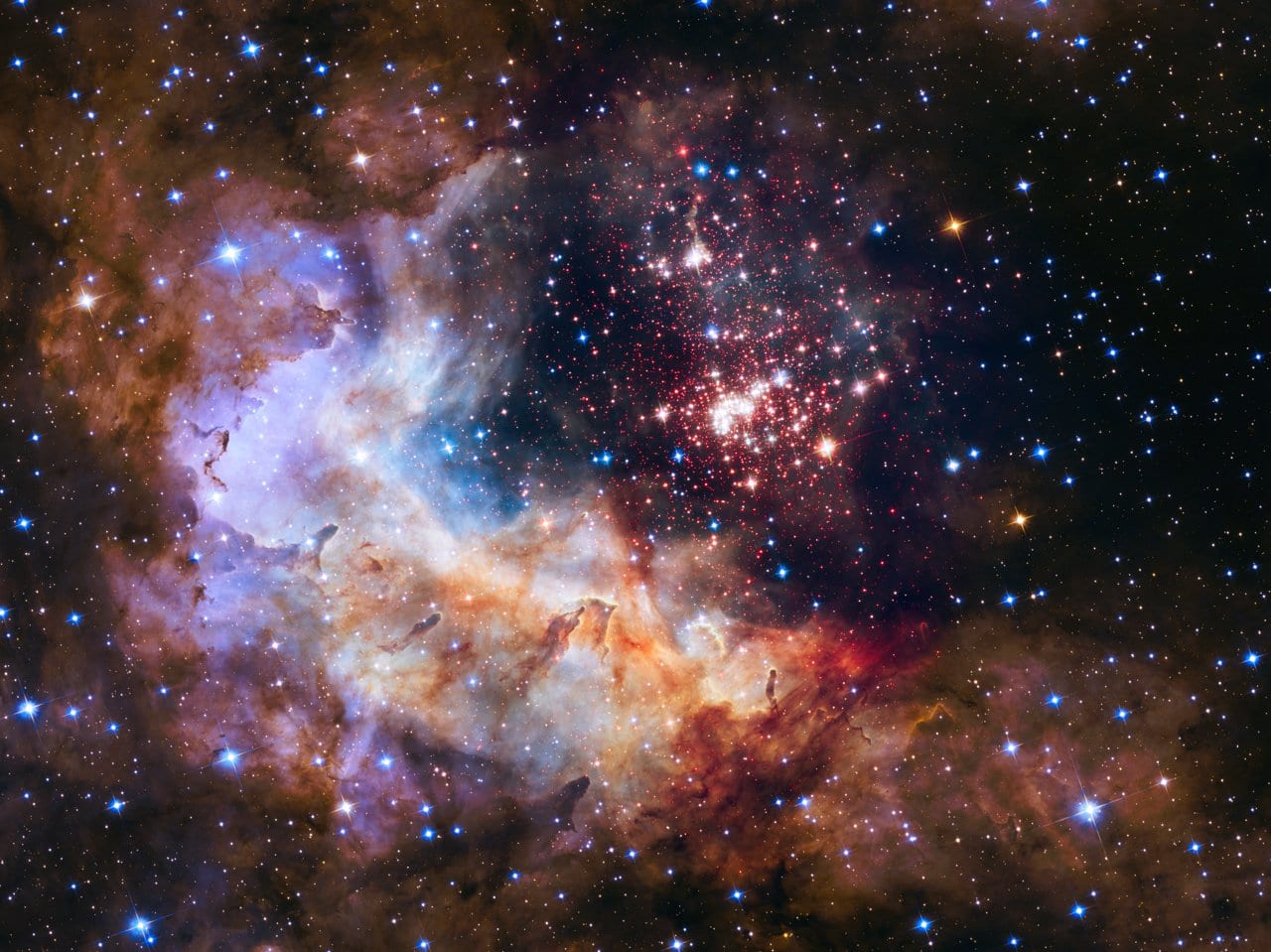
Hero image: Hubble Space Telescope image of the globular cluster Omega Centauri, the largest such cluster in the Milky Way. Credit: NASA, ESA, and the Hubble SM4 ERO Team. Inline image: Hubble image of Omega Centauri with the black hole candidate oMEGACat BH-2 location marked, showing the visible star's motion over 20-plus years of observations. Credit: NASA, ESA, STScI, University of Utah. Research published in The Astrophysical Journal Letters (Whitaker et al., July 13, 2026).