Astronomers Just Found a Fragment of the Galaxy's Birth Hiding in Plain Sight
A star cluster catalogued in 1968 was filed as a globular cluster and mostly ignored. Now Webb and Hubble have shown it contains four generations of stars born across 10 billion years, making it a surviving building block from the Milky Way's formation.
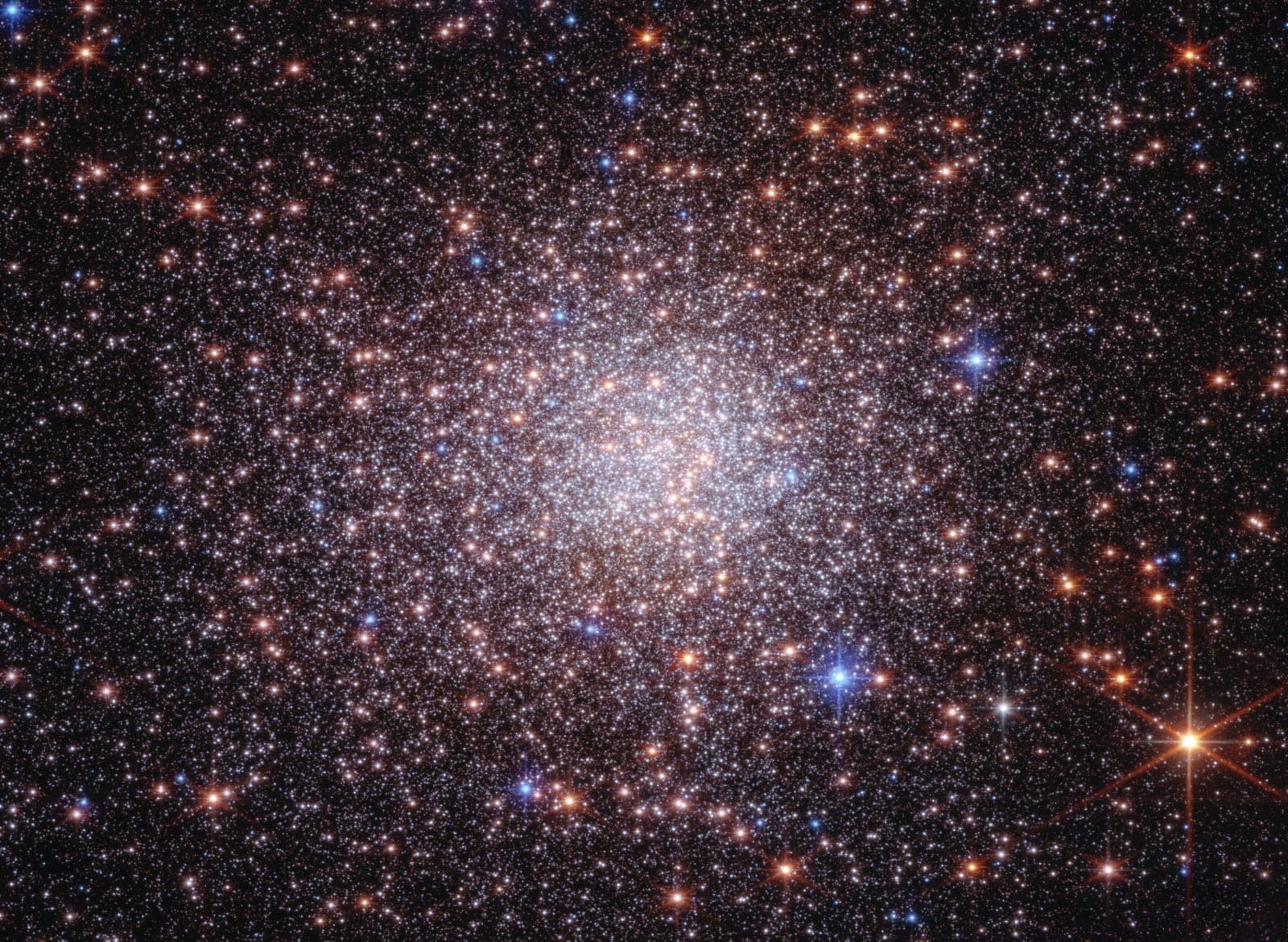
In 1968, French-Armenian astronomer Agop Terzan pointed a telescope toward the centre of the Milky Way and catalogued a faint, crowded ball of stars. It got an unremarkable label: Terzan 5. Astronomers filed it under "globular cluster" and moved on.
Fifty-eight years later, that label has been retired. Terzan 5 is not a globular cluster. It is something much stranger: a surviving fragment from the Milky Way's assembly line, a clump of stars that has been making new generations of itself for 12.5 billion years while the galaxy formed around it.
In results published June 16 in Astronomy & Astrophysics and presented at the American Astronomical Society meeting in Pasadena, a team led by researchers at the University of Bologna combined new observations from the James Webb Space Telescope with 12 years of Hubble data to show that Terzan 5 contains four distinct populations of stars, born at four different moments separated by billions of years. The finding creates a new category of object: the "bulge fossil fragment."
Four generations, one cluster
Globular clusters are supposed to be simple. A single cloud of gas collapses, forms a single batch of ancient stars, and then shuts down the factory. No new stars. No second acts. Most globular clusters have been chemically dead for over 10 billion years.
Terzan 5 refused to follow the script.
In 2009, astronomers noticed something odd: the cluster contained stars with two very different chemical signatures. Hubble observations in 2016 estimated their ages at roughly 12 billion years and 5 billion years, suggesting the cluster had somehow restarted star formation billions of years after its first generation. At the time, the leading explanation was that Terzan 5 might have collided with a giant gas cloud or another cluster, acquiring fresh fuel for a second round.
The new Webb data blows that two-generation model apart.
"Webb's new near-infrared observations, cross-referenced with Hubble's archival observations, have given us a much clearer picture of the history of Terzan 5," said Giorgia Zullo, the PhD student at the University of Bologna who led the new research.
Using Webb's NIRCam instrument, the team peered through the thick dust that shrouds the Milky Way's central bulge and catalogued stars far fainter than any previous attempt could reach. To separate Terzan 5's actual members from the millions of unrelated stars in the foreground and background, the researchers used 12 years of Hubble proper motion measurements, tracking the tiny sideways drift of individual stars to determine which ones belong to the cluster.
The result was a census showing not two, but four distinct stellar populations. The oldest formed 12.5 billion years ago, when the Milky Way itself was still assembling. The next came 4.7 billion years ago, just before Earth finished forming. A third formed 3.8 billion years ago, around the time the first single-celled life appeared on Earth. And a fourth, remarkably, formed only 2.5 billion years ago, when our planet's atmosphere was turning oxygen-rich.
That is roughly 10 billion years of intermittent star formation inside a single surviving object.
How it survived
Star formation requires raw material: gas and dust. For Terzan 5 to produce four generations of stars, it had to hold onto that material for 10 billion years while orbiting inside one of the most chaotic, crowded regions of the galaxy. That should not be possible. The Milky Way's central bulge is a gravitational scrum of stars, dust lanes, and tidal forces that ought to tear a small cluster apart or at least strip away its star-forming gas.
Terzan 5 did something unusual: it was heavy enough to resist.
"For some reason, this peculiar clump of stars formed separately from the bulge and was not destroyed as the bulge itself formed," said Francesco R. Ferraro, a professor at the University of Bologna and principal investigator of the Webb observations. "Terzan 5 is what we now call a bulge fossil fragment because it resembles the primordial clumps that contributed to the formation of the bulge."
The clue is in the chemistry. Measurements from the W. M. Keck Observatory and the European Southern Observatory's Very Large Telescope show that each successive generation of stars in Terzan 5 contains progressively more heavy elements, forged in the supernovae of earlier generations and recycled into the next batch. In a typical globular cluster, the force of those early supernovae would have blasted away any leftover gas, ending star formation permanently. Terzan 5 was massive enough that its gravity held onto the debris.
"Along with the ages of these populations, the cluster preserves a fossil record of progressive enrichment of heavy elements by supernovae," said co-author R. Michael Rich, a research astronomer at UCLA.
A lump in the cake batter
The standard picture of how the Milky Way formed goes something like this. In the early universe, a large disk of gas fragmented into clumps. Those clumps formed stars, then migrated toward the centre of the growing galaxy, where they merged and spread out to create the bulge we see today. If that picture is right, the original clumps should have been thoroughly mixed, their individual identities lost in the blending.
Terzan 5 suggests the mixing was not always complete. Some clumps were dense enough, and massive enough, to survive intact. It is, as the researchers put it, like a lump in an otherwise well-mixed cake batter.
"Based on observations and in-depth simulations, we think that galaxies in the early universe had huge disks of gas that fragmented into clumps and formed stars," said Barbara Lanzoni, a co-author and associate professor at the University of Bologna. "Terzan 5 may provide direct evidence that can help explain how bulges formed in galaxies throughout the universe."
Webb has already spotted distant galaxies in the early universe that appear to be assembling from exactly this kind of clumpy structure, such as the Firefly Sparkle galaxy observed in 2024. Terzan 5 offers a local, close-up laboratory for studying the same process, 22,000 light-years from Earth rather than billions.
Not quite alone
Terzan 5 is only the second object to earn the "bulge fossil fragment" classification. The first was Liller 1, another stellar system in the Milky Way bulge that was reclassified from globular cluster after Hubble found it also contains multiple stellar generations.
There may be more. Ferraro's team plans to examine 40 to 50 additional globular clusters that orbit within the bulge to check whether they are single-generation globulars or multi-generation fossil fragments like Terzan 5. If more turn up, the bulge fossil fragment category could grow from a two-member curiosity into a recognised class of galactic relic.
Why it matters
The reclassification of one star cluster might sound like an arcane update to an astronomical catalogue. But the implications reach further. If surviving clumps like Terzan 5 were common during the Milky Way's formation, they may have been one of the primary building blocks of galactic bulges. Understanding how they formed, how long they survived, and what they left behind is a direct window into the construction history of our own galaxy.
There is also something satisfying about the way the discovery unfolded. Terzan 5 was catalogued in 1968 and largely ignored for 40 years. The first hint of its oddness appeared in 2009. Hubble sharpened the picture in 2016. Now Webb, combined with the long time baseline of Hubble's archive, has delivered the definitive evidence. It took three observatories, 12 years of proper motion data, PhD-level persistence, and the best infrared telescope ever built to figure out what one faint ball of stars in Sagittarius actually is.
The universe is full of objects that have been mislabelled. Some of them are hiding in plain sight, inside catalogues compiled decades ago, waiting for a better instrument to come along.
Sources
- ESA/Webb Science Release: Webb and Hubble reveal history of relic of the Milky Way galaxy's formation - primary press release with researcher quotes, methodology, and image credits
- NASA Science: NASA Webb, Hubble Reveal History of Relic of Milky Way's Formation - NASA coverage of the research with additional context on Webb and Hubble contributions
- ESA: Webb & Hubble reveal relic of our galaxy's formation - ESA institutional coverage with broader mission context
- Zullo et al., Astronomy & Astrophysics (2026) - peer-reviewed paper presenting the discovery of four stellar populations in Terzan 5 and the bulge fossil fragment classification
The hero image is a composite of near-infrared data from the NASA/ESA/CSA James Webb Space Telescope and optical light data from the NASA/ESA Hubble Space Telescope. Image credit: NASA, ESA, CSA, STScI, G. Zullo (University of Bologna), F. R. Ferraro (University of Bologna); Image Processing: A. Pagan (STScI). ESA/Hubble/Webb images are released under Creative Commons Attribution 4.0 International License (CC BY 4.0). This article describes peer-reviewed research presented at the 248th AAS meeting and published in Astronomy & Astrophysics.
Related on Impossible Universe
- Explore telescope and space mission stories on Impossible Universe - Webb, Hubble, and the observatories that revealed Terzan 5's true nature
- Euclid Spent 26 Hours Looking at the Milky Way's Core. It Came Back With 60 Million Stars. - a different instrument mapping the same crowded region of the galaxy
- Webb Peered Into the Cigar Galaxy and Found 16.5 Million Stars Hidden Behind the Dust - another story about resolving individual stars in regions too dense for earlier telescopes
- A Galaxy 15 Million Light-Years Away Is Putting On a Fireworks Show Nobody Expected - another discovery that was hiding in plain sight in a catalogued object