TESS Found Its First Planet by Watching It Warp Spacetime. A Super-Jupiter 40,000 Light-Years Away Bent Light to Reveal Itself.
NASA TESS satellite discovered its first planet using gravitational microlensing, a technique that detects planets by how they warp spacetime rather than by blocking starlight. Gaia23bra b, a super-Jupiter 40,000 light-years away, was found hiding in eight years of archived TESS data after being flagged by the Gaia space telescope in 2023.
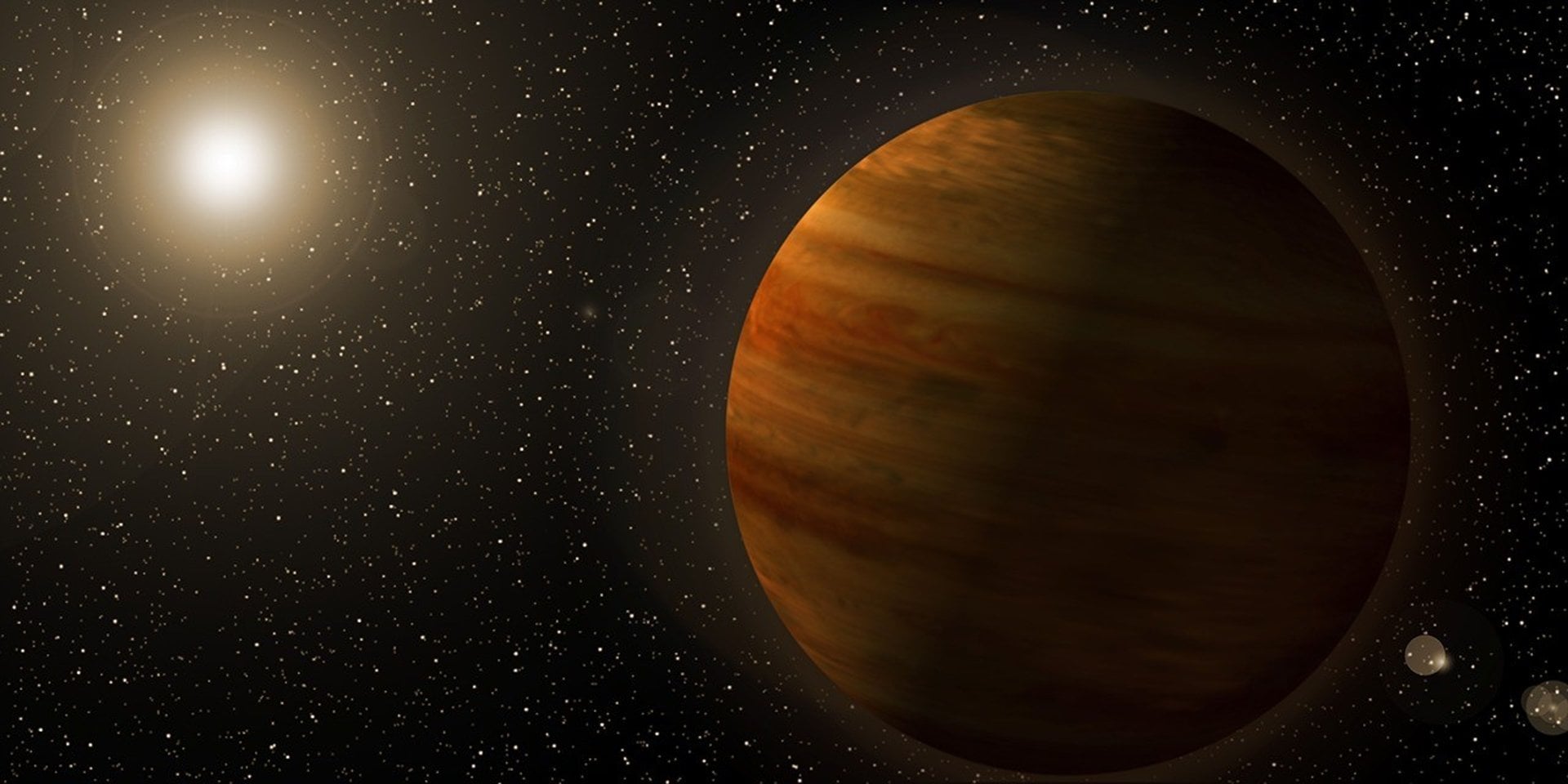
NASA's TESS satellite was designed to find planets by watching them cross in front of their stars. It has discovered thousands of worlds that way, mostly giant planets in scorchingly close orbits. But in July 2026, astronomers announced that TESS had done something it was never built to do: find a planet by watching it warp the fabric of spacetime.
The planet, named Gaia23bra b, is a super-Jupiter about 1.63 times the mass of Jupiter orbiting an orange dwarf star roughly 80 percent the mass of the Sun. It sits at a distance similar to Jupiter's orbit around our own Sun. And it is nearly 40,000 light-years from Earth, far beyond TESS's usual detection range of about 150 light-years.
"When TESS launched, no one expected it to ever be capable of finding this kind of planet," said Diana Dragomir, a professor at the University of New Mexico and co-author of the study published July 1 in The Astrophysical Journal Letters. "The discovery implies that there are probably other so-called microlensing planets hiding in TESS's data that we had not previously thought to look for."
How to find a planet with bent light
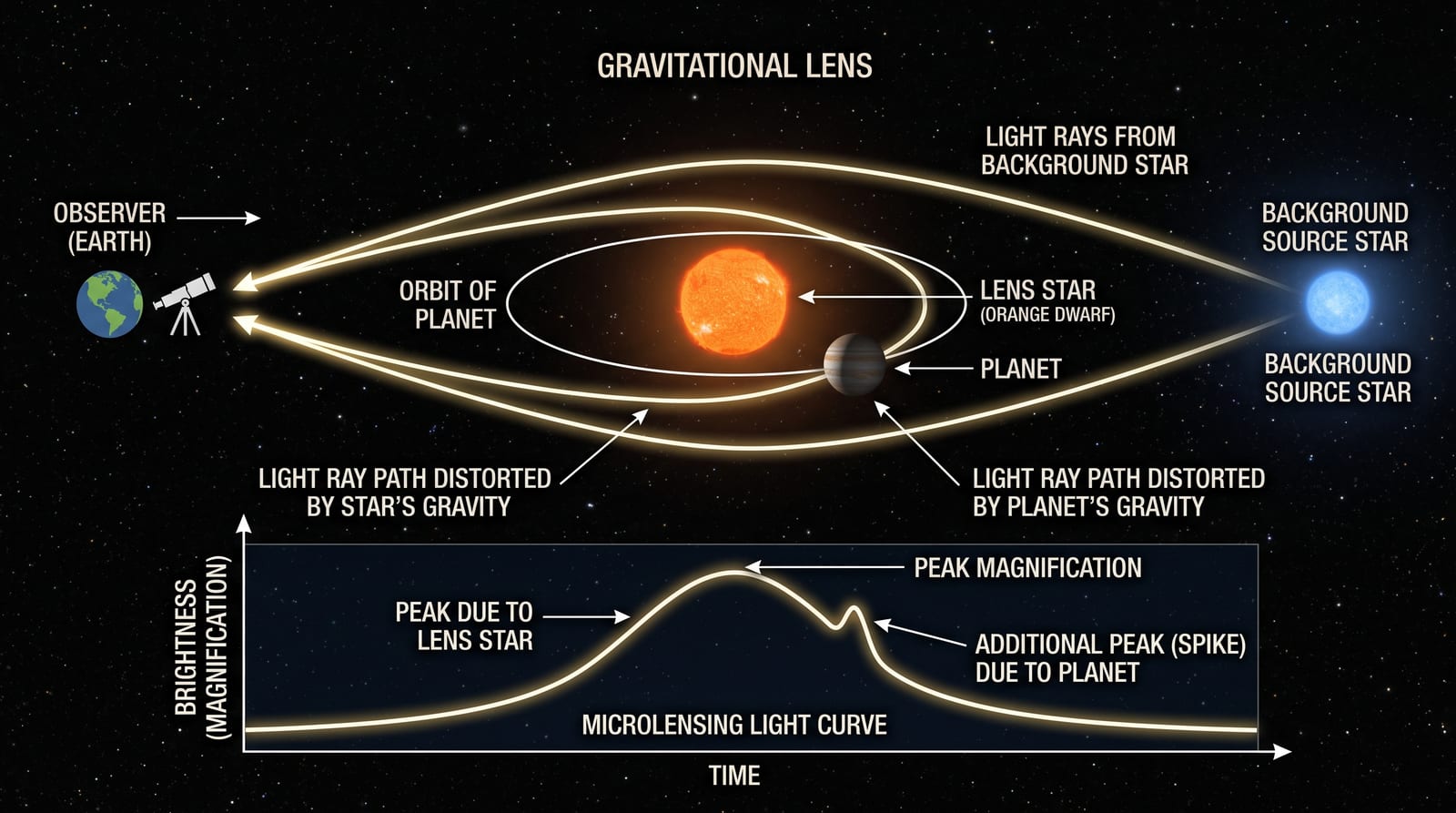
The technique that revealed Gaia23bra b is called gravitational microlensing. It works like this: when two stars align almost perfectly from Earth's perspective, the gravity of the closer star acts like a cosmic magnifying glass, bending and focusing the light from the more distant star behind it. The result is a temporary brightening that can last days or weeks.
If the foreground star has planets, those planets act as their own tiny lenses. Each planet produces a brief additional blip in the brightness curve of the background star, a deviation that reveals the planet's presence and allows astronomers to measure its mass relative to its host star.
Out of more than 6,000 known exoplanets, only about 5 percent have been found through microlensing. The technique is rare because it requires a near-perfect alignment that happens once and never repeats. But it is uniquely valuable because it can detect planets at orbital distances where the transit method cannot reach.
"Transits and microlensing are complementary because they each reveal a category of planet the other may not be able to detect," Dragomir said. "Transits give us the size of a planet. Microlensing gives us masses and orbital distances for planets we would otherwise never see."
A planet hiding in archived data
The story of Gaia23bra b begins in 2023. ESA's Gaia space telescope, which was mapping a billion stars across the Milky Way, flagged a star that had suddenly brightened. The signature looked like a microlensing event, but Gaia's scans were too widely spaced in time to reveal whether a planet was involved.
Mallory Harris, a Ph.D. candidate at the University of New Mexico and lead author on the study, went looking through TESS's archived data from the same patch of sky. TESS had been monitoring that area during the event, and its much denser time coverage showed what Gaia had missed: extra structure in the light curve that could only come from a planet.
"Gaia's observations were too sparse to pick up on the planet," Harris said. "TESS happened to be monitoring the same area of the sky during the event, and its denser time coverage showed extra features in the light curve caused by a planet."
The discovery means TESS's eight years of archived data may contain more microlensing planets that were recorded but never recognized. No one had looked for them before because TESS was not expected to have the sensitivity or time coverage for this technique. Gaia23bra b proved the concept works.
Why microlensing matters for planet hunting
The transit method, which TESS was designed for, is the most productive planet-finding technique in astronomy. It works by watching for the tiny dip in starlight when a planet crosses in front of its star. That makes it excellent at finding large planets in close orbits. Microlensing is its mirror image: it is most sensitive to planets at Earth-like distances or farther from their stars, orbiting at the same scale as the planets in our own solar system.
Most known exoplanets are hot Jupiters and ultra-short-period worlds that orbit their stars in days or hours. That is not because those planets are the most common. It is because they are the easiest to find. Microlensing offers a way to see the cooler, more distant planets that the transit method misses, giving astronomers a more complete census of what planetary systems actually look like.
The discovery is also a preview of what is coming next. NASA's Nancy Grace Roman Space Telescope, scheduled to launch on August 30, 2026, will carry a dedicated microlensing survey as one of its three core science programs. Over its five-year primary mission, Roman is expected to find roughly 2,600 exoplanets using microlensing, including potentially the first Earth-mass planets in the habitable zone. Gaia23bra b is proof that the technique works and that archived data from existing missions can still yield surprises.
"The main advantage of microlensing lies in the kinds of planets it is sensitive to," the team wrote. Planets that orbit very close to their stars essentially blend with the star's mass and do not produce a distinct microlensing signal. With microlensing, astronomers can find planets at orbital distances impossible for the transit method, filling in the missing middle of the exoplanet population.
What lies in TESS's archive
TESS has been surveying the sky since 2018, returning to the same patches of sky year after year. Its eight years of continuous monitoring create an enormous data set where rare events like microlensing alignments may be captured, recorded, and waiting to be found.
The Gaia23bra b discovery opens a new chapter for TESS, not as the transit survey it was designed to be, but as a serendipitous microlensing observatory. The same data that revealed thousands of close-in planets may contain dozens more distant worlds, hidden in the light curves of stars that happened to align perfectly, just once, while TESS was watching.
Sources
- TESS Discovers a Planet in the Gaia23bra Microlensing Event (Harris et al., The Astrophysical Journal Letters, July 1, 2026) - primary peer-reviewed paper describing the discovery
- NASA's TESS Mission Finds Planetary System in New Way (NASA Science, July 1, 2026) - NASA press release with quotes from Dragomir and Harris
- TESS Just Found a Planet in a New Way, and More May Be Hiding in Its Eight Years of Data (Phys.org) - detailed science coverage with technical context
- Warped Spacetime Reveals Exoplanet Far From Its Star (EarthSky) - accessible explainer with microlensing diagram
- NASA TESS Mission Overview - mission design, survey strategy, and discovery statistics
- NASA Roman Space Telescope Microlensing Survey - Roman's upcoming microlensing census expected to find thousands of planets
Related on Impossible Universe
- AI Found 118 Hidden Planets in NASA TESS Data. The Neptunian Desert Just Got Its First Head Count. - How AI and TESS data are reshaping our understanding of planetary populations
- JWST Caught an Ultra-Hot Jupiter Getting Roasted. The Temperature Spike Was Worse Than Expected. - Another extreme exoplanet with an unusual detection story
- JWST Saw Dawn and Dusk on a Hellish Exoplanet. The Two Faces Could Not Be More Different. - Temperature and chemistry differences on an ultra-hot Jupiter
- JWST Found Salt Clouds on the Pink Planet. After a Decade, We Finally Know What's in Its Sky. - Atmospheric detection on a planet that resisted study for years
- The Roman Space Telescope Is About to Launch. Its 100x-Hubble View Will Rewrite Astronomy. - Roman will find thousands of planets using the same microlensing technique
Hero image: NASA Goddard Space Flight Center artist concept of Gaia23bra b (public domain). Inline microlensing diagram: Generated illustration for Impossible Universe. Research published in The Astrophysical Journal Letters (Harris et al., July 1, 2026).