Astronomers Found the First Atmosphere on a Rocky World in the Habitable Zone. A Helium Leak Gave It Away.
For the first time, astronomers have confirmed an atmosphere around a rocky planet orbiting inside another star's habitable zone. LHS 1140 b, 48 light-years away, was found through escaping helium detected by the WINERED spectrograph at Chile's Magellan Observatory. The atmosphere has likely survived for more than 3 billion years, making it the strongest candidate yet for studying potentially habitable worlds beyond our solar system.
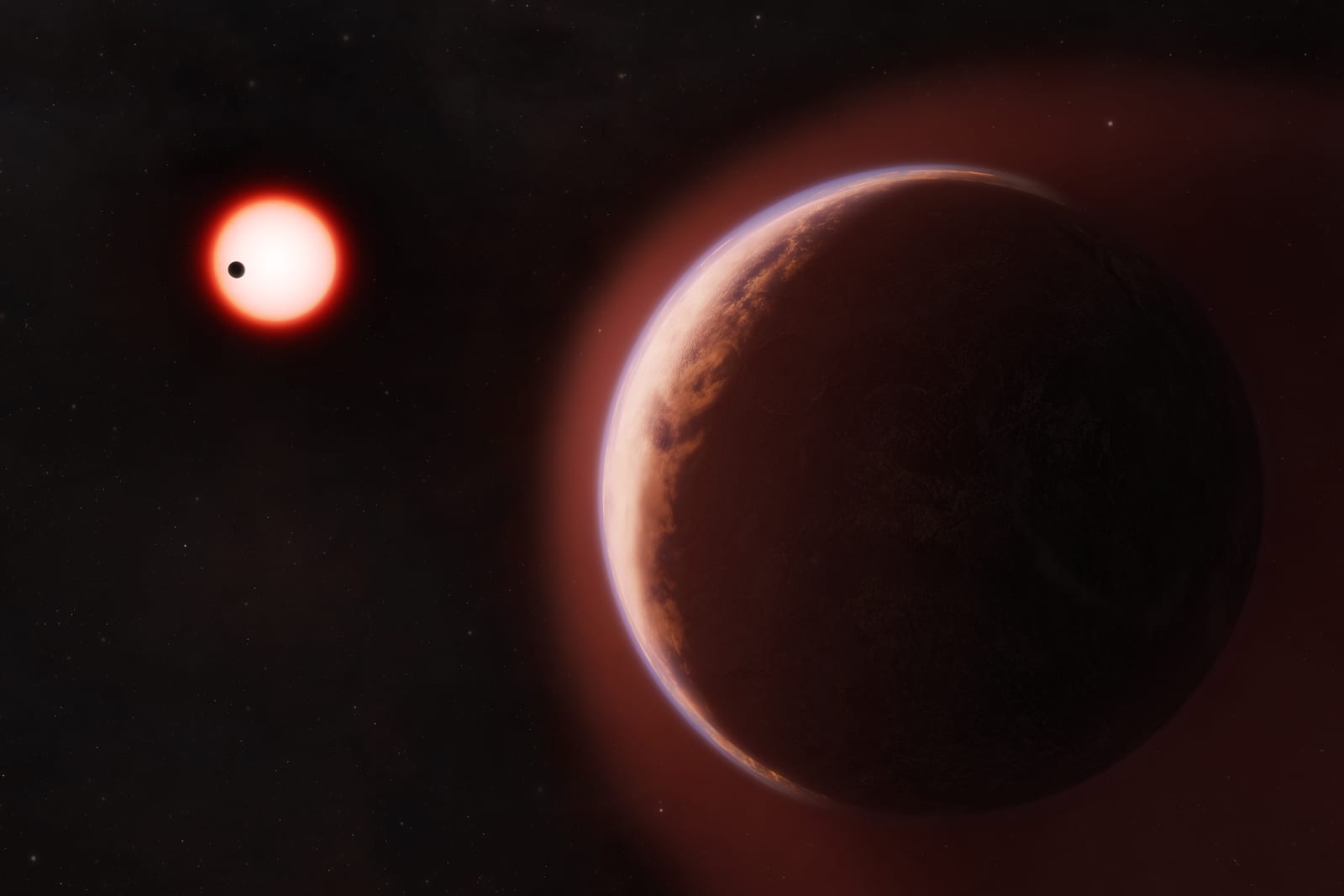
For the first time, astronomers have confirmed an atmosphere around a rocky planet orbiting inside the habitable zone of another star. The planet, LHS 1140 b, sits 48 light-years away in the constellation Cetus, circling a small red dwarf star much cooler and dimmer than the Sun.
The atmosphere was not detected directly. Instead, researchers at Harvard and the Smithsonian used a spectrograph in the Chilean Andes to spot helium slowly leaking from the planet's upper atmosphere. The signal, published July 16, 2026, in the journal Science, represents a milestone in the search for potentially habitable worlds beyond our solar system.
"This is the first time anyone has found an atmosphere on a rocky planet in the habitable zone of another star," said Collin Cherubim, lead author of the study and a recent Ph.D. graduate from Harvard's Department of Earth and Planetary Sciences.
Why finding atmospheres on rocky worlds is so hard
Astronomers have discovered thousands of exoplanets, including several rocky worlds orbiting in the habitable zones of their stars. But knowing whether a planet has an atmosphere is a much harder question than detecting the planet itself.
For gas giant exoplanets like Jupiter, atmospheric detection is routine. The thick, extended envelopes of these planets are easy to study when starlight passes through them during a transit. But rocky planets have much thinner atmospheres. A small exoplanet's atmosphere might account for only 0.01 percent of the starlight passing through it, a signal easily lost in the noise of the telescope and the activity of the star itself.
Red dwarf stars, the most common type of star in the galaxy, add another layer of difficulty. They are magnetically active, producing flares and starspots that can mimic or mask the signal from a planet's atmosphere. Several previous claims of atmospheres on rocky exoplanets, including planets in the TRAPPIST-1 system and GJ 1132 b, have been contested or remain inconclusive after follow-up observations.
The situation had grown frustrating enough that some researchers began to wonder whether any rocky planet around a red dwarf could hold onto an atmosphere at all. The intense X-ray and ultraviolet radiation from these stars can strip away a planet's atmosphere over billions of years, leaving a bare rock.
LHS 1140 b changed that picture.
A prediction, then a confirmation
The detection did not begin with a telescope. It began with a mathematical model.
Cherubim developed a theoretical model predicting which rocky exoplanets were most likely to have retained atmospheres. The model considered factors like the planet's mass, radius, orbital distance, the age and activity of its star, and the expected rate of atmospheric escape. LHS 1140 b stood out. The model predicted that if the planet had an atmosphere, it should be detectable through escaping helium in its upper atmosphere.
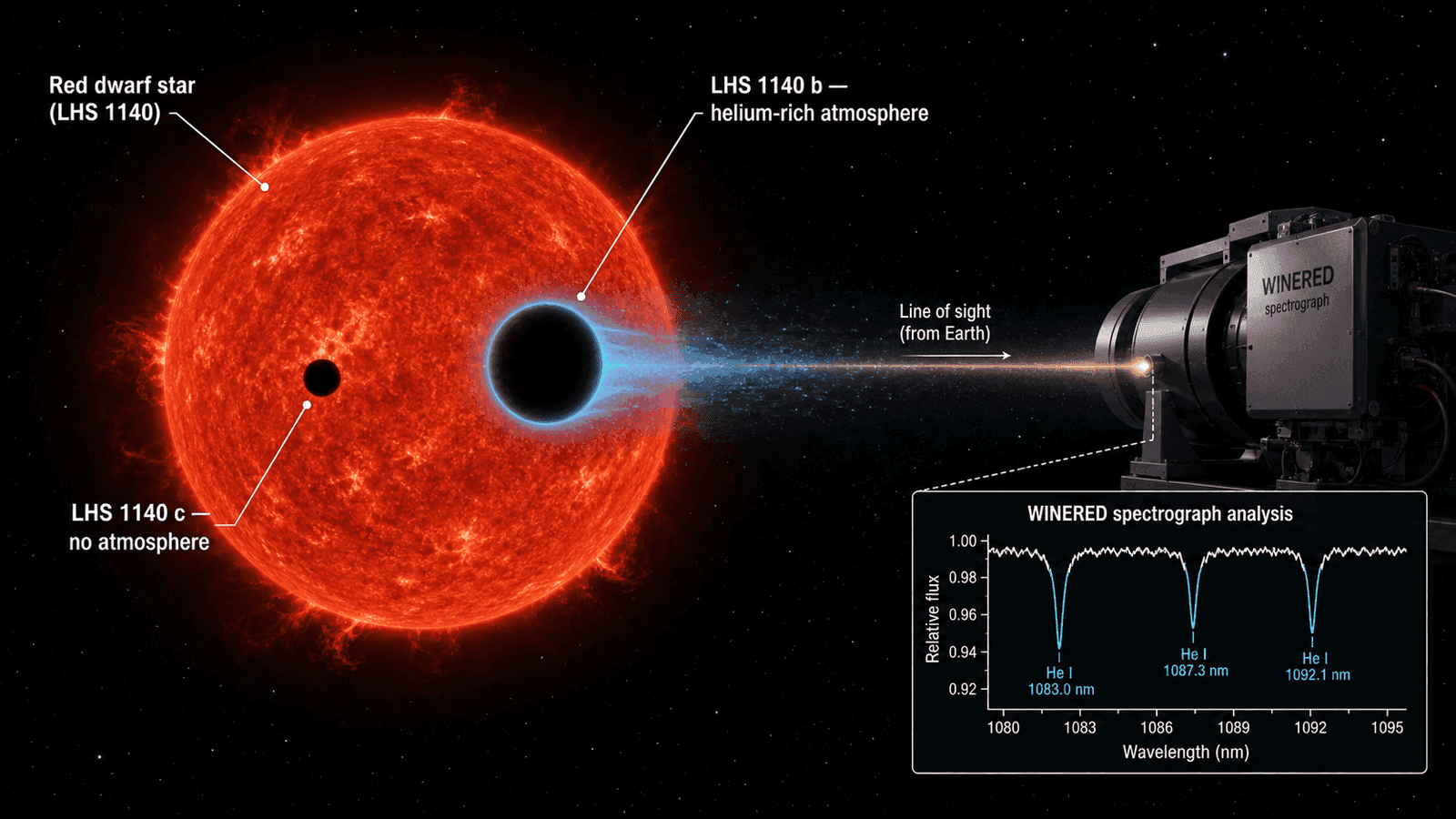
Helium is an ideal tracer for this kind of study. It is a very light gas that migrates to the top of a planet's atmosphere, where it absorbs specific wavelengths of infrared light. When a planet transits its star, a small fraction of the starlight passes through the uppermost atmosphere, and spectrographs can detect the characteristic absorption signature of helium. It is the same technique used to study the extended atmospheres of gas giants, but applying it to a rocky world in the habitable zone had never been done before.
Cherubim's advisor David Charbonneau, head of the Harvard Department of Astronomy, was initially skeptical. The prediction came from a theoretical calculation, and the signal had never been observed on a rocky world.
To test the prediction, the team used the WINERED spectrograph on the Magellan Clay Telescope at Las Campanas Observatory in Chile. They observed a rare alignment: both known planets in the LHS 1140 system, planet b and planet c, transited their star on the same night. This allowed the researchers to compare the two worlds directly under identical conditions.
Planet c, which orbits closer to the star and receives more radiation, showed no sign of an atmosphere. But LHS 1140 b produced a clear helium signal, statistically robust at 4.4-sigma significance the standard threshold for a discovery in physics.
"Collin analyzed the planets we knew about and predicted that this one would have a helium atmosphere," Charbonneau said. "Then he organized telescope time, got the data, and the detection was statistically rock solid."
What kind of atmosphere is it?
The detected helium is escaping from the planet's upper atmosphere. On Earth, helium produced by radioactive decay rises to the top of the atmosphere and slowly leaks into space. The same process is happening on LHS 1140 b, but on a much larger scale. The planet's upper atmosphere is rich in helium, and the escape rate suggests the atmosphere has been replenishing itself for billions of years.
The researchers found the helium signal in data from 2024 but not in 2025, indicating that the escape process is variable, likely driven by changes in the star's X-ray output. This variability is actually good news for the planet's habitability: it means the primordial hydrogen that the planet may have had at formation is long gone, and the current atmosphere is an evolved one, produced by the planet's own geological activity over billions of years.
Importantly, the helium detection does not tell us about the bulk composition of the atmosphere. Below the escaping upper layer, LHS 1140 b may have a thicker atmosphere containing other gases, including water vapor, carbon dioxide, nitrogen, or methane. The researchers estimate the planet's equilibrium temperature at roughly 116 degrees Fahrenheit (47 degrees Celsius), placing it comfortably within the range where liquid water could exist on the surface if the right conditions are met.
But the planet is almost certainly not a second Earth. LHS 1140 b is about 1.7 times Earth's radius and 5.6 times its mass, placing it in the super-Earth category. Its atmosphere, at least at the top, is helium-rich, not the nitrogen-oxygen mix we breathe. The habitable zone around a red dwarf also comes with serious caveats: the planet is likely tidally locked, with one hemisphere permanently facing its star, and it may experience regular stellar flares that bathe the surface in high-energy radiation.
None of those caveats diminish the importance of the discovery. The detection proves that ground-based telescopes can confirm atmospheres on rocky exoplanets, that theoretical models can predict which planets to study, and that at least one rocky world in the habitable zone has managed to hold onto its atmosphere for billions of years.
What comes next
LHS 1140 b is now one of the most important targets in exoplanet science. The planet's large size relative to its star and its frequent transits make it ideal for follow-up observations. The James Webb Space Telescope has already studied LHS 1140 b in previous cycles, and new observations are expected to search for water, carbon dioxide, methane, and other gases that would reveal the atmosphere's full composition.
The upcoming Extremely Large Telescopes, including the European Southern Observatory's ELT in Chile and the Giant Magellan Telescope, will have the light-gathering power to study the planet's atmosphere in even greater detail. These instruments could detect biosignature gases or confirm the presence of surface oceans, though neither is guaranteed.
Cherubim plans to use his model to search for other rocky worlds with detectable atmospheres, applying the same technique that succeeded for LHS 1140 b to other promising candidates. His Ph.D. dissertation, which earned him his doctorate for this work, will likely be cited for years as the starting point for a new field: ground-based atmospheric characterization of rocky exoplanets.
"This has been a model validation, and hopefully it's just the first of many more observations to come," Cherubim said.
The search for life beyond Earth is a long game. This discovery does not prove that LHS 1140 b is habitable or that it hosts life. It proves that the tools for finding out are finally ready.
Sources
- Cherubim et al., Science: An Atmosphere on a Rocky Exoplanet in the Habitable Zone (July 16, 2026)
- Center for Astrophysics | Harvard & Smithsonian: First Atmosphere Detected on a Habitable-Zone Rocky World (July 16, 2026)
- BBC News: First atmosphere found around Earth-like planet LHS 1140b
- EarthSky: 1st atmosphere detected on Earth-like, habitable-zone world
- Sci.News: Potential Atmosphere Detected on Habitable-Zone Exoplanet LHS 1140b