
A Planet With Eternal Day and Endless Night. A Tabletop Experiment in a Tank of Glycerol Found a Way Life Could Survive.
LHS 3844b, a tidally locked exoplanet 48.5 light-years away, bakes one side at thousands of degrees while the other hovers near absolute zero. Researchers at the University of Pennsylvania built a physical model of the planet mantle in a lab tank and found that internal heat circulation creates stable moderate-temperature zones that could support life.
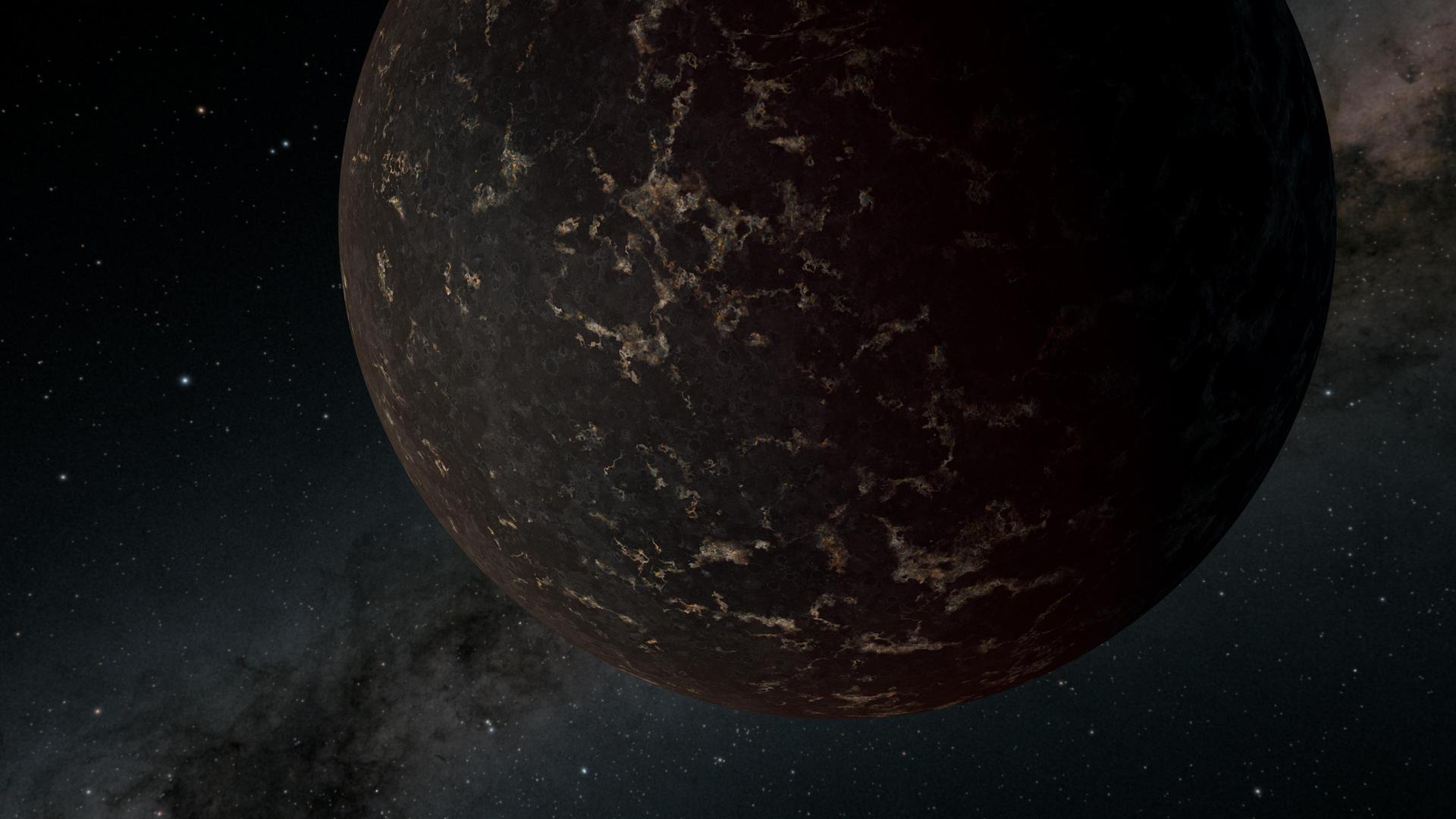
Fifty years ago, if you had asked an astronomer whether a planet with one side permanently baked at over 1,000 degrees Celsius and the other side frozen near the coldest possible temperature could support life, the answer would have been quick: no. The surface alone looks like a death sentence.
But the surface is not the whole planet. Below the crust, in the vast rocky mantle that separates a world's skin from its core, something unexpected may be happening. A team of researchers at the University of Pennsylvania, the Japan Agency for Marine-Earth Science and Technology, and Hokkaido University has shown that the same tidal locking that creates the extreme temperature contrast may also generate a stable, predictable heat circulation inside the planet, one that could create moderate-temperature zones where life might take hold.
They demonstrated it with a tank of glycerol and some color-changing liquid crystals on a lab bench.
The 11-hour day that never ends
The planet in question, LHS 3844b, orbits the red dwarf star LHS 3844 in the constellation Indus, 48.5 light-years from Earth. Discovered by NASA's TESS mission in 2018, it is a rocky world about 1.3 times the diameter of Earth with a mass estimated at 2.37 Earth masses. It completes one orbit every 11 hours.
That kind of tight orbit almost guarantees tidal locking. The same gravitational forces that keep the Moon's far side hidden from Earth have locked LHS 3844b's rotation to its orbital period. One hemisphere always faces the star, bathed in perpetual radiation. The other faces away, into permanent darkness.
Observations from NASA's Spitzer Space Telescope, which measured the planet's infrared glow before the mission ended in 2020, found that the day side reaches roughly 770 degrees Celsius (1,410 degrees Fahrenheit). The night side, with no atmosphere to redistribute heat, is cold enough that particle motion effectively stops. No sunrise. No sunset. No twilight.
Building an exoplanet on a tabletop
Daisuke Noto, a postdoctoral researcher in Hugo Ulloa's Penn GEFLOW Lab at the University of Pennsylvania, wanted to understand what happens inside a planet under those conditions. He did not have a spacecraft or a supercomputer budget. So he built a physical analog.
"Building an actual exoplanet in the lab was not in the budget," Noto said.
The setup was a rectangular tank filled with glycerol, a thick, viscous fluid. Seeded into the glycerol were thermochromic liquid crystals, tiny particles that change color with temperature, making invisible heat flow visible to the eye. Four thermostats around the tank created heating and cooling zones that mimicked the extreme temperature contrast between LHS 3844b's day side, night side, surface, and deep interior.
Mantle convection is driven by temperature and density differences, not by the Coriolis forces that shape weather and ocean currents. A tank with the right viscosity and temperature gradients can reproduce the essential physics of a planetary interior, even if the scale fits on a desk.

A slow, steady planetary heartbeat
The results, published in Nature Communications, revealed a remarkably orderly pattern. Hot material rose consistently beneath the simulated day side, flowed across the upper region toward the night side, cooled as it traveled, sank, and returned through the lower mantle. One continuous circulation loop, running again and again.
"It is not chaotic like Earth's mantle," Noto said. "It is slow and steady. Predictable. Kind of boring, but in a good way."
Earth's mantle is a turbulent system. Tectonic plates shift, plumes drift, and hotspots like the ones beneath Hawaii and Iceland wander over time. On a tidally locked planet, the single heat source on the permanent day side pins the circulation in place. The researchers also observed mushroom-shaped plumes rising from the heated base, but unlike Earth's migrating hotspots, these remained rooted to the same spot.
The team measured the heat transport efficiency, known as the Nusselt number, and found it comparable to Earth's own mantle. That match is significant: it means the internal circulation moves enough heat to create localized warm zones, especially at the planet's mid-latitudes, the transitional band between the scorching day side and the frozen night side.
What this means for life on tidally locked worlds
Tidally locked planets are not rare. They are the norm for close-in planets around red dwarfs, which are the most common type of star in the galaxy. If every one of those planets were automatically uninhabitable, the search for life beyond Earth would shrink dramatically. The new results suggest the picture is more complicated.
"Just looking at the extreme temperatures on the day and night sides might lead one to conclude these exoplanets are too harsh for life," Noto said. "But life might find a way."
The paper states that tidal locking "can contribute to maintaining moderate thermal environments locally by distributing heat flux laterally." In plain language: the same mechanism that locks a planet into an eternal split-personality climate also pumps heat from the blistered side toward the frozen one, creating a thermal gradient that is steep but not absolute.
The mid-latitude region, where the temperature gradient is gentlest, could maintain conditions stable enough for liquid water or geothermal activity. Noto's model does not claim life exists on LHS 3844b specifically. It shows that the internal conditions that support life, namely stable thermal environments with liquid solvents and available energy, are not ruled out by the surface extremes alone.
Beyond the tank: core dynamics and magnetic fields
The steady hemispheric flow may do more than keep the mid-latitudes warm. Noto speculates that the persistent circulation pattern could stir the planet's liquid core in ways that generate magnetic fields, an important factor for habitability because magnetic shields protect atmospheres from being stripped away by stellar radiation.
"That is something we could not test in this experiment," he said, "but it is an exciting direction for future work."
The team is planning follow-up experiments to explore core-mantle interactions and is extending the analog modeling approach to study geophysical systems on Earth, including hydrothermal fluid transport and heat flow in confined geological settings.
"We are planning to further extend the experimental methods to delve into different systems on our planet in different contexts," Noto said. "The possibilities are, quite literally, out of this world."
The finding adds a new dimension to the search for life beyond Earth. Astronomers have identified thousands of exoplanets, and the vast majority of the rocky ones in the habitable zone of red dwarfs are likely tidally locked. The standard assumption has been that permanent day and permanent night creates a world too extreme for biology. A tank of colored liquid on a lab bench in Pennsylvania suggests that assumption may need revision.
Sources
- Noto et al., "Tidal locking sustains moderate thermal environments in exoplanet mantles," Nature Communications, July 9, 2026 - the primary research paper
- Could exoplanets locked in eternal day and endless night support life? (Phys.org, July 2026) - coverage with quotes from the research team
- This alien planet never has sunrise or sunset. It may support life (ScienceDaily, July 9, 2026) - summary of the study
- LHS 3844 b - NASA Exoplanet Catalog - mission data and planet parameters
- LHS 3844b artist concept - NASA Science - public domain hero image source
Related on Impossible Universe
- JWST Caught an Ultra-Hot Jupiter Getting Roasted. The Temperature Spike Was Worse Than Expected. - another exoplanet with extreme temperature swings: HD 80606b's flash-heated atmosphere
- JWST Saw Dawn and Dusk on a Hellish Exoplanet. The Two Faces Could Not Be More Different. - JWST reveals the dramatic temperature and chemical differences between the two faces of an ultra-hot Jupiter
- TESS Found Its First Planet by Watching It Warp Spacetime. A Super-Jupiter 40,000 Light-Years Away Bent Light to Reveal Itself. - a different detection method reveals a super-Jupiter at extreme distance
- AI Found 118 Hidden Planets in NASA TESS Data. The Neptunian Desert Just Got Its First Head Count. - the broader census of exoplanets discovered by TESS
- JWST Found Salt Clouds on the Pink Planet. After a Decade, We Finally Know What is in Its Sky. - atmospheric chemistry on a planet that resisted study for years
Hero image: NASA/JPL-Caltech artist concept of LHS 3844b (PIA23130, public domain). The study was published in Nature Communications by an international team led by Daisuke Noto (University of Pennsylvania), with collaborators from the Japan Agency for Marine-Earth Science and Technology (JAMSTEC) and Hokkaido University.