JWST Found These Little Red Dots in the Early Universe. They Were Black Hole Stars.
In 2022, JWST spotted mysterious red objects in the early universe that defied explanation. The deepest spectrum ever taken of one points to a new kind of object: a supermassive black hole wrapped in a dense cocoon of gas.
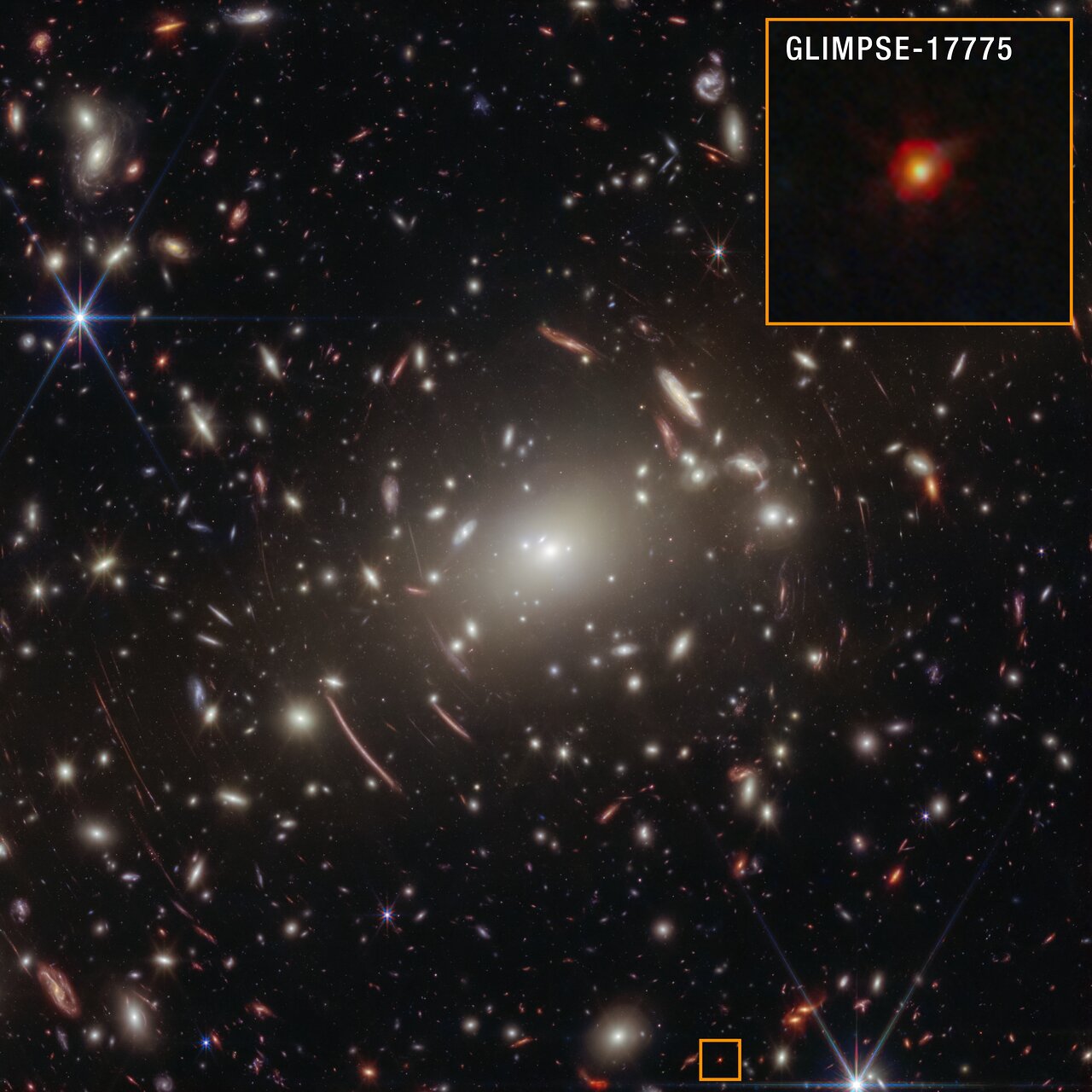
When the James Webb Space Telescope opened its eyes in 2022, one of the first things it found did not make sense. Scattered across the very early universe were hundreds of compact, crimson objects that astronomers started calling "little red dots." They were too bright to be ordinary galaxies at that distance, too small to be quasars, and too numerous to ignore. Some researchers worried they might have broken cosmology.
On June 10, 2026, a team led by Vasily Kokorev at the University of Texas at Austin published the strongest answer yet. The little red dots, they argue, are black hole stars: supermassive black holes wrapped inside dense cocoons of gas, caught in a violent growth spurt about 1.8 billion years after the Big Bang.
A lucky dot behind a cosmic magnifying glass
The key to the discovery was one particular object named GLIMPSE-17775. It was not the target of anyone's search. It happened to sit behind the galaxy cluster Abell S1063 while Webb was observing that cluster for a different project, a survey called GLIMPSE designed to hunt for the very first generation of stars.
Galaxy clusters are so massive that their gravity bends light like a lens. Objects behind them get magnified, sometimes by a factor of several. GLIMPSE-17775, at a redshift of 3.5, got brightened and stretched by this gravitational lensing effect. The result: Webb's 30-hour observation of the region was equivalent to 80 hours of telescope time on the little red dot.
"The source was discovered from the GLIMPSE programme, that was designed to reveal the faintest sources in the early Universe," said Hakim Atek of the Institut d'Astrophysique de Paris, a co-author and the principal investigator of the programme. The lensing, he added, "enables a more detailed characterization of brighter objects, including LRDs such as GLIMPSE-17775."
More than 40 clues in one spectrum
When the team received the spectrum from Webb, they saw something unusual: more than 40 distinct spectral lines packed into a single faint red dot. Most LRDs reveal only a handful of features. GLIMPSE-17775 gave them a full forensic report.
"When we saw the spectrum for the first time, it was like having all the pieces of a puzzle scattered on the floor," Kokorev said. "We picked up each piece of the puzzle, measured the lines, and started combining the different pieces into a mosaic."
Among those pieces was what the team called an "iron forest": 16 separate iron emission lines. Producing that many iron lines requires an intensely energetic source, far more powerful than star formation alone could explain. Certain oxygen line ratios told the same story. So did the presence of fluorescing and absorbing helium: both signatures of a dense gas medium surrounding a powerful central engine.
The spectral lines also showed a telltale broadening called electron scattering. Light from the central source was bouncing off particles in a thick surrounding layer of partially ionized gas, the way headlights diffuse in fog. That gas cocoon is what makes a black hole star a black hole star.
The black hole star model
The idea is not brand new. When LRDs were first discovered, researchers proposed several explanations: unusually compact galaxies, dust-obscured quasars, or black holes embedded in dense gas. What makes GLIMPSE-17775 different is that it is the first LRD to show all the expected signatures in one place.
A black hole star is not a new type of object so much as a phase. A supermassive black hole is accreting material so rapidly that its immediate surroundings become a thick, hot shell of gas. That shell reprocesses the radiation coming from near the black hole's event horizon, absorbing X-rays and re-emitting the energy at longer wavelengths. This explains why little red dots are consistently faint in X-ray observations: the X-rays get trapped in the cocoon.
The cocoon also explains why LRDs look so red. The gas absorbs the high-energy ultraviolet and X-ray photons and re-radiates them in the optical and infrared. What reaches Webb is a distinctive V-shaped spectrum: bright in the ultraviolet, dim in the middle, bright again in the red.
None of this requires broken physics. "Everything fits, nothing is broken, and I think that makes the puzzle that is our Universe even better," Kokorev said.
Two paths to the same answer
A few weeks before the Kokorev team published in The Astrophysical Journal, a separate theoretical study landed on the arXiv preprint server with a remarkably similar conclusion. Yangyao Chen of Nanjing University and Houjun Mo of the University of Massachusetts used a galaxy formation model built on standard cosmological physics to trace the likely origins of LRDs. Their model, posted on May 29, 2026, proposed that little red dots are black holes caught in episodic "nuclear bursts" of super-Eddington accretion, feeding at up to roughly ten times the theoretical maximum rate.
The two studies approached the problem from opposite directions: one from a single, extraordinarily deep observation, the other from large-scale cosmological simulation. They converged on the same picture. LRDs are black holes in a brief, violent chapter of their lives, surrounded by gas that shapes how they appear to us.
The Chen and Mo model also predicts something else: the little red dots Webb has found are only the brightest members of a much larger, dimmer population still waiting below the telescope's current detection limit.
Why it matters
When JWST first revealed little red dots, their sheer abundance was alarming. Models of early galaxy formation did not predict this many bright objects so soon after the Big Bang. If each one was a galaxy packed with stars, the implied star formation rates were impossibly high. The black hole star interpretation resolves that tension by shifting the power source from stars to accretion: growing black holes can produce the same amount of light with far less mass.
The team also found that GLIMPSE-17775's host galaxy is unusually large, contributing excess blue light to the total spectrum. This dilutes the Balmer break (a dip in the light that is a signature feature of LRDs) and may explain why some little red dots look different from others. The variation could come down to how much host galaxy light leaks through the cocoon.
Kokorev is careful not to claim the case is closed. "While we think it is a black hole, there are some other interesting theories being proposed, which is exciting," he said. "Maybe in a year or two, we will have the final answer to what powers these sources."
For now, the little red dots have gone from a cosmological crisis to a coherent story. They are not evidence that something is wrong with the standard model. They are evidence that black holes in the early universe could grow faster and more dramatically than anyone expected. Nature is not broken. It is just more interesting than we guessed.
Sources
- ESA/Webb Science Release weic2610: Webb finds strongest evidence yet for "black hole stars" - primary source for the GLIMPSE-17775 spectrum, methodology, and researcher quotes
- Kokorev et al., The Astrophysical Journal (2026) - peer-reviewed paper presenting the black hole star interpretation of GLIMPSE-17775
- Space.com: James Webb Space Telescope finds evidence the mysterious 'little red dots' are black hole stars - additional reporting and context
- Phys.org: Black hole feeding bursts may explain JWST's Little Red Dots in early universe - coverage of the Chen & Mo theoretical paper
- Chen & Mo, arXiv:2605.31077 (2026) - independent theoretical model proposing super-Eddington accretion for LRDs
The hero image is credited to NASA, ESA, CSA, V. Kokorev (University of Texas at Austin), and A. Pagan (STScI). ESA/Webb images are generally available under a Creative Commons Attribution 4.0 International License. The article describes research published in the peer-reviewed journal The Astrophysical Journal and an independent preprint on arXiv.
Related on Impossible Universe
- Webb Peered Into the Cigar Galaxy and Found 16.5 Million Stars Hidden Behind the Dust - another deep Webb survey that resolved individual objects where others saw only smudges
- Astronomers Just Found a Fragment of the Galaxy's Birth Hiding in Plain Sight - another ancient object hiding in the Milky Way that turned out to be much more than expected