Scientists Expected a Black Hole. They Found a Neutrino Factory Powered by Stars.
A single neutrino detected at the South Pole in 2021 led astronomers to a dust-shrouded galaxy 11 billion light-years away. The galaxy, nicknamed Shadow Blaster, had no black hole at its core. Instead, it was forming stars so intensely that the dense gas was converting cosmic rays into ghost particles.
On September 22, 2021, a detector buried deep in the Antarctic ice registered a single ghostly signal. A neutrino had slammed into the ice with an energy of roughly 750 teraelectronvolts, far beyond what most known processes in the universe can produce. The IceCube Neutrino Observatory fired off an alert, and telescopes around the world swung toward a patch of sky in the constellation Eridanus.
For nearly five years, nobody could find what sent it.
The answer, published on June 17, 2026 in Nature Astronomy, is a galaxy so shrouded in dust that it is nearly invisible in ordinary light. Astronomers nicknamed it Shadow Blaster. It is 11 billion light-years away, was forming stars at a furious rate when the universe was barely a few billion years old, and it does not work the way anyone expected.
The wrong kind of engine
Every neutrino-producing galaxy identified before Shadow Blaster had one thing in common: a supermassive black hole at its center, firing jets of particles into intergalactic space. The assumption was natural. When you find a particle with that much energy, you look for the most violent engine you know.
The galaxy, officially designated JCMT0402−0424, was spotted by the James Clerk Maxwell Telescope and the Submillimeter Array on Maunakea within days of the IceCube alert. It was remarkably bright at submillimeter wavelengths, trillions of times the luminosity of the Sun in the infrared. Everything about it said "extreme." The obvious inference was a hidden active black hole.
But when Yuji Urata of MITOS Science Co. in Taiwan and his team pointed the Atacama Large Millimeter/submillimeter Array (ALMA) at it, they found something else entirely. No energetic emission from an accreting black hole. No jets. No telltale X-ray or gamma-ray signature. The energy came from something simpler: stars. A lot of them, forming all at once.
A natural telescope, a hidden core
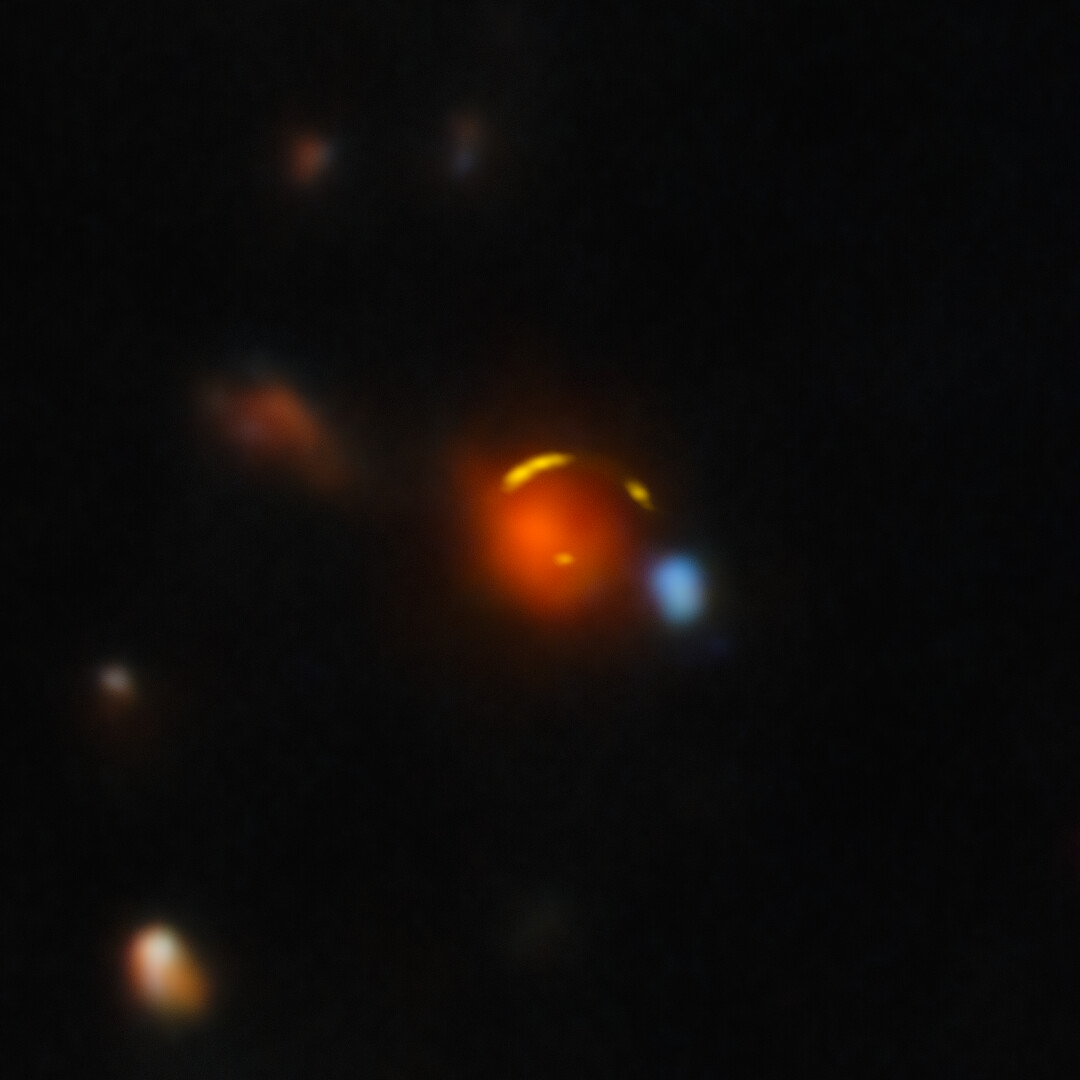
Shadow Blaster sits directly behind a massive foreground elliptical galaxy. The foreground galaxy's gravity bends the light from Shadow Blaster around it like a lens, magnifying and distorting it into four separate images that appear as yellow arcs in the ALMA data. Without this gravitational lensing, the distant galaxy would be too faint and too small to study in detail.
The team used the Gemini North telescope and its spectrographs, GMOS and GNIRS, to measure the distance and mass distribution of the foreground lensing galaxy. With that model in hand, they reconstructed Shadow Blaster's true shape. What emerged was a compact star-forming engine about 1,500 light-years across, a small region by galactic standards, packed with gas and dust and forming hundreds of solar masses of new stars every year.
"Shadow Blaster possesses the kind of dense, gas-rich environment that theoretical models have long suggested could efficiently produce high-energy neutrinos," Urata said.
How stars make ghost particles
In a dense starburst core, young massive stars live fast and die young, exploding as supernovae. Their shockwaves accelerate cosmic rays, high-energy charged particles that would normally escape into intergalactic space. But Shadow Blaster's core is packed so tightly with gas and dust that the particles cannot get out. Instead, they collide repeatedly with surrounding matter, producing short-lived particles called pions that decay into neutrinos and gamma rays.
The galaxy acts like a calorimeter: cosmic rays go in, and neutrinos come out. The physics is the same whether a black hole jet or a dense starburst core is doing the trapping. What matters is the density of the environment.
This is why a galaxy that looks like a black hole source can actually be a star-forming one. Both create the same conditions for neutrino production. The difference is what provides the energy: gravitational accretion onto a black hole, or the collective output of millions of young stars.
A population, not a one-off
The paper does not claim Shadow Blaster has been definitively proven as the source of IC 210922A. The probability of finding such a bright submillimeter galaxy at random within the neutrino's localization region is roughly 1% or lower, a strong positional coincidence but not a closed case.
What makes the result significant is what it implies about a whole class of galaxies. Shadow Blaster belongs to a population of compact, dust-obscured starburst galaxies that were common during an epoch called Cosmic Noon, roughly 10 billion years ago, when galaxies across the universe were forming stars at the highest rates in cosmic history. The team's modeling suggests these galaxies could collectively account for roughly 15 to 20 percent of the diffuse high-energy neutrino background detected by IceCube.
That is a meaningful but subdominant share. It means the neutrino sky probably has several distinct classes of sources: black hole jets in active galaxies, compact starbursts like Shadow Blaster, and likely more that have not been identified. The cosmic ghost population is not the product of a single kind of engine.
Multi-messenger astronomy at cosmic distances
The discovery is a demonstration of multi-messenger astronomy working at cosmological distances. A particle detector at the South Pole flagged the neutrino. Radio telescopes in Hawai'i and Chile followed up. An optical telescope on Maunakea measured the lens. A gravitational model reconstructed the galaxy. Each piece of information came from a different messenger: a particle, then radio waves, then optical light.
"This breakthrough shows how particle detectors and telescopes become far more impactful when they work together, opening a powerful multi-messenger window on the universe," said Martin Still, program director at the NSF Office of Research Infrastructure.
The research was a collaboration between MITOS Science Co., National Central University, Chung Yuan Christian University, Tohoku University, Fukui University of Technology, and the National Astronomical Observatory of Japan. The Gemini North observations were made through the International Gemini Observatory, operated by NSF NOIRLab. ALMA is a partnership of ESO, the U.S. National Science Foundation, and Japan's National Institutes of Natural Sciences.
What comes next
The result opens a new path for neutrino astronomy. If compact starburst galaxies contribute a significant fraction of the cosmic neutrino background, then the next generation of neutrino observatories, including IceCube-Gen2 and the Pacific Ocean Neutrino Experiment, should see enough of them to build a statistical sample. Each new association between a neutrino and a distant galaxy adds another data point for understanding how the universe accelerates particles to extreme energies.
The study also underscores something simpler: the most obvious answer is not always the right one. Astronomers looked for a black hole and found something older. A galaxy full of young stars, hidden behind a cosmic lens, firing ghost particles across 11 billion years of space and time.
Sources
- Urata, Y. et al. "Compact dusty starbursts at cosmic noon linked to high-energy neutrinos." Nature Astronomy, June 17, 2026. DOI: 10.1038/s41550-026-02884-9
- NOIRLab. "Tracing a Neutrino Ghost to Distant 'Shadow Blaster' Galaxy." June 17, 2026.
- ALMA Observatory. "ALMA Reveals a Hidden Starburst Galaxy Linked to a High-Energy Neutrino." June 19, 2026.
- NAOJ. "New Scenario for Cosmic Neutrino Events." June 17, 2026.
- Phys.org. "Tracing a neutrino ghost to a distant 'shadow blaster' galaxy." June 17, 2026.
Related on Impossible Universe
- For 100 Years, Scientists Could Not Explain Where Cosmic Rays Come From. Juno Just Watched Them Form. - the other half of the cosmic particle story: how high-energy particles are accelerated in nature
- A Galaxy 15 Million Light-Years Away Is Putting On a Fireworks Show Nobody Expected - another surprising discovery about what happens inside the most energetic regions of distant galaxies