NASA's IXPE May Have Confirmed a 90-Year-Old Prediction: Empty Space Can Bend Light. The Lab Is a Dead Star 18,000 Light-Years Away.
A 90-year-old prediction from quantum electrodynamics says empty space should bend and polarize light in an extremely strong magnetic field. No lab on Earth can reach those fields, but magnetars exceed them naturally. NASA's IXPE telescope spent more than 140 hours watching the magnetar 1E 1547-5408, a dead star about 18,000 light-years away, and found X-ray polarization up to nearly 80 percent, roughly three times higher than comparable sources. The results, published in Nature, are the strongest evidence yet for vacuum birefringence, and could be the first direct observation of the effect anywhere.
In 1936, two of the founders of quantum mechanics made a strange prediction about empty space. Werner Heisenberg and Hans Euler calculated that in an extremely strong magnetic field, the vacuum itself should behave like a crystal: bending light, polarizing it, treating different directions differently. The effect came out of quantum electrodynamics, the theory that describes how light and matter interact, and it was based on a genuinely bizarre idea: that "empty" space is not empty at all, but seething with virtual particles that pop into existence and vanish again, and that a powerful magnetic field can polarize that invisible sea.
For 90 years, the prediction sat in the equations. No experiment on Earth could build a magnetic field strong enough to test it. The scale of the field required, called the critical field, is about 4.4 x 10^13 gauss, roughly a trillion times stronger than any magnet humans have built. Magnetars, the most magnetic objects known in the universe, exceed it naturally. So in 2025, NASA pointed its X-ray polarimetry telescope IXPE at one of them, and watched the vacuum do something no one had ever directly caught it doing before.
The results, published in Nature in August 2026, are the strongest signal yet that vacuum birefringence is real: that empty space, in the presence of an extreme magnetic field, genuinely bends and polarizes light the way Heisenberg and Euler predicted. The measurement may be the first direct observation of the effect anywhere. NASA's own announcement is careful with the language: "strong support" for a 90-year-old theory, and "could be the first time this effect has been directly observed anywhere." The finding is not yet a formal detection claim, and the team says further observations are needed to confirm it. But it is a landmark for quantum electrodynamics, tested in the harshest environment the universe has to offer.
Empty space is not really empty
The idea at the heart of the result is one of the strangest in modern physics. Quantum electrodynamics, the theory that won Richard Feynman, Julian Schwinger, and Sin-Itiro Tomonaga the Nobel Prize, describes the vacuum as a restless medium. Particles and their antiparticles constantly appear out of nothing and annihilate a moment later. They are called virtual particles: real enough to affect measurements, too short-lived to be observed directly.
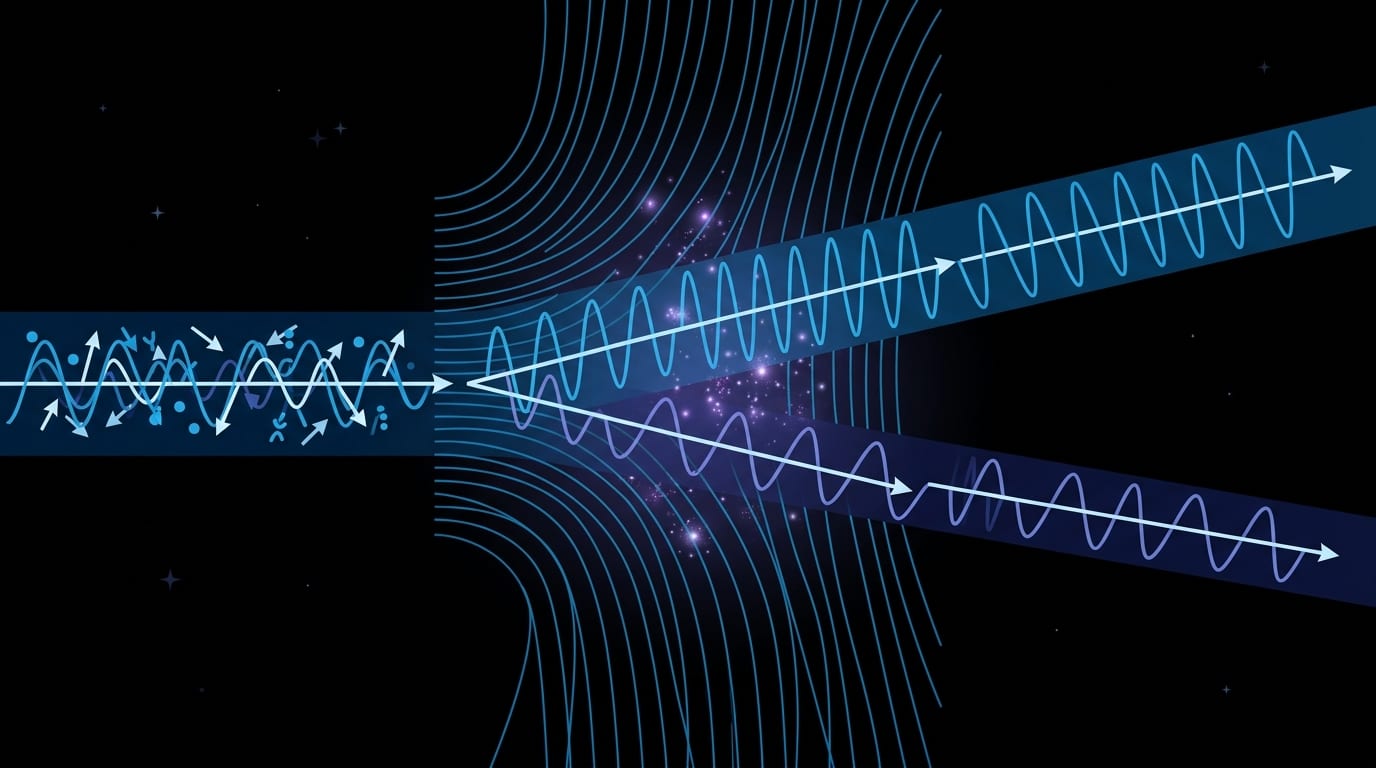
Normally, this quantum froth is completely invisible. But a strong magnetic field can influence it. The field makes the virtual particles behave slightly differently depending on the direction of the light passing through: for light polarized one way, the vacuum acts a little denser; for light polarized the other way, a little less dense. The result is birefringence, the same optical effect that makes certain crystals split a beam of light into two, except here the "crystal" is empty space.
This effect is exactly what the magnetar measurement probes. The vacuum around a magnetar is not empty in the everyday sense. It is a region where the magnetic field is so strong that the quantum properties of the vacuum become measurable, and light passing through it is polarized in a way that standard physics of the star's surface cannot explain.
A dead star with a trillion times Earth's field
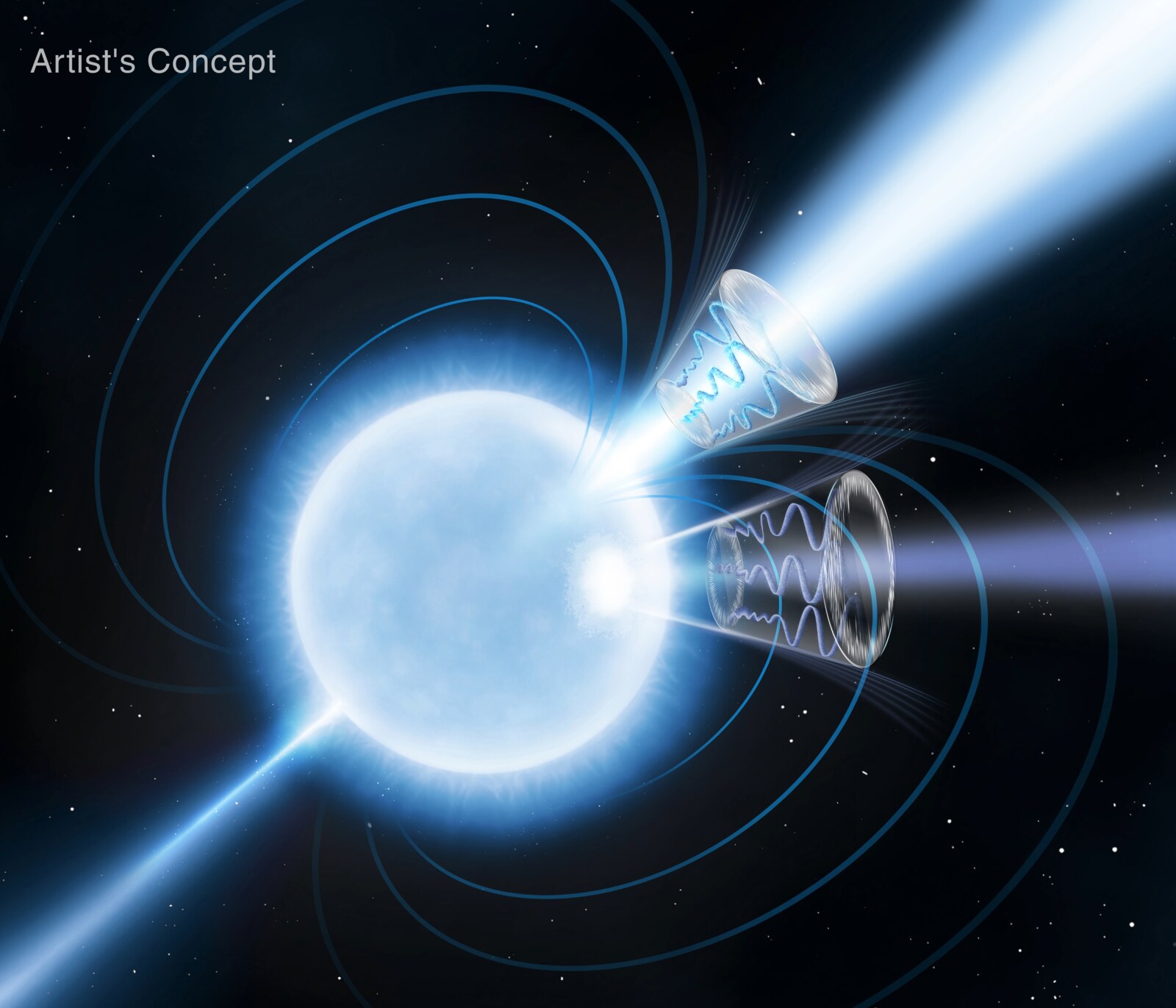
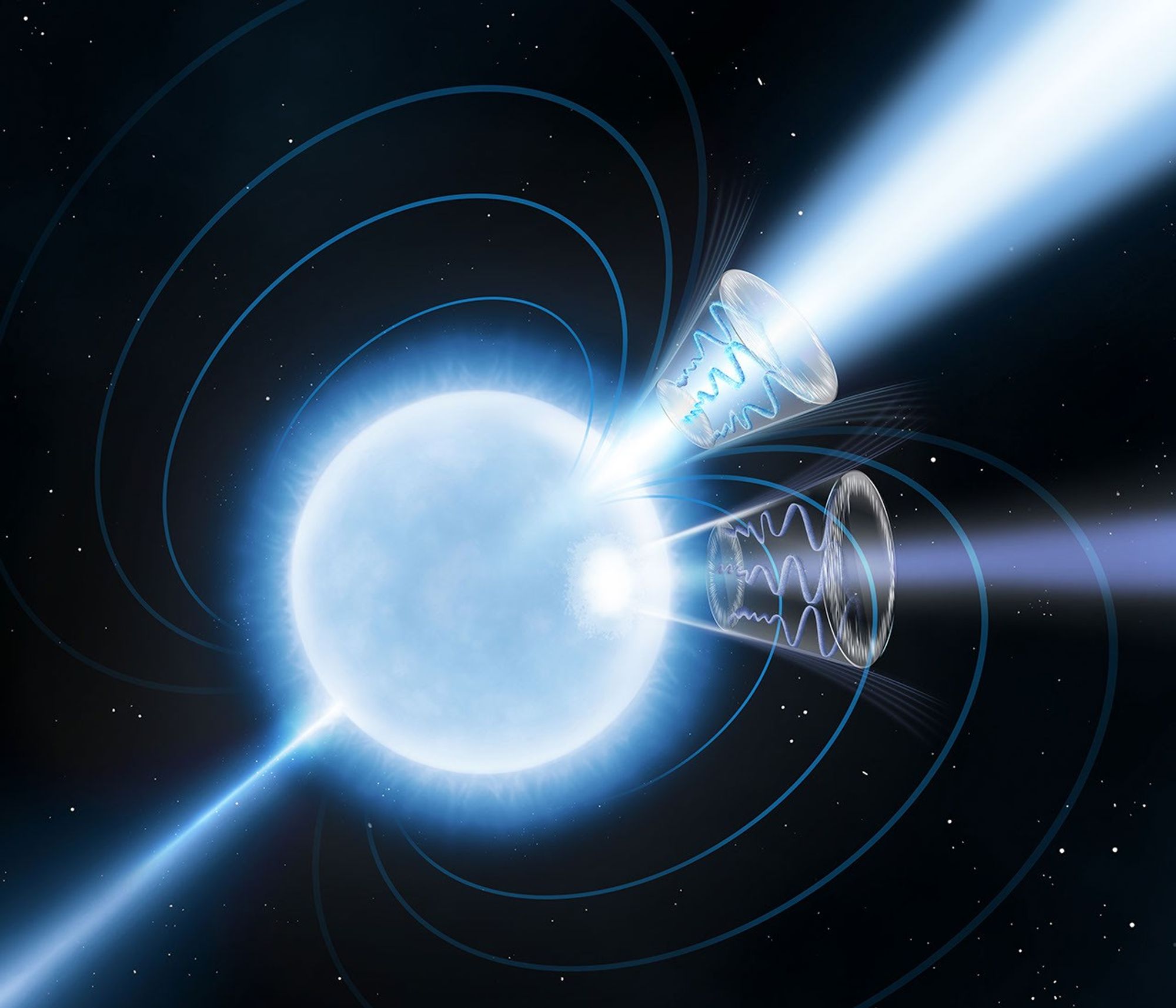
The object at the center of the measurement is 1E 1547-5408, a magnetar about 18,000 light-years away. Magnetars are a special class of neutron star, the leftover cores of massive stars that collapsed at the end of their lives. A neutron star packs more mass than the Sun into a sphere the size of a city, making it one of the densest objects in the universe. Magnetars are the most magnetic of them all: their surface fields can exceed 10^14 gauss, around a trillion times stronger than the strongest permanent magnets ever built on Earth, and the strongest magnetic fields of any object in the observable universe.
1E 1547-5408 is unusual even among magnetars. It spins a full rotation every 2 seconds, and unlike most magnetars, it consistently emits bright radio energy alongside its X-ray light, for reasons scientists still do not fully understand. That made it the perfect target for a coordinated campaign: for the first time ever, astronomers measured a magnetar's polarization in both radio and X-ray light at the same time.
The observations ran from March to April 2025, more than 140 hours of IXPE X-ray polarization data, coordinated with NASA's NICER X-ray telescope and Murriyang, the Parkes radio telescope in Australia operated by CSIRO. IXPE, the Imaging X-ray Polarimetry Explorer, is a joint NASA and Italian Space Agency mission led by NASA's Marshall Space Flight Center. It is the first satellite designed to measure the polarization of X-rays from cosmic sources, and it is exactly the kind of measurement vacuum birefringence was predicted to show up in.
Polarization three times higher than anything comparable
What the team found was surprising. The X-rays coming from 1E 1547-5408 were far more polarized than expected: in the soft X-ray band around 2 keV, the polarization reached phase-averaged values of about 65 percent, and at certain rotational phases it climbed to nearly 80 percent. That is roughly three times higher than the polarization seen from comparable sources, and it stayed high, above 40 percent, throughout the crossing of the radio beam.
The high polarization was not just unexpected, it was hard to explain. The geometry of the magnetar's magnetic field suggests that at certain points in the star's rotation, the measured polarization should drop to near zero. Standard models of how neutron star surfaces emit X-rays cannot produce values that high. Something else had to be boosting the polarization, and vacuum birefringence is the leading candidate: as the X-rays pass through the strongly magnetized vacuum around the star, the vacuum itself acts like a filter, aligning the light and enhancing its total polarization.
The team's simulations support that reading. Hoa Dinh Thi, a postdoctoral associate at Rice University and co-lead author of the paper, put it directly: "Our model suggests that reproducing the observed X-ray polarization signatures, while also satisfying the constraints set by radio observations, requires the presence of vacuum birefringence in the neutron star's environment. This finding exemplifies how neutron stars enable us to test fundamental physics in environments not replicable in labs on Earth."
There is an important distinction to keep straight. The polarization itself is data: a direct measurement of the light arriving from the magnetar. The interpretation, that vacuum birefringence is what boosted it, is model-dependent, supported by simulations that reproduce both the X-ray and radio observations. The radio measurements matter here: the team coordinated the two wavelength regimes precisely because the radio and X-ray polarization angles both track the star's large-scale magnetic field, following the same rotating-vector pattern, which strengthens the case that the X-ray signal comes from the magnetosphere where vacuum birefringence operates.
What it means if the vacuum really bends light
If vacuum birefringence is confirmed, it would be the first direct observation of a quantum electrodynamic effect in a superstrong magnetic field, a regime of physics that no laboratory on Earth can reproduce. The theory of quantum electrodynamics is one of the most precisely tested in all of science, but almost all of that testing happens at the scales humans can reach. Magnetars open a window into the extreme end of the theory, where the vacuum itself becomes an active participant in how light travels.
Rachael Stewart, a PhD candidate at George Washington University and lead author of the Nature paper, framed the result in broader terms: "This result truly highlights the interdisciplinary power of the field of astrophysics. The information we obtained from looking at this distant star core also gives us clues about the nature of the fabric of reality as we know it, and I find that to be incredible."
The honest status of the result matters. The analysis is strong evidence, but it is not yet a formal detection claim at the significance level that would seal it. The team says further IXPE observations of this source and other magnetars will confirm the signal and potentially reveal other exotic effects of quantum electrodynamics. Each new magnetar observation, and each new X-ray polarimetry mission, refreshes the story: the universe's most magnetic objects are now a working laboratory for one of the strangest ideas in physics, that the emptiness between the stars is not empty at all.
Sources
- NASA Science: NASA's IXPE May Have Proven 90-Year-Old Theory - the mission release describing the observations, the 140+ hour campaign, the polarization finding, and the Dinh Thi and Stewart quotes
- Stewart, Dinh Thi et al., "Vacuum birefringence and the polarized X-ray emission from a radio magnetar," Nature (2026), DOI 10.1038/s41586-026-10859-z - the peer-reviewed paper reporting the IXPE, NICER, and Murriyang observations of 1E 1547-5408
- Stewart, Dinh Thi et al., arXiv 2509.19446 - the preprint version of the Nature paper, with the phase- and energy-resolved polarization values
- Dinh Thi et al., "Pulsed, Polarized X-Ray Emission from Neutron Star Surfaces: The Effects of Vacuum Birefringence in the Magnetosphere," The Astrophysical Journal (2026), DOI 10.3847/1538-4357/ae313c - the peer-reviewed companion theory paper on how vacuum birefringence shapes neutron star X-ray polarization
- NASA: NASA's IXPE Studies Magnetar - the image article for the artist's concept of 1E 1547-5408, with observation details and image credit (NASA/Pablo Garcia)
- Wikipedia: Vacuum birefringence - background on the Heisenberg-Euler 1936 prediction, the critical field, and the QED context
Hero image and inline magnetar closeup: NASA artist's concepts of 1E 1547-5408 (credit NASA/Pablo Garcia for the hero; NASA for the closeup). NASA images are generally in the public domain. Vacuum birefringence diagram: generated illustration by the Impossible Universe Editorial Team. This article describes peer-reviewed research published in Nature on August 12, 2026.
Related on Impossible Universe
- Physics and Quantum: The Frontier of How Things Work - the topic hub for fundamental physics, quantum materials, and extreme measurements
- A Lab Experiment Confirmed You Can Extract Energy From a Spinning Black Hole - another extreme-physics prediction tested at laboratory scale
- Physicists Built a Time Crystal for Light - quantum electrodynamics and light manipulation at the frontier
- A Neutron Star Collision Detected in a New Kind of Place - neutron stars as laboratories for extreme physics