Two Neutron Stars Collided in a Tidal Stream Between Colliding Galaxies. It's the First Merger Ever Found in Such a Place.
On September 6, 2023, a flash of gamma rays lasting less than a second announced a neutron star collision 4.7 billion light-years away. Chandra and Hubble traced it to a tiny galaxy buried in a stream of gas and stars roughly 600,000 light-years long, debris from a crash between galaxy groups. It is the first neutron star merger ever found in such a place, and it shows how cosmic collisions forge gold, platinum, and about half of all elements heavier than iron.
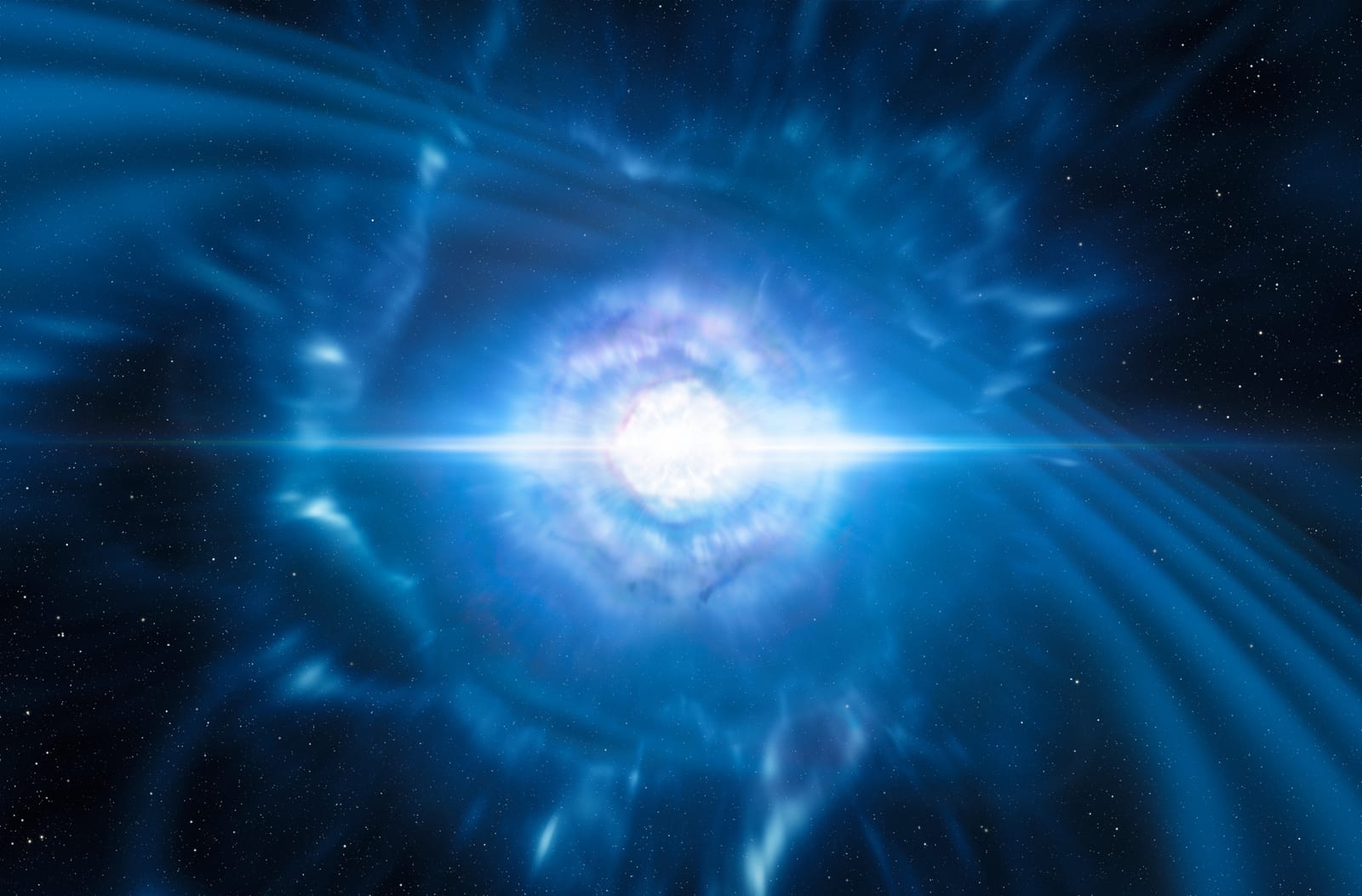
On September 6, 2023, a detector on a NASA satellite orbiting Earth caught a flash of gamma rays that lasted less than a second. It had traveled roughly 4.7 billion light-years to get there. The flash, catalogued as GRB 230906A, was a short gamma-ray burst, and short bursts have a known cause: two neutron stars, the densest visible objects in the universe, spiraling into each other and colliding. The collision sprays newly forged heavy elements, including gold, across space.
What made this burst different was where it happened. Chandra and Hubble traced it to a tiny, extremely faint galaxy buried inside a stream of gas and stars roughly 600,000 light-years long, debris left behind when two groups of galaxies crashed into each other. It is the first neutron star collision ever found in such a setting, and it helps answer a question astronomers have chased for years: how do heavy elements end up in the outskirts of galaxies, far from the crowded centers where stars usually form?
A flash that means a collision
Gamma-ray bursts come in two flavors. Long bursts, lasting more than about two seconds, are the death cries of massive stars collapsing into black holes. Short bursts, under two seconds, point to something else: the merger of two compact objects, most often neutron stars. GRB 230906A lasted about 0.9 seconds, firmly in short-burst territory.
Neutron stars are what remains when a massive star runs out of fuel and its core collapses. The result is a sphere about 20 kilometers across, roughly the size of a city, holding between one and two times the mass of the Sun. A single teaspoon of neutron star material would weigh billions of tons on Earth. When two of them orbit each other and merge, the result is a kilonova, an explosion roughly a thousand times brighter than a typical nova, plus a flash of gamma rays and a ripple of gravitational waves.
The explosion also does something remarkable. In the chaos of the collision, atomic nuclei capture neutrons faster than they can decay, a process called the r-process, for rapid neutron capture. It is the main factory for roughly half of all elements heavier than iron, including gold, platinum, and uranium. When you hold a gold ring, you are holding debris from a neutron star merger that happened long before the Solar System existed.
The one time we saw it all
Astronomers did not always know this. The connection between neutron star mergers and heavy elements was confirmed in spectacular fashion on August 17, 2017. LIGO and Virgo detected the gravitational wave signal of two neutron stars merging, and 1.7 seconds later Fermi and INTEGRAL caught a short gamma-ray burst from the same spot. Telescopes around the world, including the European Southern Observatory's facilities, then watched the aftermath, a kilonova called AT2017gfo, glow and fade in the galaxy NGC 4993, about 130 million light-years away.
That event, GW170817, remains the only neutron star merger ever seen in both gravitational waves and light, and it proved the gold connection: the freshly forged heavy elements showed up directly in the spectrum of the kilonova. GRB 230906A is a different kind of first. It is the first neutron star collision found in the wreckage of a galaxy crash.
A merger inside a merger
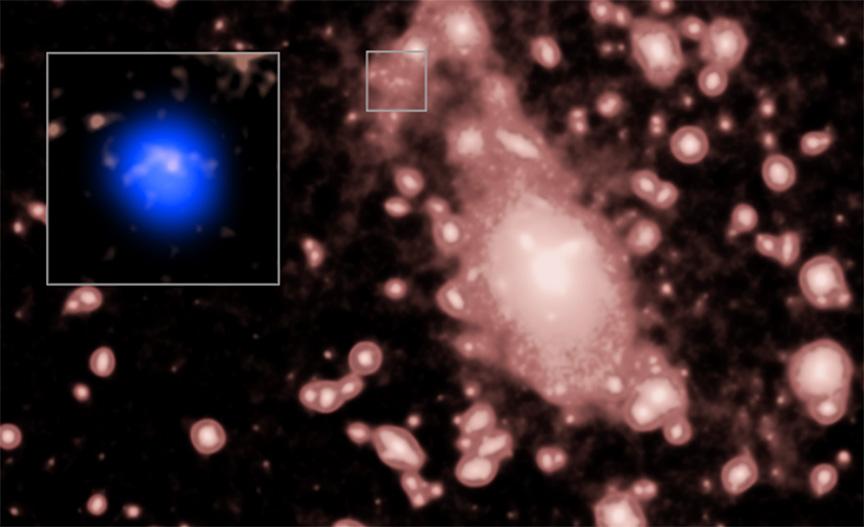
Finding where GRB 230906A came from took a chain of telescopes, each sharper than the last. Fermi caught the burst first and, with the InterPlanetary Network of spacecraft, produced a rough position. Swift narrowed it down. Then Chandra, with its sharp X-ray vision, pinned the location to sub-arcsecond precision. When Hubble looked at that exact spot, it found a faint galaxy, so dim it would be missed in any wide-field survey.
The Very Large Telescope in Chile then delivered the twist. Its MUSE spectrograph showed the faint galaxy was not alone. It is part of a group of galaxies at a redshift of about 0.45, roughly 4.7 billion light-years away, and the group shows clear signs of interactions and mergers. The burst and its host galaxy sit inside a long tidal tail, a stream of gas and stars torn from the group's central galaxy by gravity, stretching about 600,000 light-years, six times the diameter of the Milky Way. The probability that this alignment is a coincidence is under 4 percent, so the team argues the merger really happened in that stream.
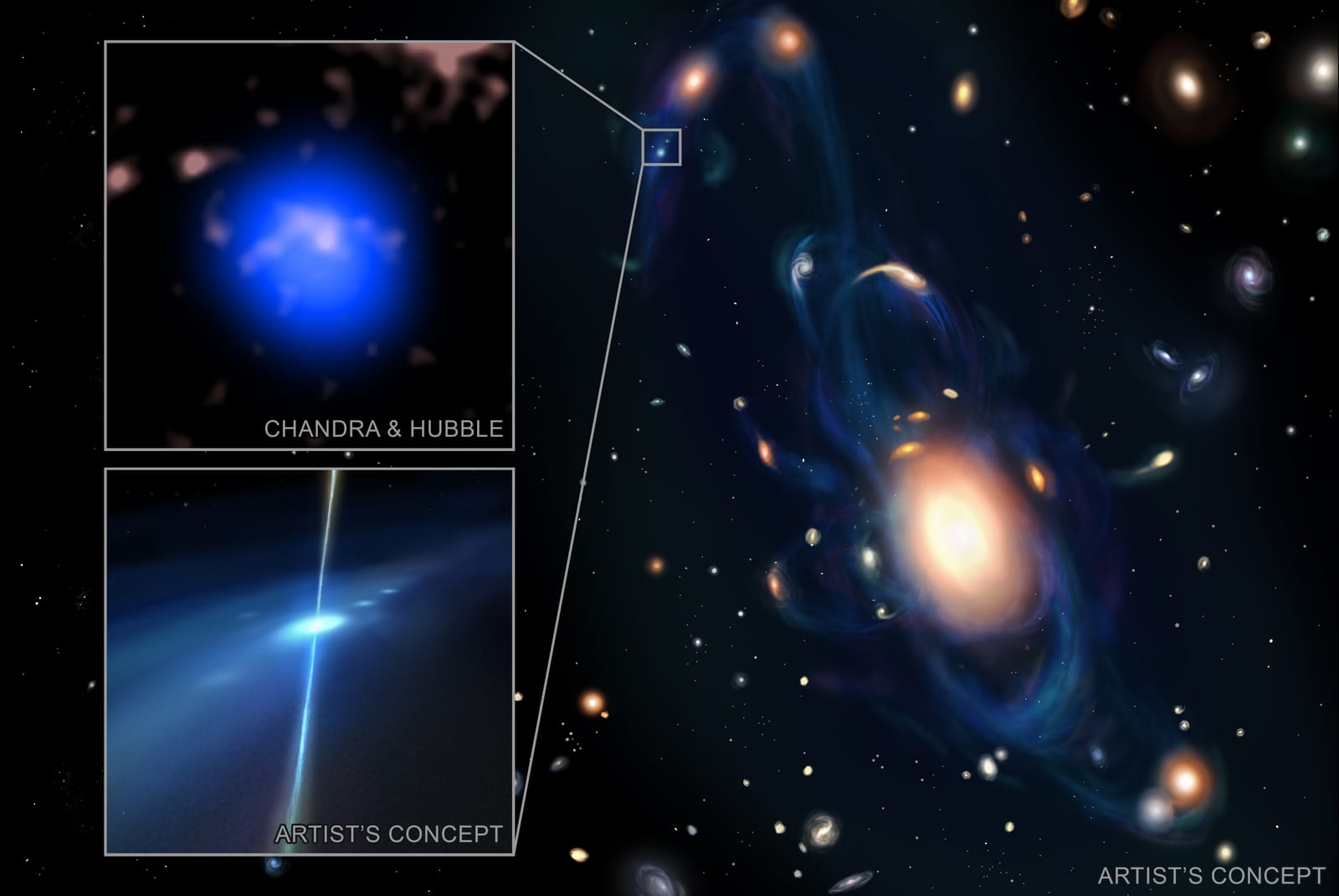
That location tells a story the team describes as a merger within a merger. When the galaxy groups collided, the encounter stirred up star formation in the debris. A pair of massive stars formed there less than about 700 million years before the burst, lived fast, died, and left behind two neutron stars. Those neutron stars spiraled together and merged, producing the short burst astronomers saw in 2023. The collision then injected freshly made r-process material into the surrounding circumgalactic medium, the halo of gas that surrounds the galaxy group.
Why the place matters
Astronomers have long puzzled over observations of stars far from the centers of galaxies that are surprisingly rich in heavy elements. Such stars should have formed from gas with little time to be enriched by supernovae. Neutron star mergers in tidal streams, like this one, offer a natural explanation: the collisions happen out in the galactic outskirts, seed the surrounding gas with gold and platinum, and future generations of stars form from that enriched material.
The discovery may also solve a smaller mystery: some gamma-ray bursts appear to have no host galaxy at all. If mergers can happen in tiny galaxies inside intergalactic debris streams, the host can simply be too faint to see in a quick search. The location of GRB 230906A suggests astronomers should expect to find more mergers in the wreckage of galaxy collisions.
What is still uncertain
The picture comes with honest caveats. The distance relies on the galaxy group association: the burst and its host project onto the group's tidal tail, and the team argues they belong to it, but the host galaxy is so faint that a much more distant galaxy behind the group remains a less likely alternative. Astronomers also never caught the kilonova light itself. GRB 230906A had no detected optical or radio counterpart, so the merger interpretation rests on the burst's short duration, less than a second, and its strange environment, not on a direct view of the explosion's glow. The finding is a strong interpretation, not a closed case.
What is not in doubt is the underlying physics. Neutron star mergers forge heavy elements, and this one appears to have done it in a place no one expected, out in a stream of debris between colliding galaxies, 4.7 billion light-years from Earth. The gold in your jewelry and the platinum in your electronics were made in collisions like this one. Now we know such collisions can happen almost anywhere, even in the wreckage of a galaxy crash.
Sources
- Dichiara et al., "A Merger within a Merger: Chandra Pinpoints the Short GRB 230906A in a Peculiar Environment," The Astrophysical Journal Letters (March 10, 2026) - the peer-reviewed study; also available on arXiv
- NASA: Discovery of the Crash of Extreme Stars in an Unexpected Site - mission coverage of GRB 230906A and the detection chain (Fermi, Swift, Chandra, Hubble)
- Chandra Photo Album: GRB 230906A (March 10, 2026) - illustrations credit Maria Cristina Fortuna / NASA / Chandra X-ray Center; host galaxy distance and tidal stream details
- Penn State News: Strange Cosmic Burst From Colliding Galaxies Shines Light on Heavy Elements - lead author Simone Dichiara on the merger-within-a-merger interpretation
- Universe Today: Finding Gold in a Stellar Explosion - coverage of the localization and the r-process context
- Wikipedia: Kilonova - kilonova physics, the r-process, and the GW170817 benchmark event
Related on Impossible Universe
- 390 Black Hole Mergers and Counting. The Gravitational Wave Catalog Just Got 161 New Entries. - the gravitational wave observatories that hear compact object mergers, including neutron stars, when light cannot tell the whole story
- Webb Peered Into the Cigar Galaxy and Found 16.5 Million Stars Hidden Behind the Dust - a galaxy whose frantic star formation was ignited by a close encounter with a neighbor, the same engine suspected inside GRB 230906A's tidal stream
- Black Holes Topic Hub - the other side of compact object physics: what happens when black holes, not neutron stars, collide and tear stars apart
- Telescopes and Space Missions Topic Hub - the observatories that find and pinpoint bursts like this one, from Fermi to Chandra to Hubble