
Physicists Built the First Photonic Time Crystal. It Reshapes Light in Trillionths of a Second.
A crystal is a pattern that repeats in space. Physicists in France and Germany just built one whose pattern repeats in time: a gold metamaterial that flips its optical properties on and off at terahertz speeds, reshaping light in trillionths of a second. Published in Nature on July 29, 2026, the first all-optical photonic time crystal cut photon losses by more than half and points toward new kinds of terahertz lasers.
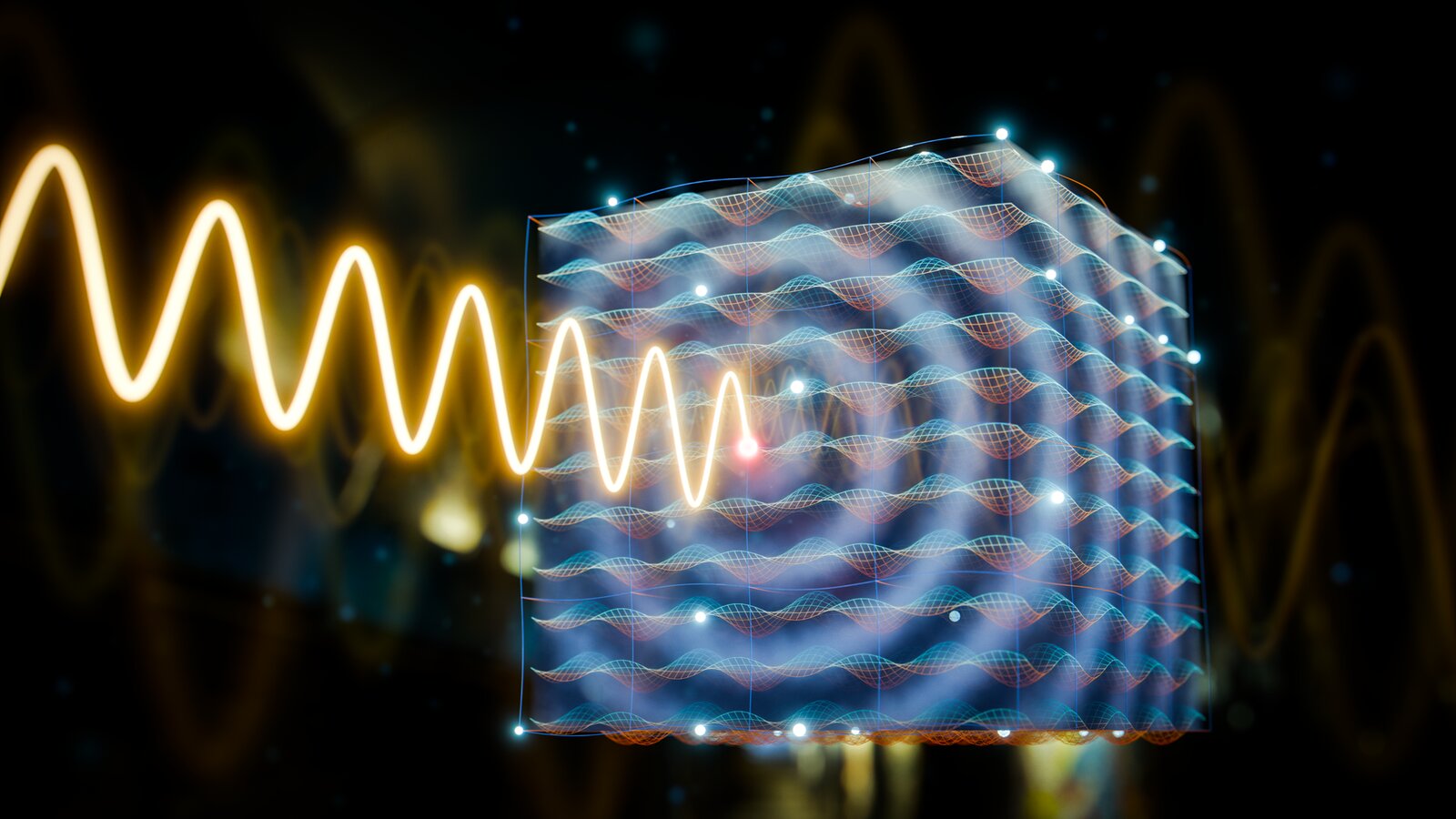
At a research center in Dresden, Germany, a small patterned piece of gold sat in the path of a terahertz laser. The gold was not a mirror or a chip. It was a metamaterial: a surface etched with tiny battlements, each only a few micrometers across, sitting on top of an insulating layer and a semiconductor. When the laser light hit it, the material's ability to reflect light began switching on and off, strongly and rapidly, millions of times faster than any electronic switch could manage.
The switching was not random. It repeated on a fixed schedule, a pattern in time rather than in space. That makes the device a time crystal, and the team behind it, from École Polytechnique, the Collège de France, and the Helmholtz-Zentrum Dresden-Rossendorf (HZDR), reports it as the first all-optical photonic time crystal ever built. The work was published in Nature on July 29, 2026.
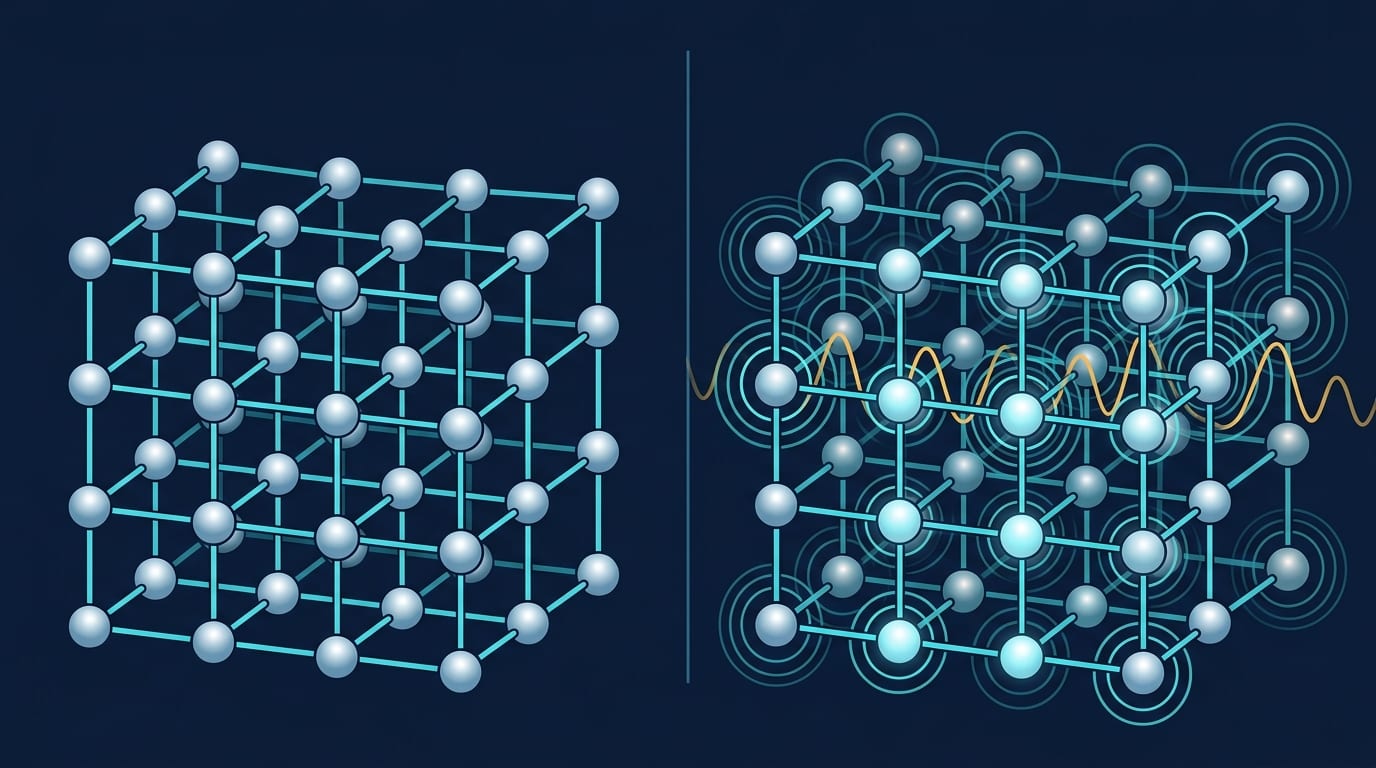
A crystal is a pattern. In space, or in time
A diamond is a crystal because its carbon atoms sit in a repeating grid. A photonic crystal, the optical cousin, is a material with a repeating pattern of different refractive indexes, arranged so it can block, guide, or strengthen selected wavelengths of light. Opals and some butterfly wings contain natural versions. Engineers build artificial ones into optical fibers and highly reflective mirrors.
In 2012, physicist Frank Wilczek asked a strange question. A diamond repeats its pattern in space. Could there be a crystal whose pattern repeats in time, a structure whose properties cycle on a fixed schedule even in its lowest energy state? Physicists call the idea a time crystal, and the early versions ran into a wall: the laws of thermodynamics forbid perpetual motion, and Wilczek's first formulation seemed to demand it.
The field found a way around that objection. Matter time crystals, phases of matter that oscillate periodically under a driving force, were first demonstrated in 2016 and 2017 in ion traps and diamond defects. They were real, but they lived inside exotic machines. A photonic time crystal is a different thing: not atoms moving on a schedule, but a material whose optical properties, its reflectivity and resonance frequency, are modulated periodically in time, fast enough to shape light while it is still passing through.
Photonic time crystals had been proposed on paper for years, and experimental versions existed only at microwave frequencies, built from electrical components. Working in the terahertz range, the band between conventional electronics and optics, was the hard part. Terahertz frequencies are about 1,000 times faster than the gigahertz used in electronics, and the range remains stubbornly underdeveloped compared with the bands on either side of it.
"The THz range represents the frontier between electronic and photonic technologies," said Yannis Laplace, assistant professor at École Polytechnique, whose Laboratory of Irradiated Solids led the study. "It is a range full of opportunities both for science and for society, yet is still underdeveloped technologically compared to its electrical and photonic counterparts."
Gold battlements that trap light
To make the pattern repeat in time, the team needed to change the material's optical properties both strongly and quickly, two requirements that had defeated earlier attempts. Their device, built with help from Thales' Laboratoire Albert Fert and École Polytechnique's Physics of Interfaces laboratory, is a stack of three layers. On top sit micrometer-scale gold crenellations, like the battlements of a castle wall. Beneath them is a thin insulating layer of silicon nitride, about three micrometers thick. At the bottom sits a semiconductor made of indium and antimony.
The gold shapes act as tiny cavities that confine light between the gold and the semiconductor. When light excites the semiconductor's surface, it produces surface plasmons: collective waves of electrons that can capture light and keep its oscillations going. The plasmons gave the researchers a grip on the trapped photons, a way to manipulate them at extraordinary speed.
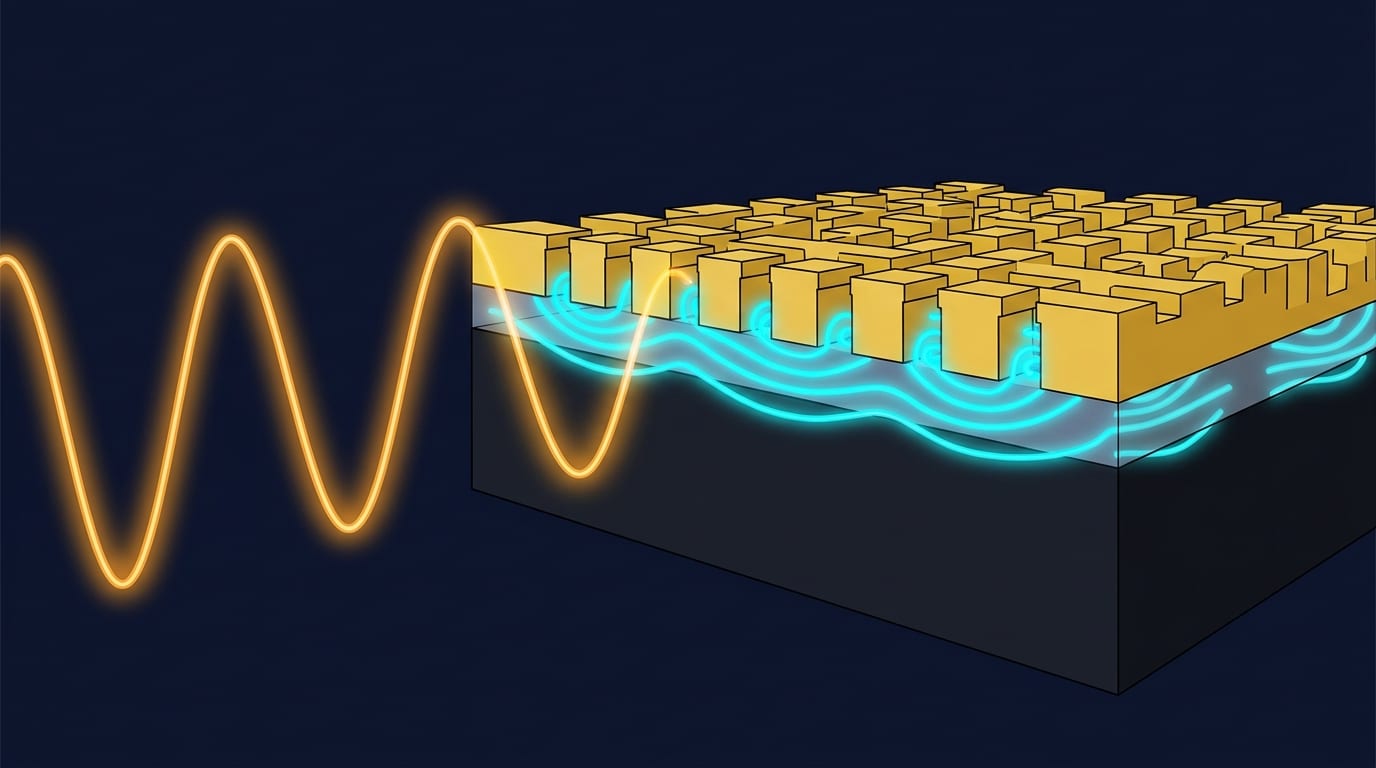
Then came the experimental punch. The team sent terahertz pulses from TELBE, HZDR's superradiant terahertz source at the ELBE accelerator, at the device. TELBE produces intense, frequency-tunable, phase-stable pulses, and that mattered: the material's optical properties, especially its reflectivity, were modulated strongly and on picosecond timescales, close to the period of the light's own oscillations. The strength of the change was comparable to forcing an object to emit a completely different color, and it happened in about a trillionth of a second.
"TELBE's unique ability to generate high-field, phase-stable terahertz pulses was critical," said Jan-Christoph Deinert, coordinator of the TELBE facility. "Without this infrastructure, achieving the coherent, ultrafast modulation needed for the PTC regime would have been impossible."
A theoretical model built by Marco Schiró and his team at the Collège de France matched the measurements and explained what the photons were doing inside the device. The calculations showed that the time-varying material cut photon dissipation in half: the share of photons that pass through the surface instead of being reflected was reduced by more than 50 percent compared with the static case. In effect, the crystal in time held onto its light better than the same material did when nothing was modulating it.
"The theory not only reproduces the experiment but also provides the basis for guiding future discoveries in this system," said Schiró.
Why terahertz light is worth the trouble
Terahertz radiation sits in an awkward, useful place. It is too fast for conventional electronics and too hard to generate cleanly for conventional optics, yet many molecules resonate at terahertz frequencies, which makes the band attractive for spectroscopy and sensing. Materials that are opaque at other wavelengths become transparent there, which is why terahertz imaging is studied for security scanning and quality control.
The new device is a step toward finally exploiting the band. Because the photonic time crystal can modulate light on the timescale of the light's own cycle, it opens a path toward amplification and lasing in a frequency range where lasers are rare. The researchers are careful about what has been proven: the applications, ultrafast optical computing, advanced telecommunications, and new terahertz lasers, are directions the work enables, not devices already on a bench.
The next steps are to cut dissipation further and hold more photons inside the crystal. If amplification gets strong enough, the structure could become the basis of highly adaptable lasers, including terahertz lasers for noninvasive medical imaging, since many biomolecules resonate at those frequencies, and for pushing communications bandwidth from gigahertz toward terahertz.
Why it matters
Time crystals began as a thought experiment about whether a pattern could repeat in time. They became real in exotic quantum systems, then visible in a liquid crystal on a lab bench. Now they have reached photonics: a material whose optical properties themselves follow a repeating schedule, reshaping light while it travels through.
The demonstration is a first, not a finished technology. The loss reduction holds in the terahertz regime under the conditions the team demonstrated, and lasing remains a goal rather than a result. But the core idea, that a pattern in time can control light the way a pattern in space already does, now has a working proof in the hardest frequency band to reach. That is the kind of result that tends to keep paying off as the rest of the field catches up.
Sources
- Guo et al., Nature (2026): Plasmonic metamaterial time crystal - peer-reviewed study, published July 29, 2026, DOI 10.1038/s41586-026-10825-9
- HZDR / École Polytechnique joint press release: Shaping light like never before, with photonic time crystals - primary institutional release with researcher quotes and image credit
- ScienceDaily: World-first photonic time crystal opens a new era of light control - additional reporting and accessible explanation
- Phys.org: Photonic time crystals unlock ultrafast control of light in the terahertz range - coverage with device details
- Optics & Photonics News: A Photonic Crystal in Time - technical explainer of the device construction and lasing outlook
Hero image: B. Schröder / HZDR, from the joint HZDR and École Polytechnique press release, used for editorial coverage with credit. Inline diagrams: generated concept illustrations by the Impossible Universe Editorial Team based on the device and concept descriptions in the cited sources.
Related on Impossible Universe
- The First Time Crystal You Can See With Your Own Eyes - a liquid crystal whose internal stripes ripple periodically in time, the first time crystal visible without specialized instruments
- Physicists Created a Tiny Universe From 24,000 Atoms and Watched Time Emerge All by Itself - an experiment testing whether time is fundamental or emerges from change, another look at what time is at its base
- This Tiny Chip Processes Information With Light Instead of Electricity - a nanoscale photonic circuit, another step toward computing with photons rather than electrons
- Scientists Built LEGO-Like Nanoparticles Into a Material That Shows Quantum Behavior at Room Temperature - an engineered material that freezes a predicted phase of matter into a physical form, like the time crystal's photonic cousin