
Quantum Entanglement, Long Confined to Tiny Particles, Was Just Found in a Crystal You Can Hold in Your Hand
Quantum entanglement is normally a property of individual photons and atoms, carefully isolated from everything around them. Researchers at TU Wien found it in a centimeter-sized crystal you could hold in one hand. The crystal, a strange metal made of cerium, palladium, and silicon, responded to a single neutron with groups of at least nine entangled particles acting together, the largest entanglement depth reported so far in any quantum material.

In a laboratory at the Institut Laue-Langevin in Grenoble, France, a crystal smaller than a matchbox sat in a beam of neutrons, cooled to within a tiny fraction of a degree of absolute zero. The crystal is a centimeter-sized chunk of a metallic compound made of cerium, palladium, and silicon, a material physicists call a strange metal. When a single neutron struck it, the response did not come from one particle. Groups of at least nine particles answered together, locked in the coordinated quantum state physicists call multipartite entanglement.
The result, published on June 15, 2026, in the journal Nature Physics, is entanglement in something you could hold in one hand. The team behind it, led by Silke Bühler-Paschen at TU Wien (Vienna University of Technology), reports it as the largest entanglement depth measured so far in any quantum material.
Entanglement usually lives somewhere else
Quantum entanglement is the connection between particles whose states are linked: measure one, and you instantly know something about the other, no matter how far apart they are. It is normally demonstrated with the smallest, most isolated systems physicists can build: pairs of photons, trapped atoms, or single ions held in place by lasers and cooled to near stillness.
For almost a century, since Erwin Schrödinger posed his famous cat thought experiment, physicists have asked how far quantum behavior can climb the size ladder. Can a big, ordinary-looking object made of enormous numbers of particles show unmistakable signs of quantum mechanics? Most attempts have tried to place a whole object into a superposition of two states at once, a strategy that gets harder as objects get bigger.
The TU Wien group took a different route. "We do not try to bring the crystal as a whole into a superposition of two states," Bühler-Paschen said. "Instead, we ask whether its constituents are, collectively, in such a state of entanglement." She compares the material to an anthill: when an anthill is disturbed, the response does not come from one ant alone, but from the whole colony acting together.
One neutron asks a question, at least nine particles answer
The crystal, known to chemists as Ce3Pd20Si6, is a heavy-fermion compound, a class of materials in which electrons behave as if they were much heavier than normal. It was already famous in physics circles for hosting a strange-metal quantum critical point: a boundary where the material's behavior changes abruptly at absolute zero, tied to the breakdown of Kondo screening, the process by which conduction electrons normally bind to and mask the magnetic moments of atoms.
PhD student Federico Mazza carried out the measurements on the ThALES spectrometer at the ILL, the world's leading neutron research facility. He cooled the crystal to 60 millikelvin, about sixty thousandths of a degree above absolute zero, and held it in a magnetic field of 1.73 tesla, tuned precisely to the material's quantum critical point. Then he fired neutrons at it and measured how the scattered neutrons carried information about the crystal's response.
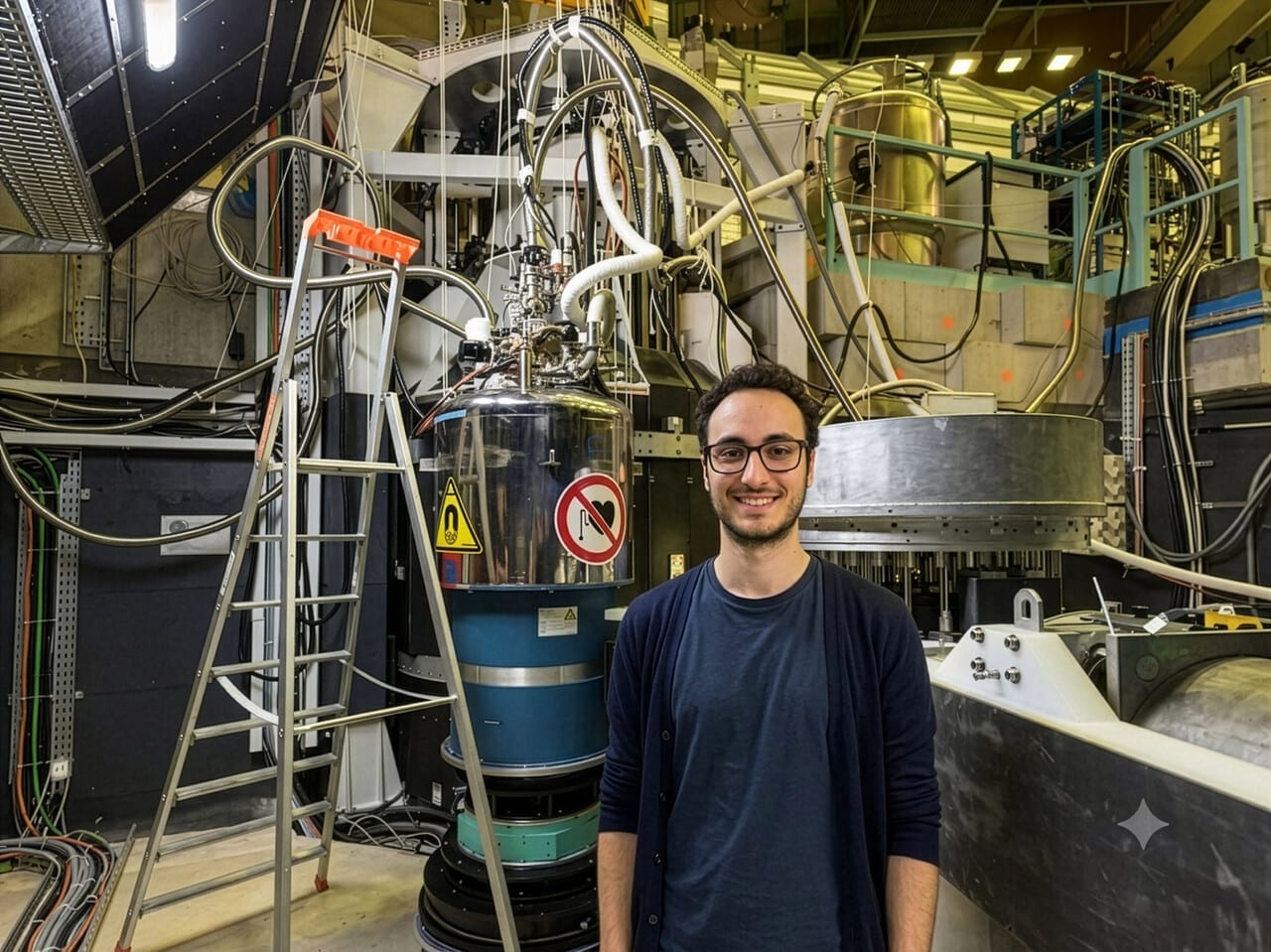
"In a normal material, one would expect a neutron to transfer its energy to an individual particle," Mazza said. "But by analyzing the data using the quantum Fisher information, we found a response that cannot be explained in terms of independent particles. Instead, it indicates that groups of at least nine quantum-entangled entities act collectively."
The tool: quantum Fisher information
The analysis relied on a quantity from quantum information theory called quantum Fisher information, or QFI. It measures how strongly a quantum system responds to a small change. For a collection of independent particles, the response is limited: each particle contributes on its own. But if the particles are entangled, the whole system can respond more strongly than the sum of its parts, and that extra sensitivity is the signature of entanglement.

The theoretical framework came from Peter Zoller's group at the University of Innsbruck, which showed that QFI can reveal entanglement even in large many-body systems, the kind found inside real solids. Extracting it from neutron scattering data is what makes the method work on a bulk crystal rather than a handful of trapped particles.
The team's analysis gave an entanglement depth of at least nine entities, and the signal grew in a scale-free way as the temperature dropped. "To the best of our knowledge, the pronounced scale-free increase in the QFI with decreasing temperature points to the largest entanglement depth reported so far in any quantum material," the authors write in the paper.
Why strange metals are strange
Strange metals get their name from a simple anomaly. In an ordinary metal, electrical resistance falls with temperature in a smooth, predictable way. In a strange metal, resistance falls in a straight line: linear in temperature, down to the lowest measurable values. The behavior was first seen in high-temperature superconductors, the cuprates, and has since turned up in several other exotic material classes. Nobody has a complete explanation for it.
The new result adds a clue. In 2025, a collaboration between TU Wien and Rice University found that electric current flows through strange metals in a surprisingly quiet way, with unusually low electrical noise. The entanglement measured now offers a possible explanation: the charge carriers have not disappeared or gone quiet on their own; they coordinate, and their collective response suppresses the fluctuations.
"What we see here is not a detail of one particular material, but a general physical principle," said Fakher Assaad of the University of Würzburg, the lead theorist on the study. "Strong entanglement appears to be directly linked to the unusual behavior of strange metals."
What this is not
The result is entanglement, but it is worth being precise about what that means. The crystal is not in a superposition of two macroscopic states, the way Schrödinger's hypothetical cat was. Its constituent particles are entangled with each other, and the evidence comes from an indirect analysis of scattering data, not from a direct Bell-type test on individual particles.
The measurement also requires extreme conditions: 60 millikelvin and a carefully tuned magnetic field. This is not a room-temperature quantum device, and the crystal does not display strange-metal behavior under everyday conditions.
The researchers' stated next goal is to make the exchange of ideas between quantum information science and solid-state physics work in both directions. "Our aim is to explore whether strange metals may one day find applications in quantum technologies, for example in high-precision measurements for quantum metrology," Bühler-Paschen said. Entanglement is the resource that makes such measurements more sensitive, and a strange metal is a place where that resource occurs naturally, in bulk, inside a crystal you could hold.
Sources
- Mazza, F., Biswas, S., Yan, X., Prokofiev, A., Steffens, P., Si, Q., Assaad, F. F., and Paschen, S., "Quantum Fisher information in a strange metal," Nature Physics (June 15, 2026), DOI 10.1038/s41567-026-03298-0 - the primary peer-reviewed study, including the QFI analysis, the entanglement-depth estimate, and the scale-free temperature dependence
- TU Wien press release: "Schrödinger's anthill: Quantum entanglement found in a crystal large enough to hold" (July 2026) - the university's announcement with researcher quotes and the original illustration and photos
- Institut Laue-Langevin news: "Quantum entanglement detected inside a centimetre-sized strange metal" (July 2026) - details of the ThALES experiment, the 60 millikelvin and 1.73 tesla conditions, and the authors' statement on entanglement depth
- ScienceDaily (July 7, 2026) - syndicated version of the TU Wien release with the journal reference
- SciTechDaily (July 2026) - detailed coverage including the 2025 low-noise current discovery and the 2026 measurement
Related on Impossible Universe
- Scientists Built LEGO-Like Nanoparticles Into a Material That Shows Quantum Behavior at Room Temperature - quantum effects in an engineered material you can hold
- The First Time Crystal You Can See With Your Own Eyes - another exotic quantum phase made real in an ordinary-looking solid
- Physicists Created a Tiny Universe From 24,000 Atoms and Watched Time Emerge All by Itself - collective quantum behavior in a many-body system, also built in Vienna
- This Tiny Chip Processes Information With Light Instead of Electricity - quantum materials heading toward practical devices
- Physics and Quantum Topic Hub - more stories from the frontier of how matter works
Hero image: Illustration of quantum states in a strange metal, Harald Ritsch / TU Wien. Inline images: Federico Mazza at the ThALES spectrometer, ILL Grenoble; quantum Fisher information concept diagram, Impossible Universe Editorial Team (generated).