This Asteroid Tumbles Like a Badly Thrown Football. Scientists Just Figured Out Why.
NASA's Lucy spacecraft buzzed an asteroid called Donaldjohanson at 30,000 mph hoping to test its cameras. The data it brought back revealed a peanut-shaped rock wobbling on two axes at once, with clay minerals that still carry the chemical signature of ancient water.
On April 20, 2025, a NASA spacecraft screamed past an asteroid at 30,000 miles per hour, snapping pictures from 650 miles away. It was supposed to be a routine test run. A dress rehearsal. The flight team wanted to make sure the cameras and spectrometers worked before the spacecraft reached its real targets.
The rehearsal went fine. But the asteroid turned out to be a lot weirder than anyone expected.
Results published June 18 in the journal Science lay out what NASA's Lucy spacecraft found at asteroid Donaldjohanson, and the list is long. The object is shaped like a peanut. It tumbles through space on two axes at once. Its surface carries chemical evidence of liquid water. It formed from the wreckage of an ancient collision only 155 million years ago, making it a newborn by asteroid standards. And for reasons that are still being worked out, it has been spinning slower and slower for the last 20 million years.
A rock that wobbles
Donaldjohanson is an inner main-belt asteroid, roughly five miles across and two miles wide. Before Lucy got close, astronomers watching from Earth could see its brightness changing in a regular 10.5-day cycle, the telltale sign of an elongated object rotating end-over-end.
What they could not see from the ground was that the asteroid has a second rotation layered on top of the first. As it flips end-over-end every 10.5 days, it also wobbles back and forth around its long axis once every 26.5 days. The result is a tumbling motion that looks more like a badly thrown football than a tidy spinning top.
"This is just one of many surprising things learned since the flyby," said Simone Marchi of the Southwest Research Institute, deputy principal investigator of the Lucy mission and the study's lead author.
Dual-axis rotation is not unheard of in asteroids, but Donaldjohanson is a useful example: small, relatively young, and well-observed by a passing spacecraft close enough to map its shape in three dimensions.
Peanut with a past
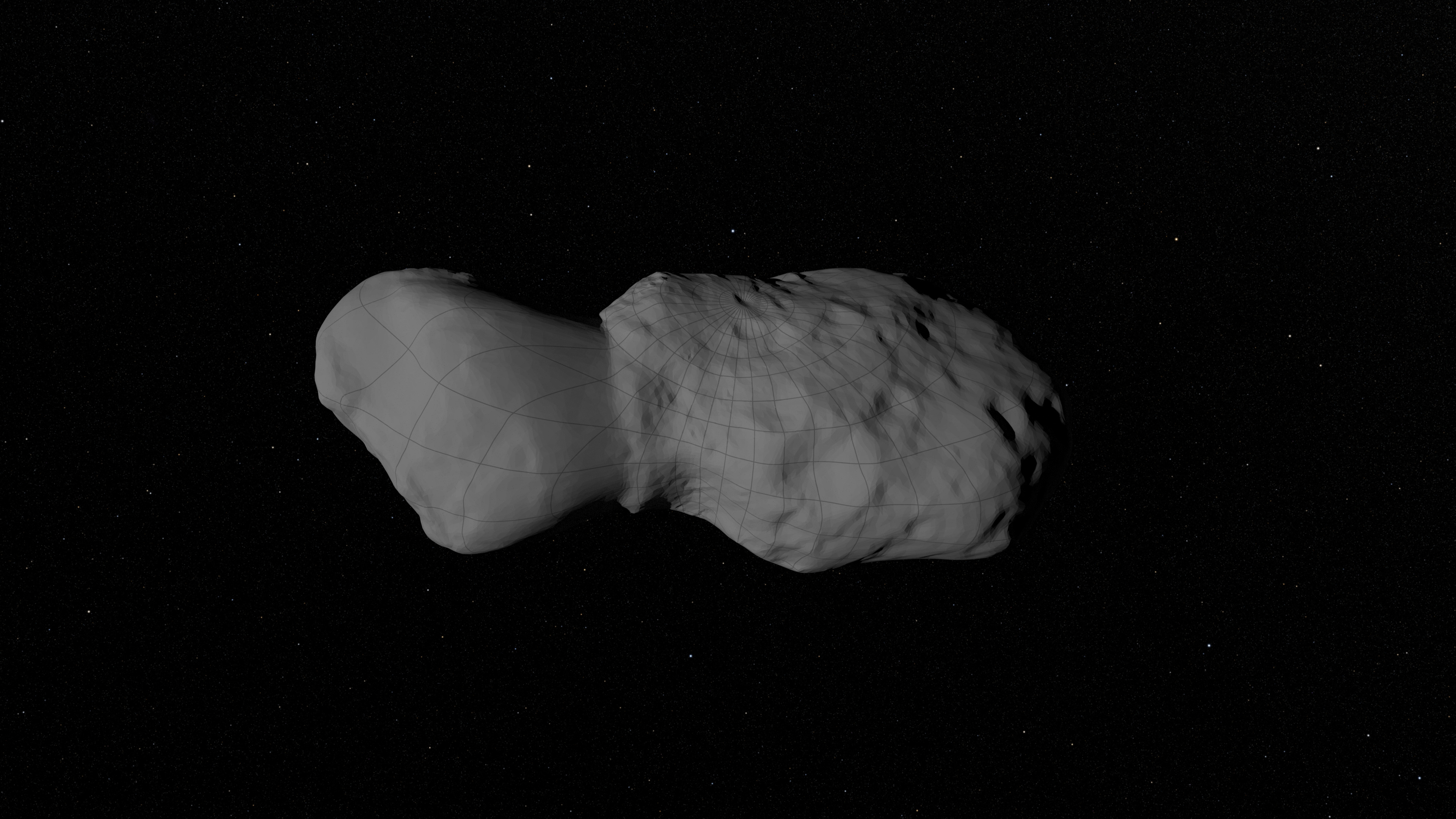
Lucy's images confirmed what ground-based data had only hinted at. Donaldjohanson is a contact binary: two separate lobes connected by a narrow neck. The two lobes are likely fragments from a larger asteroid that was smashed apart in a collision, then drifted back together under their own weak gravity and stuck.
That collision happened about 155 million years ago, dating Donaldjohanson to the late Jurassic on Earth. For context, two better-known rubble-pile asteroids, Bennu and Ryugu, formed one to two billion years ago. Donaldjohanson is barely into its adolescence. The research team now places it in the Erigone family, a group of nearly 1,800 asteroids that all trace back to a single 50-mile-wide parent body destroyed in that ancient impact.
The youth of Donaldjohanson matters scientifically. Bennu, Ryugu, and Donaldjohanson all formed from carbon- and water-rich parent bodies in the main asteroid belt. By comparing three objects with similar compositions but very different ages and histories, scientists get a kind of timeline of asteroid evolution. What changes with time, and what does not, becomes visible when you have enough examples.
Why the asteroid is slowing down
When Donaldjohanson first assembled from collision debris, the team estimates it was spinning at least ten times faster than it does today. Over the past 20 to 60 million years, its rotation has been steadily winding down.
The culprit is something called the YORP effect, named after the four scientists who worked out the physics and just as hard to explain as its acronym suggests. Sunlight heats the asteroid's uneven surface. That heat radiates back into space as infrared light, and because photons carry momentum, each departing photon pushes back with a tiny recoil. On a lopsided object, those tiny pushes do not cancel out. Over millions of years, the imbalance acts as a net torque that can either spin an asteroid up or slow it down.
For Bennu and Ryugu, YORP has been an accelerator. Bennu now completes a full rotation once every four hours. Ryugu does it in about seven. Both used to turn much more slowly. Donaldjohanson is the opposite: YORP has been putting on the brakes.
That slowdown left visible marks. As the asteroid's spin decreased, the balance between centrifugal force and gravity shifted. Loose rocky material slid down slopes, filling in craters and giving the surface the somewhat worn-down look Lucy's cameras captured. It is the kind of detail that would have stayed invisible from a telescope.
Water in the clay
The spacecraft's infrared spectrometer picked up iron-rich clay minerals on the surface. Clays of this type form only with the help of liquid water, which means Donaldjohanson's material spent at least some time in contact with water in the distant past.
But not much time. In the presence of persistent water, iron-rich clays gradually convert to magnesium-rich clays as magnesium atoms replace iron in the mineral structure. Donaldjohanson's clays are still high in iron, which suggests the water exposure was brief. Bennu and Ryugu, by contrast, are coated in magnesium-rich clays that point to prolonged contact with water, lasting perhaps millions of years.
The difference could mean these asteroids came from parent bodies that formed at different distances from the Sun, where water ice would have been available in different amounts, or at different times in the solar system's early history when conditions were changing rapidly.
A rehearsal for Jupiter
Lucy launched in October 2021 on a 12-year mission. Its primary targets are the Jupiter Trojan asteroids, two swarms of ancient objects that travel in the same orbit as Jupiter, one group 60 degrees ahead and the other 60 degrees behind. Scientists think the Trojans are relics of the early solar system, material that has been preserved largely unchanged since the planets formed.
Before reaching the Trojans, the spacecraft has to cross the main asteroid belt between Mars and Jupiter. Donaldjohanson was chosen as a convenient target along the way, a chance to test instruments and flight procedures on a simpler flyby before the more complex Trojan encounters begin.
It was Lucy's second asteroid flyby. The first, in November 2023, revealed that asteroid Dinkinesh was actually a binary system with its own tiny moon. Donaldjohanson was supposed to be the straightforward one.
"This encounter gave us an opportunity to test our instruments and our procedures to make sure we are ready when we get to Jupiter's Trojans," Marchi said. "Once we start learning more about the Trojans, a completely different population of space rocks with very different histories, our understanding of solar system formation is likely to be challenged."
The next target on Lucy's itinerary is Eurybates, a Trojan asteroid scheduled for a flyby on August 12, 2027. Eurybates is roughly 40 miles across, eight times the size of Donaldjohanson, and belongs to a population that may contain pristine material from the outer solar system's earliest days. If a small main-belt asteroid produced this many surprises, the Trojans might be hiding something big.
Sources
- NASA Science: Lucy Reveals Wobbling, Peanut-Shaped Asteroid - primary NASA coverage of the flyby findings, published June 18, 2026
- Southwest Research Institute Press Release (June 18, 2026) - institutional release with researcher quotes and mission context
- Marchi et al., "The Lucy flyby of (52246) Donaldjohanson: A bilobed asteroid with tumbling rotation," Science (2026) - peer-reviewed paper presenting the findings
- NASA Scientific Visualization Studio: Lucy Observations of Asteroid Donaldjohanson - 3D model and rotation visualizations based on flyby data
- Gizmodo: NASA Flyby Reveals Violent Origin of Weird Peanut-Shaped Asteroid - additional coverage with Erigone family context
The hero image is a frame from a 3D visualization of asteroid Donaldjohanson created by Kel Elkins at NASA's Scientific Visualization Studio using data from the Lucy mission. NASA images are in the public domain. The visualization was built from stereo images captured by the Lucy Long-Range Reconnaissance Imager (L'LORRI) during the April 20, 2025 flyby. Shape data credit: DLR. This article describes peer-reviewed research published in the journal Science on June 18, 2026.
Related on Impossible Universe
- New Horizons Heads for the Solar System's Edge. Forecasts Predict When It Will Cross. - another NASA mission exploring the outer solar system beyond the planets