These 540-Million-Year-Old Fossils Were Thought to Be Animals. Then Scientists Looked Closer.
In 2017, researchers found tiny filaments in Brazilian rocks they thought were traces left by ancient worms. A new study using a particle accelerator says they were something else entirely: fossilized communities of bacteria and algae large enough to see without a microscope.
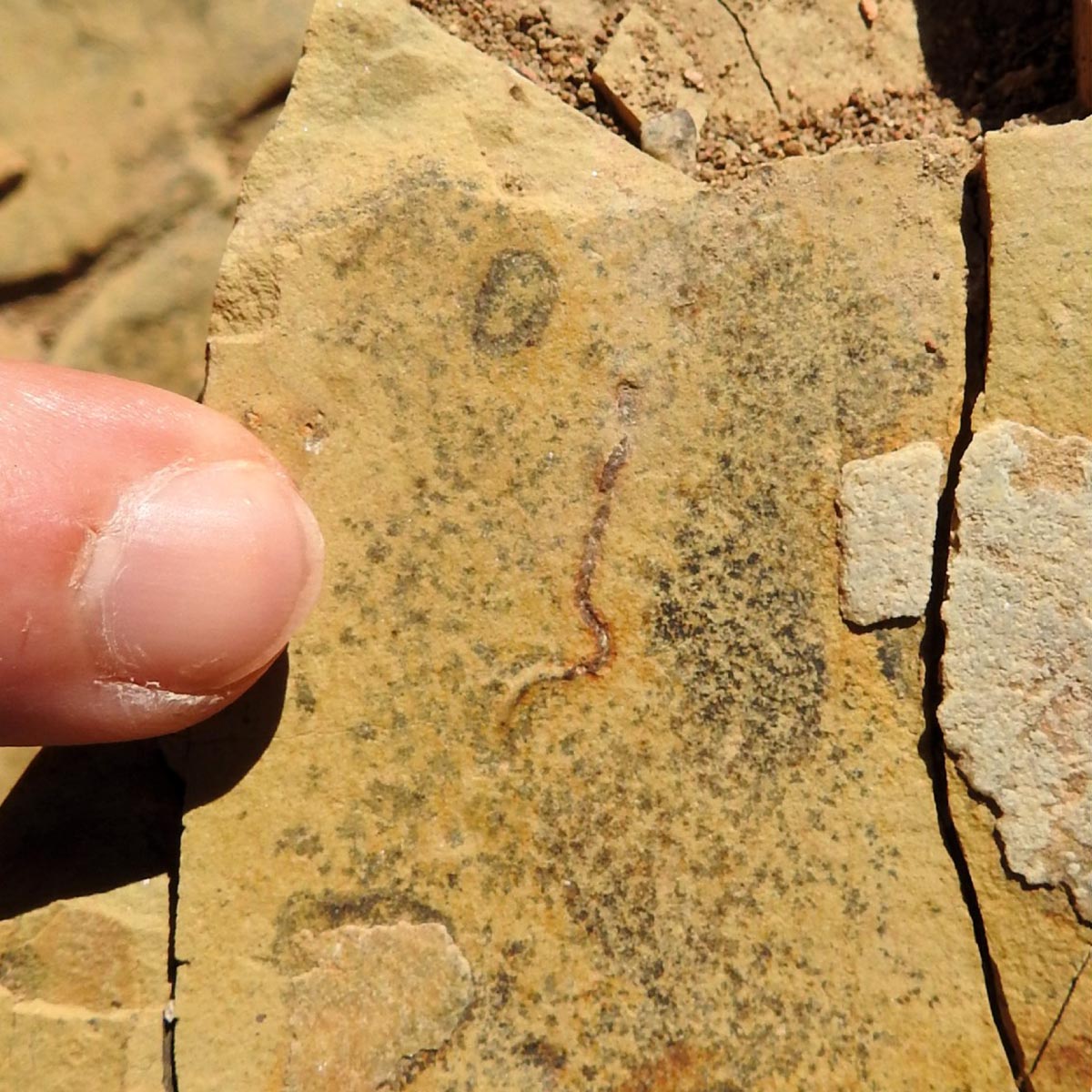
In 2017, a team of paleontologists working in the Brazilian state of Mato Grosso do Sul found something that looked like a major discovery: tiny fossilized filaments in rocks between 542 and 555 million years old. They interpreted the marks as trace fossils, the tracks and burrows left behind by small worm-like animals moving through seafloor sediment. If correct, they would have been some of the oldest animal traces ever found.
They were not correct. In a study published in Gondwana Research in early 2026, a different team reexamined the same fossils using a particle accelerator and nanoscale imaging. What the previous researchers had called animal burrows were actually fossilized communities of bacteria and algae, some large enough to be seen without a microscope.
The tool that changed the answer
The key was a piece of equipment the 2017 team did not have access to: the MOGNO beamline at Sirius, Brazil's synchrotron particle accelerator in Campinas. MOGNO is one of only a handful of instruments in the world capable of zoom tomography, a technique that lets researchers focus on a tiny structure inside a larger sample and image it at nanometer resolution without destroying it.
"When you have a large sample and want to image a structure inside it, the resolution obtained is often insufficient," said Bruno Becker-Kerber, the study's first author. Becker-Kerber conducted the research during postdoctoral work at the University of São Paulo and the Brazilian Center for Research in Energy and Materials, and is now at Harvard University.
What the tomography revealed was not the messy disturbance pattern you would expect from animals burrowing through mud. It showed something far more structured: preserved cells, divisions in cell walls, and coiled filaments all made of organic material. The team also used Raman spectroscopy to confirm the chemical composition of the cell walls themselves.
"These aren't traces of animals that may have passed through the area," Becker-Kerber said.
Giant bacteria in ancient seas
Some of the fossilized microbes contain pyrite, a mineral built from iron and sulfur. Based on their shape and chemistry, the researchers think at least some of them were sulfur-oxidizing bacteria, organisms that use sulfur in their metabolism instead of oxygen.
This group includes some of the largest bacteria ever recorded. Certain modern species in this category can grow wider than a human hair, making them visible to the naked eye despite being single-celled organisms. Becker-Kerber pointed out that some of the fossilized specimens are similarly large, visible without magnification in the rock.
The fossils fall into three distinct size categories, which suggests multiple species living together in what the paper calls a "microbial consortium." The largest forms resemble green or red algae. The smaller ones may be algae, cyanobacteria, or sulfur-oxidizing bacteria.
"There are concave and convex partitions, coiled filaments, cells without sediment but containing organic matter," Becker-Kerber said. "This evidence is much closer to bacteria or algae than to mere marks of disturbance caused by animals."
What this says about early Earth
The fossils date to the Ediacaran period, the geological chapter right before the Cambrian explosion, the event roughly 539 million years ago when oxygen levels rose and complex animal life diversified rapidly. If the Brazilian traces really were animal burrows, they would mean small invertebrates called meiofauna were already active and mobile before the Cambrian, suggesting oxygen levels were already high enough to support them.
The new interpretation points the other way. If the fossils are microbial communities, not animal traces, then the oldest known evidence of meiofauna stays within the Cambrian, where it has always been firmly documented. The Ediacaran oceans may not have been ready for crawling worms yet.
Not everyone agrees
Luke Parry, the first author of the 2017 study and now an associate professor at the University of Oxford, told Gizmodo he was not fully convinced. He commended the team's use of advanced imaging but noted that the picture gets more complicated when considering the full range of fossils examined in the 2017 paper, particularly younger specimens that the new study did not address.
"This highlights that structures with quite different origins can look similar in the fossil record due to similar preservation," Parry said, adding that regardless of the precise interpretation, the original study "provided a potential search image for the action of microscopic animals in the early trace fossil record."
Parry also pointed to a new fossil site in China, published just last month, that turned up 700 well-preserved specimens from between 554 and 539 million years ago, some of which included taxa previously known only from the Cambrian. The question of when animal life first left its mark is far from settled.
A productive correction
Becker-Kerber's team itself is no stranger to finding new things in old Brazilian rocks. The same research group previously described what may be the oldest known lichen in the fossil record, also found in Mato Grosso do Sul, from rocks younger than the bacterial fossils.
The study, part of the Rio de la Plata Craton and Western Gondwana project funded by FAPESP, is co-authored by researchers from the University of São Paulo, São Paulo State University, Harvard University (including paleontologist Andrew Knoll), and CNPEM.
What makes the story worth telling is not that scientists were wrong. It is that they got a better answer because someone looked again with a sharper tool. The 2017 team did careful work with the instruments available at the time. The 2026 team had a synchrotron beamline the earlier researchers did not. That is how science is supposed to work, and the result is a clearer picture of what Earth looked like in the long quiet before the Cambrian explosion filled the oceans with animals.
Sources
- Becker-Kerber et al., "Proposed Ediacaran meiofaunal burrows from Brazil are pyritized algal/microbial consortia," Gondwana Research (2026) - peer-reviewed study presenting the reanalysis
- Agência FAPESP: Microfossils interpreted as animal traces were actually algae and bacteria - official press release with researcher quotes and methodology details
- Phys.org: Brazilian microfossils interpreted as animal traces are actually algae and bacteria - detailed scientific reporting including image descriptions and research context
- Gizmodo: Study Claims 540-Million-Year-Old 'Animal' Fossils Are Something Else Entirely - includes Luke Parry's response and additional context about the ongoing debate
- ScienceDaily: Stunning fossil discovery challenges the origins of animal life - accessible summary of the findings
The hero image is credited to Bruno Becker-Kerber / Harvard University and was distributed through the FAPESP and Phys.org press release channels. The article describes research published in the peer-reviewed journal Gondwana Research. The 2017 study being reexamined is Parry et al., "Ichnological evidence for meiofaunal bilaterians from the terminal Ediacaran and earliest Cambrian of Brazil," Nature Ecology and Evolution (2017).
Related on Impossible Universe
- Scientists Pulled Ancient Human DNA From Cave Walls for the First Time - ancient biological traces preserved on prehistoric cave surfaces, a companion to the microfossil reinterpretation story