
Solid-State Batteries Keep Failing Because Lithium Grows Tiny Tree-Like Crystals That Crack Their Ceramic Core. Scientists Finally Saw How.
Solid-state batteries replace the flammable liquid inside lithium-ion cells with a ceramic, but soft lithium grows tree-like dendrites that crack the ceramic and short-circuit the battery. A Max Planck team used cryogenic electron microscopy to catch the mechanism: hydrostatic stress in the dendrite fractures the ceramic from within, like a water jet cutting rock. The finding points to fixes, including tougher ceramics and engineered voids that redirect the dendrites.
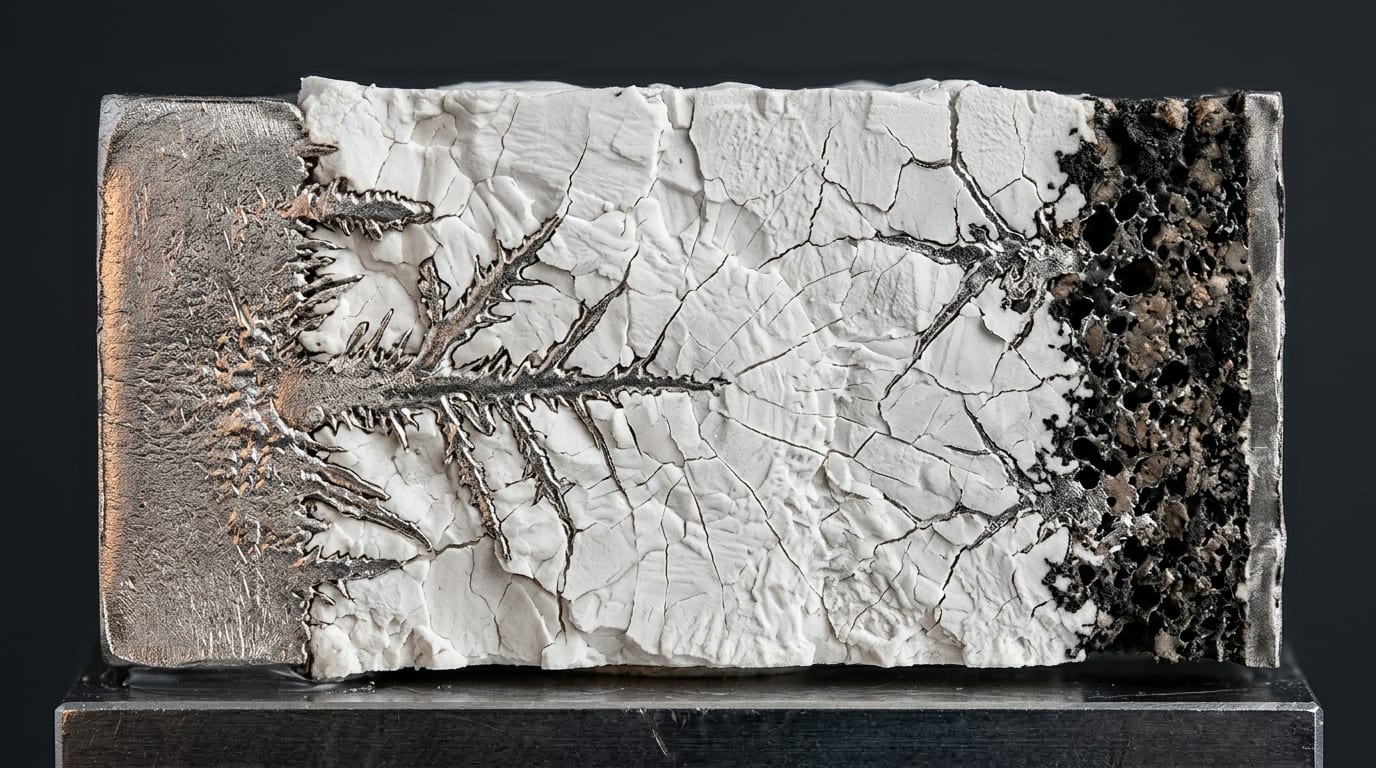
Solid-state batteries were supposed to remove the most dangerous part of a battery: the flammable liquid inside. Replace the liquid with a ceramic, and you get a cell that stores more energy and cannot catch fire. There is one catch. Every time the battery charges, tiny tree-like crystals of lithium grow from the metal anode, push into the ceramic, and crack it from within until the cell short-circuits. The metal doing the damage is so soft that researchers compare it to a gummy bear. For years, nobody could explain how something that soft breaks something that hard.
Now a team at the Max Planck Institute for Sustainable Materials (MPI-SusMat) in Düsseldorf has watched it happen, grain by grain, using electron microscopes that keep the samples frozen and sealed off from air. Their answer, published in Nature on April 22, 2026, points away from the leading explanation. The dendrites do not need an electrical trick to get through. Pressure alone is enough: stress builds inside the growing lithium, the way pressure builds inside a water jet, and that hydrostatic stress fractures the ceramic from the inside out. Once a crack opens, lithium fills it, the crack extends, and the cycle repeats until a metal bridge spans the electrolyte and the battery dies.
Why solid-state batteries matter
Today's lithium-ion batteries shuttle lithium ions between two electrodes through a liquid electrolyte. The liquid works well, but it is flammable, it limits how much energy the cell can hold, and it slowly degrades with every charge cycle. A battery fire, when it happens, is usually the liquid's fault.
Solid-state batteries replace that liquid with a solid, often a ceramic or a glass, that conducts lithium ions but does not burn. Because the solid electrolyte is tough enough to sit between the electrodes on its own, the battery can use pure lithium metal for the anode, the lightest and most energy-dense electrode material known. That combination is why the technology promises so much: smartphones that run for days on a charge, electric vehicles with roughly three times today's driving range, and cells that survive far more charge cycles without catching fire.
The promise has not reached your pocket yet. As of 2026, solid-state batteries have not scaled to commercial production, and the dendrite problem is a big part of the reason.
The tree that grows inside the battery
During charging, lithium ions move through the electrolyte and deposit onto the anode as metal. Under the right conditions, the deposits do not form a smooth layer. They branch instead, growing spiky, tree-like structures called dendrites, named after the Greek word for tree. In a liquid-electrolyte battery, a dendrite can grow until it pierces the thin plastic separator between the electrodes, shorting the cell. That is one of the oldest failure modes in lithium battery engineering.
In a solid-state battery, the separator and the electrolyte are the same material, a ceramic, and a dendrite that pierces it has nowhere to go but all the way across. The ceramic is supposed to be impenetrable. The mystery is that it is not.
The paradox: how does a gummy bear crack a rock?
Lithium metal is about as soft as a gummy bear. Garnet-type ceramics, the class of electrolyte used in this study, are hard, stiff, and brittle. So how does the soft metal win?
"Although the electrodes and the forming dendrites consist of lithium metal, which is soft like a gummy bear, the dendrites are able to penetrate the ceramic electrolyte and lead to a short circuit," says Yuwei Zhang, first author of the paper and head of the Chemo-Mechanics of Battery Materials group at MPI-SusMat.
Two explanations competed for years. The first said the dendrite builds up internal pressure as it grows, and that pressure mechanically fractures the ceramic from within. The second said electrons leak along the grain boundaries of the ceramic, the microscopic joints where crystals meet, reducing lithium ions ahead of the dendrite tip into fresh metal nuclei that grow, interconnect, and bridge the electrolyte on their own.
The two mechanisms make opposite predictions. Mechanical fracture requires a crack to open first, with lithium following behind it. The electron-leakage idea requires lithium to appear ahead of the tip, before any crack is there. A microscope that could look at the exact tip of a growing dendrite and see which one happens first would settle it.
Catching the dendrite red-handed
That is harder than it sounds. Lithium reacts with oxygen, with water, and even with the electron beam of a microscope, so any sample prepared in air shows artifacts that were never in the real battery. The MPI-SusMat team built a workflow that avoided all of it: every preparation and measurement step happened under vacuum, at cryogenic temperatures, with samples carried between instruments in an ultrahigh-vacuum transfer case.
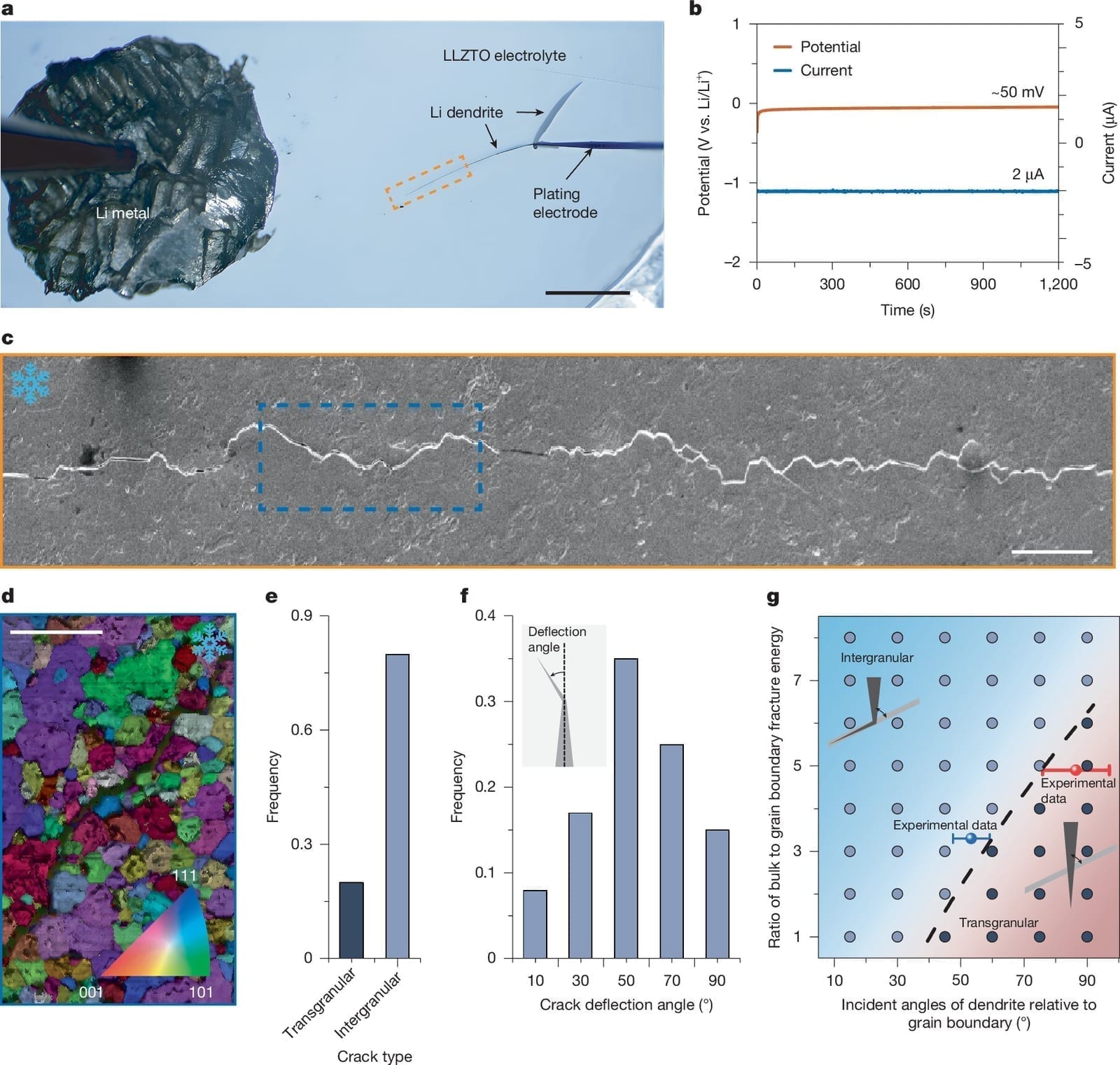
They grew a single, straight dendrite through a thin slice of the garnet electrolyte LLZTO (lithium lanthanum zirconium tantalum oxide), then froze the cell and sliced into it with a focused ion beam to expose the dendrite tip. Cryogenic electron microscopy revealed a jagged, zigzag fracture path through the ceramic, and electron backscatter diffraction mapping showed the crack following the grain boundaries between ceramic crystals, with occasional cuts straight through individual grains.
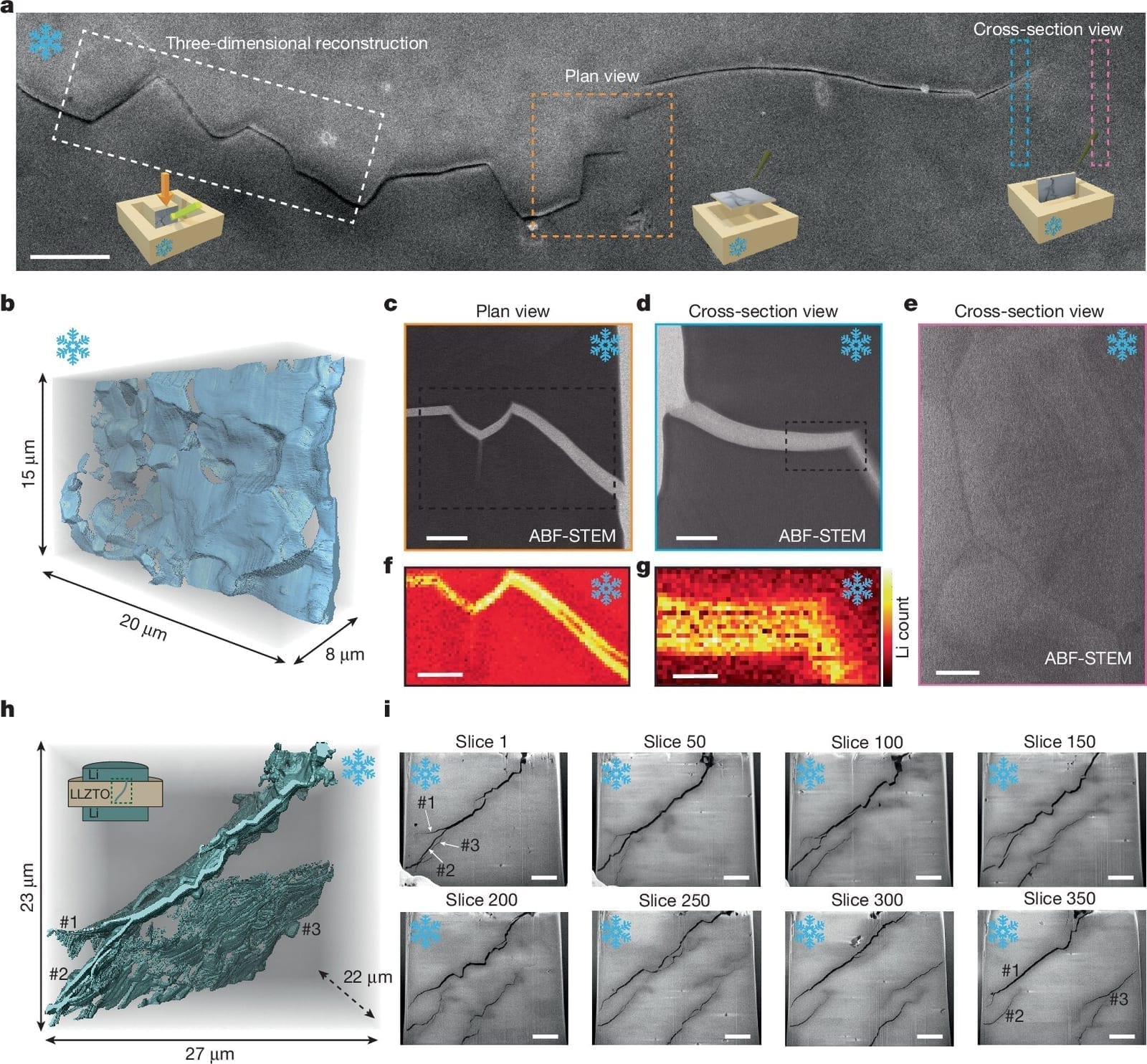
The decisive check came at the dendrite tip. Cryogenic scanning transmission electron microscopy found no isolated lithium nuclei anywhere ahead of the tip. If electrons were leaking along grain boundaries and seeding fresh metal there, the nuclei would have been visible. They were not. The lithium was always behind the crack, filling it, never ahead of it.
That leaves the mechanical explanation, and the team found the stress to back it up. In the regions of the dendrite pressed against the ceramic, the crystal lattice of the lithium showed small rotations, a signature of load. In the dendrite interior, there was no measurable rotation at all, meaning the lithium was under a nearly shear-free, largely hydrostatic pressure, squeezed evenly from all sides. Micromechanical fracture modeling and phase-field simulations agreed: at the stresses involved, the ceramic fails in brittle fracture.
Like a water jet cutting rock
"The soft lithium metal is able to penetrate the stiff ceramic electrolyte, like a continuous waterjet that penetrates a rock," Zhang says. "We calculated that hydrostatic stress in the dendrite leads to brittle fracture of the solid electrolyte in the end."
Here is the mechanism in plain terms. Lithium plates into the base of the dendrite faster than the crack can open, so the metal inside the existing crack is squeezed. That pressure turns the dendrite into a hydraulic wedge. The ceramic cannot deform to relieve the load, because ceramics are brittle and have no give, so the tensile stress at the crack tip climbs until the ceramic snaps. The crack advances, lithium flows in, and the wedge resets. Soft metal, steady pressure, brittle ceramic: the soft thing wins by never stopping.
The result explains the mechanism for garnet-type electrolytes under the conditions tested. It does not solve solid-state batteries on its own. The electron-leakage pathway may still matter in other ceramic systems or under other operating conditions, and the team says the two mechanisms are not mutually exclusive across the whole field. What this study does is pin down which one dominates in garnet, with direct evidence instead of inference.
How to stop the wedge
Understanding the mechanism points at the fix. If the dendrite wins by fracturing the ceramic, then the ceramic is the place to fight back. The team is exploring three strategies.
The first is to make the electrolyte tougher, so it resists cracking longer and the cell survives more cycles before a dendrite gets across. The second is coatings: a protective layer on the lithium electrode that suppresses dendrite formation in the first place. The third is the most inventive: engineer the ceramic so that when a dendrite does grow, it gets redirected.
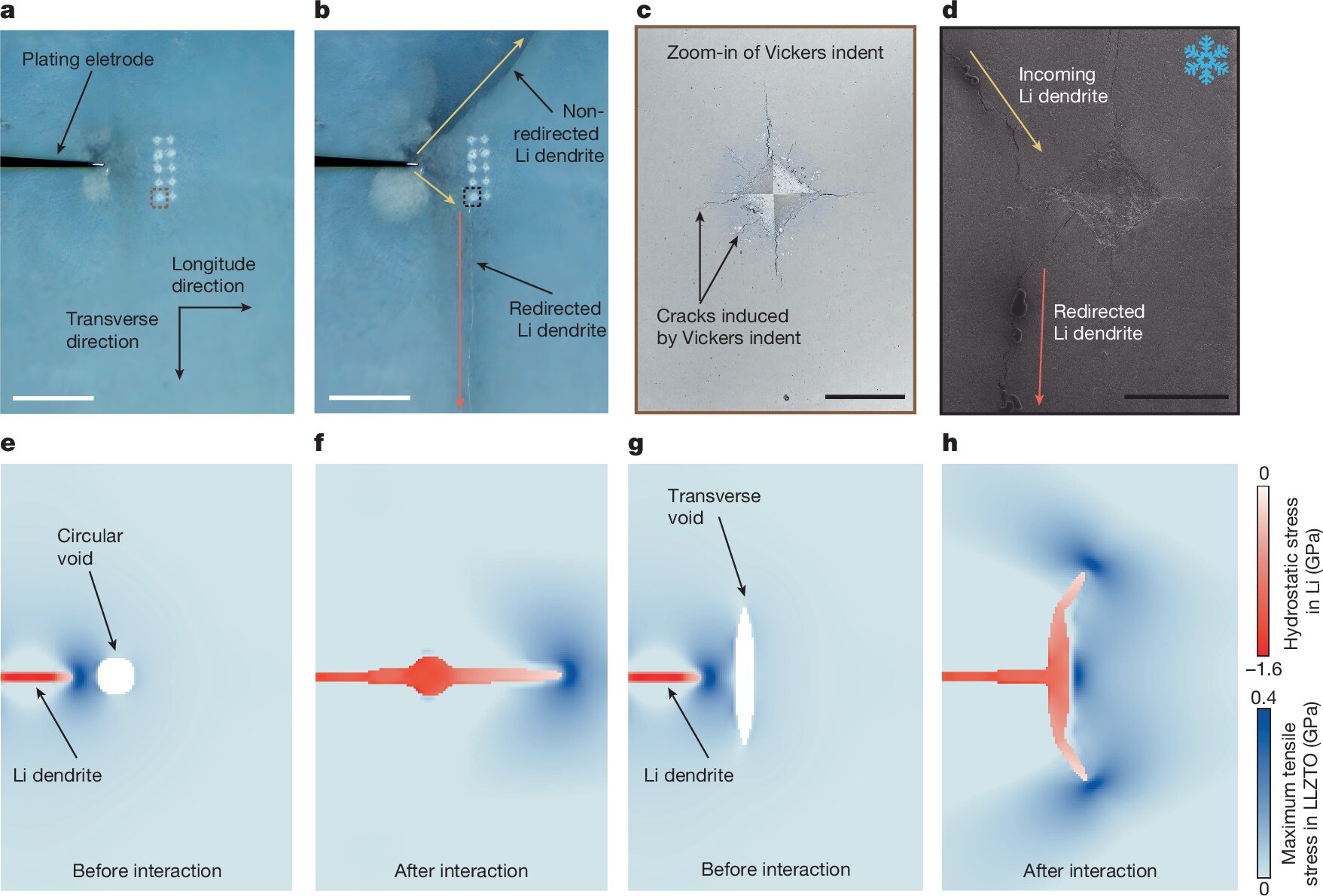
The paper demonstrates that redirection directly. The team pressed tiny Vickers indents into the ceramic, the same diamond-pyramid marks used to test hardness, and watched the local stress field around an indent bend an incoming dendrite away from its straight path. Computer models of the same idea show engineered voids, circular or transverse cavities carved into the electrolyte, steering the crack tip along a longer, harmless route instead of straight across the cell. The dendrite still grows. It just stops being lethal.
Where solid-state batteries stand
Automakers and battery makers have been chasing solid-state cells for years, and the gap between laboratory demonstrations and production lines remains wide. Manufacturing a flawless ceramic electrolyte at scale is expensive, the interfaces between ceramic and electrodes are finicky, and the dendrite problem has made every step harder to trust. As of 2026, no solid-state battery has reached broad commercial production.
That is why a mechanism paper matters outside the lab. Every proposed fix, tougher ceramics, protective coatings, engineered voids, is a bet on a specific failure theory. If engineers were designing against the wrong mechanism, the fixes would fail in the field and nobody would know why. Now the design target for garnet electrolytes is concrete: stop the wedge, or steer it.
The deeper lesson is a materials-science one. The battery industry spent decades treating dendrites as an electrochemical problem. The MPI-SusMat result treats them as a mechanical one, a soft metal quietly prying apart a stiff ceramic, and that reframing is what opens new fixes. The same instinct, that strange materials behavior is worth understanding at the scale of atoms and grains before building bigger things, is what keeps turning promising technologies into practical ones.
Sources
- Zhang et al., "Mechanically driven Li dendrite penetration in garnet solid electrolyte," Nature 652:912-918 (April 22, 2026), DOI 10.1038/s41586-026-10415-9 - the primary peer-reviewed paper, open access under CC BY 4.0, with all four figures reproduced here
- MPI-SusMat press release, April 23, 2026: Understanding the short circuit in solid-state batteries - the Yuwei Zhang quotes, the full author list, and the proposed mitigation strategies
- ScienceDaily, July 10, 2026: The biggest problem with solid-state batteries may finally be solved - coverage of the study and its context
- Wikipedia: Solid-state battery - background on the technology, energy density claims, and commercialization status
- EurekAlert! release, April 2026: news-releases/1125712 - syndicated version of the press release (link requires a browser)
Hero image: generated illustration by the Impossible Universe Editorial Team, based on the described mechanism. Inline figures: reproduced from Zhang et al., Nature 652:912-918 (2026), an open-access article licensed under CC BY 4.0; credit as shown. The MPI-SusMat press release image (copyright P. Mehta, MPI-SusMat GmbH) was not used.
Related on Impossible Universe
- Solar Panels Just Hit 35.5% Efficiency. The 43% Ceiling Is Now in Sight. - the other half of the clean-energy materials story: how materials science keeps pushing efficiency records
- This Tiny Chip Processes Information With Light Instead of Electricity - nanoscale materials engineering turning physics into working devices
- A New Quantum Material Works at Room Temperature. It Could Change Computing. - engineered materials with surprising properties, from superlattices to solid electrolytes
- Physics and Quantum Topic Hub - more on the strange behavior of matter and energy, from time crystals to topological insulators