A Faint Trail of Stars in a Ghost Galaxy Is the First Stellar Stream Ever Found Beyond the Milky Way. It Could Map Dark Matter.
In the ultra-diffuse galaxy UGC 9050-Dw1, about 115 million light-years away, astronomers found a thin trail of stars being pulled from a globular cluster. Named Oyashio, it is the first stellar stream ever found beyond the Milky Way, and it gives researchers a new way to weigh the dark matter halo of a galaxy outside our own.
Our galaxy is wrapped in rivers of stars. Long, thin trails of light, each one the shredded remains of a star cluster that wandered too close and was torn apart by gravity, loop through the Milky Way's halo. Astronomers have studied these stellar streams for decades because they are sensitive to the invisible mass that shapes them. The catch: until now, the technique only worked in our own galaxy.
That changed in August 2026. An international team led by researchers at the University of Copenhagen found the first stellar stream ever confirmed beyond the Milky Way, in a galaxy so faint that its stars spread out like a ghost across a region the size of the Milky Way. The stream, named Oyashio after a cold Pacific ocean current, is a thin trail of stars being pulled from a globular cluster in the ultra-diffuse galaxy UGC 9050-Dw1, about 115 million light-years away. The discovery, published in Nature, extends a tool that maps dark matter to galaxies beyond our own for the first time.
What a stellar stream is
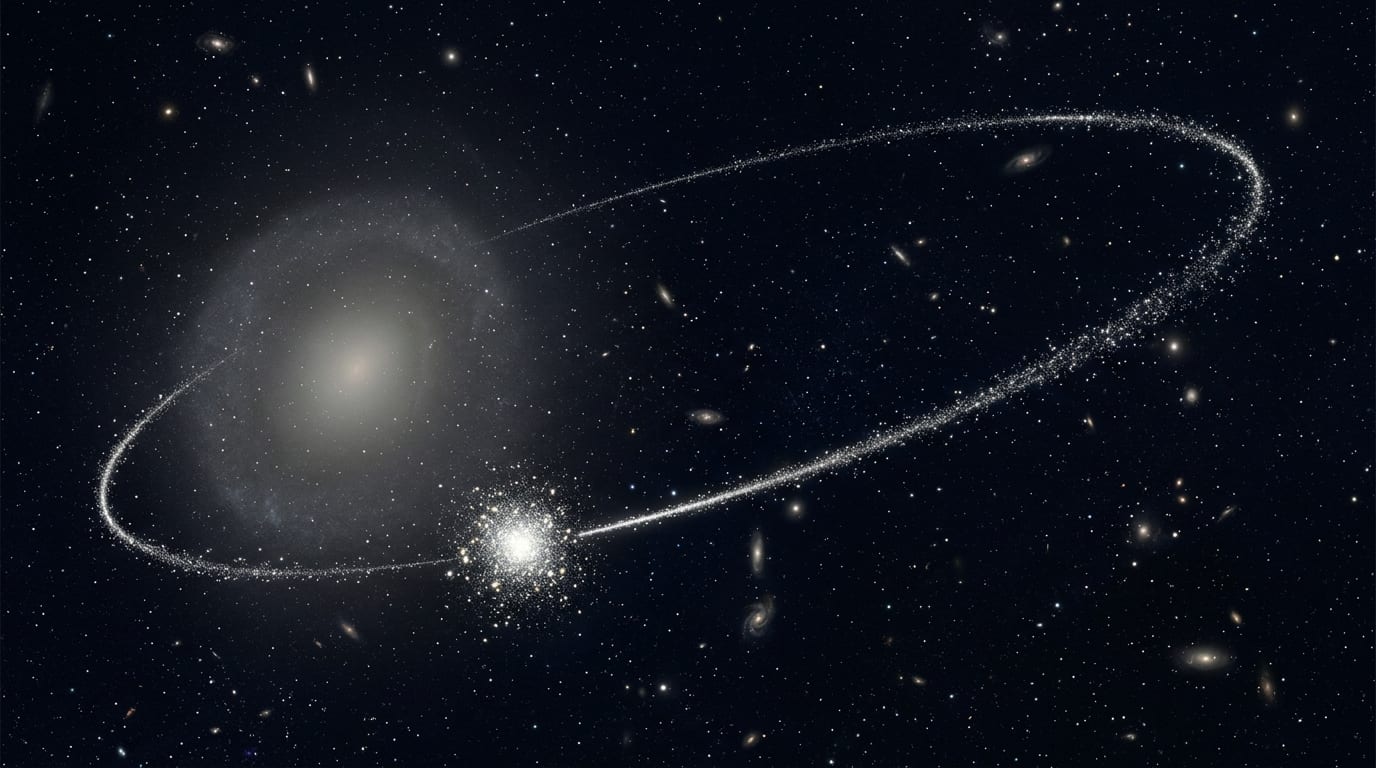
A stellar stream forms when a dense cluster of stars orbits a larger galaxy. The galaxy's gravity pulls harder on the near side of the cluster than on the far side, a difference called a tidal force, the same physics that makes the Moon raise ocean tides on Earth. Over hundreds of millions of years, those tides peel stars off the cluster and string them out along its orbit: a thin leading arm ahead of the cluster and a trailing arm behind it. The result is a stream, a coherent ribbon of stars that can persist for billions of years, long after the cluster that spawned it has dissolved.
Streams matter far beyond their beauty. The stars in a stream move together, so any change in their path records the gravitational field they travel through. If a clump of dark matter, an invisible subhalo, passes near a stream, its gravity tugs at the stars and leaves a visible gap or kink in the ribbon. That makes streams one of the best tools astronomers have for detecting and weighing dark matter, the unseen substance that makes up most of the universe's mass. In the Milky Way, gaps in the stream GD-1 have been used to search for dark subhalos predicted by cold dark matter models.
The catch was reach. Globular cluster streams, the thinnest and most sensitive kind, had only ever been observed in the Milky Way. Their signal is extremely faint, far too faint to pick out in a distant galaxy with most telescopes. Detecting one outside our own galaxy required a galaxy that is itself almost invisible, and a telescope sharp enough to see the trail anyway.
The ghost galaxy and its trail
UGC 9050-Dw1 is an ultra-diffuse galaxy, a class that astronomers have only recognized as a group in the past decade. Ultra-diffuse galaxies look like nothing so much as a faint haze: they hold as few stars as a small dwarf galaxy, but spread them across a region as large as the Milky Way. Their dimness makes their dark matter content genuinely hard to measure. Their stars are too spread out for most rotation-curve measurements, and their internal motions are hard to read. The dark matter content of ultra-diffuse galaxies, and how they got so diffuse in the first place, is one of the livelier debates in modern astronomy.
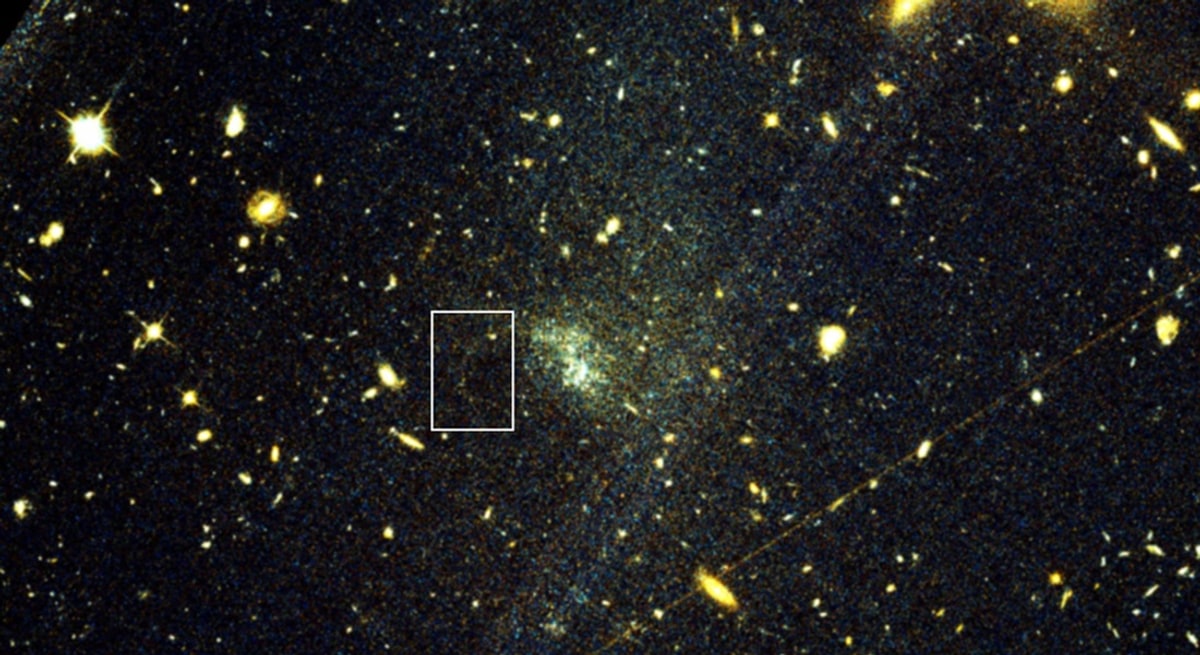
The researchers, led by PhD student Julie Kiel Holm of the Niels Bohr Institute and Associate Professor Sarah Pearson of DTU Space, went looking in deep images of UGC 9050-Dw1 taken by the Hubble Space Telescope and the Canada-France-Hawaii Telescope (CFHT) on Maunakea. The galaxy was already known to be rich in globular clusters: a 2023 study led by Catherine Fielder, now a co-author of the new work, found that most of its clusters probably formed at the same time, during a past dwarf merger. In the Hubble images, taken with the ACS camera through two filters (F555W and F814W), the team spotted something the earlier study had not flagged: a thin, faint feature stretching about 2 kiloparsecs from one of the cluster candidates near the galaxy's center. The same feature shows up independently in the CFHT images, which rules out an artifact of a single instrument or data processing run.
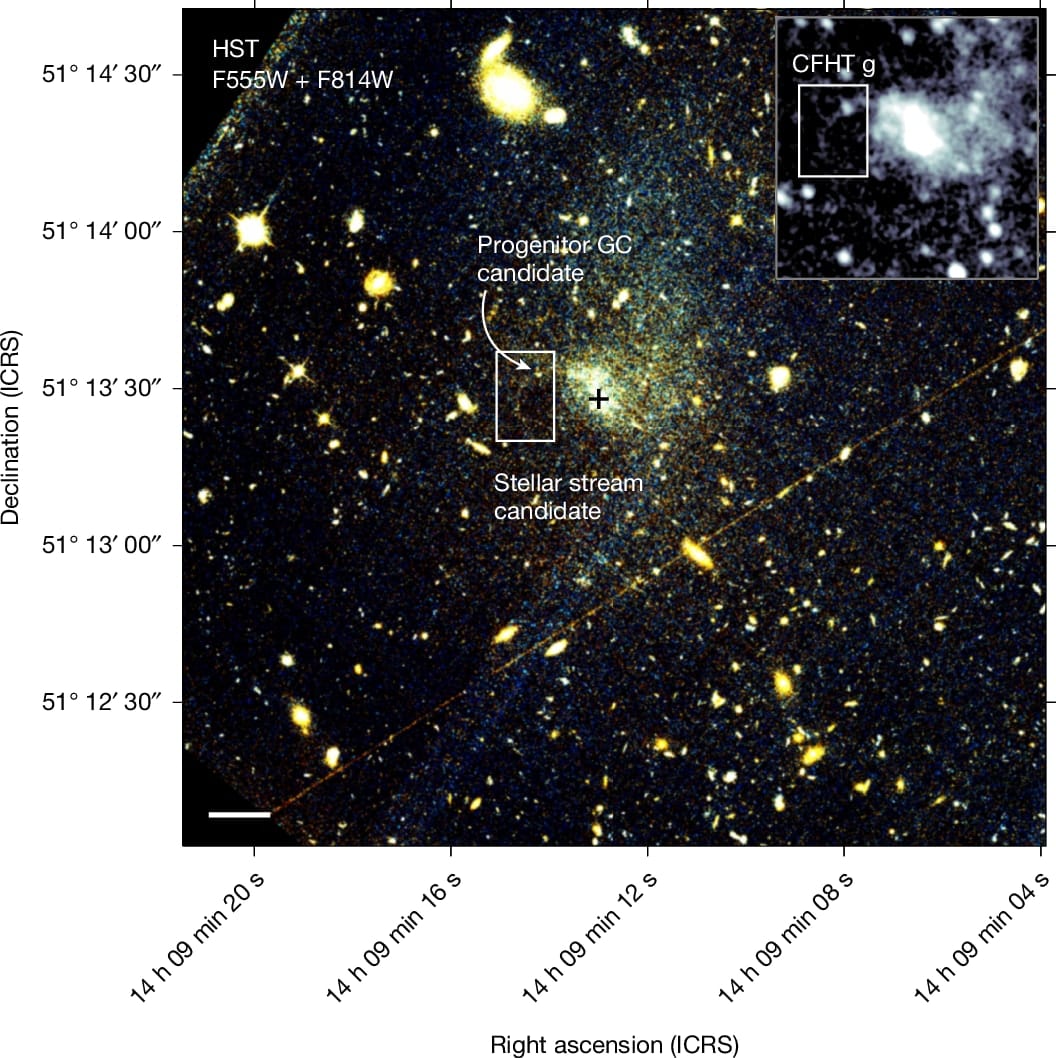
The feature is thin. Its measured width is about 72 parsecs, only a few times wider than a typical globular cluster stream in the Milky Way, and far narrower than streams produced by shredded dwarf galaxies, which run hundreds of parsecs wide. Its colors match its presumed parent cluster, both consistent with the same stellar population, and both fall inside the color box used to select globular clusters in the galaxy. On the strength of the morphology, the colors, and the independent detection in two telescope datasets, the team named it Oyashio, following the ocean-current naming convention used for Milky Way streams such as the Orphan-Chenab.
A first dark matter measurement
The stream's real value is what it allows astronomers to measure. The team fitted dynamical models to the stream's shape using a modeling technique called X-Stream, which simulates millions of possible orbits and cluster masses and asks which ones reproduce the observed trail. The models put an upper limit on the original mass of the progenitor cluster: less than about 2.5 million times the Sun's mass, comfortably in globular cluster territory and below the mass of Omega Centauri, the Milky Way's most massive globular cluster, which has its own stream.
More importantly, the stream's curvature constrains the mass of the dark matter halo it is moving through. The models find a halo mass of about 10^11.31 solar masses, equivalent to a total mass of roughly 1.6 x 10^11 solar masses, similar to the Large Magellanic Cloud. That matches, within the error bars, the halo mass that Fielder's 2023 study estimated from counting the galaxy's globular clusters, about 1.5 to 1.8 x 10^11 solar masses. Two completely different techniques, one counting clusters and one tracing a stream, now agree on how much dark matter UGC 9050-Dw1 carries. It is the first time a stellar stream has been used to constrain a dark matter halo in a galaxy beyond the Milky Way.
The result also touches the running argument about what ultra-diffuse galaxies are made of. Some ultra-diffuse galaxies, like the famous Dragonfly 44, have been claimed to be almost entirely dark matter. Others seem to have almost none. The new measurement points to a halo with a slightly steeper inner density profile than the average low-surface-brightness dwarf, a data point in a debate that has swung back and forth for years.
An honest caveat
The paper's title is careful: "evidence for" the first stream, not a confirmation. The stream is a candidate identified in imaging and supported by modeling, not a spectroscopically confirmed structure. The stars in it are too faint to measure individually at this distance, so the team cannot rule out every alternative with certainty, including a chance alignment of unrelated stars. They argue the case is strong: the colors match, the modeling reproduces the shape, the halo mass agrees with an independent method, and mock observations show the feature is exactly what a real globular cluster stream would look like in these images. But the honest summary is that this is the best case yet, not the final word.
Why it matters
The significance is not the single trail of stars. It is that the tool now works beyond our galaxy. For the first time, astronomers can use a stellar stream to weigh the dark matter halo of a galaxy that is not the Milky Way, and the technique can be pointed at any ultra-diffuse galaxy with a sharp enough image.
Dark matter makes up most of the mass in the universe, and nobody has seen it directly. It reveals itself only through gravity, so every new way to map that gravity matters. Cold dark matter models predict a swarm of low-mass, starless subhalos around galaxies, objects that should be nearly impossible to see, except through the gaps and kinks they leave in stellar streams. Extending stream analysis beyond the Milky Way opens a much larger sample of galaxies to this kind of probe, including hosts with fewer confusing baryonic structures than our own galaxy.
The near future should bring many more of these detections. The Euclid space telescope and the Nancy Grace Roman Space Telescope, both built for wide, deep surveys, are expected to multiply the number of observable globular cluster streams dramatically. Holm, Pearson, and their colleagues have shown what to look for, in a class of galaxy that turns out to be the perfect place to find it. The first extragalactic stream is a proof that the method travels, and the next survey image could contain the second.
Sources
- Holm, Pearson, Nibauer, Sand, Price-Whelan, Starkenburg, Hendel and Fielder, "Evidence for the first globular cluster stellar stream beyond the Milky Way," Nature, August 12, 2026 - the peer-reviewed paper, open access (CC BY 4.0)
- University of Copenhagen: Breakthrough in unusual galaxy may help unravel the mystery of dark matter - institutional release with author quotes and the press image
- Wikipedia: Stellar stream - background on tidal stripping, Palomar 5, GD-1, and Orphan-Chenab
- Wikipedia: Ultra-diffuse galaxy - background on UDGs and the Dragonfly 44 dark matter debate
- Fielder et al., "The disturbed and globular-cluster-rich ultradiffuse galaxy UGC 9050-Dw1," The Astrophysical Journal Letters 954, L39 (2023), DOI 10.3847/2041-8213/acf0c3 - the prior study of the galaxy's globular cluster population and halo mass estimates
- Nibauer and Pearson, "Testing dark matter with generative models for extragalactic stellar streams," The Astrophysical Journal 1002, 204 (2026), DOI 10.3847/1538-4357/ae5bb0 - the modeling framework behind the stream constraints
Hero image: Hubble Space Telescope observation of UGC 9050-Dw1 as presented in the University of Copenhagen release, credit "Hubble Space Telescope and Holm et al. (2026)." Discovery figure: adapted from Holm et al., Nature (2026), CC BY 4.0. Tidal stripping illustration: generated by the Impossible Universe Editorial Team based on the cited sources.
Related on Impossible Universe
- Astronomers Found the First of 10,000 Missing Black Holes in Omega Centauri. It Took Hubble 20 Years to Spot It. - the Milky Way's most massive globular cluster, the kind of object that produces streams like Oyashio
- A Third Galaxy Without Dark Matter Just Showed Up. It's Right Where Scientists Predicted. - the other side of the ultra-diffuse galaxy dark matter debate
- JWST Found These Little Red Dots in the Early Universe. They Were Black Hole Stars. - more from the Copenhagen group at the frontier of galaxy science
- NASA's Roman Space Telescope Launches in 36 Days. It Will Map a Billion Galaxies and Find Thousands of New Worlds. - the survey telescope expected to find many more stellar streams
- Telescopes and Space Missions Topic Hub - the observatories, from Hubble to Euclid, doing the imaging
- Physics and Quantum Topic Hub - more on dark matter and the invisible universe