Astronomers Found a Jupiter-Sized Object Orbiting a Failed Star. It May Be the First Moon Ever Seen Outside Our Solar System.
Astronomers have found strong evidence for a Jupiter-sized object orbiting a brown dwarf in the CD-35 2722 system, 73 light-years away. If confirmed, it is the first moon-like object ever detected outside our solar system, and it is strange enough that the team stopped calling it a moon and settled on a new word: exosatellite.
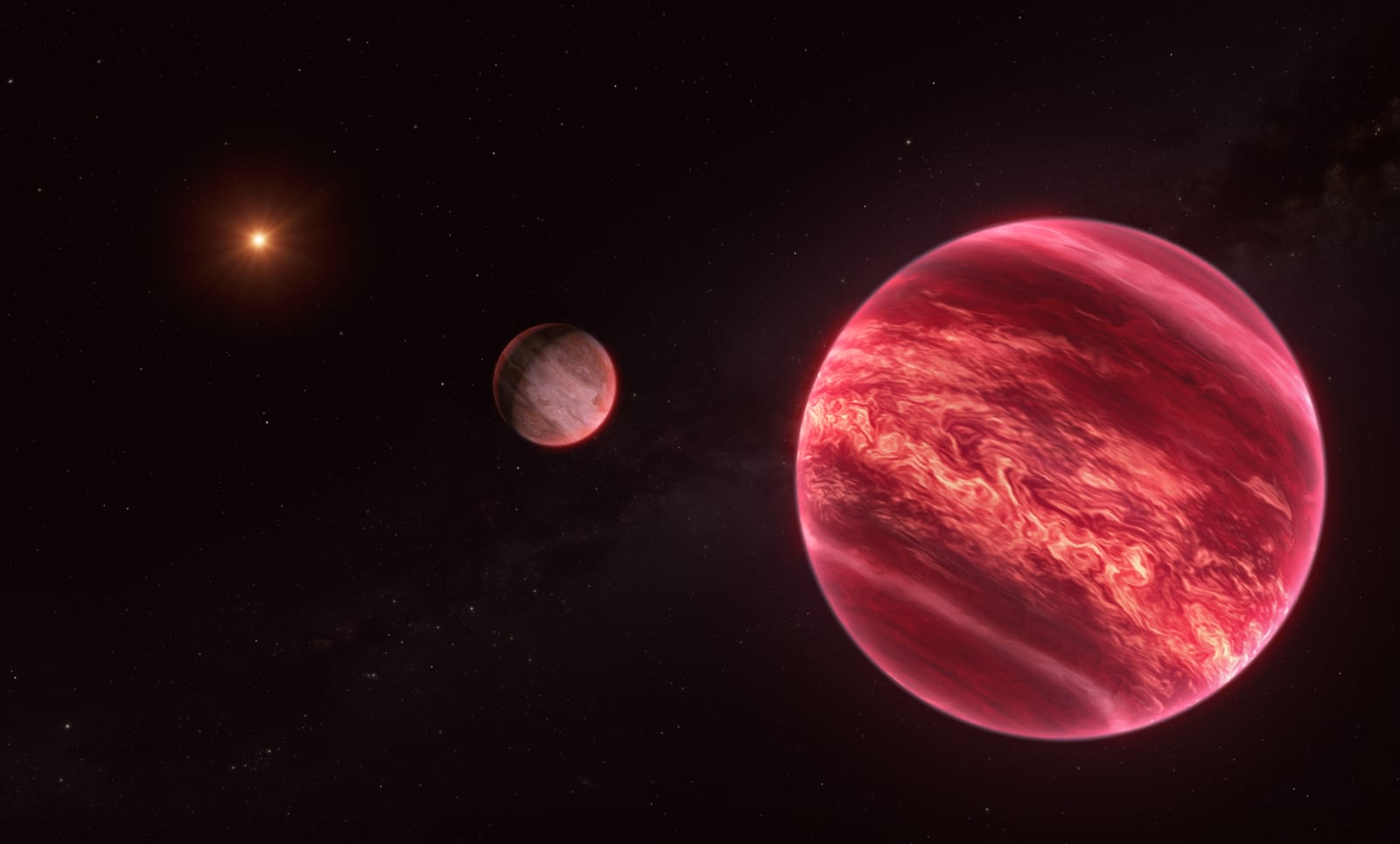
More than 6,000 planets have been found orbiting other stars, but no one has ever confirmed a moon around one of them. The hunt for the first exomoon has run for more than a decade, through two celebrated candidates that could not ultimately be confirmed. Now a team using the European Southern Observatory's Very Large Telescope (VLT) reports a new kind of candidate: a gas giant at least comparable in mass to Jupiter, orbiting not a planet but a brown dwarf, an object too massive to be a planet and too small to be a star.
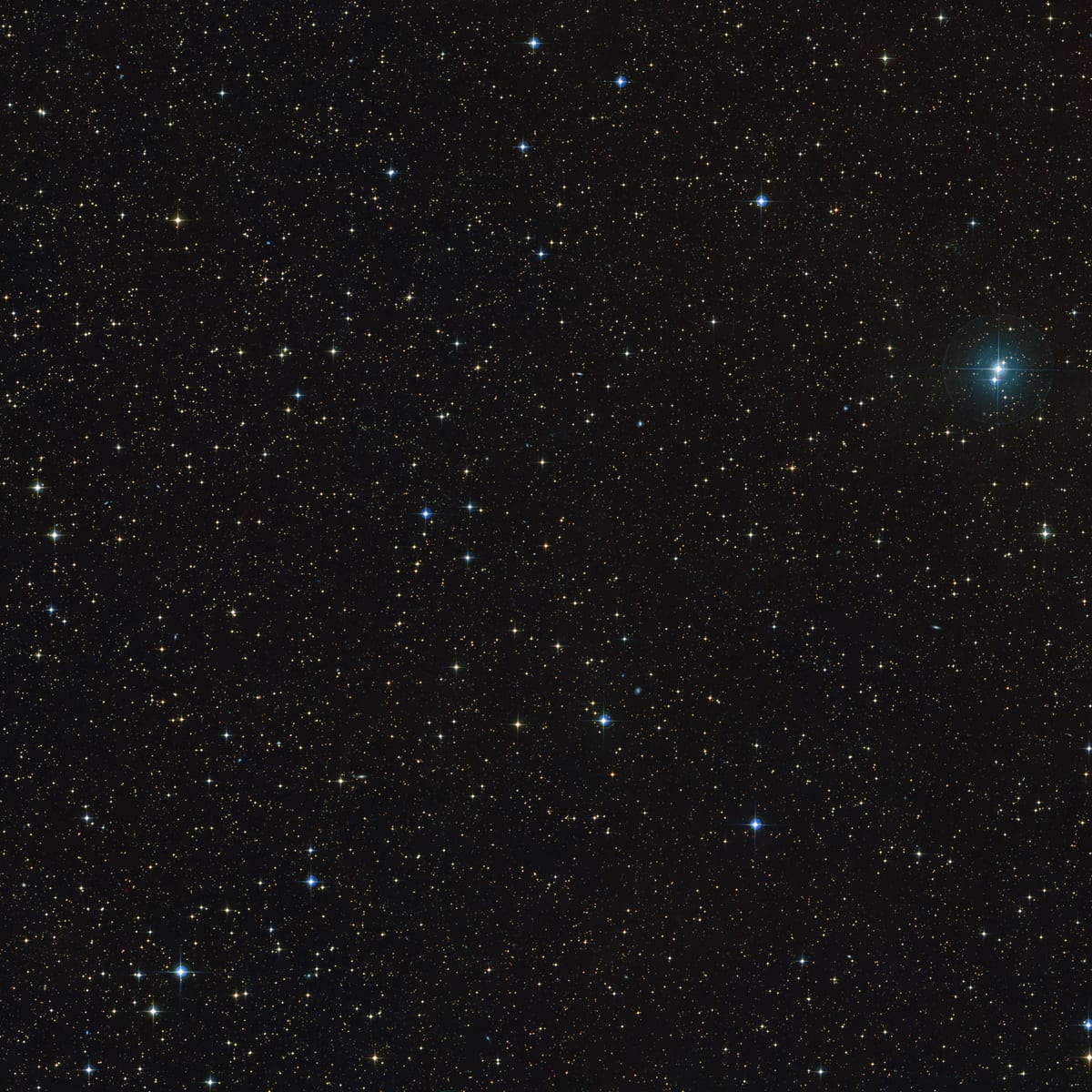
The system is CD-35 2722, about 73 light-years away in the constellation Columba. The paper, published in Nature on July 22, 2026, describes the object as a "planetary-mass exosatellite," and the team deliberately avoids the word moon. The reason is not shyness. It is that the object breaks the categories we use to describe our own solar system.
A three-body system that breaks the labels
The setup is a kind of matryoshka doll of cosmic definitions. At the center is CD-35 2722, a young M-dwarf star with about half the mass of the Sun. Orbiting it is a brown dwarf called CD-35 2722 B, roughly 37 times the mass of Jupiter, discovered in 2011 by direct imaging with the Gemini telescope. And orbiting that brown dwarf is the new object, a gas giant with a minimum mass of about 0.9 times Jupiter's mass, circling once every 171 days.
"This system is somewhat hard to define using Solar-System-based words like 'planet' and 'moon'," said Kevin Hoy, the ESO student in Chile who led the study and is also affiliated with Universidad Diego Portales and the Millennium Nucleus of Young Exoplanets and their Moons. "The exosatellite is clearly massive enough to be a planet, but it does not orbit a star, though it orbits an object that orbits a star."
The naming problem is real. A moon, loosely speaking, is a natural object that orbits a planet. A planet orbits a star. In this system, the object in question orbits a brown dwarf, which is neither planet nor star, and the object itself is massive enough that it would be called a planet if it orbited the star directly. There is no officially accepted definition of an exomoon, so the authors settled on exosatellite, a neutral word for a natural satellite beyond our solar system.
Alice Zurlo, director of the YEMS center in Chile and a collaborator on the study, put the problem plainly: "We have a clear delineation between the planets and the Sun in the Solar System, so defining things like moons is simple. In the CD-35 2722 system, where we are blurring the lines between stars, planets, and moons, the whole thing becomes more complicated to describe."
What a brown dwarf is, and why this moon is strange
A brown dwarf is a failed star. It forms the way stars do, from a collapsing cloud of gas, but it never accumulates enough mass to ignite sustained hydrogen fusion in its core. The boundary sits around 80 times the mass of Jupiter. CD-35 2722 B, at 37 Jupiter masses, sits well below it: too big to be a planet, too small to shine like a star, and warm enough to glow faintly in the infrared for a while after it forms.
What makes the new object odd is how heavy it is relative to the thing it orbits. In our solar system, the largest moon-to-planet mass ratio is the Earth and the Moon, at about 1.2 percent. Jupiter's moons are far smaller fractions of Jupiter. But this exosatellite is about 2.5 percent of its brown dwarf's mass, a much larger satellite relative to its host than anything around our planets. It is a moon that behaves like a companion.
How they found it: the Doppler wobble
The detection used the same technique that found the first exoplanet around a Sun-like star in 1995. As the exosatellite circles the brown dwarf, its gravity tugs the brown dwarf slightly toward and away from Earth. That motion shows up in the brown dwarf's light as a Doppler shift, a tiny back-and-forth stretch and squeeze of the wavelengths in its spectrum. By measuring that wobble, astronomers can work out the orbiting object's mass and period without ever seeing it.
The team used CRIRES+, an infrared spectrograph on the VLT in Chile, and gathered 23 high-quality observations over 26 nights between October 2023 and February 2026. Because the brown dwarf is far enough from its star in the sky, about 2.8 arcseconds, the team could record its spectrum with almost no starlight bleeding in. That separation, plus the instrument's high spectral resolution, gave measurements the team says were up to 100 times more precise than earlier attempts on similar targets.
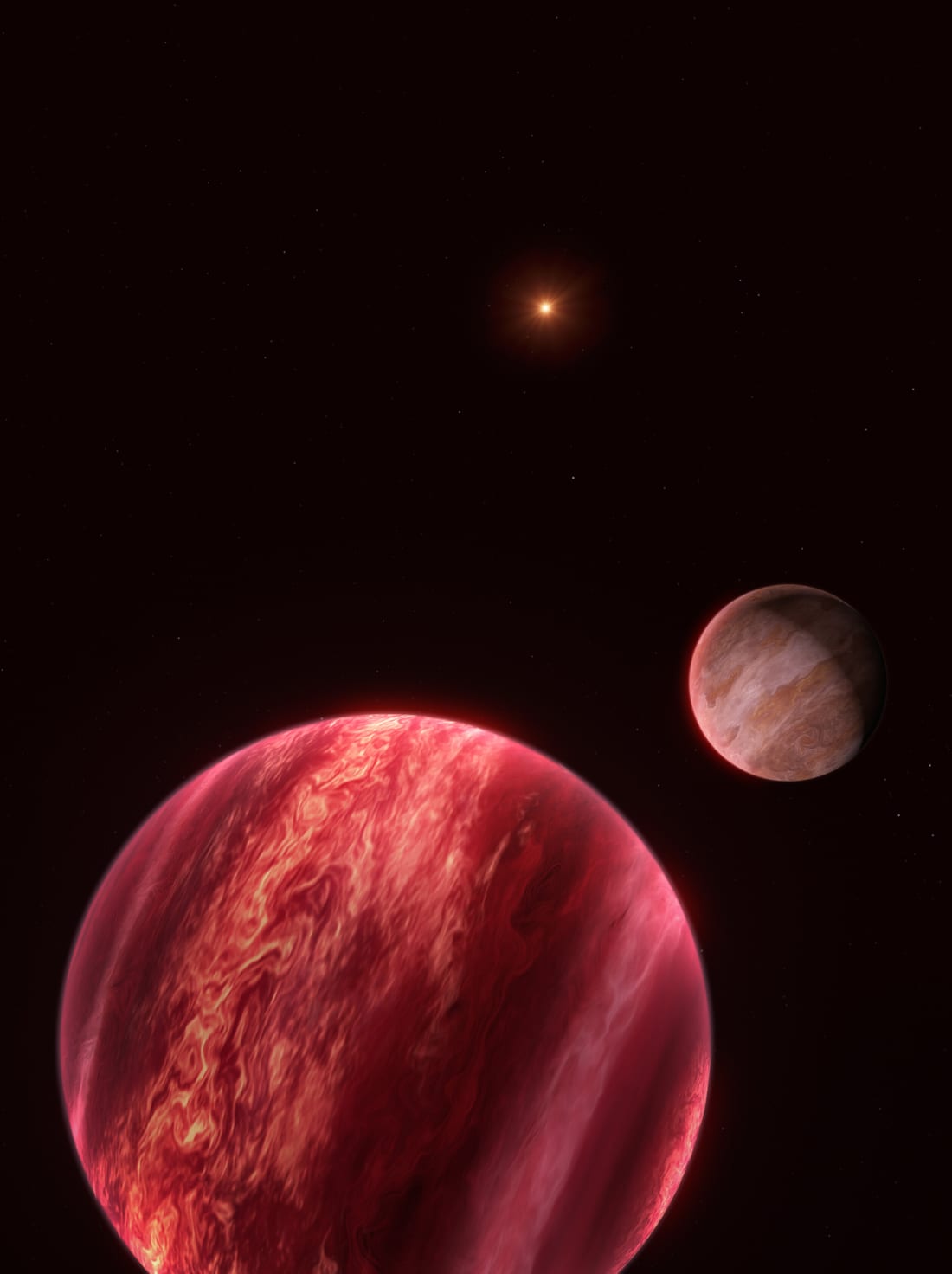
The signal was strong, but the team did not stop there. They checked whether the 171-day wobble could be something else: a fake period introduced by corrections for Earth's own orbital motion, by seasonal changes in the atmosphere, or by the brown dwarf's own rotation. None of them fit. The brown dwarf's rotation, for one, would have to produce a signal of at most about 0.65 days, far too fast to explain a 171-day cycle. A two-satellite model could also fit the data, but the team notes it would be dynamically unstable except in a narrow set of special cases.
They also checked the physics of the orbit itself. The exosatellite sits well inside the brown dwarf's Hill sphere, the region where its gravity dominates, and well outside its Roche limit, the boundary where tidal forces would tear a moon apart. The orbit is stable, in other words, which is exactly where a real long-lived satellite should be.
Why earlier exomoon candidates did not stick
This is not the first time astronomers have claimed a possible exomoon, which is why the team is careful. The two best-known earlier candidates were Kepler-1625b-i and Kepler-1708b-i, both spotted as subtle transit timing variations as a planet passed in front of its star. Independent analyses later questioned both, and they remain unconfirmed. A few months before the CD-35 2722 result, a team led by Quentin Kral reported hints of a satellite around the star HD 206893 using the VLT Interferometer, but again without a firm detection.
What makes the new candidate different is the method. Instead of hunting for a faint timing signal in a transit light curve, the team measured the brown dwarf's radial velocity directly, a technique that returns a mass estimate. The result is still a candidate, not a confirmed moon, but it is the strongest evidence yet for a satellite around a substellar companion, and Zurlo calls it "the first plausible detection of an exosatellite."
What it does and does not prove
A few caveats keep the story honest. The object has not been photographed, and its existence rests on a wobble in the brown dwarf's light that the team attributes to a companion. The mass quoted is a minimum: radial velocity only measures the component of the tug along our line of sight, so the true mass could be higher if the orbit is tilted. The paper's favored fit gives about 0.9 Jupiter masses, while the abstract rounds it to roughly 0.7 Jupiter masses and ESO's materials describe the object as at least as massive as Jupiter. Either way it is a gas giant, not a small rocky moon like ours.
The "first moon" framing also depends on definitions. If moons must orbit planets, then this object, orbiting a brown dwarf, might not count. The paper itself acknowledges it is uncertain whether the object will meet whatever formal criteria astronomers eventually settle on. The discovery is a step toward that definition, not the final word.
Why it matters beyond the naming debate
The naming argument is fun, but the science underneath it is serious. Moons are thought to be common in other planetary systems, and finding them is one of the last big observational gaps in exoplanet research. Knowing how satellites form and how massive they can be feeds directly into theories of how planets and their retinues come together.
There is also a habitability thread. If smaller, rocky moons exist around brown dwarfs, they could be warmed from within by tidal heating, the same flexing that keeps Jupiter's moon Europa liquid inside. A warm moon around a failed star, far from any sun, is one of the stranger places life might hide. The new result does not claim any of that, but it opens the door.
Detecting smaller exomoons will fall to the next generation of instruments. ESO's Extremely Large Telescope, with its 39-meter mirror under construction in Chile and first light expected around 2029, is designed to do exactly this, resolving fainter satellites and pushing the exomoon search down to rocky, Earth-sized moons. Until then, CD-35 2722 holds a peculiar title: the system that forced astronomers to ask, out loud, what a moon actually is.
Sources
- Nature: Planetary-mass exosatellite detected around the substellar companion of a star (Hoy et al., July 22, 2026, DOI 10.1038/s41586-026-10751-w) - the peer-reviewed paper with the radial velocity measurements, mass fits, and alternative-explanation checks
- ESO press release eso2610 (July 22, 2026) - primary announcement with the artist impressions, scientist quotes, and detection details
- Nature news and podcast: What counts as a moon? (July 22, 2026) - the naming debate and context
- Sci.News: Planetary-Mass Exomoon Found Circling Brown Dwarf (July 2026) - independent summary with system parameters and DOI confirmation
- WIRED: Astronomers Have Detected an Exomoon for the First Time (July 2026) - the detection method, alternative explanations checked, and the mass-ratio comparison
- Wikipedia: CD-35 2722 - background on the system, the brown dwarf's 2011 discovery, and the AB Doradus moving group
Related on Impossible Universe
- Exoplanets: Strange Worlds Beyond Our Solar System Topic Hub - the full collection of alien-world stories, from scorching hot Jupiters to cotton candy planets
- JWST Found a Third Planet in the Beta Pictoris System, a World That Was Hiding in Plain Sight - another multi-body system imaged and untangled one body at a time
- HD 80606b, the Roasted Jupiter Whose Temperature Spikes 1,100 Degrees in Hours - how extreme a gas giant's orbit can get around a normal star
- A Dark Comet Is Blurring the Line Between Asteroids and Comets in Our Own Backyard - objects that refuse to fit the categories we already have
- Telescopes and Space Missions Topic Hub - the instruments doing the finding, including the VLT and the coming Extremely Large Telescope
The hero and inline images are official ESO media assets: the artist impressions are credited ESO/M. Kornmesser and the wide-field view is credited ESO/Digitized Sky Survey 2, all released under a Creative Commons Attribution 4.0 license (CC BY 4.0). They depict the CD-35 2722 system and its location in the sky. The article is an evergreen explainer of the July 22, 2026 Nature result on a planetary-mass exosatellite candidate.