
The Sharpest Images of the Sun Ever Taken Reveal Tiny Swirling Whirlpools. They May Explain Its Biggest Mystery.
The Daniel K. Inouye Solar Telescope has produced the highest-resolution images of the Sun's surface ever captured, and they show something never seen there before: tiny, swirling, whirlpool-like vortices at the edges of magnetic structures, each only tens of kilometers across. They are Kelvin-Helmholtz instabilities, the same physics that curls breaking ocean waves, caught for the first time in the solar photosphere. The vortices could help explain why the corona is millions of degrees hotter than the Sun's surface and how the star stores the magnetic energy behind flares and coronal mass ejections.
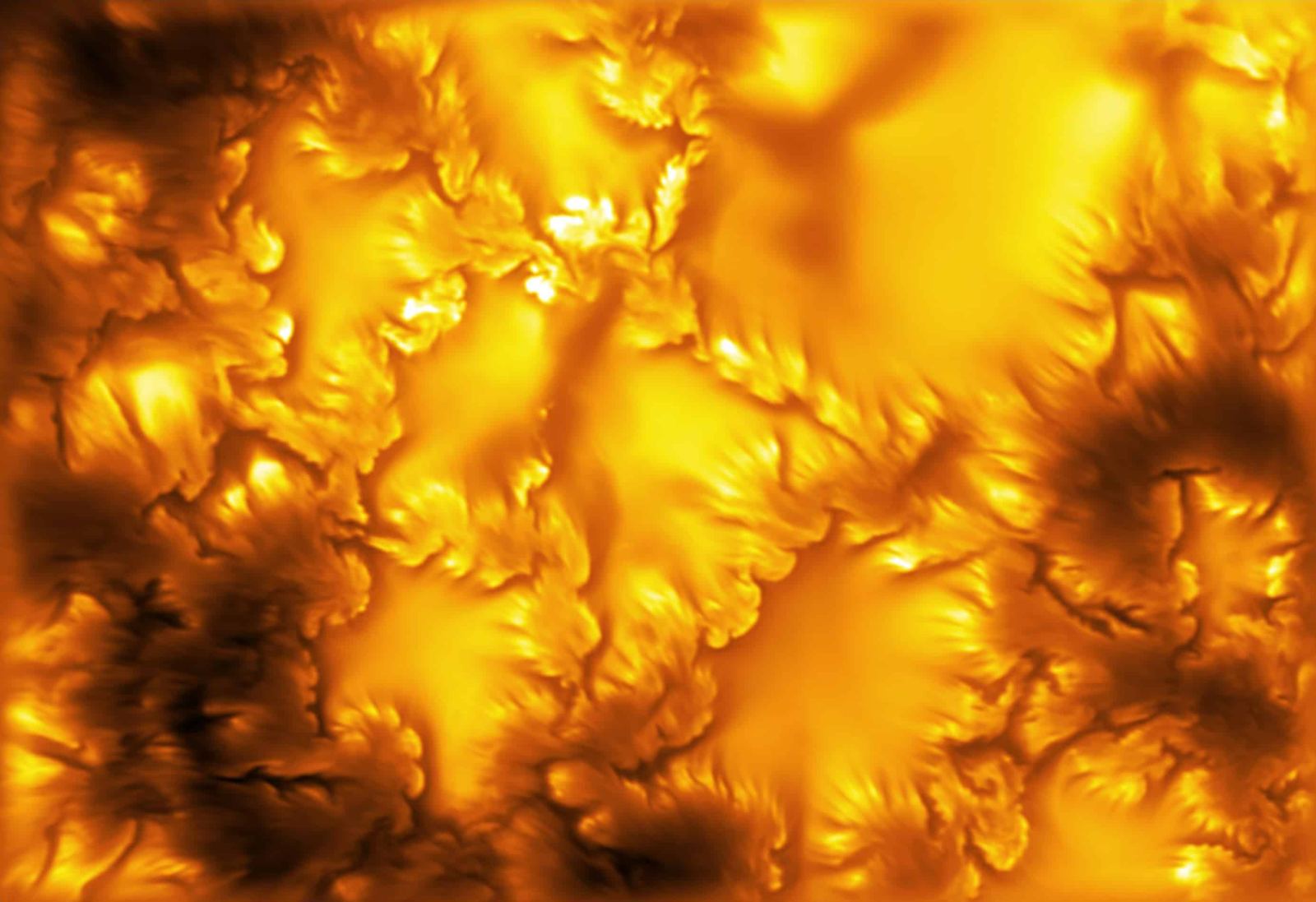
On April 14, 2025, the most powerful solar telescope on Earth pointed its camera at a patch of the Sun's surface near a sunspot and recorded three minutes of blue light. The frames that came out of that session, published in Nature on August 5, 2026, are the sharpest images of the solar surface ever captured. They also show something no one had seen there before: the entire scene is lined with tiny, swirling vortices, dozens of them, each only tens of kilometers across.
The swirls are Kelvin-Helmholtz instabilities, the same fluid phenomenon that curls breaking ocean waves and rolls clouds into parallel bands on Earth. They have been caught in the atmospheres of Jupiter and Saturn, in the solar wind, and at the edges of planetary magnetic fields. But never in the solar photosphere, the visible surface of the Sun, because no telescope had ever resolved the details small enough to see them. The Daniel K. Inouye Solar Telescope (DKIST) on Haleakalā, Maui, just became the first.
An international team from the U.S. National Science Foundation National Solar Observatory (NSO), NSF NCAR's High Altitude Observatory (HAO), and the Max Planck Institute for Solar System Research (MPS) says the finding could help explain two of the longest-standing puzzles in solar physics: why the Sun's outer atmosphere is millions of degrees hotter than its surface, and how the star stores and releases the magnetic energy behind flares and coronal mass ejections.
What the sharpest image of the Sun shows
The Sun's visible surface, the photosphere, is a rolling landscape of plasma. Bright granules, each roughly the size of a small country, are columns of hot gas rising from the interior. When that gas reaches the top and cools, it sinks back down along the dark lanes that outline each granule.
Threaded through this boiling scene are magnetic structures: pores and sunspots, where intense magnetic fields suppress the rising convection and leave darker, cooler patches. At the boundaries between these magnetic features and the surrounding granulation, the new DKIST images reveal something striking. Instead of the smooth, blurry interfaces seen in earlier, lower-resolution images, the edges are made of vortex-like structures and fine dark striations.
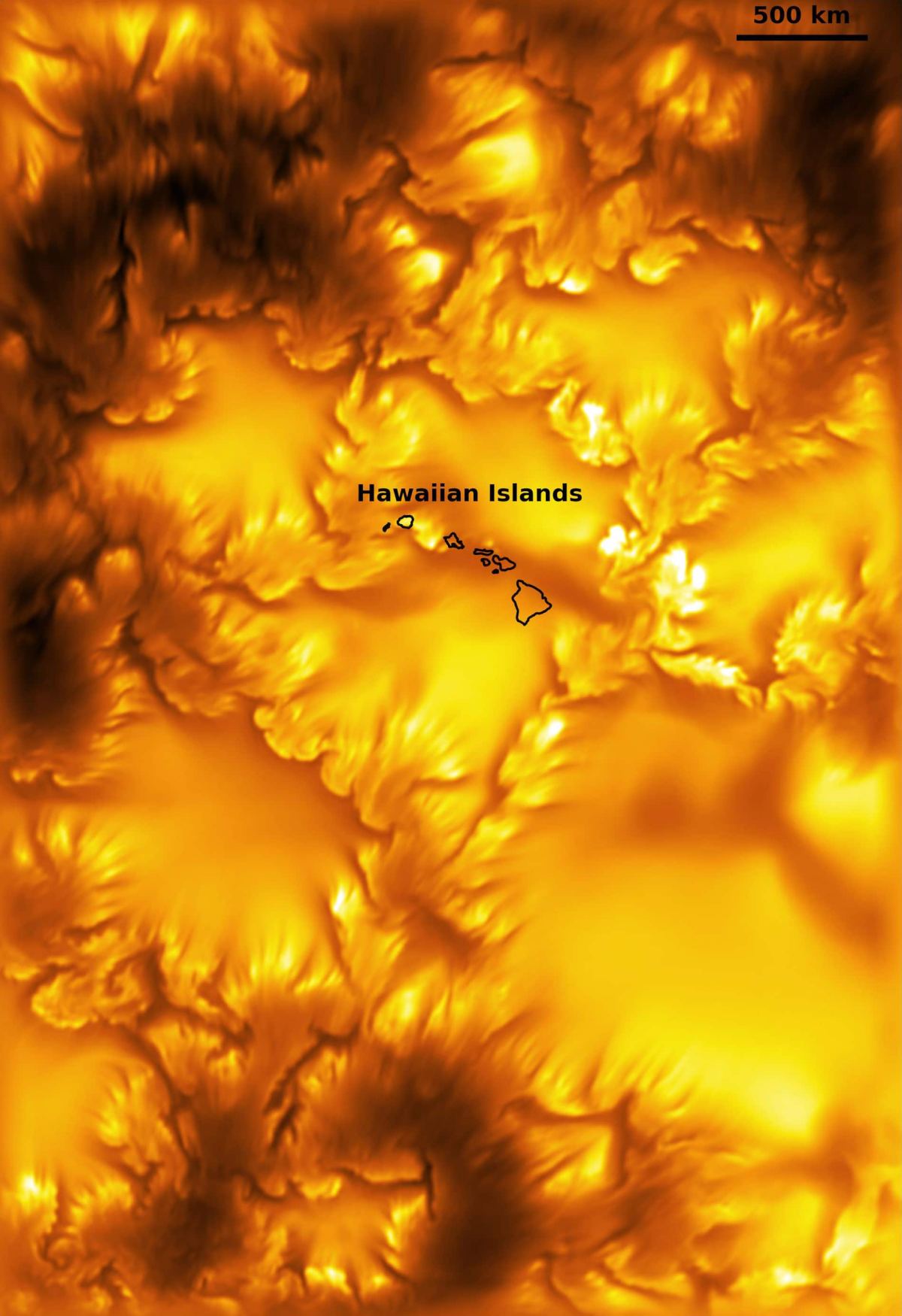
The observations were made with an instrument called FastCam, a high-speed camera built jointly by NSO and the Max Planck Institute for Solar System Research. It shot at 740 frames per second with exposures of 100 microseconds, and the team reconstructed each science frame from 2,000 individual images using a technique called multi-frame blind deconvolution, which removes the blurring of Earth's atmosphere. The result: a spatial resolution of about 19 kilometers on the solar surface, roughly the diffraction limit of the telescope at the 416 nm wavelength used. The vortices are small enough that the paper's authors argue they were never seen before simply because no telescope could resolve them: the characteristic scale is not accessible to instruments with apertures below about 2 meters, and DKIST is the first solar telescope built above that threshold.
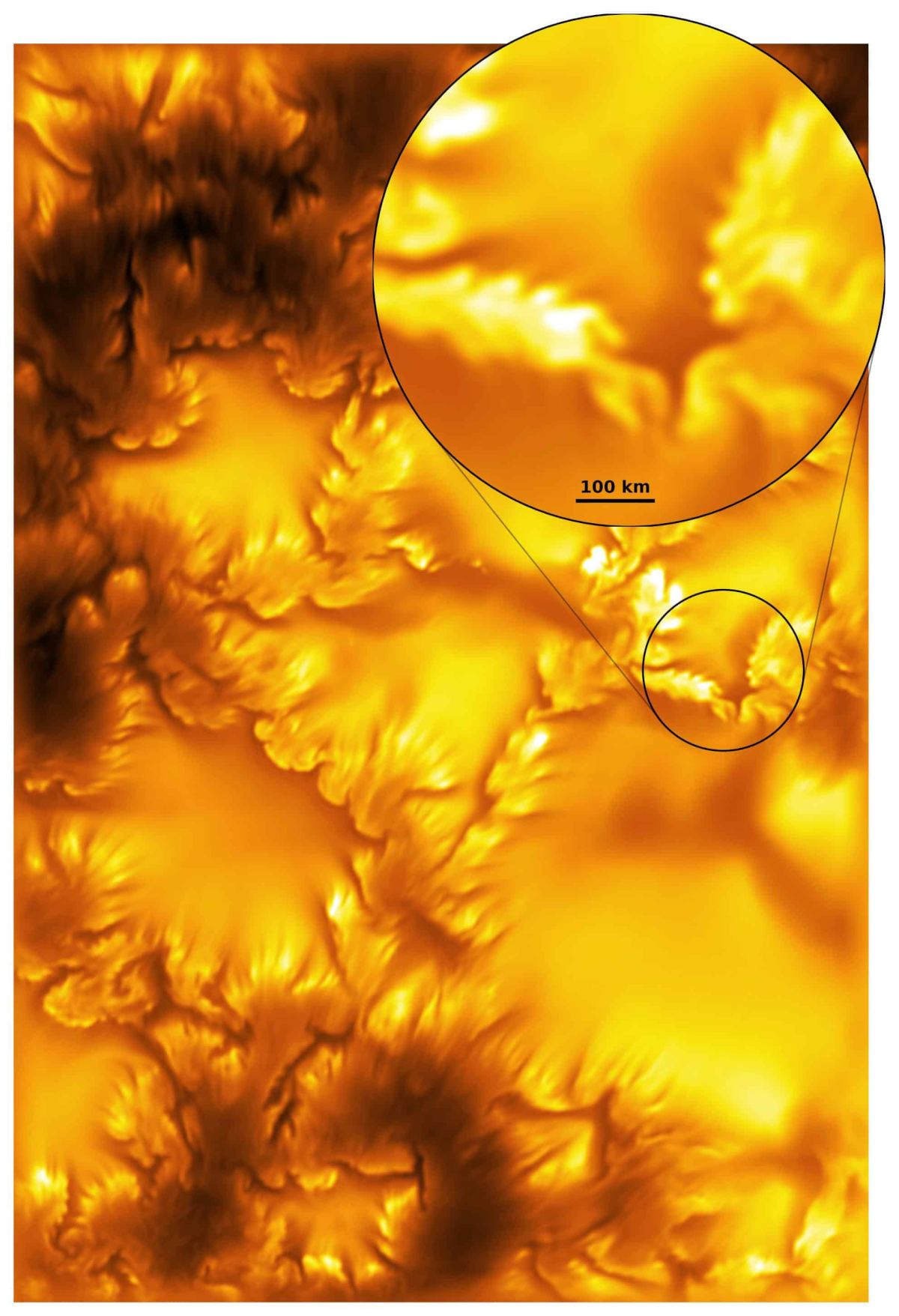
Counting the vortices in the field of view, the team found 47 clear examples along the edges of the magnetic structures. The characteristic spacing between them, the instability wavelength, was about 65 kilometers, with individual vortex sizes ranging from 25 to 170 kilometers. The boundaries grew unstable at rates between 0.014 and 0.054 per second, and the swirls drifted around the magnetic elements at 0.7 to 3.0 kilometers per second.
Why this matters: the two biggest mysteries of the Sun
The finding matters because of what it could explain. The first mystery is the coronal heating problem. The Sun's visible surface sits at about 5,500 degrees Celsius. But the corona, the wispy outer atmosphere visible during a total solar eclipse, reaches 1 to 3 million degrees. That is backwards from intuition: the further you get from a fire, the cooler it should be. Something is dumping energy into the corona, and for decades, physicists have not been able to say exactly what.
The second mystery is how the Sun builds up magnetic energy. The leading explanation is called flux braiding. Magnetic field lines in the solar atmosphere twist around each other like braided hair, storing tension. When that tension snaps, the field lines cross and reconnect in new shapes, releasing a burst of energy. That process, magnetic reconnection, is what powers solar flares and coronal mass ejections, the eruptions that send charged particles toward Earth and can disrupt satellites, power grids, GPS, and communications. But what drives the braiding in the first place has been unclear.
The new vortices could be part of the answer to both questions. Because the swirls appear constantly and everywhere on the Sun where the magnetic field is strong enough, they may be the everyday engine that keeps twisting the field lines, feeding the braiding process, and they also mix plasma across the boundaries between magnetized and unmagnetized regions, a kind of stirring that could transport energy into the upper atmosphere.
In the paper, the team showed that the vortices create turbulent diffusion strong enough to mix material across magnetic boundaries, letting cool plasma from the edges of granules enter the magnetized regions and altering how convection transports energy beneath the surface. The vortices, the authors write, extend vertically like rolling cylinders through hundreds of kilometers of the lower atmosphere, maintaining the same phase and wavelength at every height.
"We believe that the discovery of Kelvin-Helmholtz instability in the solar photosphere, backed up by analysis of numerical simulations, is a major step forward in our understanding of the dynamics and evolution of solar and stellar plasma, and will serve as a basis for future discoveries," said David Boboltz, deputy director of the National Solar Observatory.
How the Sun's whirlpools were confirmed
The observations alone were not enough. The team also ran computer simulations of the same patch of the Sun using the MURaM code, a radiative magnetohydrodynamics model maintained by HAO and MPS, and compared them frame by frame with the telescope data. The simulations, run on a grid with 3.2-kilometer spacing, produced 94 instability events with a characteristic wavelength near 49 kilometers, growth rates of 0.027 to 0.059 per second, and vortex speeds of 1.6 to 2.8 kilometers per second, all close to the measured values.
The agreement with linear theory, the classical mathematics of the instability first worked out by Lord Kelvin and Hermann von Helmholtz around 1870, was also tight. Theory predicts the most unstable wavelength for these conditions should fall between 60 and 100 kilometers. The observed 65 kilometers sits squarely in that range.
"It is very exciting to see that the highest-resolution observations of the solar photosphere revealed a new dynamical regime in the form of KH vortices at the edges of magnetic field concentrations," said Matthias Rempel, senior scientist at the High Altitude Observatory. "These observations also provide the highest resolution validation of solar magnetohydrodynamic simulations to date, and the agreement in physical details is impressive."
What it does and does not prove
A few caveats keep the story honest. Kelvin-Helmholtz instability itself is not a new discovery. It is a well-understood fluid phenomenon, observed for more than a century in oceans, clouds, and other atmospheres. What is new is seeing it in the solar photosphere, the first experimental confirmation in a place where theory predicted it but telescopes could not resolve it.
The link to coronal heating and magnetic energy buildup is also a proposal, not a measurement. The team showed that the vortices are capable of mixing plasma and stirring magnetic fields on the scales required, and the simulations support that reading. But nobody has directly measured the heat transported from these swirls into the corona. The paper identifies a plausible mechanism, one that fits the numbers, and it will take more observations to know how much of the Sun's behavior it actually drives.
"We are only at the beginning of recognizing the wide-reaching impact the discovery of Kelvin-Helmholtz instability has on our understanding of the connection between the magnetized plasma motion and the energy transport and release into the upper solar atmosphere," said Friedrich Wöger, senior scientist at the National Solar Observatory.
The images themselves, whatever the swirls turn out to do, have already changed the map. The sharpest view ever taken of the Sun's surface shows a landscape far more restless than anyone expected, and the whirlpools along every magnetic boundary are now a permanent feature of how we picture our star. They are also a reminder of what a new telescope can do: DKIST saw, in three minutes of blue light, the mechanism that theory had predicted for 150 years.
Sources
- Nature: Ubiquitous Kelvin-Helmholtz instabilities driving plasma mixing on the Sun (August 5, 2026, DOI 10.1038/s41586-026-10871-3) - the peer-reviewed paper with the observations, simulations, and vortex statistics
- NSF National Solar Observatory press release (August 5, 2026) - primary announcement with the media kit imagery and scientist quotes
- EurekAlert! release (August 5, 2026) - distributed announcement of the result
- CNN: Inouye telescope Sun images and magnetic energy (August 5, 2026) - coverage of the coronal heating link
- Sci.News: Inouye Solar Telescope plasma vortices (August 2026) - independent summary with DOI confirmation
Related on Impossible Universe
- The Fastest Object Ever Built Keeps Touching the Sun. Parker Solar Probe Just Made Its 28th Close Pass. - the mission sampling the corona and solar wind directly, where these vortices may feed their energy
- The Sun Has a Hidden Switch-Off Signal That Can Predict the Next Solar Cycle Years in Advance - how the Sun's magnetic activity rises and falls on its 11-year cycle
- The Sun Might Not Swallow Earth After All. A New Model Just Made the Case. - the Sun's long-term evolution, on timescales far beyond a single cycle
- Sun and Solar Physics Topic Hub - the full solar collection, from surface observations to the Sun's far future
- Telescopes and Space Missions Topic Hub - the full collection of observatories and missions, including the Inouye Solar Telescope
The hero image and both inline images are official media kit imagery from the NSF National Solar Observatory, credit NSF/NSO/AURA/MPS, used for editorial purposes with credit. They show the solar photosphere at 416 nm as observed by the Daniel K. Inouye Solar Telescope. The article is an evergreen explainer of the August 5, 2026 Nature result on Kelvin-Helmholtz instabilities in the solar photosphere.