The Fastest Object Ever Built Keeps Touching the Sun. Parker Solar Probe Just Made Its 28th Close Pass.
The fastest object ever built has now flown through the Sun's outer atmosphere 28 times. On June 8, 2026, Parker Solar Probe matched its own records, 3.8 million miles from the solar surface at 430,000 mph, with its heat shield at an estimated 1,700 degrees Fahrenheit. Here is what the mission has found so far, and why it keeps going back.
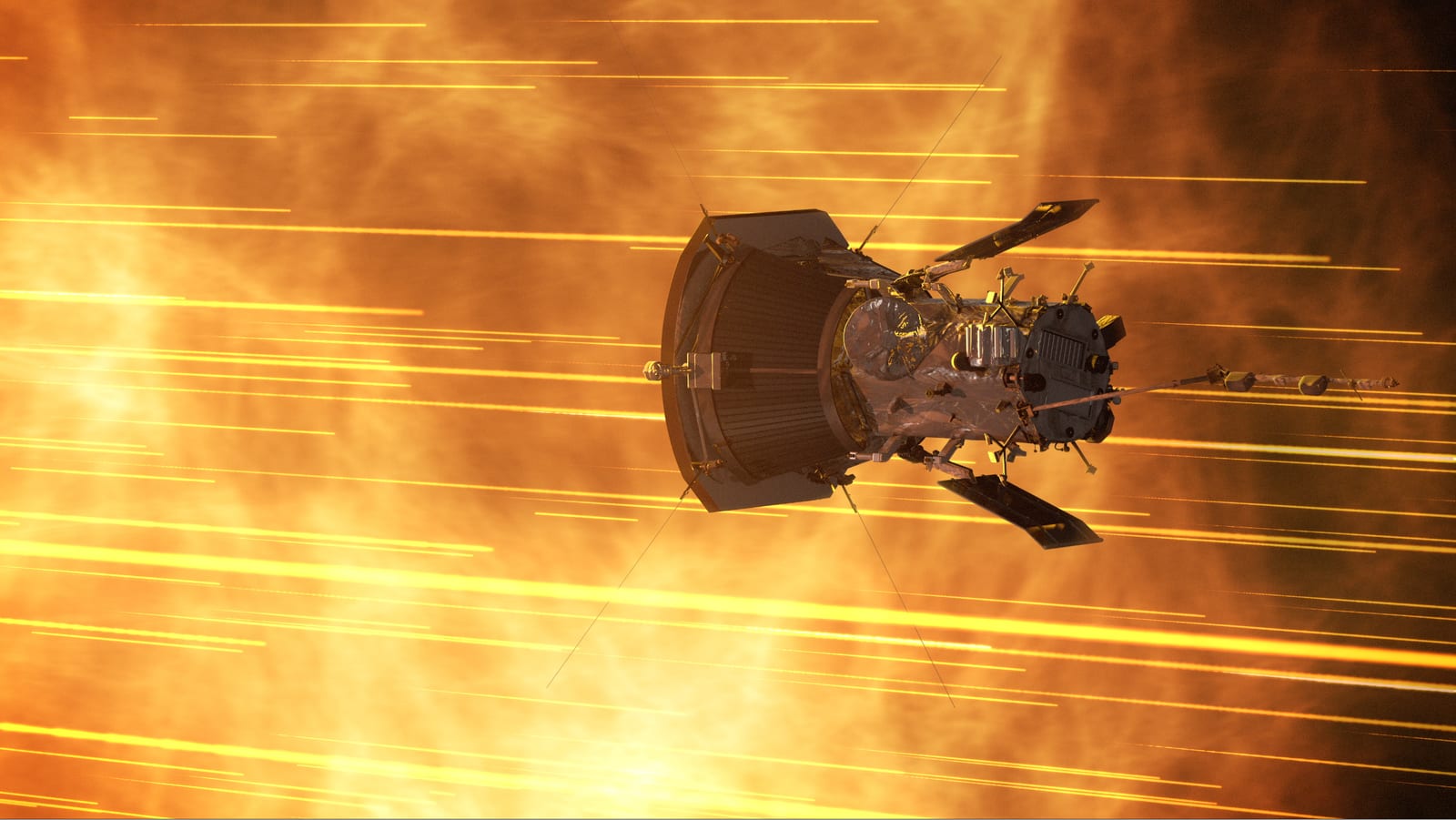
On June 8, 2026, the fastest object ever built went quiet. For nine days, NASA's Parker Solar Probe flew through the outer atmosphere of the Sun with no contact with Earth, running entirely on its own, while its heat shield took the full light of a star at point-blank range. When it swung back around and beamed home a simple beacon tone on June 11, flight controllers at the Johns Hopkins Applied Physics Laboratory in Laurel, Maryland, got the signal they wanted: the spacecraft was healthy, and the pass had worked.
That was close approach number 28. Parker has now lapped the Sun 28 times since launching in 2018, and this pass matched the two records the mission set on December 24, 2024: a distance of 3.8 million miles from the solar surface, and a speed of 430,000 miles per hour, the fastest any human-made object has ever traveled.
A record it keeps matching
To get a feel for those numbers, put them next to something familiar. Three point eight million miles is roughly 4 percent of the distance between Earth and the Sun. If the Sun's surface were the goal line of a football field, Parker would be about 4 yards past it at the moment of closest approach; Earth would be standing near the far end of the field, 95 yards back.
At 430,000 mph, about 191 kilometers per second, the spacecraft covers the distance from New York to Los Angeles in under half a minute. The speed is measured relative to the Sun, and it is not new. It was set on December 24, 2024, matched during five flybys since, most recently on March 11, 2026, and equaled again on June 8. Each pass is a routine lap in an orbit that Parker repeats roughly every three months, close enough that the spacecraft dips into the corona, the wispy outer atmosphere that becomes visible during a total solar eclipse.
The June encounter ran from June 3 to June 13. During that window, Parker's four instrument suites gathered data from inside the Sun's atmosphere, and the spacecraft transmitted the detailed science back to Earth from June 17 to 30.
Why it doesn't melt
The obvious question, the one that follows every Parker story, is why a spacecraft can fly through a star's atmosphere without turning into a streak of vapor. The answer is a shadow.
The heat shield, officially the Thermal Protection System, is a sandwich of two panels of reinforced carbon-carbon around a core of carbon foam. It is 4.5 inches (11.4 centimeters) thick, and the foam core is mostly air, which is why the shield is surprisingly light and fragile despite its size. Mission systems engineer John Wirzburger of APL described it bluntly: "The heat shield material is incredibly light and fragile, but the thermal design, as well as the software that keeps the spacecraft pointing the TPS toward the Sun, have been outstanding."
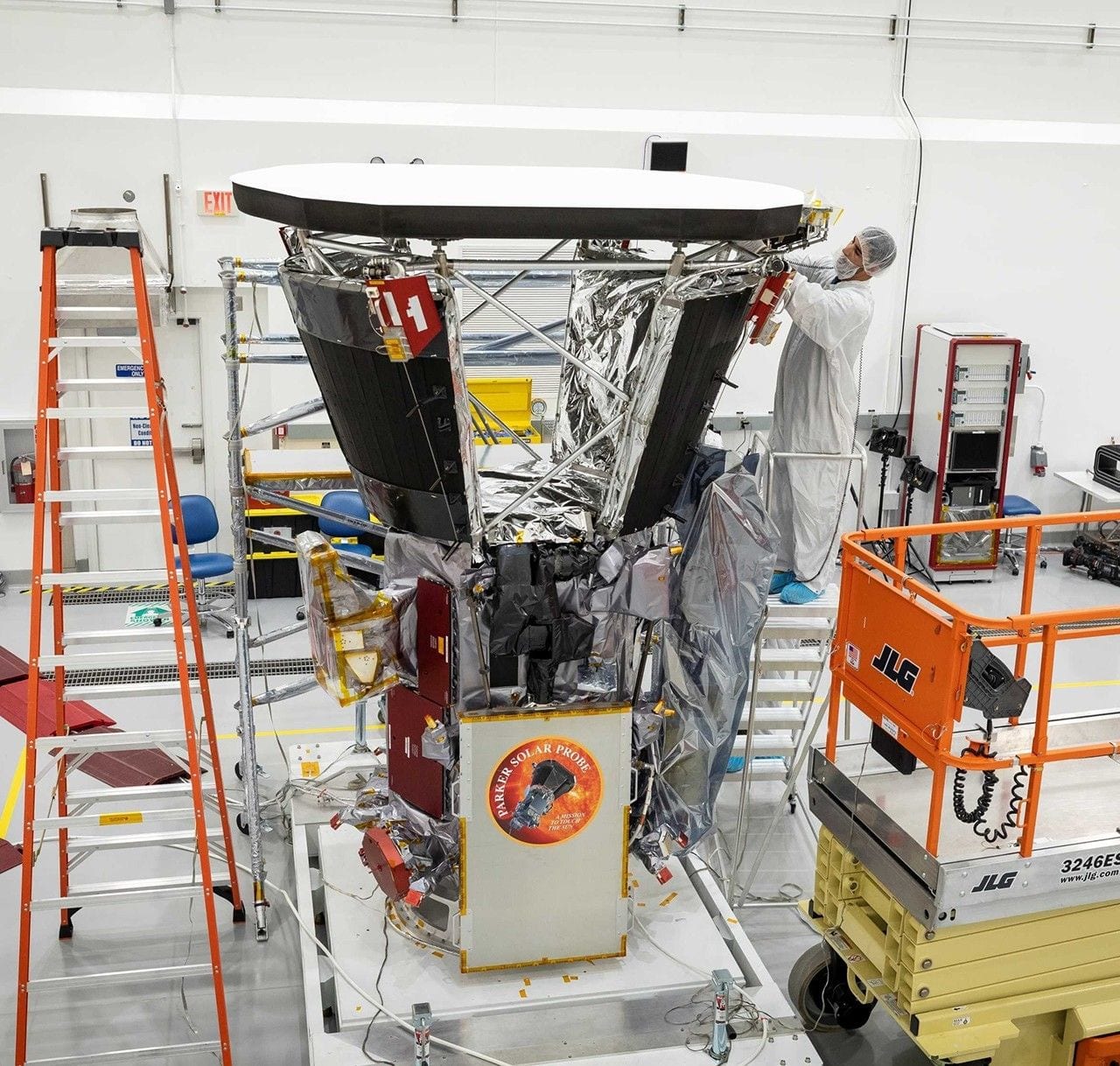
Because the spacecraft never turns its back on the Sun, the shield casts a permanent shadow, and the entire spacecraft rides inside it. The pointing is the hard part. If the attitude control software lost track of the Sun for even a moment, the spacecraft would be exposed to the full glare and would not survive. The shield has held up through 28 passes, and the team watches its health in a clever way: there is no temperature sensor on the shield's front face, so the famous figure of about 1,700 degrees Fahrenheit at closest approach comes from models, not direct measurement. But the blanketing below the shield is instrumented, and its temperature has been consistent on every pass.
"That temperature consistency is a major indicator of spacecraft health," Wirzburger said. "It tells us the heat shield isn't degrading. If it were cracking or weakening, we'd see temperatures drift upward as more heat leaked through."
Not everything hides in the shadow. Four of the FIELDS instrument's antennas extend past the shield into full sunlight, where they face temperatures around 2,500 degrees Fahrenheit (1,370 degrees Celsius). They are made of niobium tubes, chosen because the metal keeps its strength at extreme heat, and they are the only hardware built to live outside the shield's protection.
What Parker is measuring out there
Flying through the corona is not a stunt. It is the only way to sample the solar wind at its source. The solar wind is the stream of charged particles that flows off the Sun in every direction and fills the entire solar system. It is what creates auroras, what pushes against Earth's magnetic field, and what poses a real risk to astronauts, satellites, air travel, and power grids when the Sun unleashes a coronal mass ejection or a flare. Parker's four instrument suites, SWEAP, WISPR, FIELDS, and IS☉IS, measure the particles, fields, and light in the region where all of that begins.
Each close pass is a sample of the Sun's atmosphere at a particular moment. The encounters are spread across the 11-year solar cycle, which is what makes the mission's long run so valuable: Parker launched in August 2018, when the Sun was near the quiet minimum of its cycle. In 2024, NASA, NOAA, and the international Solar Cycle Prediction Panel announced that the Sun had reached solar maximum. Parker's 28 encounters now span both extremes, and the mission is scheduled to keep sampling into the declining phase, building a record of how the Sun's atmosphere behaves as the cycle turns.
What it has found so far
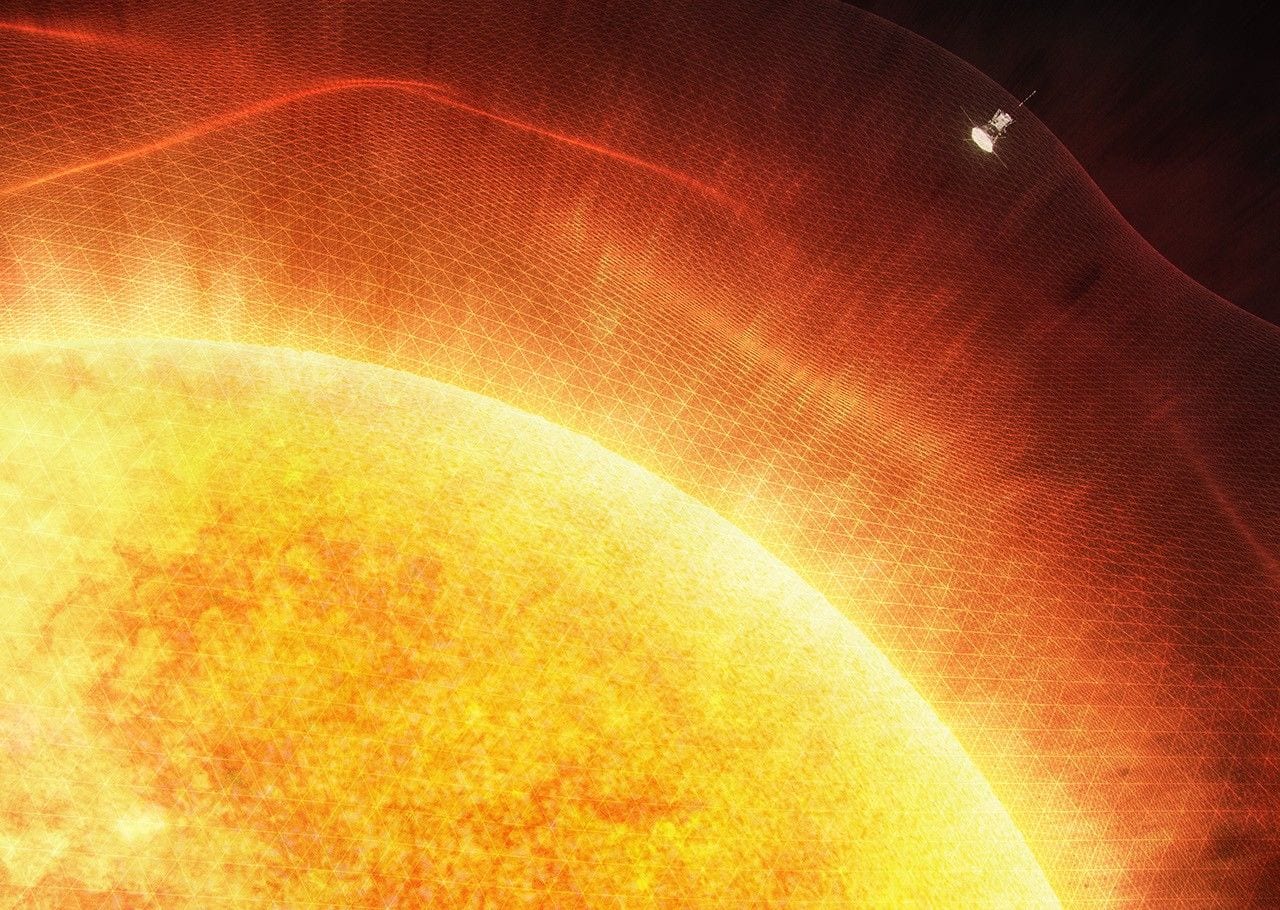
The mission has already rewritten parts of solar physics. In December 2021, NASA announced that Parker had become the first spacecraft to touch the Sun, crossing the Alfvén surface, the invisible boundary where the solar wind becomes fast enough to break free of the star. Inside that boundary, the Sun's atmosphere is still anchored to the Sun itself, and Parker spent hours measuring it from within.
Early in the mission, Parker's magnetometer caught something unexpected: sudden reversals in the direction of the magnetic field carried by the solar wind, structures the team named switchbacks. They zigzag through the wind like folds in a ribbon, and they are now leading candidates for explaining the coronal heating problem, the long-standing puzzle of why the corona, a few million degrees Fahrenheit, is so much hotter than the Sun's visible surface, which sits near 10,000 degrees Fahrenheit. Parker's measurements have narrowed the list of candidate explanations, though the problem is not solved.
The spacecraft has also mapped the dust around the Sun. Its instruments showed that dust grains vanish in a zone about 3.5 million miles from the Sun, because the intense light vaporizes them, and it confirmed that the slow solar wind streams out of equatorial coronal holes. WISPR, the mission's only camera, photographs the corona and the solar wind in visible light, producing the streamer images that are the mission's most recognizable pictures.
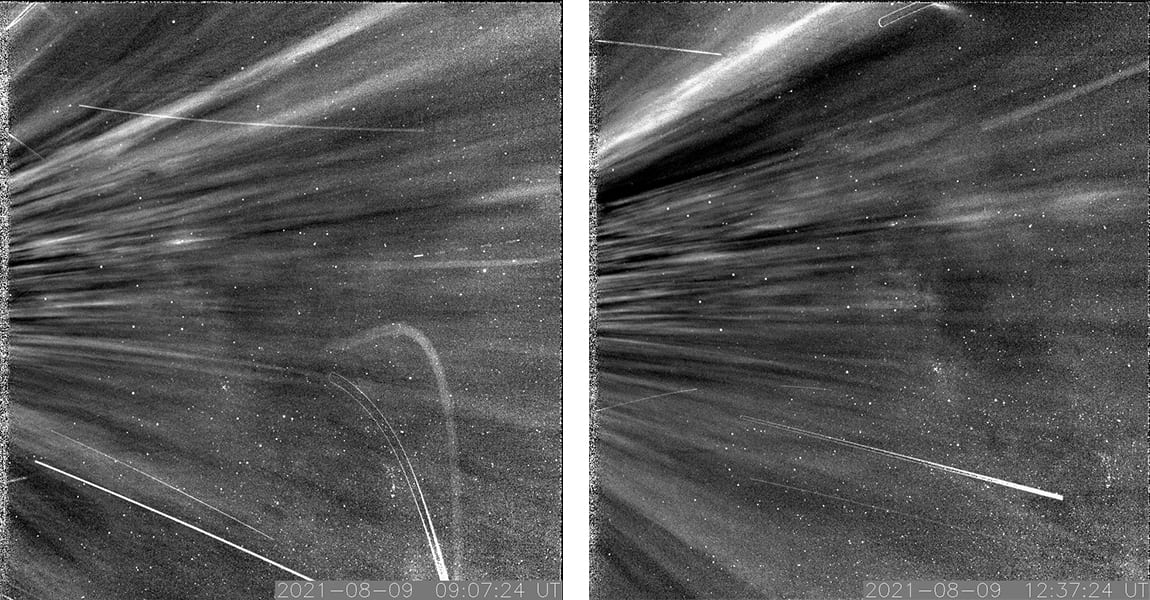
The mission is named for Eugene Parker, the University of Chicago physicist who predicted the solar wind in 1958, decades before any spacecraft could test the idea. It was the first NASA mission named after a living person. Parker died in 2022, a year after his namesake spacecraft flew through the corona for the first time.
What the records do and do not mean
A few caveats keep the story honest. The 1,700-degree heat shield figure is modeled, not measured, because no sensor sits on the shield's front face. The speed and distance records are relative to the Sun, and the June 8 pass did not set new records; it matched the ones set on December 24, 2024. Parker has narrowed the candidates for coronal heating without closing the question, and the mission's path after late 2026 is under review at NASA.
What is solid is the streak itself. A spacecraft built to last seven years has now spent eight flying through a star's atmosphere, and on June 8 it did so again, out of contact, on its own, at the fastest speed humans have ever achieved. The records are matched, not broken, but that is the point: the fastest object ever built is now doing this routinely.
Sources
- NASA Science: Parker Solar Probe Makes 28th Close Pass of Sun (June 11, 2026) - primary mission update with quotes from John Wirzburger and the record numbers
- NASA Science: Parker Solar Probe Makes 27th Swing Around the Sun (March 16, 2026) - previous encounter update
- NASA Science: Parker Solar Probe Completes 26th Closest Approach to Sun (December 18, 2025) - encounter updates across the solar cycle
- Wikipedia: Parker Solar Probe - mission history, heat shield design, instruments, and discovery background
- Johns Hopkins APL: Parker Solar Probe Mission Site - mission overview from the lab that designed, built, and operates the spacecraft
Related on Impossible Universe
- The Sun Has a Hidden Switch-Off Signal That Can Predict the Next Solar Cycle Years in Advance - the same 11-year cycle Parker is sampling, read from the other end
- The Sun Might Not Swallow Earth After All. A New Model Just Made the Case. - what the Sun's long-term evolution looks like, on timescales Parker can only hint at
- For 100 Years, Scientists Could Not Explain Where Cosmic Rays Come From. Juno Just Watched Them Form. - another NASA mission measuring particle acceleration at the frontier of the solar system
- Telescopes and Space Missions Topic Hub - the full collection of observatories and solar system missions, including Parker Solar Probe
The hero image is an artist concept of Parker Solar Probe in the solar wind, credit NASA/Johns Hopkins APL. The cleanroom photograph of the heat shield assembly is credit NASA/Johns Hopkins APL/Ed Whitman. The Alfvén surface illustration is credit NASA/Johns Hopkins APL. The WISPR streamer image is credit NASA/Johns Hopkins APL/Naval Research Laboratory. NASA imagery is generally in the public domain. This article is an evergreen mission explainer anchored on the spacecraft's 28th close approach to the Sun on June 8, 2026.