
JWST Just Caught an Interstellar Comet Carrying Chemicals That Don't Match Our Solar System
More than a dozen NASA missions tracked 3I/ATLAS as it passed through. Webb's MIRI instrument caught the chemical fingerprint on the way out, and found methane buried under the surface ice, the first ever detected on an object from another star system.
When astronomers first spotted a faint dot moving fast against the stars in July 2025, the trajectory was the giveaway. This was not a solar system comet. This was something from somewhere else. They gave it the name 3I/ATLAS, the third interstellar object ever found passing through our neighborhood, and pointed every instrument they could at it before it left forever.
More than a dozen NASA missions turned to watch. Parker Solar Probe caught it near the Sun. Europa Clipper snapped it with its ultraviolet spectrograph. Hubble tracked it as a moving point of light. Webb saved its look for the exit.
What Webb found, announced June 1 and published in The Astrophysical Journal Letters, was methane. Nobody had ever detected methane on an interstellar object before. And the amount of it, relative to the water vapor also present, suggests this comet formed around a star very different from our own.
A visitor that arrived with secrets
Comet 3I/ATLAS was only the third confirmed interstellar object. The first was 'Oumuamua in 2017, an elongated mystery that briefly had some astronomers wondering aloud about alien technology. The second was 2I/Borisov in 2019, a comet that looked, chemically speaking, a lot like the comets we already know.
3I/ATLAS looked different from the start. Early observations found it was rich in carbon dioxide, far more than typical solar system comets. In March 2026, researchers reported it was bursting with methanol, a simple alcohol. Each data point pushed the same conclusion: whatever star system this comet came from, the chemistry there was not like ours.
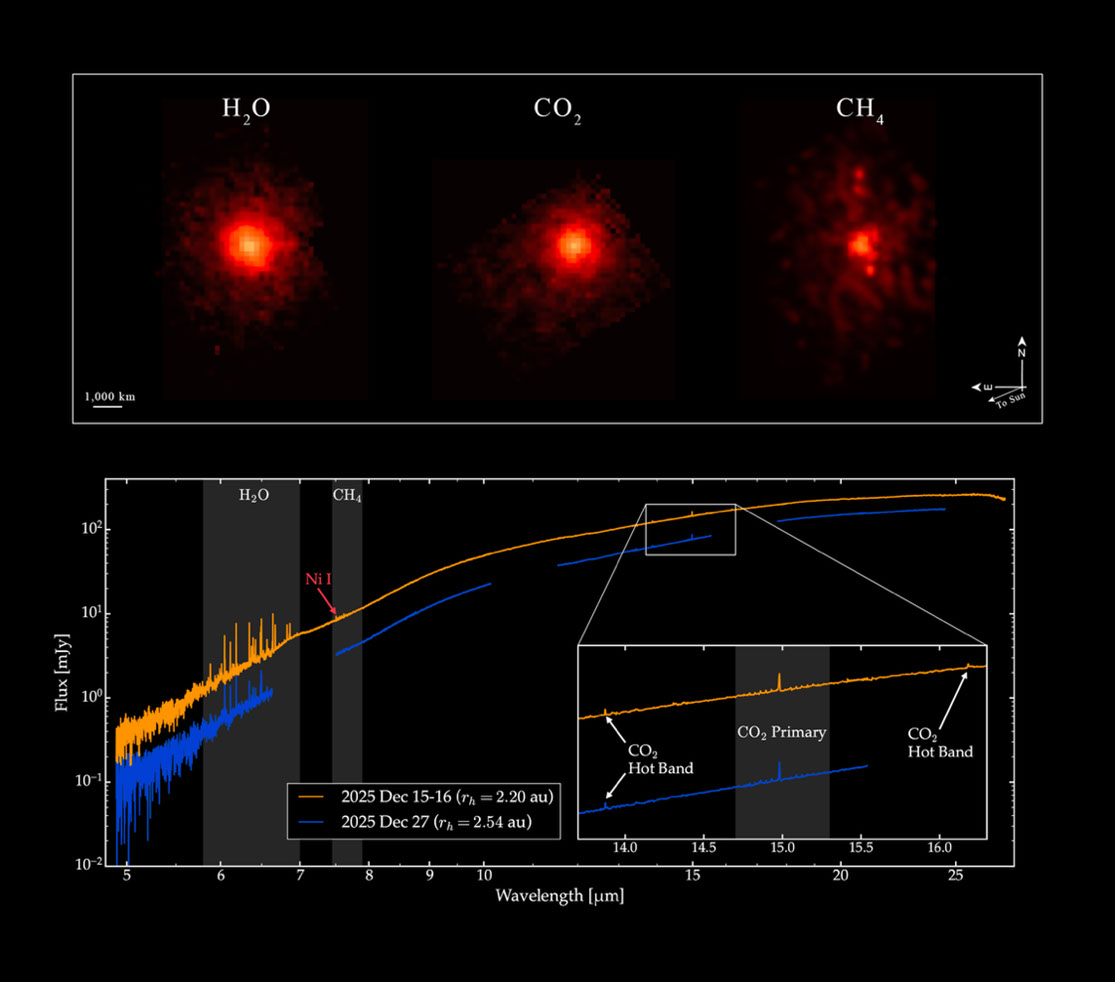
The Webb team, led by researchers at Caltech and the Space Telescope Science Institute, used the telescope's MIRI instrument on two nights in December 2025. By then, the comet had already swung around the Sun in October and was heading back out. The first observation caught it at 205 million miles from the Sun. The second, twelve days later, at 236 million miles.
MIRI's spectrometer broke the comet's infrared light into its chemical fingerprint. Water vapor was there, spreading far beyond the nucleus as icy grains in the coma released gas. Carbon dioxide was abundant and concentrated near the nucleus. And then there was methane, a clear signature where nobody expected to find any at all.
Why the methane stayed hidden
The timing of the methane detection turned out to be a clue in itself. Astronomers had been watching 3I/ATLAS for months before Webb pointed its mirror at it. None of those earlier observations caught methane. The reason, the researchers think, is that the methane was buried.
Methane is highly volatile. It sublimates, going straight from solid ice to gas, at very low temperatures. If any methane sat exposed on the comet's surface, it would have boiled off long before the comet reached the inner solar system. But Webb did not see methane until December, two months after the comet's closest approach to the Sun.
That delay means the methane was locked underground, trapped beneath a layer of surface ice that protected it. It took the slow inward creep of solar heat, reaching deeper into the comet's interior over weeks and months, to finally liberate the buried methane into a gas cloud Webb could read.
The same pattern showed up in other gases. Water vapor production dropped sharply between the two Webb observations as the comet moved farther from the Sun and the surface cooled. Methane and carbon dioxide, more volatile than water, kept sublimating longer before their production also began to fade. Everything about the gas release pointed to a comet with a layered internal structure, warmed from the outside in.
A chemistry set from another star
The real surprise was not just that methane existed. It was how much of it there was. The ratio of methane to water in 3I/ATLAS is unusually high compared to most solar system comets. Combined with the already-known overabundance of carbon dioxide and methanol, the picture that emerges is of a comet born in a very cold, chemically distinct environment.
Comets in our solar system formed in the protoplanetary disk that surrounded the young Sun, a swirling cloud of gas and dust with a particular chemical mix. The relative amounts of water, carbon dioxide, methane, and other ices in a comet act like a birth certificate, recording the temperature and chemistry of the region where the comet came together.
3I/ATLAS does not match the profile. Its chemical fingerprint points to formation in an environment richer in carbon-bearing molecules and colder than the typical comet-forming zones of our solar system. A separate study published in April had already concluded that 3I/ATLAS formed in a cold environment, based on its carbon monoxide abundances. The methane detection reinforces that conclusion and adds a new marker.
This is what makes interstellar objects so valuable. They are free samples from other planetary systems, delivered to our telescopes without the need to travel light-years. Each one carries a chemical record of the place it came from, a place we will likely never visit.
A coordinated goodbye
The scientific response to 3I/ATLAS was extraordinary in its scale. More than a dozen NASA missions, plus ESA's JUICE and SOHO spacecraft, turned their instruments toward a single comet over the span of a few months. Parker Solar Probe caught it from inside the Sun's corona. TESS, designed to find exoplanets, tracked its brightness changes. SPHEREx, a brand-new infrared survey telescope, measured its composition.
The reason for the coordination was simple. Interstellar objects come rarely. 'Oumuamua was discovered by accident and was already leaving by the time anyone understood what it was. Borisov gave astronomers more time but fewer surprises. 3I/ATLAS, discovered with enough lead time to organize a campaign, became the best-studied piece of another star system in human history.
SETI researchers even scanned it for artificial radio signals during its departure, a now-routine check on interstellar objects. They found nothing. 3I/ATLAS is a natural object, a dirty snowball from a star we will never see.
What remains
The comet is gone now, receding into the darkness between stars at a speed that guarantees it will never return. What remains is its data, stored in NASA's public archives: spectra, images, light curves, and chemical abundances gathered by a fleet of spacecraft that briefly converged on a single moving point of light.
The methane detection matters beyond this one comet. It establishes that interstellar objects can carry volatile ices in abundances and ratios that differ sharply from the comets of our own system. When the next interstellar visitor arrives, and the one after that, astronomers will have a chemical checklist to work from: check for methane, check the CO2 ratio, see if the pattern holds.
The third interstellar object turned out to be the richest. It carried a chemistry set that does not match anything native to the solar system, hidden beneath a protective layer of ice, released only after the Sun warmed it enough to speak. If this is what the third one looked like, there is no telling what the thirtieth will carry.
Sources
- NASA Science: Webb Detects Methane on Interstellar Comet 3I/ATLAS - primary NASA coverage of the Webb MIRI observations and methane detection
- The Volatile Inventory of 3I/ATLAS as Seen with JWST/MIRI (The Astrophysical Journal Letters, 2026) - peer-reviewed paper presenting the chemical fingerprint of the comet
- EarthSky: Comet 3I/ATLAS has methane, unexpected discovery reveals - detailed coverage including context on the interstellar object designation and prior findings
- EarthSky: Interstellar comet 3I/ATLAS born in a cold environment - prior study establishing the comet's cold formation environment
- NASA Science: How Open NASA Data on Comet 3I/ATLAS Will Power Tomorrow's Discoveries - overview of the multi-mission observing campaign
The hero image shows interstellar comet 3I/ATLAS as seen with the MIRI instrument on the NASA/ESA/CSA James Webb Space Telescope, with gas distribution contours overlaid. NASA images are generally in the public domain. Image credit: NASA, ESA, CSA, STScI, M. Belyakov (Caltech), I. Wong (STScI); Image Processing: A. Pagan (STScI). This article describes peer-reviewed research published in The Astrophysical Journal Letters.
Related on Impossible Universe
- NASA Says Farewell to MAVEN Mars Mission After 11 Years - the Mars orbiter that also tracked this comet during its 2025 passage