
NASA Just Named the Crew That Will Clear the Path Back to the Moon
On June 9, 2026, NASA announced four astronauts who will fly the most complex human spaceflight mission in recent history. Their job is not to land on the Moon. It is to dock with two commercial lunar landers in Earth orbit and prove the choreography works before the next crew goes for the surface.
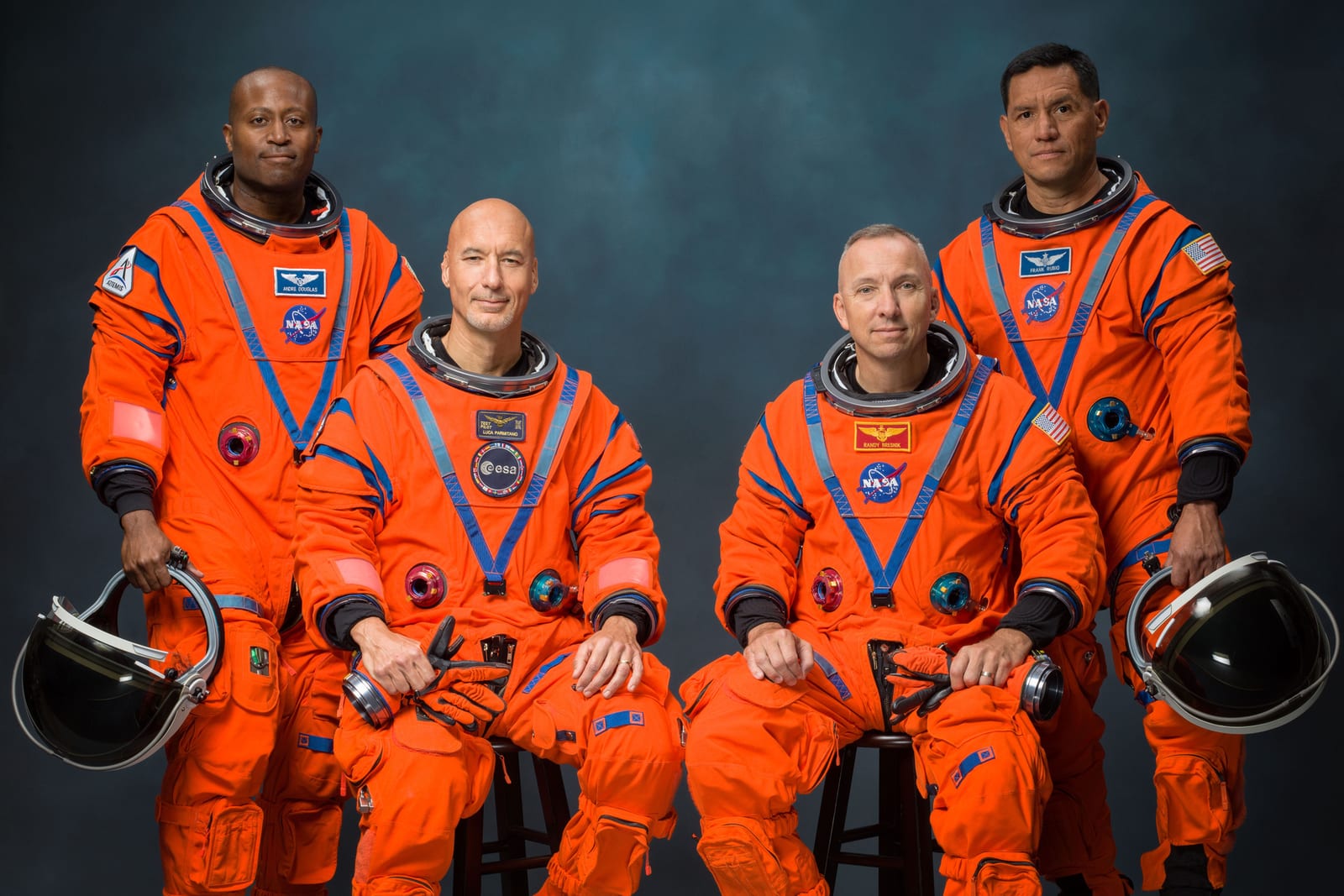
On June 9, 2026, NASA named four astronauts who will fly the most complex human spaceflight mission in recent history. Their job is not to land on the Moon. It is to prove that the spacecraft and two commercial lunar landers can find each other in orbit, dock, and cooperate so that the next crew can walk on the lunar surface.
The mission is Artemis III. The landing comes later, on Artemis IV, currently planned for 2028. But without Artemis III, Artemis IV does not happen. The assignment puts all four crew members at the center of a multi-launch, multi-company choreography that has no direct precedent in American spaceflight.
The crew
Commander Randy Bresnik is a retired U.S. Marine colonel with two prior spaceflights: one on shuttle Atlantis in 2009 and one aboard a Russian Soyuz in 2017, where he served as commander of Expedition 53. He has logged more than 7,000 flight hours across 95 types of aircraft and is a fellow of the Society of Experimental Test Pilots. Since 2018, Bresnik has helped oversee the development and testing of Artemis spacecraft and systems as assistant to the chief of the Astronaut Office for exploration.
Pilot Luca Parmitano is an ESA astronaut and Italian Air Force colonel. He is the first European assigned to fly on an Artemis mission. Parmitano has flown to the International Space Station twice, in 2013 and 2019, and became the first Italian to command the ISS during Expedition 61. He has earned degrees in political science and experimental flight test engineering and has flown more than 40 types of aircraft. His operational resume includes a 2013 spacewalk during which his helmet began filling with water, an emergency he navigated calmly while working his way back to the airlock without full visibility.
Mission specialist Frank Rubio holds the American record for the longest single spaceflight: 371 days aboard the ISS across 2022 and 2023, after a Soyuz coolant leak extended his planned six-month mission to more than a year. He is a U.S. Army lieutenant colonel, a helicopter pilot, and a board-certified physician. His selection for Artemis III places a medical doctor on a critical test flight for the first time, which carries obvious advantages for a mission long enough to run physiological experiments and track crew health across launch, docking, and reentry.
Mission specialist Andre Douglas is the only member of the prime crew making his first spaceflight. A Coast Guard veteran, he holds a doctorate in systems engineering from George Washington University and previously served on the Artemis II backup and closeout crew. His background spans maritime search and rescue, autonomous vehicle design, and undersea warfare platform testing at Johns Hopkins Applied Physics Laboratory.
NASA astronaut Bob Hines, a U.S. Air Force colonel and former SpaceX Crew-4 pilot, was named as the backup crew member. Should any prime crew member become unable to fly, Hines would join the mission.
What Artemis III actually does
Artemis III is not a lunar landing. It is a two-week orbital test flight built around a multi-launch sequence. First, a lander pathfinder from Blue Origin will launch and wait in orbit. Then NASA's Space Launch System will carry Orion and the four crew members from Kennedy Space Center to low Earth orbit.
Once Orion completes its systems checks, it will rendezvous and dock with Blue Origin's lander test article. The crew will spend roughly two days docked, running checkouts and technology demonstrations, including entering the lander. Then Orion will undock and wait for the second pathfinder: SpaceX's Starship-derived lander will launch, meet Orion in orbit, and spend about a day docked for a separate round of testing.
After both docked phases, Orion and its crew will undock, fire for Earth return, and splash down in the Pacific Ocean under U.S. Navy and NASA recovery teams. Total time in space is expected to be about two weeks, with the exact length determined in real time based on launch windows and docked operations.
The sequence demands that NASA, Blue Origin, and SpaceX coordinate launches of the three most powerful rockets in the world within a short window. If any one of them is not ready, the choreography has to be rebuilt. This is the part of the mission that makes it genuinely hard, and it is the reason Artemis III exists before Artemis IV: dock twice in orbit, with two different commercial spacecraft, before attempting a lunar landing.
A path that runs through Europe
Parmitano's assignment as pilot is also a statement about international partnership. ESA has been building the European Service Module for Orion since the program began. The module provides propulsion, power, thermal control, and life support. It is not a bolt-on contribution. Orion cannot fly without it.
Putting an ESA astronaut in the pilot seat for Artemis III formalizes what the hardware arrangement already implied. "Luca's assignment as pilot reflects the depth of European expertise in human spaceflight," ESA Director General Josef Aschbacher said in the announcement.
ESA Director General Josef Aschbacher added: "Europeans can take pride in being part of this exciting journey."
What happens next
The crew begins training immediately on Orion systems, docking procedures, and lander operations. On the hardware side, NASA plans to connect the Orion crew module to its service module this summer. The SLS core stage is being integrated with its engine section ahead of installing four RS-25 engines. Solid rocket booster segments are already at Kennedy Space Center, and rocket stacking is scheduled to begin this summer.
Blue Origin is building its crewed Blue Moon lander, and SpaceX is building its Starship lunar lander variant. Both companies are producing test articles for Artemis III under NASA oversight that includes sharing agency expertise from previous missions.
NASA Administrator Jared Isaacman framed the moment this way: "The Artemis III astronauts, alongside ESA and our international partners, and the tens of thousands of the best and brightest across the agency and industry, are ushering in a new Golden Age of exploration carrying forward the hopes and dreams of the next generation just as the Apollo astronauts did for so many of us."
The last time a U.S. space agency named a crew whose job was to clear the path to a lunar landing, it was March 1969. The crew was Apollo 10: Tom Stafford, John Young, and Gene Cernan. Their mission was to fly the lunar module to within 14 kilometers of the surface and prove the rendezvous and docking systems worked before Apollo 11 went for the landing two months later. NASA is now running the same playbook, this time with two commercial landers, an international pilot, and a crew that has not been assembled from one country's test pilot corps but from decades of orbital experience across multiple space agencies and military services.
Sources
- NASA: "NASA Marches Toward Artemis III Mission in 2027, Names Crew Members" (June 9, 2026) - primary source for crew assignments, mission details, and administrator statements
- NASA Artemis Program - mission architecture, timeline, and partner information
- ESA: European Service Module for Orion - ESA's role in the Artemis program
- NASA astronaut biographies: Randy Bresnik, Frank Rubio, Andre Douglas, Bob Hines
- ESA: Luca Parmitano biography
Related on Impossible Universe
- The New Earthrise: Artemis II Photographs Home - the photo that captured Earth sliding behind the Moon from Orion's window, just before the 40-minute quiet zone
The Artemis III crew photo is a NASA image in the public domain and free for educational and informational use.