
This NASA Rover Walks, Squirms, and Drives Sideways. It Just Finished a 16-Mile Desert Trek.
A four-wheeled prototype called ERNEST just drove 16 miles through the Colorado Desert at ten times the speed of any Mars rover, lifting its wheels over rocks and navigating the worst terrain by itself. The active suspension, reinforcement learning, and nighttime testing point to a future where rovers go farther and faster than anyone thought possible.
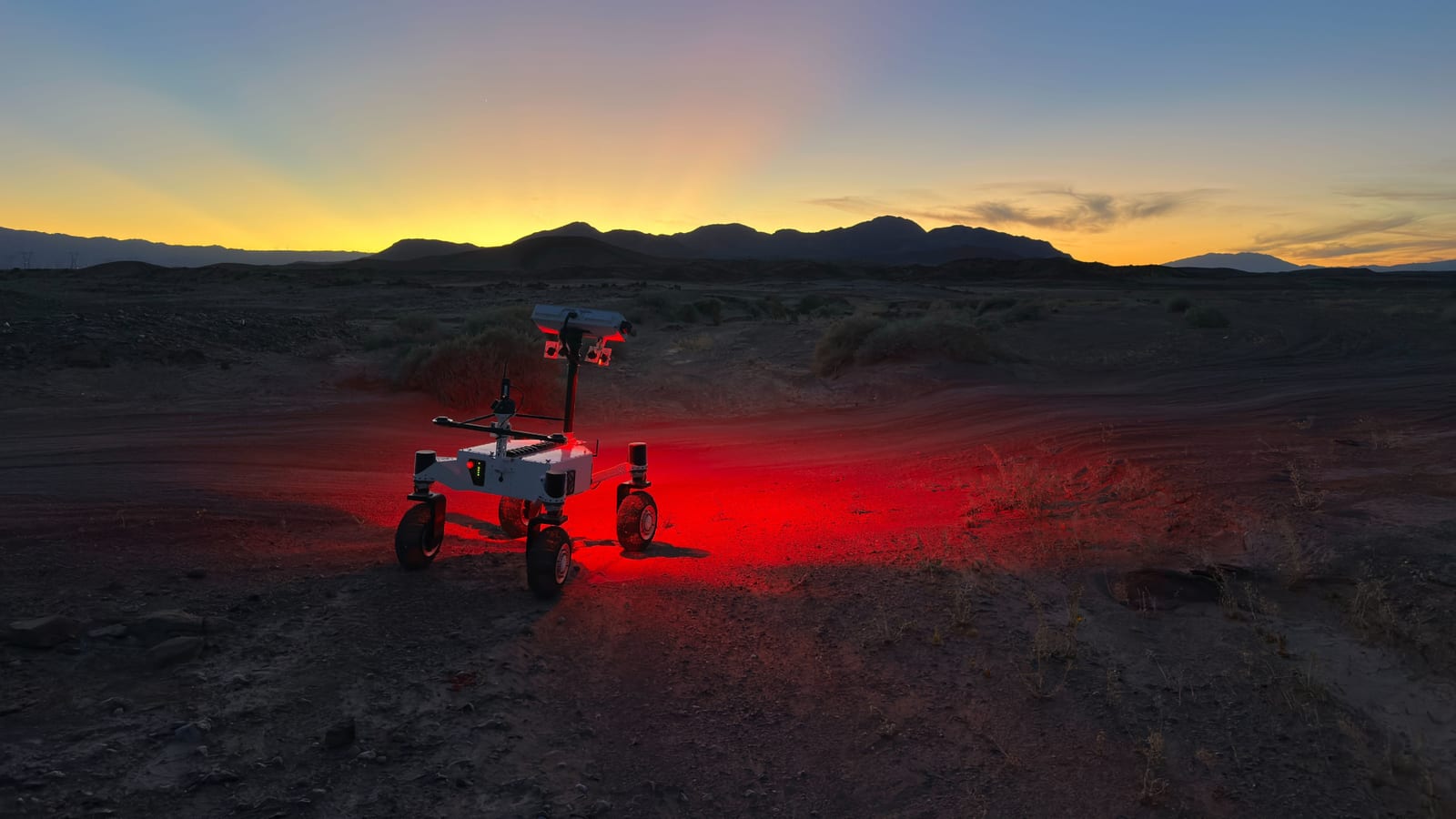
In March 2026, on a bleak stretch of the Colorado Desert in Southern California, a compact four-wheeled rover set off across the sand and rock. A small team of engineers trailed it on foot, but nobody was holding a joystick. The rover was driving itself. Over seven days of intermittent testing, it covered 16 miles in 37 hours of actual drive time, picking its own path across terrain that would have stopped Curiosity or Perseverance cold.
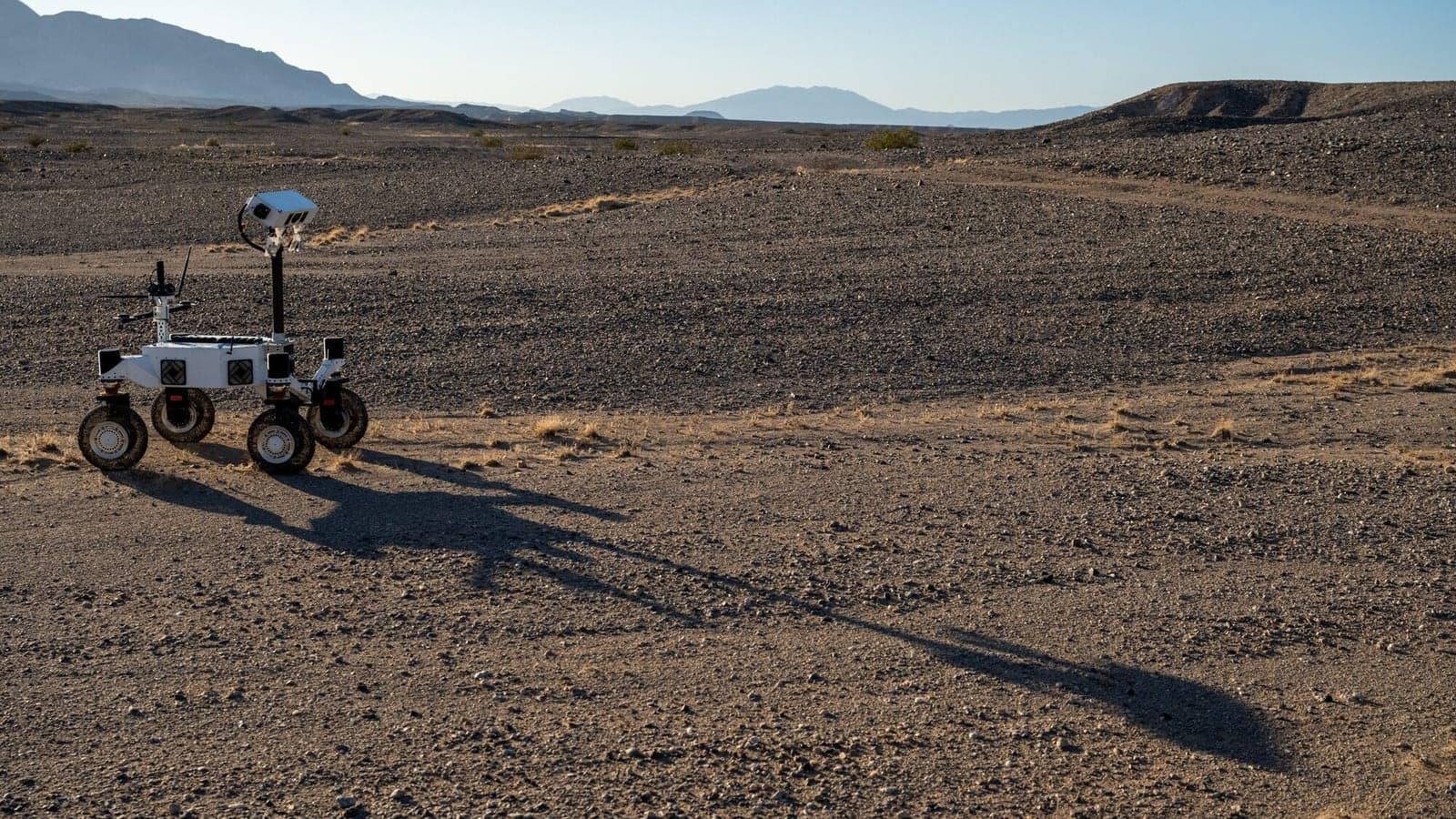
The prototype is called ERNEST, short for Exploration Rover for Navigating Extreme Sloped Terrain. Built at NASA's Jet Propulsion Laboratory, it is 4 feet long, stands about 4.5 feet tall with its mast, and can do things no Mars rover has ever done. It can lift each of its four mesh wheels independently to step over rocks. It can squirm like a worm, walk its wheels forward one at a time, and drive sideways. It can switch its suspension from active to passive when the terrain gets easy, saving power. And thanks to reinforcement learning, it can decide how to move without being told.
Thirty Years of Rocker-Bogie, and Why It Was Time to Move On
Every Mars rover since Sojourner in 1997 has used the same basic suspension design: the rocker-bogie system. Six wheels, passive pivots, no springs. Each wheel conforms to the surface independently, keeping weight distribution fairly constant regardless of what it is driving over. It works. It has driven more than 30 miles on Mars across three rovers, and Perseverance is still going.
But the rocker-bogie has limits. If a wheel gets caught on a rock face taller than the wheel diameter, the rover is stuck. If you want to go fast, the passive system cannot keep up. And if you want to reach the kind of rugged terrain that geologists actually care about, like crater walls, steep slopes, or boulder fields, you need something that can actively manage its footing.
"We started by postulating that we could do better in designing a planetary surface robotic mobility system," said Hari Nayar, the JPL principal technologist who leads the ERNEST team. "While the rocker-bogie system has been very successful over the past 30 years, there's been a lot of research in that time on mobility and understanding terrain interaction."
Before building the current ERNEST, Nayar's team built two smaller prototypes, each about 2 feet long, and ran them through 11 different active suspension configurations inside a trailer filled with simulated lunar soil. They tested slope angles for months before landing on the final design: four steerable wheels, two powered front joints that articulate a gimbal, and a clutch mechanism that lets the rover switch between active suspension for climbing and passive suspension for efficient cruising.
Teaching a Rover to Think for Itself
The hardware was completed in September 2024, but at that point ERNEST still needed a human operator with a joystick to tell it how to get over obstacles. The team wanted the rover to figure it out on its own.
They turned to reinforcement learning, a type of artificial intelligence where the robot learns by interacting with its environment and receiving feedback. JPL's Dynamics and Real-Time Simulation Laboratory built a high-fidelity virtual environment that replicated the rover's physical behavior, feeding it data from engineers who had documented exactly how the real hardware responded to different terrain types.
On a high-performance computing cluster, the team ran thousands of simulated hours of driving in a single weekend. The virtual ERNEST tried millions of approaches to sand ripples, rubble piles, steps, and steep slopes. Failures in simulation cost nothing. The successful strategies became the autonomous navigation system.
Then they put it to the test in the Mars Yard, JPL's outdoor terrain proving ground, where the rover had to drive through a real obstacle course with no human input. It passed. Repeatedly. The rover figured out how to squirm through tight sections, walk individual wheels over tall steps, and pick the most stable line across loose rubble.
The Desert Run: 16 Miles in the Dark
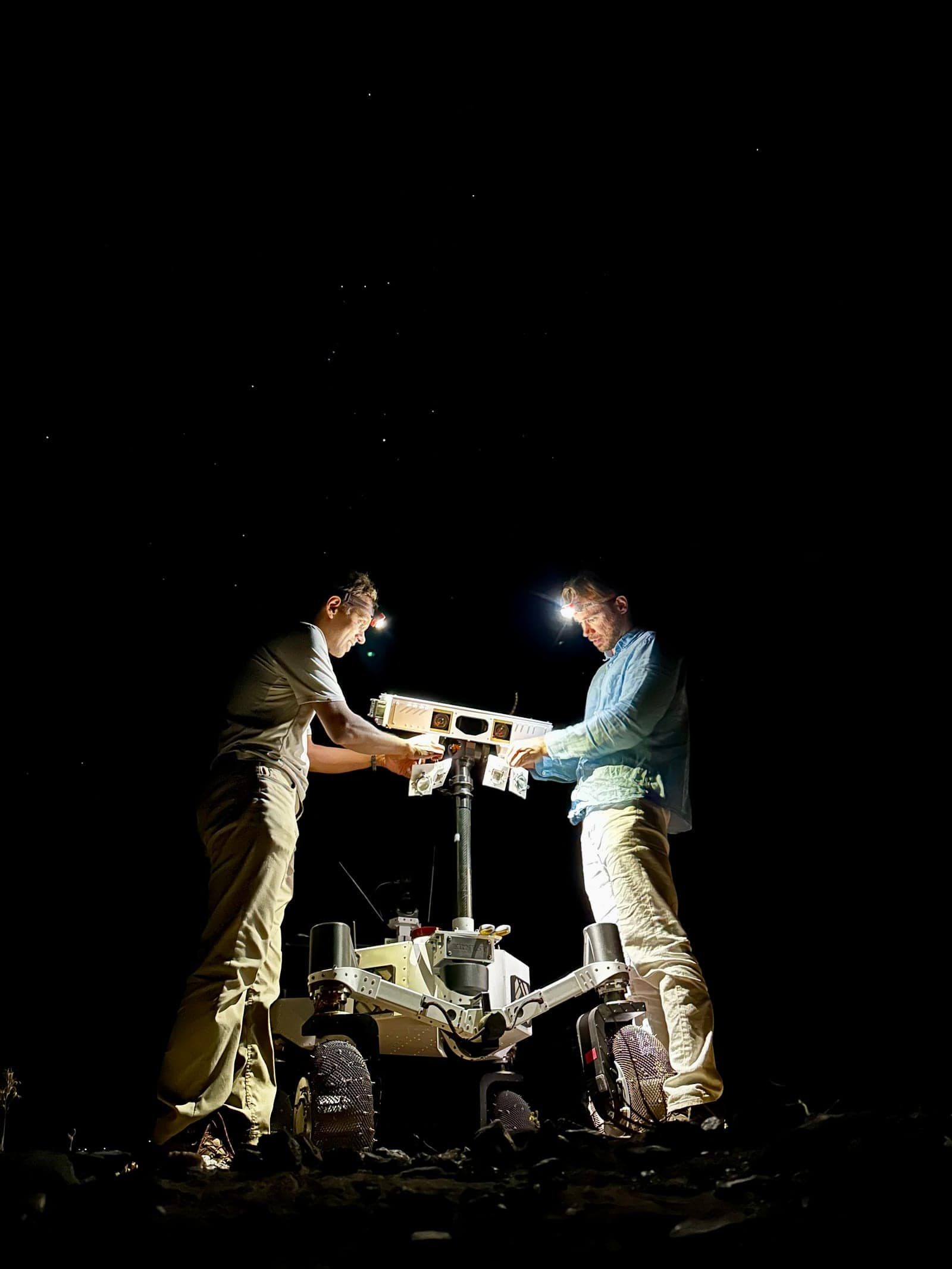
The March 2026 field test near Plaster City, California was the real milestone. Over seven days, ERNEST drove 16 miles at speeds up to 0.6 miles per hour. That might sound leisurely, but it is an order of magnitude faster than Perseverance or Curiosity can navigate, and the rover was choosing its own route the entire time. The engineers walked behind it, monitoring telemetry but not intervening unless the situation demanded it. Most of the time, it did not.
Issa Nesnas, the JPL principal technologist who led the field testing as the autonomy lead for a potential future long-range lunar rover concept, described the test as a demonstration that a rover twice ERNEST's size could handle the demands of a long-distance Moon mission. The desert was not just a convenient backdrop. The team deliberately tested during dawn, dusk, and full darkness to replicate the lighting conditions a rover would face near the lunar poles, where the Sun sits permanently low on the horizon and shadows can stretch for miles.
"You could do a science road trip across the Moon, or Mars, with this vehicle," said James Keane, a JPL planetary scientist working on lunar missions.
The rover's autonomous algorithms do not just pick a path. Nayar's team is now integrating the active suspension decisions with longer-range intelligent navigation, so ERNEST can distinguish between obstacles it should climb and ones it should go around. On the Moon, where driving around a boulder field might add kilometers to a traverse, that calculation matters. On Mars, where a rover might need to reach a specific outcrop on a crater wall, the ability to lift wheels and squirm through tight rock formations could be the difference between collecting a critical sample and spending weeks looking for a safer approach.
What Comes Next
ERNEST is a prototype, not a flight-ready rover. The work, which started in 2022 with internal JPL research funds and is now funded by NASA's Mars Exploration Program and the Exploration Science Strategy and Integration Office, is focused on proving that the hardware and autonomy work before committing them to a mission. The next step is scaling up to a vehicle twice the size, something closer to what a real lunar or Martian mission would require.
For context, the longest drive on the Moon to date is the Apollo 17 Lunar Roving Vehicle's total of 22.3 miles, which took three days of astronaut-driven traversals across three EVAs. A robotic rover that can drive 16 miles in 37 hours, autonomously, in darkness, over terrain that would trap current rovers, changes the math of what a robotic mission can cover. It makes a single-landing-site geology campaign look less like a neighborhood walk and more like a cross-country expedition.
The ERNEST team will continue testing. The desert is a good stand-in for Mars, but it is not quite the Moon. The regolith is different, the temperatures swing differently, and there is no two-week night to plan around. Those challenges will come later. For now, the important thing is that a rover just drove 16 miles through a desert and figured out how to get itself over every obstacle along the way.
Sources
- NASA: Testing Advanced Capabilities for Moon, Mars Rovers - primary NASA feature article on the ERNEST prototype, June 18, 2026
- JPL: NASA Testing Advanced Capabilities for Moon, Mars Rovers - JPL press release with detailed technical background on active suspension, reinforcement learning, and field testing
- JPL Photojournal: PIA26701 - Desert Field Test with NASA Advanced Rover Prototype - image metadata and figure descriptions for the multi-frame desert field test images
- Gizmodo: Meet ERNEST, NASA's Next-Generation Rover - secondary coverage with additional detail on the March 2026 field test and JPL engineering context
- Engadget: NASA is testing a rover that can drive faster and lift its wheels to climb obstacles - coverage of the ERNEST prototype's mobility capabilities and desert field test results
All images are NASA/JPL-Caltech public domain. The hero image shows ERNEST during the March 2026 Colorado Desert field test. Figure A shows the rover driving at dawn with elongated shadows simulating lunar polar lighting. Figure B shows JPL engineers setting up nighttime illuminators. Research and development on ERNEST is funded by NASA's Mars Exploration Program and the Exploration Science Strategy and Integration Office.
Related on Impossible Universe
- NASA's MAVEN Spacecraft Went Silent Over Mars. It Left Behind 11 Years of Discoveries. - the orbiter that revealed how the solar wind stripped away the Martian atmosphere
- A Mars Meteorite Just Revealed a Mineral Nobody Knew Was There - the first garnet ever found in a Martian rock, hiding in a meteorite at the Royal Ontario Museum