For 13 Years, Scientists Pelted Europa With Radar From Earth. What Bounced Back Changed How We'll Explore It.
A 13-year campaign using NASA's Goldstone radar and the Green Bank Telescope produced the most extensive ground-based radar study of Europa ever. The echoes confirmed its ice is clean, porous, and scatters radio energy in a way not seen on any rocky world, setting new constraints for two spacecraft already on their way.
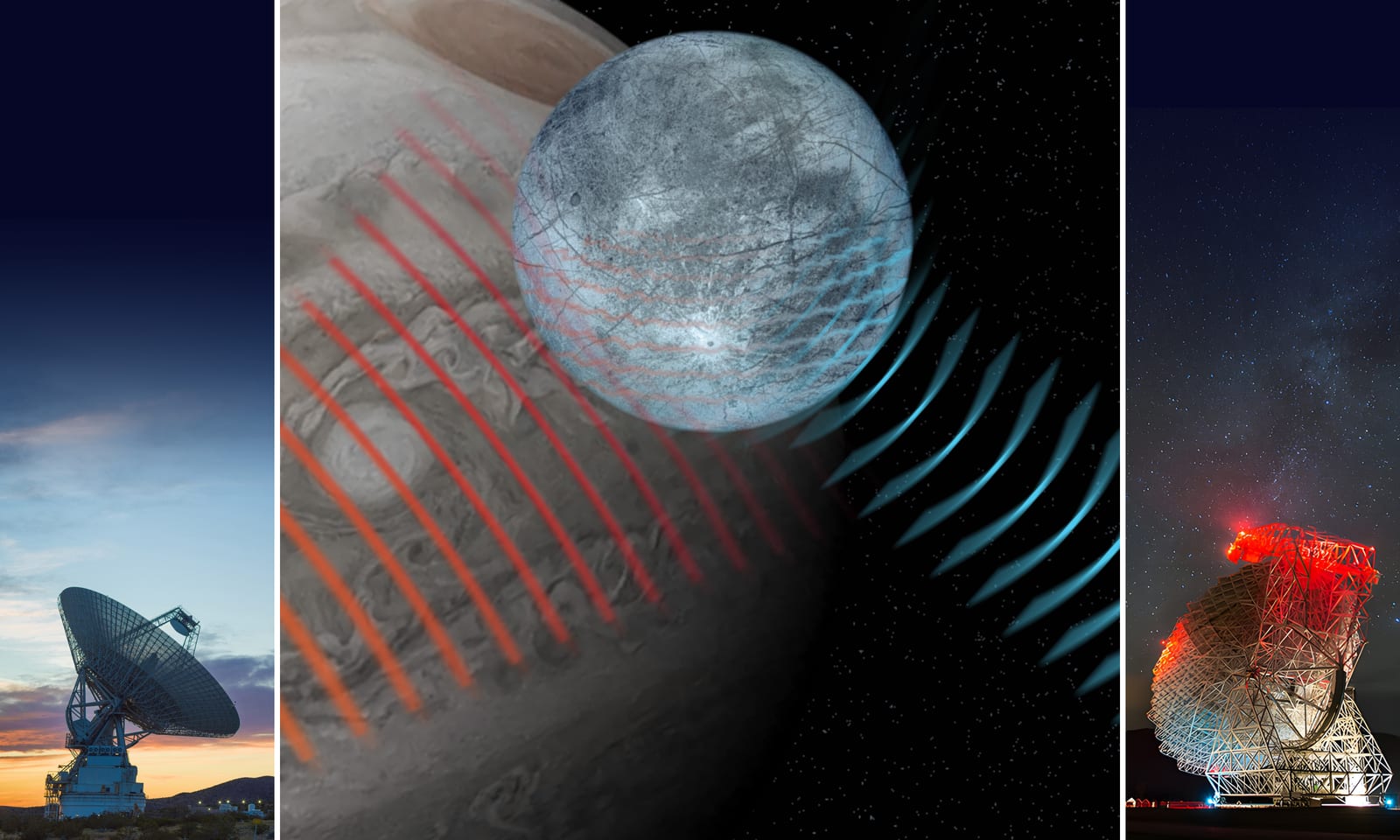
In 2011, a team of astronomers pointed a massive radar dish in the Mojave Desert at a moon 600 million kilometers away and fired a burst of 3.5-centimeter radio waves at it. Then they did it again. And again. And again. For 13 years.
What came back from Europa, the ocean moon of Jupiter, was not a clean reflection like you would get from a rocky planet or an asteroid. It was a diffuse, scattered glow of radio energy that looked more like light bouncing around inside a snowbank. The signal was overwhelmingly dominated by a phenomenon called the coherent backscatter opposition effect, where radio waves ricochet through clean, porous ice before escaping back toward Earth, their polarization preserved and their intensity amplified.
Presented on June 16, 2026, at the 248th meeting of the American Astronomical Society, the results represent the most extensive ground-based radar study of Europa ever conducted. They fill a 30-year gap since the last major campaign in the late 1980s and early 1990s, and they provide a new roadmap for two spacecraft, NASA's Europa Clipper and ESA's Juice, that are already on their way to study this world up close.
The Moon That Should Not Be This Shiny
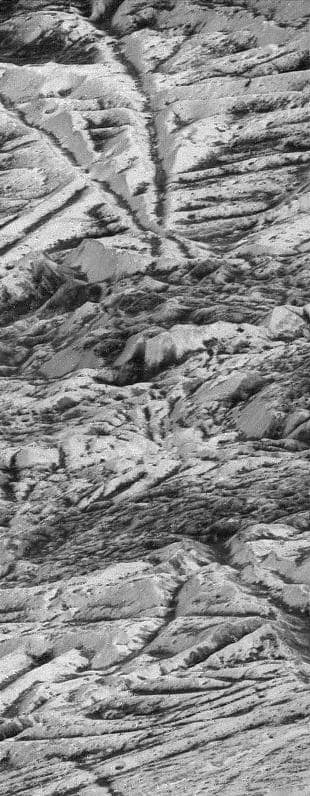
Europa is one of four large moons of Jupiter discovered by Galileo in 1610. It is slightly smaller than Earth's Moon, and from a distance it looks like a cracked billiard ball: a pale, icy surface crosshatched with dark reddish-brown streaks that scientists call lineae. Beneath that frozen shell, almost every planetary scientist agrees, lies a global ocean of liquid water, kept warm by the gravitational tug of Jupiter and its neighboring moons. The shell itself is estimated to be somewhere between 15 and 25 kilometers thick.
Geologic features on the surface tell you some things about what might be happening underneath: chaos terrain where icebergs of crust have broken apart and refrozen, ridges where the ice has cracked and material from below has welled up into the gap. But those features only reveal what is happening at or near the surface. To see deeper, you need something that can penetrate the ice.
"Radar delves below what is easily seen, because radio waves can penetrate into the ice and carry information about its internal structure and purity," said Tunhui (Tina) Xie, a graduate student at UCLA who worked on the study with Professor Jean-Luc Margot.
Pinging a Moon From Two Sides of a Continent
The experiment used a bistatic configuration, an arrangement that makes astronomers sound like they are describing a stereo setup but is actually much more interesting. NASA's 70-meter Goldstone antenna in California transmitted the 3.5-centimeter radar pulses toward Europa. Then, both Goldstone and the 100-meter NSF Green Bank Telescope in West Virginia listened for the echoes.
This dual-receiver setup was crucial. By comparing the signal that arrived at Goldstone with the signal that arrived at Green Bank, separated by thousands of kilometers and a slightly different angle, the team could measure how the radar brightness changed, or did not change, as the angle between transmitter, moon, and receiver increased.
If Europa's surface were a smooth mirror of ice, the signal would drop off sharply as the angle widened. It did not. Europa's radar brightness stayed roughly constant across the range of angles the team sampled. The implication: the bright backscatter "peak," the region where returning radar waves constructively interfere to boost the echo, is broad. That broadness places a direct limit on how deep the radio waves traveled before being absorbed by the ice.
Think of it like shining a flashlight into fog. If the fog is thin, the light penetrates deep before scattering back, and the glowing region spreads wider. If the fog is thick, you get a tight, bright spot right at the surface. Europa's ice scattered the radar signal into a broad, sustained glow, strong evidence that the upper layers are clean and porous, relatively free of the absorbing contaminants that would dampen the signal near the surface.
Thirty Years of Silence, Broken
The last time anyone did a serious radar study of Europa, the Soviet Union still existed. The campaigns of the late 1980s and early 1990s established that Europa was unusually radar-bright, but the instruments and analysis techniques of the era left plenty of room for uncertainty.
When Xie and Margot compared their new measurements against those decades-old results, they found strong agreement. Europa's radar properties appear stable over time, and its radar albedo, the measure of how bright it appears to radar, is much higher than that of any rocky planet or asteroid ever studied. The signal is dominated by diffuse scattering, the kind you get from a volume of material, not from a surface. It is the radar equivalent of looking at snow versus looking at a mirror.
The researchers also checked whether Europa's radar brightness changed from one hemisphere to another as it rotated. Across the full range of longitudes they sampled, the disk-integrated radar properties stayed statistically consistent. But there was a hint, not quite statistically conclusive, that the trailing hemisphere might be slightly brighter in one polarization state.
If confirmed, that subtle difference could be a fingerprint of Jupiter's magnetosphere at work. The trailing hemisphere of Europa gets bombarded by charged particles trapped in Jupiter's enormous magnetic field, which could chemically alter the ice or create small-scale surface structures that absorb or scatter radio waves differently. It is the kind of detail that a follow-up study with more data could turn from a hint into a discovery.
Why It Matters for the Missions Already on Their Way
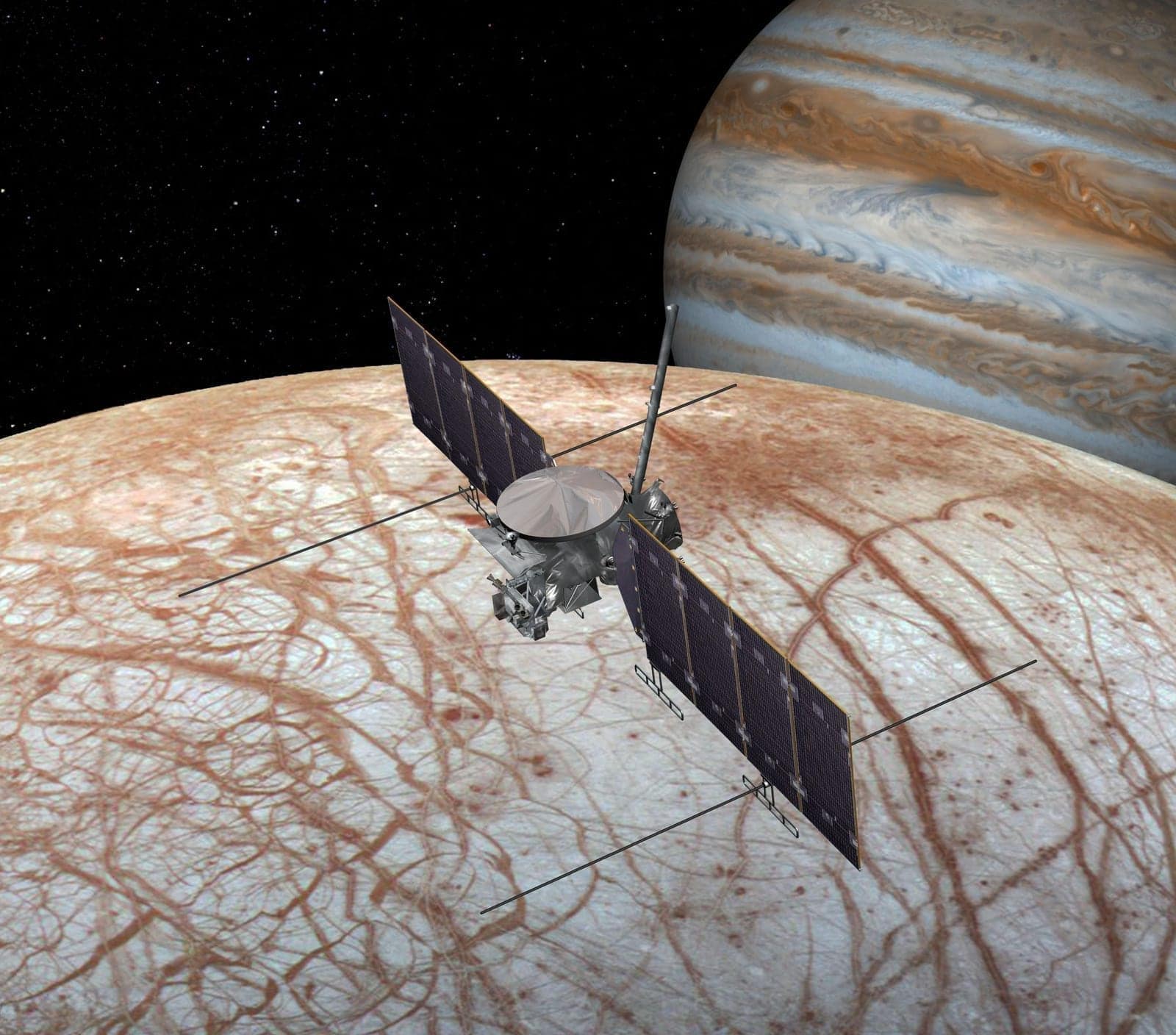
Two spacecraft are currently en route to study Jupiter's icy moons in unprecedented detail. NASA's Europa Clipper launched in October 2024 and will arrive in 2030. It carries REASON (Radar for Europa Assessment and Sounding: Ocean to Near-surface), an ice-penetrating radar specifically designed to characterize Europa's ice shell. ESA's Jupiter Icy Moons Explorer, Juice, launched in April 2023 and will study Ganymede, Callisto, and Europa.
The new ground-based results from Goldstone and Green Bank give both missions a head start. The depth constraint from the coherent backscatter measurements tells scientists how far the REASON and RIME (Juice's radar instrument) signals should be able to penetrate before being absorbed. The confirmation that Europa's ice is clean and porous suggests the radar windows will be wide open. The hint of hemispheric asymmetry gives mission planners a specific question to investigate once the spacecraft arrive.
"Future planetary science and space flight missions, like NASA's Europa Clipper, could benefit from this type of radar science," said Will Armentrout, a scientist with NSF NRAO who supports radar projects at Green Bank. "As the Green Bank Telescope's radar capabilities evolve, with new technologies currently under development, we're looking forward to providing even more radar capabilities for the scientific community."
The study represents an unusual kind of persistence in planetary science. For 13 years, whenever Europa was in the right position and the telescopes were available, the team pointed the most powerful radar system on Earth at a moon of Jupiter and listened. The reward is not a single dramatic image or a press-conference revelation. It is a careful, quantitative portrait of a world's outermost skin, built one radar ping at a time, that will shape how we explore Europa when our spacecraft finally get there.
Sources
- NRAO: Radar Echoes From Europa Reveal Secrets Beneath the Ice - primary press release and research summary from the National Radio Astronomy Observatory, June 2026
- Phys.org: Radar echoes from Europa reveal secrets beneath the ice - detailed coverage of the AAS 248 presentation by Lisa Lock and Robert Egan
- NASA Science: Europa - overview of Europa's geology, ocean, and exploration history
- NASA: Europa Clipper Mission - mission overview, instruments including REASON ice-penetrating radar, and timeline
- ESA: Juice (Jupiter Icy Moons Explorer) - ESA's complementary mission to study Jupiter's icy moons, launched April 2023
The hero image is an artist's impression by P. Vosteen, provided by NSF/AUI/NSF NRAO as part of the June 2026 press release. The Europa surface mosaic is from NASA's Galileo mission (public domain). The Europa Clipper artist's rendering is by NASA/JPL-Caltech (public domain). This article describes research presented at the 248th meeting of the American Astronomical Society on June 16, 2026.
Related on Impossible Universe
- Jupiter's Radiation Belts Are So Intense They Show Up in 10,000-Year-Old Antarctic Ice - how Jupiter drives the harshest radiation environment in the solar system, relevant to Europa