An AI Searched Hubble's Archive and Found 800 Things Nobody Had Seen
ESA researchers trained a neural network called AnomalyMatch on nearly 100 million Hubble image cutouts. In two and a half days it found more than 1,300 cosmic oddities, and over 800 were new to science.
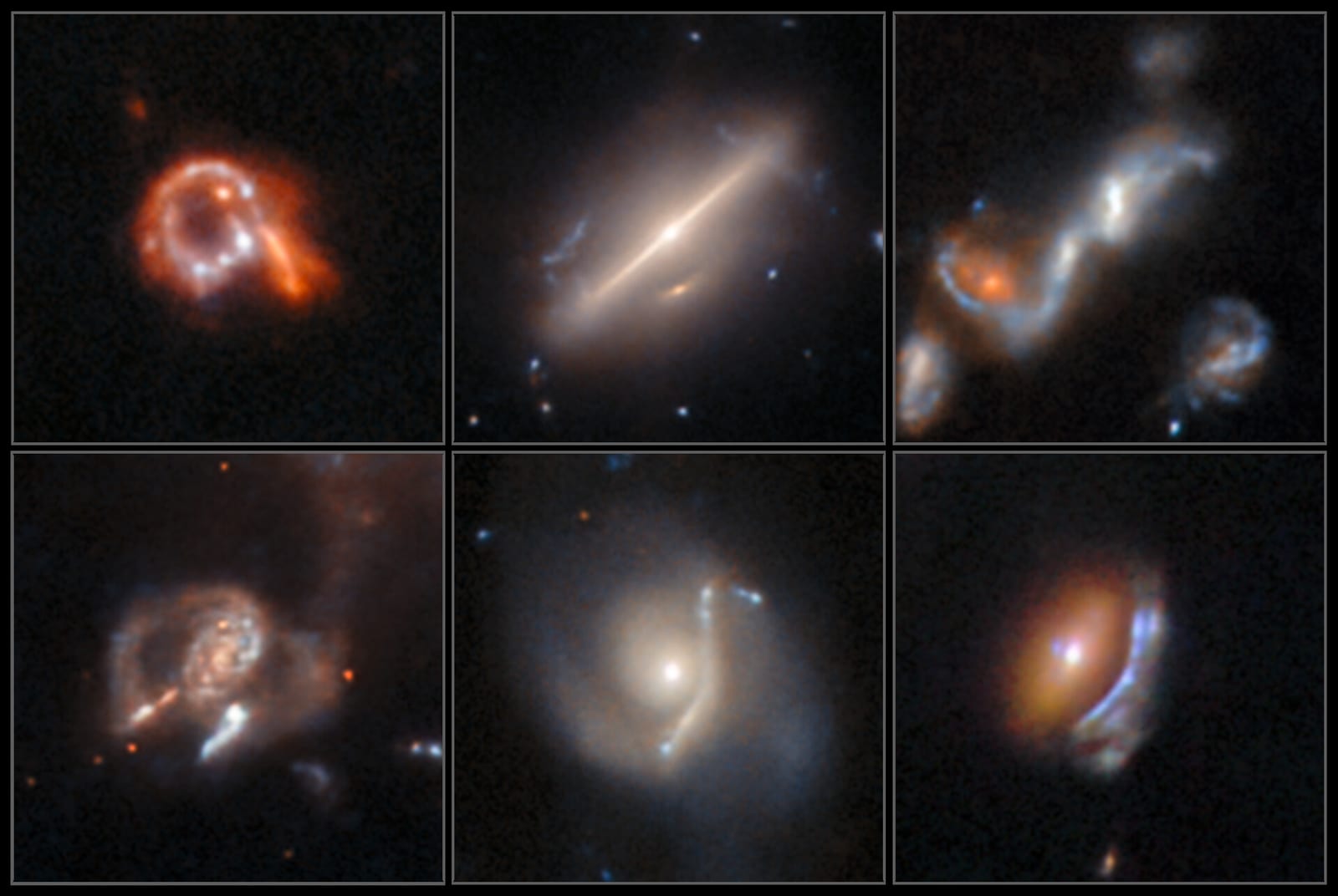
The Hubble Space Telescope has been taking pictures of the sky for 35 years. In that time, it has made more than 1.6 million observations. Every one of those observations produced data that went into an archive. Most of it has never been looked at twice.
In early 2026, two researchers at the European Space Agency decided to change that. They built a neural network called AnomalyMatch, pointed it at nearly 100 million image cutouts from the Hubble Legacy Archive, and told it to find the weird stuff. It took two and a half days. When the results came back, more than 800 of the objects the AI flagged had never appeared in any scientific paper.
How the search worked
David O'Ryan and Pablo Gómez, the ESA researchers behind the project, trained AnomalyMatch using a technique called semi-supervised learning. They fed it examples of rare objects they already knew about: gravitational lenses bending light into arcs, jellyfish galaxies dragging gaseous tentacles, ring galaxies formed by head-on collisions. The network learned the patterns and went looking for more.
Each image cutout the AI analyzed was tiny. About 7 to 8 arcseconds on a side. A few dozen pixels. The kind of detail a human astronomer would need to squint at individually, one at a time, for years to cover the same ground. The algorithm processed them all in roughly 60 hours and returned a ranked list of the strangest-looking targets.
Then the humans took over. O'Ryan and Gómez personally inspected the top-rated sources and confirmed more than 1,300 as genuine anomalies. Over 800 had never been documented. Several dozen defied classification entirely.
What the AI found
The confirmed anomalies fell into several categories, each representing a distinct kind of cosmic oddity.
Gravitational lenses. When a massive foreground galaxy sits directly between Hubble and a more distant background galaxy, its gravity warps spacetime and bends the background light into arcs, rings, or multiple copies. Einstein predicted the effect. Hubble sees it regularly. But the new search turned up lenses so subtle or oddly shaped that previous surveys had missed them.
Jellyfish galaxies. These galaxies move through clusters at high speed, and as they move, gas gets stripped away and streams behind them. The result looks like tentacles trailing through water. The phenomenon is called ram-pressure stripping. Finding a large batch of new examples gives astronomers more data on how galaxies lose their gas and stop forming stars.
Ring galaxies. When one galaxy punches straight through the center of another, the collision can trigger a shock wave that pushes gas and stars outward into a ring. The core empties. The ring stays. These are rare and short-lived in cosmic terms, so every new example helps pin down how often such collisions happen.
Merging and interacting galaxies. Most of the new anomalies fell into this category. Two or more galaxies caught in the middle of combining, their shapes distorted, their stars pulled into tails and streams that stretch across hundreds of thousands of light years. Human classifiers can spot the big dramatic mergers. The AI found the quiet ones.
Edge-on protoplanetary disks. In our own galaxy, the search found young planetary systems seen from the side, their dusty disks silhouetted against background starlight. Seen this way they resemble hamburgers or butterflies. These systems are still forming planets, and studying them edge-on helps astronomers measure how thick the disks are and how fast material is settling.
The objects that do not fit
Buried in the results were several dozen objects that O'Ryan and Gómez could not assign to any known category. They were not lenses, not mergers, not rings, not jellyfish. The shapes did not match the training data. The researchers flagged them as unclassifiable and moved on, but the implication is clear: there are things in Hubble's archive that nobody has a name for yet.
This is not the same as saying the AI found aliens or new physics. It means the training set did not cover every possible shape a galaxy can take, and some of those shapes have been sitting in the archive for decades without anyone noticing. Follow-up observations with other instruments will eventually place most of them into known categories or create new ones.
Why 35 years of data is still hiding things
Hubble's archive is not one organized catalog. It is tens of thousands of individual datasets collected by different instruments, for different projects, across more than three decades. No single person has seen all of it. The Hubble Legacy Archive was built to make the data searchable, but the search was mostly guided: an astronomer would ask for all images of a specific target or region. Nobody had ever run a systematic anomaly hunt across the whole thing.
AnomalyMatch is the first tool to do that. Its success suggests that the archive still contains discoveries that do not require a new telescope or a bigger budget. Just a fresh way of looking.
"This is a fantastic use of AI to maximize the scientific output of the Hubble archive," Gómez said in the ESA announcement. "Finding so many anomalous objects in Hubble data, where you might expect many to have already been found, is a great result."
What comes next
The researchers published their findings in the journal Astronomy & Astrophysics. But the larger story is not about one paper. It is about the telescopes coming online soon that will produce datasets far larger than Hubble's.
ESA's Euclid space telescope has already begun surveying billions of galaxies across a third of the sky. The Vera C. Rubin Observatory in Chile is about to begin a 10-year survey that will collect more than 50 petabytes of images. NASA's Nancy Grace Roman Space Telescope, scheduled to launch by May 2027, will image the sky with Hubble-quality resolution but a field of view 100 times wider.
Each of these observatories will generate too much data for any human team to inspect manually. The AnomalyMatch approach, combining AI screening with expert review, is likely to become standard practice. The 800-plus anomalies found in Hubble's archive might be a small preview of what is waiting in the next generation of data.
Hubble's old pictures still contain things nobody has seen. The researchers who put them there did not know what they had. Now an AI is going through the drawers.
Sources
- NASA Science: AI Unlocks Hundreds of Cosmic Anomalies in Hubble Archive - primary source for the discovery and quotes
- ESA/Hubble heic2603 Science Release - anomaly types, methodology, and image credit
- O'Ryan & Gómez, Astronomy & Astrophysics (2025) - peer-reviewed paper describing AnomalyMatch and the systematic Hubble Legacy Archive search
- ESA/Hubble: Astrophysical Anomalies from Hubble's Archive - hero image and image description
- ESA: 1400 Quirky Objects Found in Hubble's Archive - additional context and upcoming telescope references
The hero image is credited to ESA/Hubble & NASA, D. O'Ryan, P. Gómez (European Space Agency), M. Zamani (ESA/Hubble). ESA/Hubble images are generally available under a Creative Commons Attribution 4.0 International License. The article describes research published in the peer-reviewed journal Astronomy & Astrophysics.
Related on Impossible Universe
- How NASA APOD Became a Curiosity Machine That Works Better Than Anyone Expected - a different kind of AI-assisted discovery from the vast archives of NASA imagery