The Universe Is Expanding Faster Than It Should. The Most Precise Measurement Yet Says the Gap Is Real.
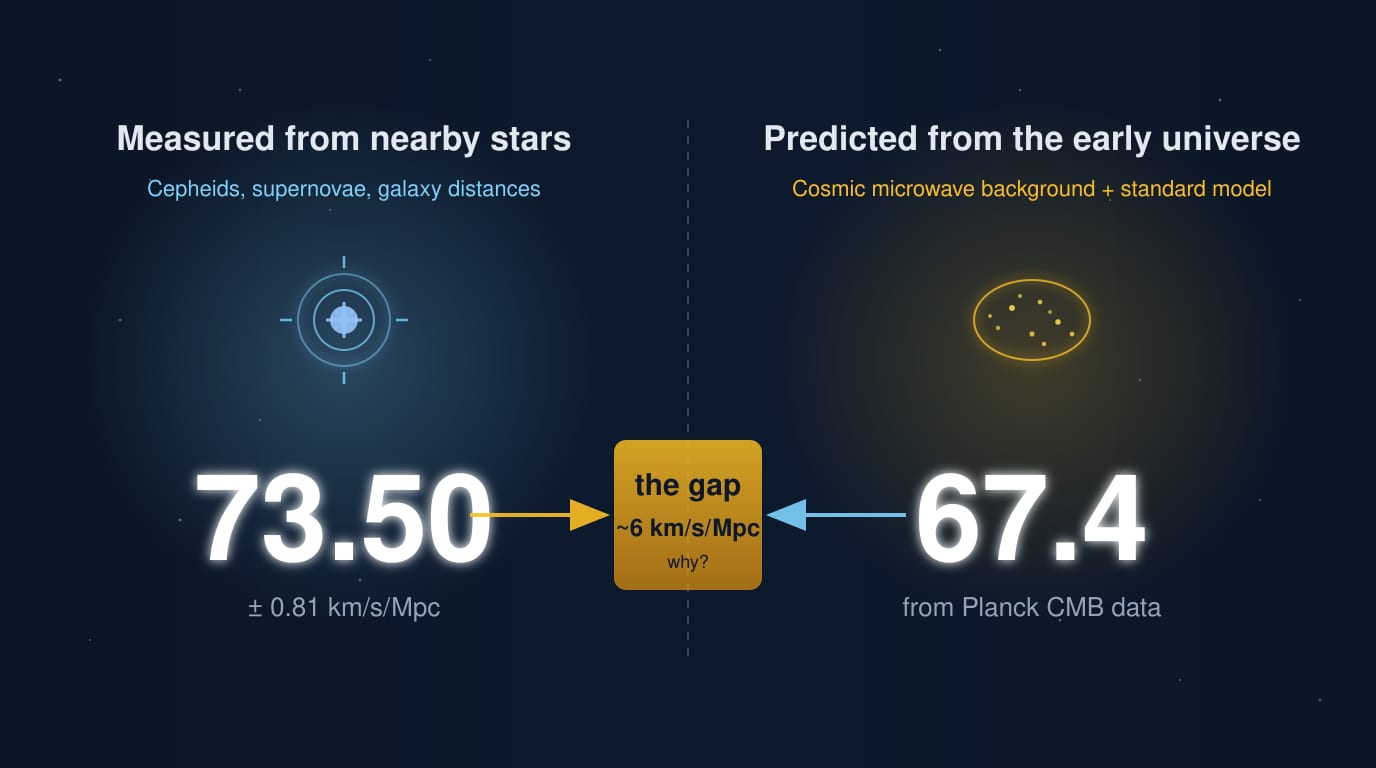
Two ways of measuring how fast the universe expands give different answers. The most precise direct measurement yet, 73.50 ± 0.81 km/s/Mpc from the H0 Distance Network, says the gap is real and may point to physics beyond the standard model of cosmology.
The universe is expanding, and it is expanding faster than it should be. That has been true for more than a decade, and the most precise measurement yet, published in April 2026, has made the problem harder to ignore. An international collaboration called the H0 Distance Network, or H0DN, combined decades of independent distance measurements into a single framework and arrived at 73.50 ± 0.81 kilometers per second per megaparsec, a precision of just over 1 percent. That number sits roughly 5 to 9 percent above what the standard model of cosmology predicts from the afterglow of the Big Bang. The gap, known as the Hubble tension, is the biggest unresolved puzzle in modern cosmology.
What the Hubble constant actually is
The Hubble constant, usually written H0, is the rate at which the universe is stretching. The units look forbidding but are easy to unpack. A megaparsec is about 3.26 million light-years. The number 73.5 means that for every megaparsec of distance between two points, the space between them is growing by 73.5 kilometers every second. A galaxy 10 megaparsecs away recedes at 735 km/s. A galaxy 100 megaparsecs away recedes at 7,350 km/s. The farther apart two things are, the faster they fly apart, which is exactly what you would expect from a fabric of space that is uniformly stretching.
Edwin Hubble first measured this rate in 1929, using the redshifts of distant galaxies. His early value was wildly wrong, about 500 km/s/Mpc, because the distance scale of the universe was unknown. Over the following century, the number was refined again and again, and by the 2000s the different methods had converged on a value near 70. That convergence was the puzzle's setup: two families of measurement, built on completely different logic, both pointed to about 70, but with a stubborn offset between them that would not go away.
Two ways to measure the same number
The first family of measurements looks at the nearby universe directly. Astronomers build what they call a cosmic distance ladder. The bottom rung is a class of pulsing stars called Cepheid variables, which brighten and dim on a schedule tied to their true brightness. Measure the period, know the intrinsic luminosity, compare with how dim the star appears, and you get its distance. The next rung uses Type Ia supernovae, exploding white dwarfs that reach a remarkably uniform peak brightness, bright enough to be seen across billions of light-years. Each rung extends the ladder farther out, and the slope of the resulting distance-versus-speed relationship gives H0.
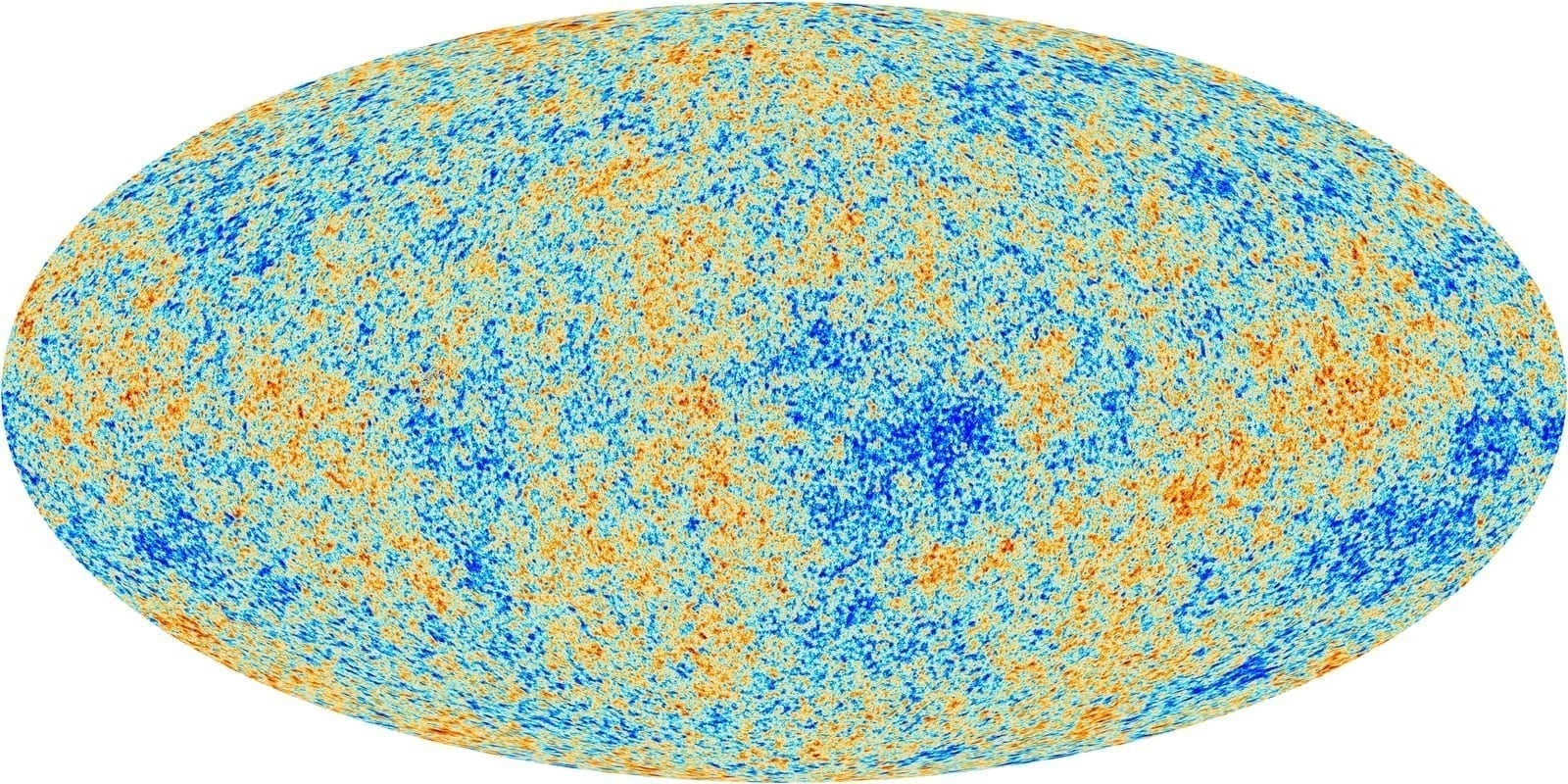
The second family never measures a distance at all. It starts with the cosmic microwave background, the bath of light released about 380,000 years after the Big Bang, when the universe cooled enough for atoms to form. The Planck satellite mapped that light in exquisite detail, and the tiny temperature fluctuations in the map encode the universe's composition and history. Feed those numbers into the standard model of cosmology, the framework known as Lambda-CDM, and the model predicts what the expansion rate should be today. The answer comes out at about 67.4 km/s/Mpc.
Both approaches have been refined for decades, and neither has moved toward the other. The nearby measurements cluster around 73. The early-universe prediction sits near 67. The difference is small in absolute terms, but it is far larger than the error bars on either side allow.
The most precise local measurement yet
The H0DN result, published in Astronomy & Astrophysics on April 10, 2026, was built differently from any single measurement before it. Rather than betting on one technique, the collaboration, launched at a Breakthrough Workshop at the International Space Science Institute in Bern in March 2025, linked many overlapping methods into what they call a "distance network": Cepheid variables, red giant stars that shine with a known brightness, Type Ia supernovae, and certain classes of galaxies. The network lets many independent paths reach the same final number, and that redundancy is the point.
Here is the critical test the framework enables. If the Hubble tension were caused by a subtle error in one technique, then removing that technique from the analysis should shift the final answer. The team ran that test. When individual techniques were removed one at a time, the result barely changed. The authors' conclusion was blunt: "This work effectively rules out explanations of the Hubble tension that rely on a single overlooked error in local distance measurements." The measured value, 73.50 ± 0.81, held together no matter which pieces were left out.
The data came from observatories around the world, including telescopes at NSF Cerro Tololo Inter-American Observatory in Chile and NSF Kitt Peak National Observatory in Arizona, both programs of NSF NOIRLab, whose astronomer John Blakeslee is a member of the collaboration.
An independent check from warped light
The H0DN result is not the only recent vote for the higher number. In December 2025, a team using a completely different method, time-delay cosmography, published an independent measurement that also lands near 73. That technique exploits gravitational lensing: a massive galaxy bends the light of a more distant quasar behind it, producing multiple images of the same object. Because the light in each image travels a slightly different path, a flicker in the quasar arrives at slightly different times in each image. Those time delays, combined with careful spectroscopy of the lens galaxy, give a geometric distance that requires no distance ladder at all.
The measurement used the Keck Cosmic Web Imager on the W. M. Keck Observatory on Maunakea, along with the James Webb Space Telescope, the Hubble Space Telescope, and the Very Large Telescope. It achieved about 4.5 percent precision, not yet enough to settle the question on its own, but it independently lands on the high side, consistent with the distance-ladder measurements and inconsistent with the early-universe prediction. "Cosmology as we know it may be broken," said John O'Meara, chief scientist at Keck, in the release announcing the result. "If it is true that the Hubble tension isn't a mistake in the measurements, we will have to come up with new physics."
If it's not a measurement error, what is it?
The leading explanations for the tension fall into two camps: a systematic error that everyone has missed, or new physics that changes the expansion history. The H0DN result weakens the first camp, but does not kill it. A systematic shared by every local technique, for example a subtle bias in how distances are calibrated, could still hide in the data. That is why the tension is described as a persistent discrepancy, not as proof of new physics.
If the second camp is right, the possibilities are strange and specific. One popular idea is early dark energy: a form of energy that briefly accelerated the universe's expansion in the first few hundred thousand years, then faded away. Adding it to the model would raise the predicted expansion rate without disturbing the well-tested later universe. Another idea is that dark energy is not constant but changes over time, which would alter the expansion history in ways the standard model does not capture. Others involve new particles, such as a fourth species of neutrino or an exotic particle that interacts with ordinary matter only through gravity, or modifications to gravity itself at large scales.
The stakes are high because the early-universe number depends on the standard model of cosmology. If that model is incomplete, then every conclusion drawn from it, including the age of the universe and the amounts of dark matter and dark energy it contains, is on shakier ground. Resolving the tension one way or the other is not a detail. It is a test of the framework that describes the entire cosmos.
What comes next
The H0DN framework was designed to be extended. Its methods and data are openly available, and new observations can be fed in as they arrive. The next generation of facilities is expected to tighten both sides of the gap: the Vera C. Rubin Observatory will map the sky repeatedly for a decade, catching supernovae and refining distances; the Euclid mission is charting the universe's expansion and structure at unprecedented scale; the Roman Space Telescope will image the infrared sky and measure distances to Cepheids and supernovae in bulk; and DESI is already mapping the expansion history through the imprint of baryon acoustic oscillations.
Each of these facilities will add precision, and precision is what the tension needs. The gap between 73.5 and 67.4 is roughly six units, far larger than the error bars, and it has survived a decade of increasingly careful measurement. If new data pulls the numbers together, the tension dissolves and cosmology breathes a sigh of relief. If it holds, the universe is telling us something about the fundamental ingredients of reality that the current model simply does not contain.
Why it matters
The Hubble tension is not an esoteric disagreement between rival lab groups. It is a place where the most successful model in physics, one that predicted the existence of dark matter and dark energy decades before they were observed, fails to predict its own central number. The model describes the universe so well in so many ways that the mismatch is genuinely surprising. Either the measurements are wrong in a way no one has found, which would itself be a remarkable story about how hard astronomy is, or the model is missing a piece, which would be a discovery with consequences for everything from the universe's age to the fate of its expansion.
For now, the honest summary is the one the H0DN authors gave: the growing body of evidence suggests the tension is real, and if it is real, it may point to physics beyond the standard cosmological model. The gap has been measured, re-measured, and independently confirmed. The question is no longer whether it is there. It is what it means.
Sources
- NOIRLab noirlab2611: The Local Universe's Expansion Rate Is Clearer Than Ever, but Still Doesn't Add Up - primary institutional release, April 10, 2026, with the H0DN value 73.50 ± 0.81 km/s/Mpc and collaboration quotes
- H0 Distance Network Collaboration, "The Local Distance Network: a community consensus report on the measurement of the Hubble constant at ~1% precision," Astronomy & Astrophysics, April 10, 2026, DOI 10.1051/0004-6361/202557993 - peer-reviewed paper (the journal page blocks automated readers; the DOI is valid for human browsers)
- ScienceDaily: The Universe Is Expanding Too Fast and Scientists Still Can't Explain It - accessible reporting on the H0DN result and its implications
- EarthSky: Universe's Expansion Rate, "Something Doesn't Add Up" - context and plain-language framing of the two numbers
- W. M. Keck Observatory: Astronomers Sharpen the Universe's Expansion Rate, Deepening a Cosmic Mystery - the independent time-delay cosmography measurement and expert quotes
- Wikipedia: Hubble's Law - background on the expansion rate, the distance ladder, and the tension's history
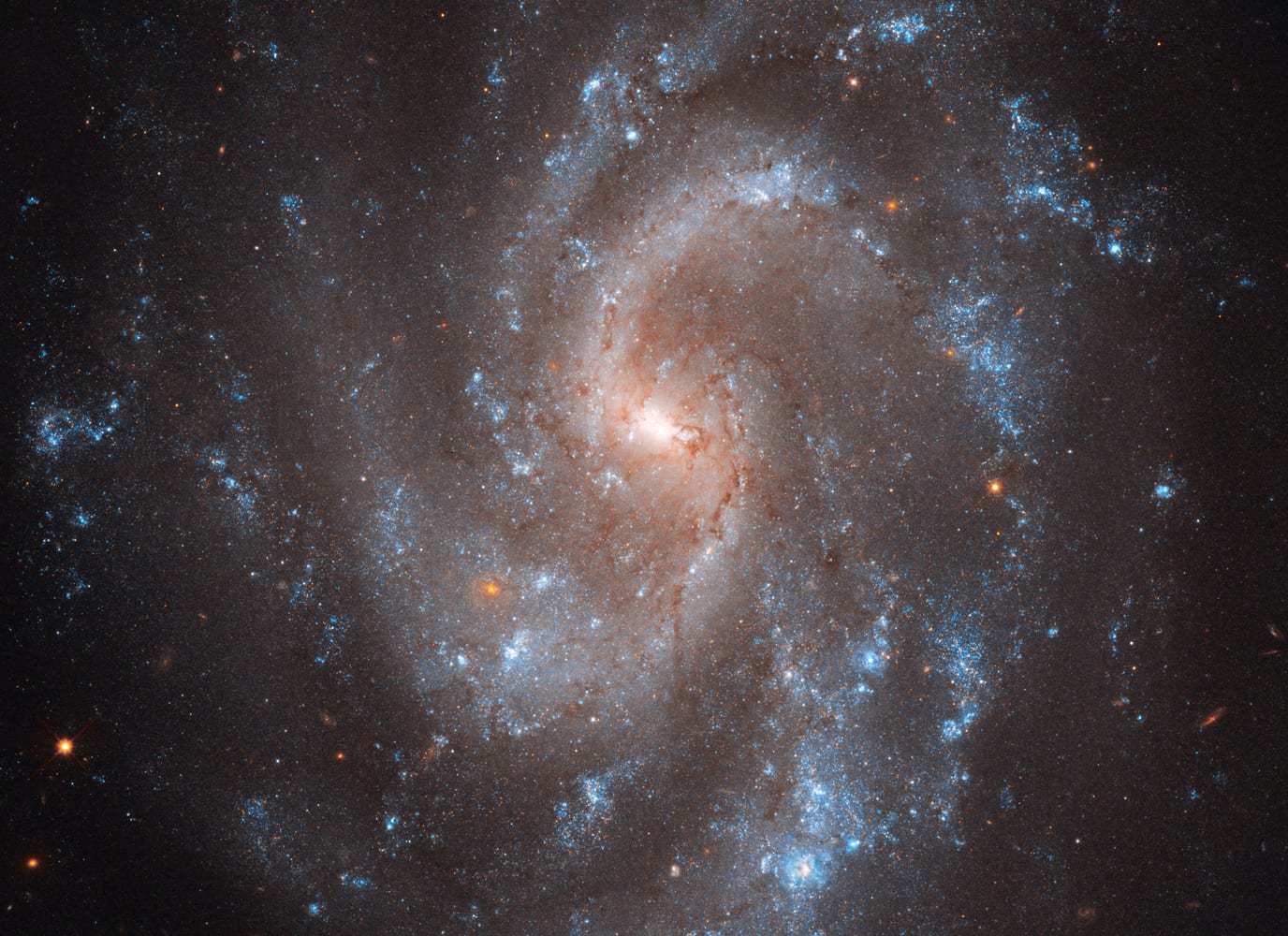
Hero image: the cosmic microwave background all-sky map from ESA's Planck mission. Credit: ESA and the Planck Collaboration (CC BY-SA 4.0). Inline galaxy image: NGC 5584, ESA/Hubble & NASA (CC BY 4.0). Comparison diagram: generated by the Impossible Universe Editorial Team based on the cited sources. The Astronomy & Astrophysics DOI is cited without a live link because the publisher blocks automated readers; the link works in a normal browser.
Related on Impossible Universe
- JWST Keeps Finding Tiny Red Galaxies From the Universe's Dawn. They Shouldn't Exist This Early - the early universe looks different than the standard model expects, a companion puzzle to the Hubble tension
- Euclid's First Look at the Milky Way's Bulge Reveals a Hidden Population of Stars - how the Euclid mission is mapping the universe with unprecedented precision
- The Rubin Observatory Just Began Its 10-Year Survey of the Night Sky - the survey that will sharpen the local measurement of the expansion rate
- The Webb Telescope Resolved the Chaotic Heart of a Starburst Galaxy - another look at how the newest space telescopes are testing cosmology's assumptions
- Physics and Quantum Topic Hub - more stories from the frontier of how matter, energy, time, and the cosmos work
- Telescopes and Space Missions Topic Hub - the observatories, from Planck to Rubin, doing the measuring