
This Four-Winged Dinosaur Glided Like a Flying Squirrel. It Hunted Early Birds.
A fossil bed in China held hundreds of ancient birds and mysterious pellets of crushed bone. The missing predator that made them has finally been discovered: a feathered, four-winged cousin of Velociraptor named Jian changmaensis.
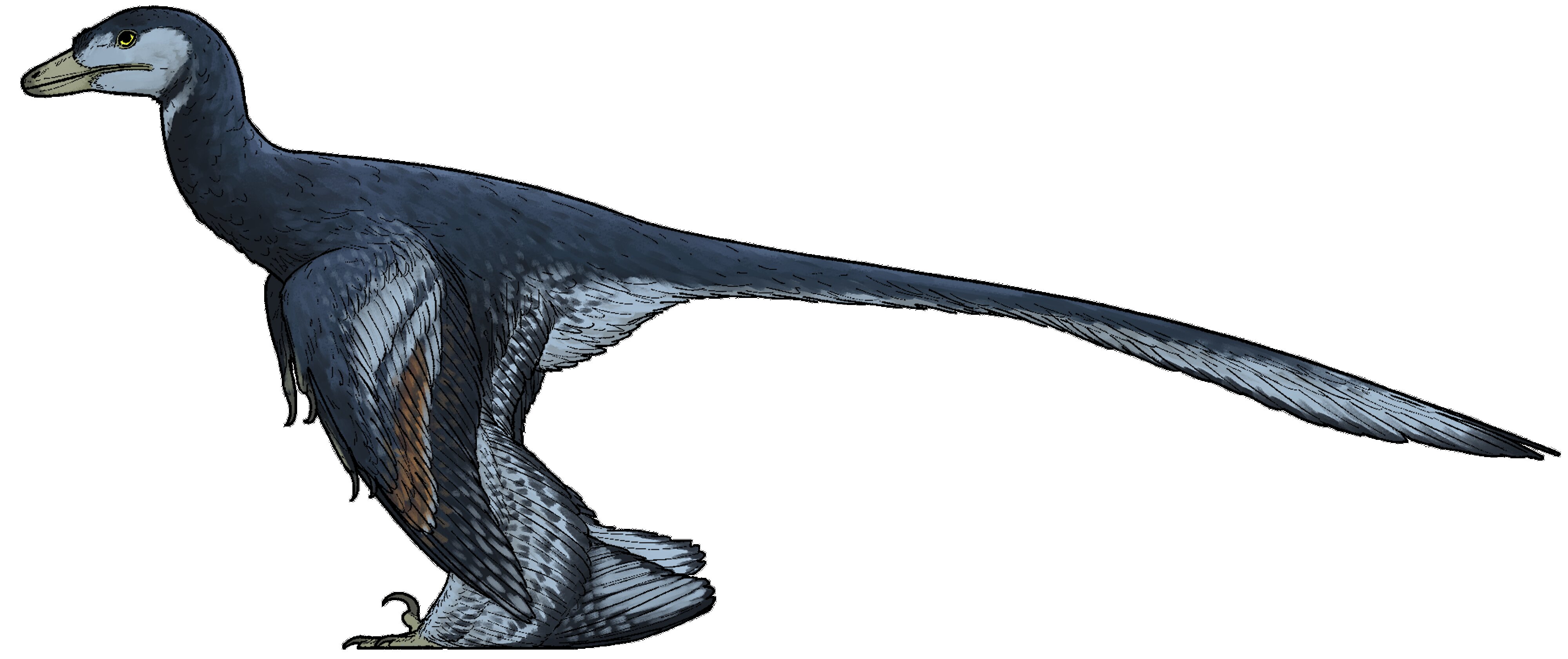
The Changma Basin in northwestern China holds a fossil bed unlike most others. Over the years, paleontologists have pulled more than a hundred bird fossils from the site, many of them remarkably intact. But among the skeletons were clusters of broken bones crushed into tight little pellets, the kind modern owls cough up after they eat.
Something had been hunting those early birds, and for years nobody knew what.
On June 4, 2026, the missing predator got a name. In a paper published in the Annals of Carnegie Museum, a team of Chinese and American paleontologists introduced Jian changmaensis, a feathered, four-winged dinosaur that glided through the Early Cretaceous forests about 120 million years ago, eating whatever it could catch.
"Scientists have found these weird, broken-up clusters of bird bones at this site, and we didn't know what made them," said Jingmai O'Connor, associate curator of fossil reptiles at the Field Museum in Chicago and senior author of the study. "This new microraptor dinosaur, Jian changmaensis, is our best guess."
A feathered cousin of Velociraptor
Jian belongs to a group called dromaeosaurs, the family that includes Velociraptor. But Jian was not the scaly, six-foot movie monster. It was a microraptor, one of the smallest and most bird-like of all predatory dinosaurs. Most microraptors were the size of a crow. Jian was bigger.
"Jian is one of the biggest microraptor specimens that has ever been found," O'Connor said. The upper arm bone is about four inches long, which suggests the whole animal had a four-foot wingspan, roughly the size of a barn owl.
That makes it the largest known microraptorine. And while the fossil itself is modest, consisting of only a partial shoulder girdle and forelimb, those bones were enough to identify it as something new. The scapula and coracoid, the two shoulder bones, were fully fused, a sign the animal was skeletally mature when it died. The bone surfaces lacked the grooved, pitted texture seen in growing juveniles. This was an adult.
Four wings and no engine
Based on the anatomy of its closest relatives, paleontologists believe Jian had something no living animal has: long, flight-capable feathers on both its arms and its legs, giving it the appearance of having four wings.
But Jian probably could not fly in the way a modern bird does. Instead, it likely climbed into trees and launched itself, spreading all four feathered limbs to glide between branches, like a flying squirrel with a four-foot reach.
"Jian and the other microraptors probably weren't capable of true, powered flight, but they could probably glide like a flying squirrel," O'Connor said.
Microraptors like Jian were not on the direct line to modern birds. They were an evolutionary side branch, a group of dinosaurs that independently experimented with feathers and gliding while true birds were already taking to the air alongside them. The two groups shared the same forests for tens of millions of years, and Jian appears to have treated those early birds as prey.
The missing piece of a Chinese fossil bed
The Xiagou Formation in the Changma Basin is famous for its birds. More than a hundred bird fossils have been excavated there, representing some of the earliest members of the lineage that survived the asteroid impact 66 million years ago. But until now, every dinosaur skeleton found at the site had been a bird.
"Jian changmaensis reveals that non-avian dinosaurs lived in what is now the Changma Basin, an area famous for its fossil birds," said Matt Lamanna, corresponding author of the study and the Carnegie Museum of Natural History's curator of vertebrate paleontology. "Jian provides critical new insight into the biological history of the Changma region and the ecological context of the ancestors of today's birds."
Out of more than a hundred fossils, Jian is the only non-bird dinosaur. That ratio is telling. It suggests the forest was dominated by birds, with predators like Jian filling a narrow niche above them, a gliding hunter in a three-dimensional world of branches and shadows.
What the name means
The dinosaur's name reflects where it was found and what it looked like. "Jian" refers to a winged creature from Chinese mythology. "Changmaensis" points to the Changma Basin in Gansu Province where the fossil was discovered. It is a name that captures both the animal's appearance and its origin.
The fossil was originally found in 2008 and first reported in a conference abstract in 2010. The 2026 paper, led by Ling-Qi Zhou of the Gansu Geological Museum, is the formal scientific description.
Why early birds survived
The discovery is about more than one dinosaur. It is a piece of a larger question: why did birds survive the mass extinction that killed every other dinosaur?
"You cannot understand life on the planet today without looking at its origins," O'Connor said. "Birds are arguably the most successful group of land-dwelling vertebrate animals on Earth today. Learning about early birds and their close non-bird dinosaur relatives gives us a better understanding of what made the group of birds that survived so special."
Jian changmaensis was a threat to those early birds. It was also one of their closest relatives. The line between the hunter and the hunted, between the dinosaurs that vanished and the ones that became ten thousand living species, ran straight through forests like the one that once stood in the Changma Basin. Jian is one more fossil that helps make that line a little sharper.
Sources
- Field Museum press release: New species of dinosaur, a cousin of Velociraptor, probably glided on four wings
- Zhou et al. (2026). "First Non-Avian Theropod (Dromaeosauridae, Microraptorinae) From the Bird-Bearing Lower Cretaceous Xiagou Formation of the Changma Basin, Gansu Province, Northwestern China." Annals of Carnegie Museum.
- SciTechDaily: New Feathered Dinosaur May Have Solved a 120-Million-Year-Old Fossil Mystery
- EurekAlert: New species of dinosaur, a cousin of Velociraptor, probably glided on four wings
- Wikipedia: Jian changmaensis
Related on Impossible Universe
- This 90-Million-Year-Old Crocodile Ancestor Walked on Two Legs. Scientists Named It After a Witch. - another prehistoric predator that challenges assumptions about dinosaur-era reptiles