The Witch Croc: A Two-Legged, Toothless Crocodile Cousin from Triassic New Mexico
At Ghost Ranch, paleontologists found a bipedal, beaked crocodile relative that looked more like an ostrich than a reptile. They had been waiting 20 years for it.
In 2006, a field crew was working the Hayden Quarry at Ghost Ranch, New Mexico, a fossil site whose red and tan badlands Georgia O'Keeffe once painted. They pulled out leg bones, arm bones, and parts of a spine. The animal looked like it belonged to a group called shuvosaurs, but the details were slightly off. The humerus was different. The date was wrong. It sat between two known species in time and anatomy, exactly where paleontologists predicted something should be.
Twenty years later, that prediction paid off. In May 2026, researchers led by Alan Turner of Stony Brook University named the animal Labrujasuchus expectatus in the Journal of Vertebrate Paleontology. The species name, expectatus, means "expected." Its genus name references Ranchos de los Brujos, an old Spanish name for Ghost Ranch that translates to Ranch of the Witches. The animal is the Witch Croc.
A crocodile that ran on two legs
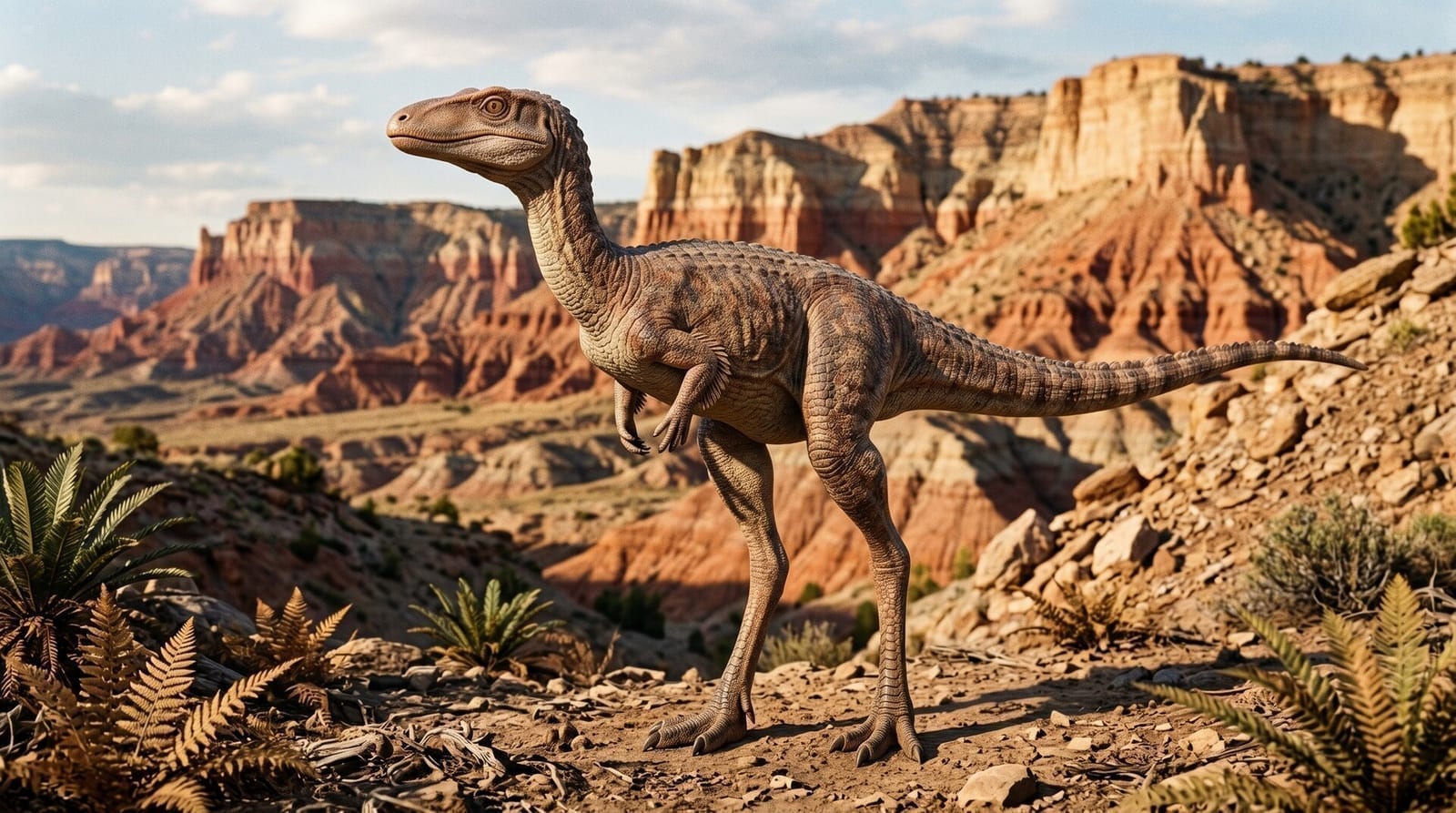
At a glance, Labrujasuchus looked like an ostrich-sized dinosaur. It walked on two long hind legs. Its arms were tiny. Its mouth ended in a toothless beak. If you saw a reconstruction without a label, you would place it alongside ornithomimosaurs, the Cretaceous dinosaurs that independently evolved the same ostrich-like shape.
But Labrujasuchus was not a dinosaur. It belonged to the archosaur branch that eventually produced modern crocodiles. That makes its body plan a striking example of convergent evolution: two completely separate lineages arriving at the same solution for walking efficiently on land.
"Bipedalism is certainly a unique path for crocodile relatives to take, but it's a path well-trod by dinosaurs and later birds," Turner said. "It obviously worked for these animals."
Turner emphasized that the animal is not a direct ancestor of modern crocodilians. "You can think of them as like a very, very distant cousin. They split hundreds of millions of years ago from the group that eventually leads us to alligators and crocodiles. It's sort of a side branch."
As for what it ate, the toothless beak makes the answer less obvious than it seems. No teeth does not mean no meat. Eagles have beaks too. And in the Triassic, fruit had not yet evolved. Turner told Scientific American that Labrujasuchus was probably a carnivore, possibly a scavenger, but a definitive dietary reconstruction will require more evidence.
The expected unexpected
Labrujasuchus is one of only five identified species of shuvosaur, a group of bipedal crocodile relatives whose name comes from Shuvosaurus, the first member discovered. Paleontologists excavating Ghost Ranch had already found one shuvosaur from earlier in the Triassic and another from later. Basic evolutionary logic said there must be more in between.
"Finding one shuvosaur from earlier in the Triassic and one from later meant that we paleontologists knew there were probably more from in-between waiting to be discovered and described," said co-author Nate Smith, director of the Natural History Museum of Los Angeles County's Dinosaur Institute.
Labrujasuchus, dated to roughly 212 million years ago, slots neatly into that gap. Its anatomy shows subtle differences from its relatives, particularly in the humerus and other limb proportions, that mark it as a distinct species. The discovery does not rewrite the shuvosaur family tree so much as confirm a chapter paleontologists had already sketched in pencil.
The naming nods to this quality of being both surprising and inevitable. "Expectatus" captures the idea of the expected unexpected, the thing you knew was there before you found it.
A Triassic menagerie
The Triassic period, which ran from about 252 to 201 million years ago, was a time of wild evolutionary experimentation. The modern animal groups we recognize were still sorting themselves out, and the result was a cast of creatures that can sound like science fiction.
Alongside Labrujasuchus lived lagerpetids, bipedal dinosaur cousins whose relatives would eventually take to the air as pterosaurs. There was Drepanosaurus, a tree-dwelling reptile with a single enormous claw on each hand and a small claw on its prehensile tail. And Vancleavea, an aquatic armored reptile that looked like a miniature tank with a finned tail.
"We see a lot of the successful strategies for modern animals and non-avian dinosaurs first arise in the Triassic, and shuvosaurs are a great example of that convergent evolution," Turner said. The bipedal body plan that dinosaurs would ride to dominance for 150 million years was first tested by their distant crocodile cousins.
Twenty years at Ghost Ranch
Ghost Ranch occupies 21,000 acres in northern New Mexico, about 65 miles northwest of Santa Fe. Its colorful Mesozoic rock layers have produced some of the most important Triassic fossils in North America. Four active quarries are excavated by paleontologists each summer.
"This summer is the 20th anniversary of Nate and his colleagues coming out to do excavations at Ghost Ranch," said Joanne Lefrak, Director of Experience and Social Impact at the Ghost Ranch Education and Retreat Center. The site hosts teams of paleontologists and volunteers annually, combining scientific work with the landscape that drew Georgia O'Keeffe to live and paint there for decades.
The Hayden Quarry, where Labrujasuchus was found, continues to produce new material. The legend behind the name "Ranchos de los Brujos" involves the Archuleta brothers, local ranchers who spread stories of witches to keep people away from their cattle-rustling operations. The site that once hid stolen livestock now yields fossils that nobody knew existed.
And Labrujasuchus is not alone. In April 2026, a separate team described Eosphorosuchus lacrimosa, another crocodile relative from Ghost Ranch. That animal, about the size of a jackal, had a short snout, a strong skull, and large jaw muscles built for biting. Its bones had been sitting in the Yale Peabody Museum's basement since 1948, misidentified for nearly 80 years until paleontologist Miranda Margulis-Ohnuma noticed discrepancies in its facial structure.
"For early crocs, we're very data deficient, so every new fossil that comes out is changing the story," Margulis-Ohnuma told Live Science. "If we can continue to describe this material that we have, and ideally find new fossils, it will change the story every single time."
Two new crocodile relatives announced from one site within weeks of each other suggests the story is still being written. Ghost Ranch, a landscape that once inspired paintings, is now filling pages in the fossil record.
Sources
- Smithsonian Magazine: Meet the 'Witch Croc,' a Strange Ancient Crocodile Relative - discovery context, shuvosaur background, and Eosphorosuchus mention
- EurekAlert / NHMLAC Dinosaur Institute: New species of bizarre, bipedal, toothless crocodile relative from the Triassic discovered - primary institutional press release with quotes from Turner, Smith, and Lefrak
- Scientific American: A toothless, beaked, bipedal crocodile cousin roamed Earth 200 million years ago - Turner quotes on diet, convergent evolution, and the animal's place on the family tree
- Turner et al., Journal of Vertebrate Paleontology (2026) - peer-reviewed species description
- Phys.org: What a toothless, two-legged crocodile cousin reveals about life before dinosaurs dominated - Triassic context, Ghost Ranch history, and naming explanation
The hero image is a generated reconstruction based on the anatomical description in Turner et al. (2026) and the paleoartistic reconstructions credited to Jorge Gonzalez / NHMLAC Dinosaur Institute. The research was published in the peer-reviewed Journal of Vertebrate Paleontology.
Related on Impossible Universe
- A New Four-Winged Dinosaur from China Just Solved a 120-Million-Year-Old Fossil Mystery - another Mesozoic-era discovery that reshapes what we know about prehistoric life